Presenting by:
MR. PURUSHOTHAM K N
Asst. Professor
Department of
Pharmaceutical Chemistry
SACCP,B.G.Nagara
2021-2022
Stereochemistry and Drug
Action
• Stereochemistry mainly deals
with the spatial arrangements
of the atoms or group of
atoms in a molecules.
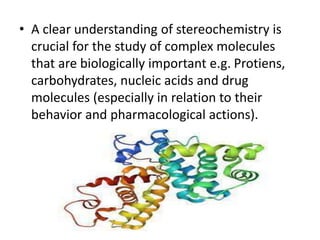
• A clear understanding of stereochemistry is
crucial for the study of complex molecules
that are biologically important e.g. Protiens,
carbohydrates, nucleic acids and drug
molecules (especially in relation to their
behavior and pharmacological actions).
IMPORTANT DEFINITIONS
• Isomerism refers to the phenomenon in
which more than one compounds have the
same chemical formula but different
chemical structures. And those chemical
compounds that have identical chemical
formulae but they differ in physical or
chemical properties and the arrangement of
atoms in the molecule are called isomers.
Therefore, the compounds that possess
isomerism are called “isomers”.
• Chirality is defined as an object or a compound which is
asymmetric and cannot be superimposed over its mirror
image (for example, our both palms) is known as ‘chiral’ or
‘stereocenter’ and this property is known as “chirality”. The
chirality is due to the three-dimensional or spatial
arrangements of the molecules and a carbon is said to be
chiral carbon when it is bonded with four different
substituents to it. The asymmetry of the molecule or
chirality is mainly responsible for the optical activity in
such organic compounds.
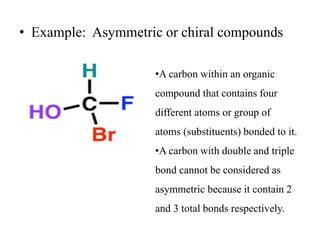
• Example: Asymmetric or chiral compounds
•A carbon within an organic
compound that contains four
different atoms or group of
atoms (substituents) bonded to it.
•A carbon with double and triple
bond cannot be considered as
asymmetric because it contain 2
and 3 total bonds respectively.
• STEREOISOMERS: Isomers that have same
molecular formula and connectivity but differ
in a way that atoms are oriented in space – i.e;
Difference between isomers lies only in 3D
arrangements of atoms.
• ENANTIOMER:
Greek word: enantio : opposite merons : parts
Stereoisomers with non superimposable
mirror images.
• DIASTEREOMER : Diastereomers are
stereoisomers that are not mirror images of
one another and are non-superimposable on
one another. Stereoisomers with two or more
stereocenters can be diastereomers.
Stereoisomers
Configurational isomer :
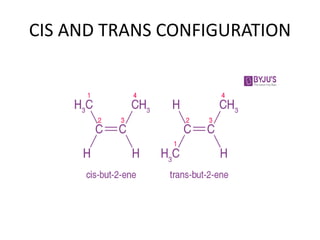
• Geometric isomers : (a) cis & trans system
/ E & Z system
• Relative configuration / Fischer projection (
L & D configuration)
• Absolute configuration (R & S
configuration
CIS AND TRANS CONFIGURATION
L AND D CONFIGURATION
R and S CONFIGURATION
• Priority of an atom is
determined by its atomic
number
• Order of substituents going
from highest to lowest
priority.
• Clockwise – R (rectus).
• Anticlockwise – S (sinister).
• Unless established
experimentally no idea
whether (+) or (-) rotation is
associated with R or S
configuration
Importance of the chirality in drugs
• This stereoisomerism results in different physical and
chemical properties of the compound. If this
compound happens to be drug then it results in
different pharmacokinetic and pharmaco dynamic
properties
• The importance of chiral drugs in the drug
development space cannot be understated. In
pharmaceutical industries, 56% of the drugs currently
in use are chiral molecules and 88% of the last ones are
marketed as racemates (or racemic mixtures),
consisting of an equimolar mixture of two enantiomers
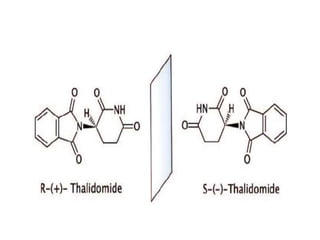
Thalidomide-disastrous
• biological activity of the wrong
enantiomer
• In 1960 in Europe, racemic
thalidomide was given to
pregnant females to cure
morning sickness.
• This led to deformations in
babies and neurotoxic effects.
• These were due to S-
thalidomide.
• R-thalidomide contained the
desired therapeutic activity
EXAMPLES OF CHIRAL DRUGS
• INTRAVENOUS ANAESTHETICS
• LOCAL ANAESTHETICS
• INHALATIONAL AGENTS
• NUEROMUSCULAR BLOCKING AGENTS
• SOME OTHER DRUGS
Intravenous anaesthetics
Etomidate
• Administered as a single isomer: R-isomer.
• Site of action: GABAA receptor.
• R-isomer is 15 times more potent than the S-isomer.
• S-isomer lacks hypnotic activity.
LOCAL ANAESTEHTICS
BUPIVACAINE
• Long acting local anaesthetic marketed as 50:50
racemic mixture. Reports of death due to
• Bupivacaine induced CNS toxicity and cardiotoxicity on
accidental intravenous injection and difficult
resuscitation following cardiotoxicity. Safer alternatives
• Levobupivacaine
• Ropivacaine These are S- enantiomers of bupivacaine.
• Ropivacaine is the first ‘pure’ enantiomer containing
>99% of the S-form
• Potential advantages of single enantiomer
products:
• Less complex, more selective
pharmacodynamic profile
• Potential for an improved therapeutic index
• Less complex pharmacokinetic profile
Reduced potential for complex drug
interactions
• Less complex relationship between plasma
concentration and effect
Biological Discrimination
Pharmacokinetics stereoselectivity
Absorption
• Passive intestinal absorption
• Carrier transporter stereoselectivity
Distribution
• Protein binding
• Tissue distribution
Metabolism
• first pass metabolism
• Phase I and phase II metabolism
Elimination
Absorption and stereoselectivity
• Passive intestinal absorption For the majority of
racemic drugs, absorption appears to be by
passive diffusion , provided no stereoselectivity
Carrier mediated transporter
• Stereo selective
intestinal transporter
is the main cause for
marked differences in
the oral absorption of
enantiomers. L-
Methotrexate have 40
fold higher Cmax and
AUC than D-
Methotrexate
Distribution
Protein binding
• Stereo selective plasma protein binding could
influence distribution and elimination because
the major determinant of drug distribution and
elimination is protein binding.
• The enantiomers may display different
magnitudes of stereoselectivity between the
various proteins found in plasma
• Ex// the R- propranolol binding to albumin is
greater than S- propranolol and the opposite is
observed for 1 -acid glycoprotein.
R- propranolol
• Highly albumin bound
• Less potent
S- propranolol
• highly bound to AAG
available as unbound
• 40-100 time more
potent
• Metabolism first pass metabolism Stereo
selective drug metabolism is commonly
observed in vitro for racemic drugs and can
results in substantial differences in the vivo
plasma concentration - time profiles between
enantiomers due to stereo selective
bioavailability or drug disposition.
• some time the two isomers compete with
each other to bind the enzyme binding site,
this result in inhibition the metabolism of the
one enantiomer. Ex// propaphenone
REFERENCES
1. https://www.slideshare.net/AZMINMOGAL/stereoch
emistry-83184901?qid=6fc35486-
740a45b083bdf812d3804882&v=&b=&from_search=
3
2. https://www.slideshare.net/arzoodharasandiya/case
-study-of-stereochemistry-and-drug-
design85443779?qid=6fc35486-740a-45b0-
83bdf812d3804882&v=&b=&from_search=2
3. https://www.slideshare.net/rudramadhab1/chiraldru
g?qid=37d78d5f-a23d-4f72-8268-
08b3b65105f7&v=&b=&from_search=7
STEREOCHEMISTRY.pptx

STEREOCHEMISTRY.pptx

  • 1.
    Presenting by: MR. PURUSHOTHAMK N Asst. Professor Department of Pharmaceutical Chemistry SACCP,B.G.Nagara 2021-2022 Stereochemistry and Drug Action
  • 2.
    • Stereochemistry mainlydeals with the spatial arrangements of the atoms or group of atoms in a molecules.
  • 3.
    • A clearunderstanding of stereochemistry is crucial for the study of complex molecules that are biologically important e.g. Protiens, carbohydrates, nucleic acids and drug molecules (especially in relation to their behavior and pharmacological actions).
  • 4.
    IMPORTANT DEFINITIONS • Isomerismrefers to the phenomenon in which more than one compounds have the same chemical formula but different chemical structures. And those chemical compounds that have identical chemical formulae but they differ in physical or chemical properties and the arrangement of atoms in the molecule are called isomers. Therefore, the compounds that possess isomerism are called “isomers”.
  • 5.
    • Chirality isdefined as an object or a compound which is asymmetric and cannot be superimposed over its mirror image (for example, our both palms) is known as ‘chiral’ or ‘stereocenter’ and this property is known as “chirality”. The chirality is due to the three-dimensional or spatial arrangements of the molecules and a carbon is said to be chiral carbon when it is bonded with four different substituents to it. The asymmetry of the molecule or chirality is mainly responsible for the optical activity in such organic compounds.
  • 6.
    • Example: Asymmetricor chiral compounds •A carbon within an organic compound that contains four different atoms or group of atoms (substituents) bonded to it. •A carbon with double and triple bond cannot be considered as asymmetric because it contain 2 and 3 total bonds respectively.
  • 9.
    • STEREOISOMERS: Isomersthat have same molecular formula and connectivity but differ in a way that atoms are oriented in space – i.e; Difference between isomers lies only in 3D arrangements of atoms.
  • 10.
    • ENANTIOMER: Greek word:enantio : opposite merons : parts Stereoisomers with non superimposable mirror images. • DIASTEREOMER : Diastereomers are stereoisomers that are not mirror images of one another and are non-superimposable on one another. Stereoisomers with two or more stereocenters can be diastereomers.
  • 12.
    Stereoisomers Configurational isomer : •Geometric isomers : (a) cis & trans system / E & Z system • Relative configuration / Fischer projection ( L & D configuration) • Absolute configuration (R & S configuration
  • 13.
    CIS AND TRANSCONFIGURATION
  • 14.
    L AND DCONFIGURATION
  • 15.
    R and SCONFIGURATION • Priority of an atom is determined by its atomic number • Order of substituents going from highest to lowest priority. • Clockwise – R (rectus). • Anticlockwise – S (sinister). • Unless established experimentally no idea whether (+) or (-) rotation is associated with R or S configuration
  • 16.
    Importance of thechirality in drugs • This stereoisomerism results in different physical and chemical properties of the compound. If this compound happens to be drug then it results in different pharmacokinetic and pharmaco dynamic properties • The importance of chiral drugs in the drug development space cannot be understated. In pharmaceutical industries, 56% of the drugs currently in use are chiral molecules and 88% of the last ones are marketed as racemates (or racemic mixtures), consisting of an equimolar mixture of two enantiomers
  • 17.
    Thalidomide-disastrous • biological activityof the wrong enantiomer • In 1960 in Europe, racemic thalidomide was given to pregnant females to cure morning sickness. • This led to deformations in babies and neurotoxic effects. • These were due to S- thalidomide. • R-thalidomide contained the desired therapeutic activity
  • 19.
    EXAMPLES OF CHIRALDRUGS • INTRAVENOUS ANAESTHETICS • LOCAL ANAESTHETICS • INHALATIONAL AGENTS • NUEROMUSCULAR BLOCKING AGENTS • SOME OTHER DRUGS
  • 20.
    Intravenous anaesthetics Etomidate • Administeredas a single isomer: R-isomer. • Site of action: GABAA receptor. • R-isomer is 15 times more potent than the S-isomer. • S-isomer lacks hypnotic activity.
  • 21.
    LOCAL ANAESTEHTICS BUPIVACAINE • Longacting local anaesthetic marketed as 50:50 racemic mixture. Reports of death due to • Bupivacaine induced CNS toxicity and cardiotoxicity on accidental intravenous injection and difficult resuscitation following cardiotoxicity. Safer alternatives • Levobupivacaine • Ropivacaine These are S- enantiomers of bupivacaine. • Ropivacaine is the first ‘pure’ enantiomer containing >99% of the S-form
  • 22.
    • Potential advantagesof single enantiomer products: • Less complex, more selective pharmacodynamic profile • Potential for an improved therapeutic index • Less complex pharmacokinetic profile Reduced potential for complex drug interactions • Less complex relationship between plasma concentration and effect
  • 23.
  • 24.
    Pharmacokinetics stereoselectivity Absorption • Passiveintestinal absorption • Carrier transporter stereoselectivity Distribution • Protein binding • Tissue distribution Metabolism • first pass metabolism • Phase I and phase II metabolism Elimination
  • 25.
    Absorption and stereoselectivity •Passive intestinal absorption For the majority of racemic drugs, absorption appears to be by passive diffusion , provided no stereoselectivity
  • 26.
    Carrier mediated transporter •Stereo selective intestinal transporter is the main cause for marked differences in the oral absorption of enantiomers. L- Methotrexate have 40 fold higher Cmax and AUC than D- Methotrexate
  • 27.
    Distribution Protein binding • Stereoselective plasma protein binding could influence distribution and elimination because the major determinant of drug distribution and elimination is protein binding. • The enantiomers may display different magnitudes of stereoselectivity between the various proteins found in plasma • Ex// the R- propranolol binding to albumin is greater than S- propranolol and the opposite is observed for 1 -acid glycoprotein.
  • 28.
    R- propranolol • Highlyalbumin bound • Less potent S- propranolol • highly bound to AAG available as unbound • 40-100 time more potent
  • 29.
    • Metabolism firstpass metabolism Stereo selective drug metabolism is commonly observed in vitro for racemic drugs and can results in substantial differences in the vivo plasma concentration - time profiles between enantiomers due to stereo selective bioavailability or drug disposition. • some time the two isomers compete with each other to bind the enzyme binding site, this result in inhibition the metabolism of the one enantiomer. Ex// propaphenone
  • 32.