Presented by :-
Padam Raj Bhatt
M.Sc. Chemical sciences (SCS
CUG)
Enrollment No.180501003
EVANS’ ALDOL
INTRODUCTION
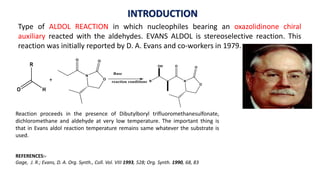
Type of ALDOL REACTION in which nucleophiles bearing an oxazolidinone chiral
auxiliary reacted with the aldehydes. EVANS ALDOL is stereoselective reaction. This
reaction was initially reported by D. A. Evans and co-workers in 1979.
REFERENCES:-
Gage, J. R.; Evans, D. A. Org. Synth., Coll. Vol. VIII 1993, 528; Org. Synth. 1990, 68, 83
+
Reaction proceeds in the presence of Dibutylboryl trifluoromethanesulfonate,
dichloromethane and aldehyde at very low temperature. The important thing is
that in Evans aldol reaction temperature remains same whatever the substrate is
used.
Chiral Auxiliary
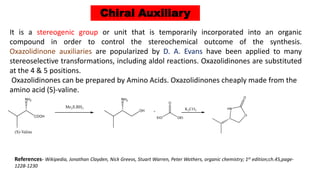
It is a stereogenic group or unit that is temporarily incorporated into an organic
compound in order to control the stereochemical outcome of the synthesis.
Oxazolidinone auxiliaries are popularized by D. A. Evans have been applied to many
stereoselective transformations, including aldol reactions. Oxazolidinones are substituted
at the 4 & 5 positions.
Oxazolidinones can be prepared by Amino Acids. Oxazolidinones cheaply made from the
amino acid (S)-valine.
References- Wikipedia, Jonathan Clayden, Nick Greevs, Stuart Warren, Peter Wothers, organic chemistry; 1st edition;ch.45,page-
1228-1230
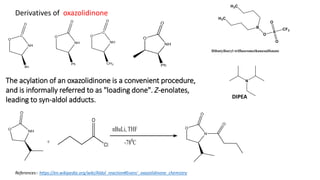
Derivatives of oxazolidinone
DIPEA
The acylation of an oxazolidinone is a convenient procedure,
and is informally referred to as "loading done". Z-enolates,
leading to syn-aldol adducts.
References:- https://en.wikipedia.org/wiki/Aldol_reaction#Evans'_oxazolidinone_chemistry
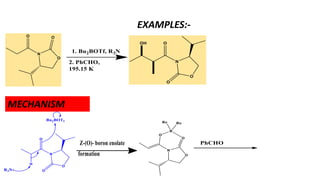
EXAMPLES:-
MECHANISM
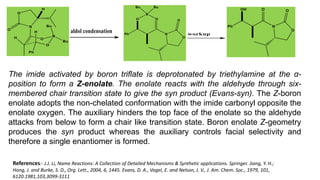
The imide activated by boron triflate is deprotonated by triethylamine at the α-
position to form a Z-enolate. The enolate reacts with the aldehyde through six-
membered chair transition state to give the syn product (Evans-syn). The Z-boron
enolate adopts the non-chelated conformation with the imide carbonyl opposite the
enolate oxygen. The auxiliary hinders the top face of the enolate so the aldehyde
attacks from below to form a chair like transition state. Boron enolate Z-geometry
produces the syn product whereas the auxiliary controls facial selectivity and
therefore a single enantiomer is formed.
References:- J.J. Li, Name Reactions: A Collection of Detailed Mechanisms & Synthetic applications. Springer. Jiang, Y. H.;
Hong, J. and Burke, S. D., Org. Lett., 2004, 6, 1445. Evans, D. A., Vogel, E. and Nelson, J. V., J. Am. Chem. Soc., 1979, 101,
6120.1981,103,3099-3111
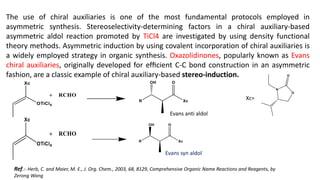
The use of chiral auxiliaries is one of the most fundamental protocols employed in
asymmetric synthesis. Stereoselectivity-determining factors in a chiral auxiliary-based
asymmetric aldol reaction promoted by TiCl4 are investigated by using density functional
theory methods. Asymmetric induction by using covalent incorporation of chiral auxiliaries is
a widely employed strategy in organic synthesis. Oxazolidinones, popularly known as Evans
chiral auxiliaries, originally developed for efficient C-C bond construction in an asymmetric
fashion, are a classic example of chiral auxiliary-based stereo-induction.
Xc=
Evans anti aldol
Evans syn aldol
Ref.:- Herb, C. and Maier, M. E., J. Org. Chem., 2003, 68, 8129, Comprehensive Organic Name Reactions and Reagents, by
Zerong Wang
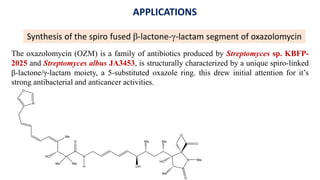
Synthesis of the spiro fused β-lactone-γ-lactam segment of oxazolomycin
The oxazolomycin (OZM) is a family of antibiotics produced by Streptomyces sp. KBFP-
2025 and Streptomyces albus JA3453, is structurally characterized by a unique spiro-linked
β-lactone/γ-lactam moiety, a 5-substituted oxazole ring. this drew initial attention for it’s
strong antibacterial and anticancer activities.
APPLICATIONS
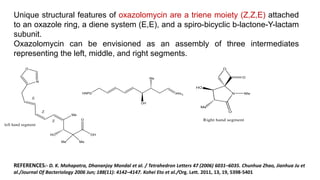
Unique structural features of oxazolomycin are a triene moiety (Z,Z,E) attached
to an oxazole ring, a diene system (E,E), and a spiro-bicyclic b-lactone-Y-lactam
subunit.
Oxazolomycin can be envisioned as an assembly of three intermediates
representing the left, middle, and right segments.
REFERENCES:- D. K. Mohapatra, Dhananjoy Mondal et al. / Tetrahedron Letters 47 (2006) 6031–6035. Chunhua Zhao, Jianhua Ju et
al./Journal Of Bacteriology 2006 Jun; 188(11): 4142–4147. Kohei Eto et al./Org. Lett. 2011, 13, 19, 5398-5401
The Evans aldol reaction has been used as a standard strategy in the synthesis of
natural products, particularly polyketide compounds.
 Since this reaction is associated with chiral auxiliaries, it has been found that in spite
of the stoichiometric requirements, auxiliary-controlled reactions are still powerful
tools in the construction of complex molecules, especially in their chiral inducing
stage.
asymmetric synthesis is a selective synthesis of one enantiomer or diastereomer form
of an optically active compound. It is an over growing important strategy in modern
synthetic organic chemistry particularly in the total synthesis of biologically active
natural products.
Chiral auxiliaries are generally reliable and versatile, enabling the synthesis of a large
number of enantiomerically pure compounds in a time-efficient fashion. Therefore,
chiral auxiliaries have been used
References:- Majid M. Heravi et al./RSC Adv., 2016,6, 30498-30551. Evans, D. A. Aldrichimica Acta 1982, 15, 23. Crimmins M. T., King
B. W., Tabet A. E. J. Am. Chem. Soc. 1997, 119, 7883

Evans aldol ppt

  • 1.
    Presented by :- PadamRaj Bhatt M.Sc. Chemical sciences (SCS CUG) Enrollment No.180501003 EVANS’ ALDOL
  • 2.
    INTRODUCTION Type of ALDOLREACTION in which nucleophiles bearing an oxazolidinone chiral auxiliary reacted with the aldehydes. EVANS ALDOL is stereoselective reaction. This reaction was initially reported by D. A. Evans and co-workers in 1979. REFERENCES:- Gage, J. R.; Evans, D. A. Org. Synth., Coll. Vol. VIII 1993, 528; Org. Synth. 1990, 68, 83 + Reaction proceeds in the presence of Dibutylboryl trifluoromethanesulfonate, dichloromethane and aldehyde at very low temperature. The important thing is that in Evans aldol reaction temperature remains same whatever the substrate is used.
  • 3.
    Chiral Auxiliary It isa stereogenic group or unit that is temporarily incorporated into an organic compound in order to control the stereochemical outcome of the synthesis. Oxazolidinone auxiliaries are popularized by D. A. Evans have been applied to many stereoselective transformations, including aldol reactions. Oxazolidinones are substituted at the 4 & 5 positions. Oxazolidinones can be prepared by Amino Acids. Oxazolidinones cheaply made from the amino acid (S)-valine. References- Wikipedia, Jonathan Clayden, Nick Greevs, Stuart Warren, Peter Wothers, organic chemistry; 1st edition;ch.45,page- 1228-1230
  • 4.
    Derivatives of oxazolidinone DIPEA Theacylation of an oxazolidinone is a convenient procedure, and is informally referred to as "loading done". Z-enolates, leading to syn-aldol adducts. References:- https://en.wikipedia.org/wiki/Aldol_reaction#Evans'_oxazolidinone_chemistry
  • 5.
  • 6.
    The imide activatedby boron triflate is deprotonated by triethylamine at the α- position to form a Z-enolate. The enolate reacts with the aldehyde through six- membered chair transition state to give the syn product (Evans-syn). The Z-boron enolate adopts the non-chelated conformation with the imide carbonyl opposite the enolate oxygen. The auxiliary hinders the top face of the enolate so the aldehyde attacks from below to form a chair like transition state. Boron enolate Z-geometry produces the syn product whereas the auxiliary controls facial selectivity and therefore a single enantiomer is formed. References:- J.J. Li, Name Reactions: A Collection of Detailed Mechanisms & Synthetic applications. Springer. Jiang, Y. H.; Hong, J. and Burke, S. D., Org. Lett., 2004, 6, 1445. Evans, D. A., Vogel, E. and Nelson, J. V., J. Am. Chem. Soc., 1979, 101, 6120.1981,103,3099-3111
  • 7.
    The use ofchiral auxiliaries is one of the most fundamental protocols employed in asymmetric synthesis. Stereoselectivity-determining factors in a chiral auxiliary-based asymmetric aldol reaction promoted by TiCl4 are investigated by using density functional theory methods. Asymmetric induction by using covalent incorporation of chiral auxiliaries is a widely employed strategy in organic synthesis. Oxazolidinones, popularly known as Evans chiral auxiliaries, originally developed for efficient C-C bond construction in an asymmetric fashion, are a classic example of chiral auxiliary-based stereo-induction. Xc= Evans anti aldol Evans syn aldol Ref.:- Herb, C. and Maier, M. E., J. Org. Chem., 2003, 68, 8129, Comprehensive Organic Name Reactions and Reagents, by Zerong Wang
  • 8.
    Synthesis of thespiro fused β-lactone-γ-lactam segment of oxazolomycin The oxazolomycin (OZM) is a family of antibiotics produced by Streptomyces sp. KBFP- 2025 and Streptomyces albus JA3453, is structurally characterized by a unique spiro-linked β-lactone/γ-lactam moiety, a 5-substituted oxazole ring. this drew initial attention for it’s strong antibacterial and anticancer activities. APPLICATIONS
  • 9.
    Unique structural featuresof oxazolomycin are a triene moiety (Z,Z,E) attached to an oxazole ring, a diene system (E,E), and a spiro-bicyclic b-lactone-Y-lactam subunit. Oxazolomycin can be envisioned as an assembly of three intermediates representing the left, middle, and right segments. REFERENCES:- D. K. Mohapatra, Dhananjoy Mondal et al. / Tetrahedron Letters 47 (2006) 6031–6035. Chunhua Zhao, Jianhua Ju et al./Journal Of Bacteriology 2006 Jun; 188(11): 4142–4147. Kohei Eto et al./Org. Lett. 2011, 13, 19, 5398-5401
  • 10.
    The Evans aldolreaction has been used as a standard strategy in the synthesis of natural products, particularly polyketide compounds.  Since this reaction is associated with chiral auxiliaries, it has been found that in spite of the stoichiometric requirements, auxiliary-controlled reactions are still powerful tools in the construction of complex molecules, especially in their chiral inducing stage. asymmetric synthesis is a selective synthesis of one enantiomer or diastereomer form of an optically active compound. It is an over growing important strategy in modern synthetic organic chemistry particularly in the total synthesis of biologically active natural products. Chiral auxiliaries are generally reliable and versatile, enabling the synthesis of a large number of enantiomerically pure compounds in a time-efficient fashion. Therefore, chiral auxiliaries have been used References:- Majid M. Heravi et al./RSC Adv., 2016,6, 30498-30551. Evans, D. A. Aldrichimica Acta 1982, 15, 23. Crimmins M. T., King B. W., Tabet A. E. J. Am. Chem. Soc. 1997, 119, 7883