GENE THERAPY
BY
SUNNY DHIMAN
2ND
SEM M-PHARM
PHARMACOLOGY
ISCP MOGA (PUNJAB)
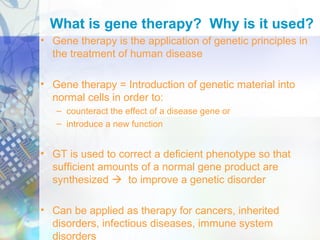
What is gene therapy? Why is it used?
• Gene therapy is the application of genetic principles in
the treatment of human disease
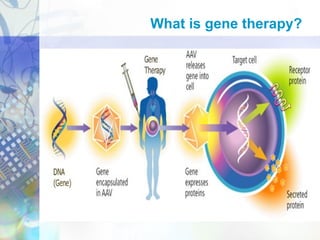
• Gene therapy = Introduction of genetic material into
normal cells in order to:
– counteract the effect of a disease gene or
– introduce a new function
• GT is used to correct a deficient phenotype so that
sufficient amounts of a normal gene product are
synthesized  to improve a genetic disorder
• Can be applied as therapy for cancers, inherited
disorders, infectious diseases, immune system
disorders
What is gene therapy?
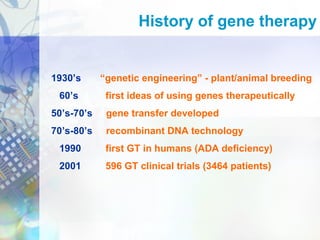
History of gene therapy
1930’s “genetic engineering” - plant/animal breeding
60’s first ideas of using genes therapeutically
50’s-70’s gene transfer developed
70’s-80’s recombinant DNA technology
1990 first GT in humans (ADA deficiency)
2001 596 GT clinical trials (3464 patients)
Human Genome Project
• A genome is all the DNA in an organism,
including its genes. Genes carry information for
making all the proteins required by all organisms
• Variations in structure of person’s genes
collectively helps define us as individuals
• Rationale for GT is based on knowledge of the
human genetic code
• Began formally in 1990, set as a 13 year project.
HGP GOALS
• Identify aproximately 30,000 genes
• Determine 3 billion chemical base pairs that
make up human DNA
• Store information in databases
• Improve tools for data analysis
• Address ethical, legal and social issues that
might arise from this
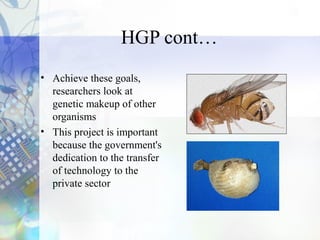
HGP cont…
• Achieve these goals,
researchers look at
genetic makeup of other
organisms
• This project is important
because the government's
dedication to the transfer
of technology to the
private sector
Three types of gene therapy:
• Monogenic gene therapy
• Provides genes to encode for the production of a
specific protein
• Cystic fibrosis, Muscular dystrophy, Sickle cell
disease, Haemophilia, SCID
• Suicide gene therapy
• Provide ‘suicide’ genes to target cancer cells for
destruction
• Cancer
• Antisense gene therapy
• Provides a single stranded gene in an’antisense’
(backward) orientation to block the production of
harmful proteins
• AIDS/HIV
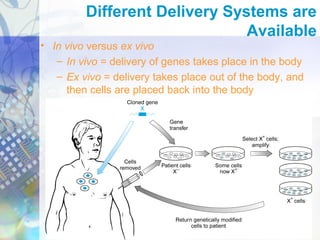
Different Delivery Systems are
Available
• In vivo versus ex vivo
– In vivo = delivery of genes takes place in the body
– Ex vivo = delivery takes place out of the body, and
then cells are placed back into the body
Getting genes into cells
• In vivo versus ex vivo
– In vivo = intravenous or intramuscular or non-
invasive (‘sniffable’)
– Ex vivo = hepatocytes, skin fibroblasts,
haematopoietic cells (‘bioreactors’)
• Gene delivery approaches
– Physical methods
– Non-viral vectors
– Viral vectors
• In vivo techniques usually utilize viral vectors
– Virus = carrier of desired gene
– Virus is usually “crippled” to disable its ability to cause disease
– Viral methods have proved to be the most efficient to date
– Many viral vectors can stable integrate the desired gene into
the target cell’s genome
In vivo techniques
– Problem: Replication defective viruses adversely
affect the virus’ normal ability to spread genes in
the body
• Reliant on diffusion and spread
• Hampered by small intercellular spaces for transport
• Restricted by viral-binding ligands on cell surface 
therefore cannot advance far.
“Viruses are highly evolved
natural vectors
for the transfer of foreign genetic information
into cells”
But to improve safety,
they need to be replication defective
Viral vectors
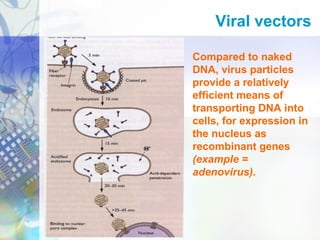
Compared to naked
DNA, virus particles
provide a relatively
efficient means of
transporting DNA into
cells, for expression in
the nucleus as
recombinant genes
(example =
adenovirus).
Viral vectors
Viral vectors
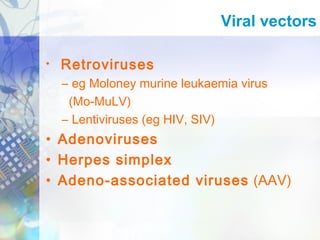
• Retroviruses
– eg Moloney murine leukaemia virus
(Mo-MuLV)
– Lentiviruses (eg HIV, SIV)
• Adenoviruses
• Herpes simplex
• Adeno-associated viruses (AAV)
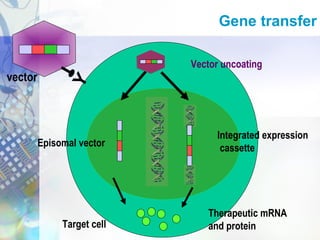
Yvector
Vector uncoating
Therapeutic mRNA
and protein
Episomal vector
Integrated expression
cassette
Target cell
Gene transfer
Delivery System of Choice = Viral
Vectors
A. Rendering virus vector harmless
Remove harmful genes  “cripple” the virus
Example – removal of env gene  virus is not capable
of producing a functional envelope
Vectors needed in very large numbers to achieve
successful delivery of new genes into patient’s cells
Vectors must be propagated in large numbers in cell
culture (109
) with the aid of a helper virus
B. Integrating versus Non-Integrating Viruses
• Integrating viruses
– Retrovirus (e.g. murine leukemia virus)
– Adeno-associated virus (only 4kbp
accommodated)
– Lentivirus
• Non-Integrating viruses
– Adenovirus
– Alphavirus
– Herpes Simplex Virus
– Vaccinia
Delivery System of Choice = Viral
Vectors
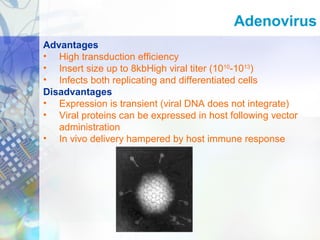
Advantages
• High transduction efficiency
• Insert size up to 8kbHigh viral titer (1010
-1013
)
• Infects both replicating and differentiated cells
Disadvantages
• Expression is transient (viral DNA does not integrate)
• Viral proteins can be expressed in host following vector
administration
• In vivo delivery hampered by host immune response
Adenovirus
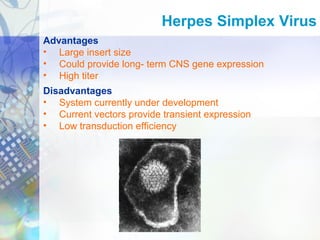
Advantages
• Large insert size
• Could provide long- term CNS gene expression
• High titer
Disadvantages
• System currently under development
• Current vectors provide transient expression
• Low transduction efficiency
Herpes Simplex Virus
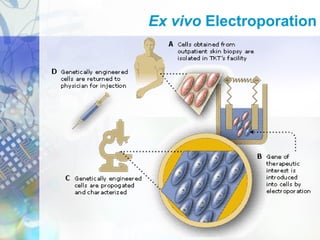
• Ex vivo manipulation techniques
– Electroporation
– Liposomes
– Calcium phosphate
– Gold bullets (fired within helium pressurized gun)
– Retrotransposons (jumping genes – early days)
– Human artificial chromosomes
Ex vivo
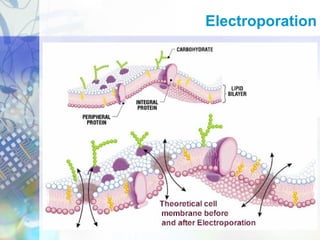
Electroporation
Ex vivo Electroporation
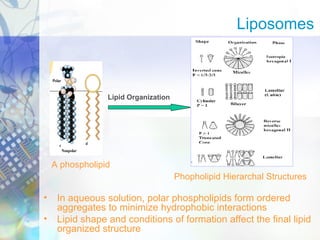
• In aqueous solution, polar phospholipids form ordered
aggregates to minimize hydrophobic interactions
• Lipid shape and conditions of formation affect the final lipid
organized structure
A phospholipid
Lipid Organization
Phopholipid Hierarchal Structures
Liposomes
Liposomes
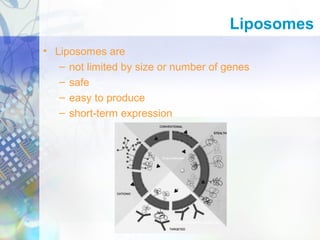
• Liposomes are
– not limited by size or number of genes
– safe
– easy to produce
– short-term expression
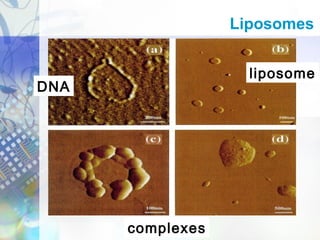
DNA
liposome
complexes
Liposomes
• Diverse manners of ‘lysing’ the liposome
• Temperature sensitive
• Target sensitive
• pH sensitive
• Electric field sensitive
Liposomes
Limitations of Gene Therapy
• Gene delivery
– Limited tropism of viral vectors
– Dependence on cell cycle by some viral vectors
(i.e. mitosis required)
• Duration of gene activity
– Non-integrating delivery will be transient (transient
expression)
– Integrated delivery will be stable
• Patient safety
– Immune hyperresponsiveness (hypersensitivity
reactions directed against viral vector components
or against transgenes expressed in treated cells)
– Integration is not controlled  oncogenes may be
involved at insertion point  cancer?
• Gene control/regulation
– Most viral vectors are unable to accommodate full
length human genes containing all of their original
regulatory sequences
– Human cDNA often used  much regulatory
information is lost (e.g. enhancers inside introns)
– Often promoters are substituted  therefore gene
expression pattern may be very different
– Random integration can adversely affect
expression (insertion near highly methylated
heterogeneous DNA may silence gene
expression)
Limitations of Gene Therapy
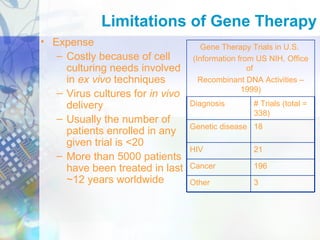
• Expense
– Costly because of cell
culturing needs involved
in ex vivo techniques
– Virus cultures for in vivo
delivery
– Usually the number of
patients enrolled in any
given trial is <20
– More than 5000 patients
have been treated in last
~12 years worldwide
Limitations of Gene Therapy
3Other
196Cancer
21HIV
18Genetic disease
# Trials (total =
338)
Diagnosis
Gene Therapy Trials in U.S.
(Information from US NIH, Office
of
Recombinant DNA Activities –
1999)
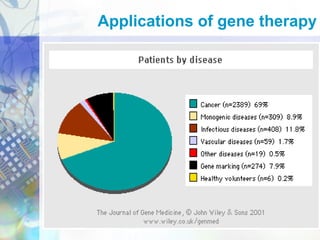
Applications of gene therapy
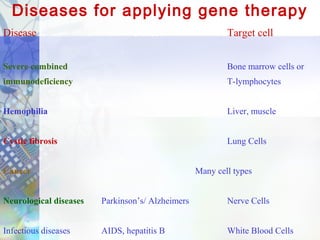
Diseases for applying gene therapy
Disease Defect Target cell
Severe combined Bone marrow cells or
immunodeficiency T-lymphocytes
Hemophilia Liver, muscle
Cystic fibrosis Lung Cells
Cancer Many cell types
Neurological diseases Parkinson’s/ Alzheimers Nerve Cells
Infectious diseases AIDS, hepatitis B White Blood Cells
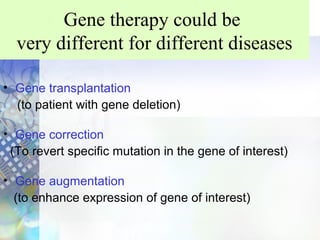
Gene therapy could be
very different for different diseases
• Gene transplantation
(to patient with gene deletion)
• Gene correction
(To revert specific mutation in the gene of interest)
• Gene augmentation
(to enhance expression of gene of interest)
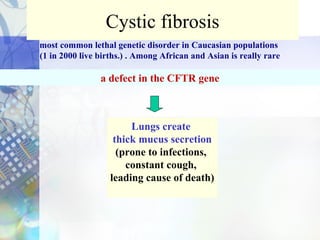
Cystic fibrosis
most common lethal genetic disorder in Caucasian populations
(1 in 2000 live births.) . Among African and Asian is really rare
a defect in the CFTR gene
Lungs create
thick mucus secretion
(prone to infections,
constant cough,
leading cause of death)
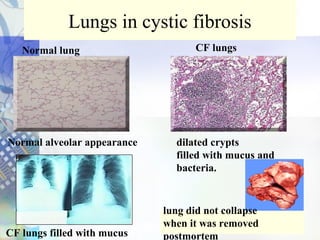
Lungs in cystic fibrosis
Normal lung CF lungs
dilated crypts
filled with mucus and
bacteria.
Normal alveolar appearance
CF lungs filled with mucus
lung did not collapse
when it was removed
postmortem
Example: Severe Combined
Immunodeficiency Disease (SCID)
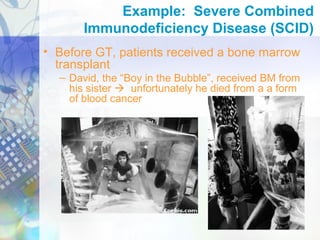
• Before GT, patients received a bone marrow
transplant
– David, the “Boy in the Bubble”, received BM from
his sister  unfortunately he died from a a form
of blood cancer
What is Severe Combined
Immunodoficiency (SCID)?
> 8 new ear infections per year
> 2 serious sinus infections per year
> 2 month on antibiotics with little effect
> 2 pneumonias per year
-- failure to gain weight and grow
-- recurrent deep skin and organ abscesses
• SCID is caused by an Adenosine Deaminase
Deficiency (ADA)
– Gene is located on chromosome #22 (32 Kbp, 12
exons)
– Deficiency results in failure to develop functional T and
B lymphocytes
– ADA is involved in purine degradation
– Accumulation of nucleotide metabolites = TOXIC to
developing T lymphocytes
– B cells don’t mature because they require T cell help
– Patients cannot withstand infection  die if untreated
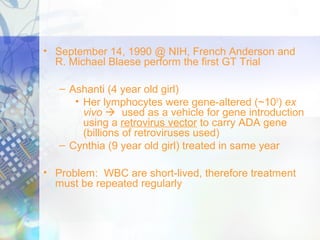
• September 14, 1990 @ NIH, French Anderson and
R. Michael Blaese perform the first GT Trial
– Ashanti (4 year old girl)
• Her lymphocytes were gene-altered (~109
) ex
vivo  used as a vehicle for gene introduction
using a retrovirus vector to carry ADA gene
(billions of retroviruses used)
– Cynthia (9 year old girl) treated in same year
• Problem: WBC are short-lived, therefore treatment
must be repeated regularly
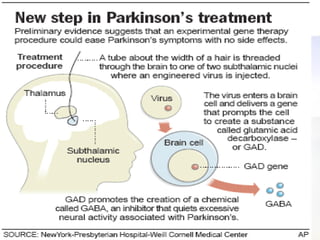
Parkinson's Disease Cont.
• The gene transfer procedure utilized the
AAV (adeno-associated virus) vector, a
virus that has been used safely in a variety
of clinical gene therapy trials, and the
vehicle that will be used in all of the
company's first generation products,
including epilepsy and Huntington's
disease. In its Parkinson's disease trial,
Neurologix used its gene transfer
technology.
Ornithine transcarbamylase (OTC)
deficiency
• September 17, 1999
– Ornithine transcarbamylase (OTC) deficiency
• Urea cycle disorder (1/10,000 births)
• Encoded on X chromosome
– Females usually carriers, sons have
disease
– Urea cycle = series of 5 liver enzymes that rid the
body of ammonia (toxic breakdown product of
protein)
• If enzymes are missing or deficient, ammonia
accumulates in the blood and travels to the
brain (coma, brain damage or death)
• Severe OTC deficiency
– Newborns  coma within 72 hours
• Most suffer severe brain damage
• ½ die in first month
• ½ of survivors die by age 5
– Early treatment
• Low-protein formula called “keto-acid”
– Modern day treatment
• Sodium benzoate and another sodium
derivative
• Bind ammonia  helps eliminate it from the
body
Ornithine transcarbamylase (OTC)
deficiency
• Case study: Jesse Gelsinger
– GT began Sept. 13, 1999, Coma on Sept. 14, Brain
dead and life support terminated on Sept. 17, 1999
– Cause of death: Respiratory Disease Syndrome
– Adenovirus (a weakened cold virus) was the vector of
choice (DNA genome and an icosahedral capsid)
– Chain reaction occurred that previous testing had not
predicted following introduction of “maximum tolerated
dose”
• Jaundice, kidney failure, lung failure and brain
death
• Adenovirus triggered an overwhelming inflammatory
reaction  massive production of monokine IL-6
 multiple organ failure
Ornithine transcarbamylase (OTC)
deficiency
• AIDS
– HIV patients  T lymphocytes treated ex vivo
with rev and env defective mutant strains of HIV
– Large numbers of cells obtained
• Injected back into patient
• Stimulated good CD8+
cytotoxic T cell
responses (Tcyt)
• Familial Hypercholesterolemia
– Defective cholesterol receptors on liver cells
• Fail to filter cholesterol from blood properly
• Cholesterol levels are elevated, increasing risk
of heart attacks and strokes
– 1993  First attempt
• Retroviral vector used to infect 3.2 x 10⁹
liver
cells (~15% of patients liver) ex vivo
– Infused back into patient
– Improvement seen
– Has been used in many trials since then
• Lesch-Nyhan Disease – Candidate
– Early days  confined to animal models and in vitro
tests
– Defect in producing HGPRT enzyme (hypoxanthine-
guanine phosphoribosyl transferase)
• Defective metabolism of hypoxanthine and guanine
 Uric acid accumulates
– Gout, Kidney disease, cerebral palsy, mental
retardation, head banging, profanity, spitting,
mutilation of fingers
• Gaucher’s disease
– Glucocerebrosidase gene defect
– RAC approved clinical tests – 1993
– Affects CNS, enlarged spleen and liver, long
bone erosion and discoloration of skin
• Liposomes coated in polymer PEG – can cross the
blood-brain barrier (viral vectors are too big) (January
2003)
• Case Western Uni. & Copernicus Therapeutics able
to create tiny liposomes 25nm across to carry
therapeutic DNA through pores in nuclear membrane
• New gene approach repairs errors in mRNA
• Thalassaemia
• Cystic fibrosis
• Some cancers
Recent Developments in Gene Therapy
• 2003 – temporary hold on all gene therapy trials
including retroviral vectors in blood stem cells
• Too early to tell
• Desperately need improved DELIVERY …could
liposomes be the answer?
Future?
• 2003 – temporary hold on all gene therapy trials
including retroviral vectors in blood stem cells
• Too early to tell
• Desperately need improved DELIVERY …could
liposomes be the answer?
Future?

Gene theary seminar

  • 1.
    GENE THERAPY BY SUNNY DHIMAN 2ND SEMM-PHARM PHARMACOLOGY ISCP MOGA (PUNJAB)
  • 2.
    What is genetherapy? Why is it used? • Gene therapy is the application of genetic principles in the treatment of human disease • Gene therapy = Introduction of genetic material into normal cells in order to: – counteract the effect of a disease gene or – introduce a new function • GT is used to correct a deficient phenotype so that sufficient amounts of a normal gene product are synthesized  to improve a genetic disorder • Can be applied as therapy for cancers, inherited disorders, infectious diseases, immune system disorders
  • 3.
    What is genetherapy?
  • 4.
    History of genetherapy 1930’s “genetic engineering” - plant/animal breeding 60’s first ideas of using genes therapeutically 50’s-70’s gene transfer developed 70’s-80’s recombinant DNA technology 1990 first GT in humans (ADA deficiency) 2001 596 GT clinical trials (3464 patients)
  • 5.
    Human Genome Project •A genome is all the DNA in an organism, including its genes. Genes carry information for making all the proteins required by all organisms • Variations in structure of person’s genes collectively helps define us as individuals • Rationale for GT is based on knowledge of the human genetic code • Began formally in 1990, set as a 13 year project.
  • 6.
    HGP GOALS • Identifyaproximately 30,000 genes • Determine 3 billion chemical base pairs that make up human DNA • Store information in databases • Improve tools for data analysis • Address ethical, legal and social issues that might arise from this
  • 7.
    HGP cont… • Achievethese goals, researchers look at genetic makeup of other organisms • This project is important because the government's dedication to the transfer of technology to the private sector
  • 8.
    Three types ofgene therapy: • Monogenic gene therapy • Provides genes to encode for the production of a specific protein • Cystic fibrosis, Muscular dystrophy, Sickle cell disease, Haemophilia, SCID • Suicide gene therapy • Provide ‘suicide’ genes to target cancer cells for destruction • Cancer • Antisense gene therapy • Provides a single stranded gene in an’antisense’ (backward) orientation to block the production of harmful proteins • AIDS/HIV
  • 9.
    Different Delivery Systemsare Available • In vivo versus ex vivo – In vivo = delivery of genes takes place in the body – Ex vivo = delivery takes place out of the body, and then cells are placed back into the body
  • 10.
    Getting genes intocells • In vivo versus ex vivo – In vivo = intravenous or intramuscular or non- invasive (‘sniffable’) – Ex vivo = hepatocytes, skin fibroblasts, haematopoietic cells (‘bioreactors’) • Gene delivery approaches – Physical methods – Non-viral vectors – Viral vectors
  • 11.
    • In vivotechniques usually utilize viral vectors – Virus = carrier of desired gene – Virus is usually “crippled” to disable its ability to cause disease – Viral methods have proved to be the most efficient to date – Many viral vectors can stable integrate the desired gene into the target cell’s genome In vivo techniques – Problem: Replication defective viruses adversely affect the virus’ normal ability to spread genes in the body • Reliant on diffusion and spread • Hampered by small intercellular spaces for transport • Restricted by viral-binding ligands on cell surface  therefore cannot advance far.
  • 12.
    “Viruses are highlyevolved natural vectors for the transfer of foreign genetic information into cells” But to improve safety, they need to be replication defective Viral vectors
  • 13.
    Compared to naked DNA,virus particles provide a relatively efficient means of transporting DNA into cells, for expression in the nucleus as recombinant genes (example = adenovirus). Viral vectors
  • 14.
    Viral vectors • Retroviruses –eg Moloney murine leukaemia virus (Mo-MuLV) – Lentiviruses (eg HIV, SIV) • Adenoviruses • Herpes simplex • Adeno-associated viruses (AAV)
  • 15.
    Yvector Vector uncoating Therapeutic mRNA andprotein Episomal vector Integrated expression cassette Target cell Gene transfer
  • 16.
    Delivery System ofChoice = Viral Vectors A. Rendering virus vector harmless Remove harmful genes  “cripple” the virus Example – removal of env gene  virus is not capable of producing a functional envelope Vectors needed in very large numbers to achieve successful delivery of new genes into patient’s cells Vectors must be propagated in large numbers in cell culture (109 ) with the aid of a helper virus
  • 17.
    B. Integrating versusNon-Integrating Viruses • Integrating viruses – Retrovirus (e.g. murine leukemia virus) – Adeno-associated virus (only 4kbp accommodated) – Lentivirus • Non-Integrating viruses – Adenovirus – Alphavirus – Herpes Simplex Virus – Vaccinia Delivery System of Choice = Viral Vectors
  • 18.
    Advantages • High transductionefficiency • Insert size up to 8kbHigh viral titer (1010 -1013 ) • Infects both replicating and differentiated cells Disadvantages • Expression is transient (viral DNA does not integrate) • Viral proteins can be expressed in host following vector administration • In vivo delivery hampered by host immune response Adenovirus
  • 19.
    Advantages • Large insertsize • Could provide long- term CNS gene expression • High titer Disadvantages • System currently under development • Current vectors provide transient expression • Low transduction efficiency Herpes Simplex Virus
  • 20.
    • Ex vivomanipulation techniques – Electroporation – Liposomes – Calcium phosphate – Gold bullets (fired within helium pressurized gun) – Retrotransposons (jumping genes – early days) – Human artificial chromosomes Ex vivo
  • 21.
  • 22.
  • 23.
    • In aqueoussolution, polar phospholipids form ordered aggregates to minimize hydrophobic interactions • Lipid shape and conditions of formation affect the final lipid organized structure A phospholipid Lipid Organization Phopholipid Hierarchal Structures Liposomes
  • 24.
    Liposomes • Liposomes are –not limited by size or number of genes – safe – easy to produce – short-term expression
  • 25.
  • 26.
    • Diverse mannersof ‘lysing’ the liposome • Temperature sensitive • Target sensitive • pH sensitive • Electric field sensitive Liposomes
  • 27.
    Limitations of GeneTherapy • Gene delivery – Limited tropism of viral vectors – Dependence on cell cycle by some viral vectors (i.e. mitosis required) • Duration of gene activity – Non-integrating delivery will be transient (transient expression) – Integrated delivery will be stable • Patient safety – Immune hyperresponsiveness (hypersensitivity reactions directed against viral vector components or against transgenes expressed in treated cells) – Integration is not controlled  oncogenes may be involved at insertion point  cancer?
  • 28.
    • Gene control/regulation –Most viral vectors are unable to accommodate full length human genes containing all of their original regulatory sequences – Human cDNA often used  much regulatory information is lost (e.g. enhancers inside introns) – Often promoters are substituted  therefore gene expression pattern may be very different – Random integration can adversely affect expression (insertion near highly methylated heterogeneous DNA may silence gene expression) Limitations of Gene Therapy
  • 29.
    • Expense – Costlybecause of cell culturing needs involved in ex vivo techniques – Virus cultures for in vivo delivery – Usually the number of patients enrolled in any given trial is <20 – More than 5000 patients have been treated in last ~12 years worldwide Limitations of Gene Therapy 3Other 196Cancer 21HIV 18Genetic disease # Trials (total = 338) Diagnosis Gene Therapy Trials in U.S. (Information from US NIH, Office of Recombinant DNA Activities – 1999)
  • 30.
  • 31.
    Diseases for applyinggene therapy Disease Defect Target cell Severe combined Bone marrow cells or immunodeficiency T-lymphocytes Hemophilia Liver, muscle Cystic fibrosis Lung Cells Cancer Many cell types Neurological diseases Parkinson’s/ Alzheimers Nerve Cells Infectious diseases AIDS, hepatitis B White Blood Cells
  • 32.
    Gene therapy couldbe very different for different diseases • Gene transplantation (to patient with gene deletion) • Gene correction (To revert specific mutation in the gene of interest) • Gene augmentation (to enhance expression of gene of interest)
  • 33.
    Cystic fibrosis most commonlethal genetic disorder in Caucasian populations (1 in 2000 live births.) . Among African and Asian is really rare a defect in the CFTR gene Lungs create thick mucus secretion (prone to infections, constant cough, leading cause of death)
  • 34.
    Lungs in cysticfibrosis Normal lung CF lungs dilated crypts filled with mucus and bacteria. Normal alveolar appearance CF lungs filled with mucus lung did not collapse when it was removed postmortem
  • 35.
    Example: Severe Combined ImmunodeficiencyDisease (SCID) • Before GT, patients received a bone marrow transplant – David, the “Boy in the Bubble”, received BM from his sister  unfortunately he died from a a form of blood cancer
  • 36.
    What is SevereCombined Immunodoficiency (SCID)? > 8 new ear infections per year > 2 serious sinus infections per year > 2 month on antibiotics with little effect > 2 pneumonias per year -- failure to gain weight and grow -- recurrent deep skin and organ abscesses
  • 37.
    • SCID iscaused by an Adenosine Deaminase Deficiency (ADA) – Gene is located on chromosome #22 (32 Kbp, 12 exons) – Deficiency results in failure to develop functional T and B lymphocytes – ADA is involved in purine degradation – Accumulation of nucleotide metabolites = TOXIC to developing T lymphocytes – B cells don’t mature because they require T cell help – Patients cannot withstand infection  die if untreated
  • 38.
    • September 14,1990 @ NIH, French Anderson and R. Michael Blaese perform the first GT Trial – Ashanti (4 year old girl) • Her lymphocytes were gene-altered (~109 ) ex vivo  used as a vehicle for gene introduction using a retrovirus vector to carry ADA gene (billions of retroviruses used) – Cynthia (9 year old girl) treated in same year • Problem: WBC are short-lived, therefore treatment must be repeated regularly
  • 39.
    Parkinson's Disease Cont. •The gene transfer procedure utilized the AAV (adeno-associated virus) vector, a virus that has been used safely in a variety of clinical gene therapy trials, and the vehicle that will be used in all of the company's first generation products, including epilepsy and Huntington's disease. In its Parkinson's disease trial, Neurologix used its gene transfer technology.
  • 41.
    Ornithine transcarbamylase (OTC) deficiency •September 17, 1999 – Ornithine transcarbamylase (OTC) deficiency • Urea cycle disorder (1/10,000 births) • Encoded on X chromosome – Females usually carriers, sons have disease – Urea cycle = series of 5 liver enzymes that rid the body of ammonia (toxic breakdown product of protein) • If enzymes are missing or deficient, ammonia accumulates in the blood and travels to the brain (coma, brain damage or death)
  • 42.
    • Severe OTCdeficiency – Newborns  coma within 72 hours • Most suffer severe brain damage • ½ die in first month • ½ of survivors die by age 5 – Early treatment • Low-protein formula called “keto-acid” – Modern day treatment • Sodium benzoate and another sodium derivative • Bind ammonia  helps eliminate it from the body Ornithine transcarbamylase (OTC) deficiency
  • 43.
    • Case study:Jesse Gelsinger – GT began Sept. 13, 1999, Coma on Sept. 14, Brain dead and life support terminated on Sept. 17, 1999 – Cause of death: Respiratory Disease Syndrome – Adenovirus (a weakened cold virus) was the vector of choice (DNA genome and an icosahedral capsid) – Chain reaction occurred that previous testing had not predicted following introduction of “maximum tolerated dose” • Jaundice, kidney failure, lung failure and brain death • Adenovirus triggered an overwhelming inflammatory reaction  massive production of monokine IL-6  multiple organ failure Ornithine transcarbamylase (OTC) deficiency
  • 44.
    • AIDS – HIVpatients  T lymphocytes treated ex vivo with rev and env defective mutant strains of HIV – Large numbers of cells obtained • Injected back into patient • Stimulated good CD8+ cytotoxic T cell responses (Tcyt)
  • 45.
    • Familial Hypercholesterolemia –Defective cholesterol receptors on liver cells • Fail to filter cholesterol from blood properly • Cholesterol levels are elevated, increasing risk of heart attacks and strokes – 1993  First attempt • Retroviral vector used to infect 3.2 x 10⁹ liver cells (~15% of patients liver) ex vivo – Infused back into patient – Improvement seen – Has been used in many trials since then
  • 46.
    • Lesch-Nyhan Disease– Candidate – Early days  confined to animal models and in vitro tests – Defect in producing HGPRT enzyme (hypoxanthine- guanine phosphoribosyl transferase) • Defective metabolism of hypoxanthine and guanine  Uric acid accumulates – Gout, Kidney disease, cerebral palsy, mental retardation, head banging, profanity, spitting, mutilation of fingers
  • 47.
    • Gaucher’s disease –Glucocerebrosidase gene defect – RAC approved clinical tests – 1993 – Affects CNS, enlarged spleen and liver, long bone erosion and discoloration of skin
  • 48.
    • Liposomes coatedin polymer PEG – can cross the blood-brain barrier (viral vectors are too big) (January 2003) • Case Western Uni. & Copernicus Therapeutics able to create tiny liposomes 25nm across to carry therapeutic DNA through pores in nuclear membrane • New gene approach repairs errors in mRNA • Thalassaemia • Cystic fibrosis • Some cancers Recent Developments in Gene Therapy
  • 49.
    • 2003 –temporary hold on all gene therapy trials including retroviral vectors in blood stem cells • Too early to tell • Desperately need improved DELIVERY …could liposomes be the answer? Future?
  • 50.
    • 2003 –temporary hold on all gene therapy trials including retroviral vectors in blood stem cells • Too early to tell • Desperately need improved DELIVERY …could liposomes be the answer? Future?