Essential Drug List &
Rational Use of Drug
Presented By- Santu
M.Pharm (p’cology)
ISCP Moga.
 The concept of essential medicines
A limited range of carefully selected essential
drugs leads to
Better health care
Better drug management
Lower costs
 Definition of essential medicines
Essential medicines are those that satisfy the
priority health care needs of the population at
all time.
Essential medicines
History of the WHO Model List
of Essential Drugs
 1977 First Model list published, ± 200 active
substances
 List is revised every two years by WHO Expert
Committee
 April 2003 revised Model list contains 315 active
substances
 2007, a separate list for children up to 12 years
was included.
 Latest, The 18th edition for adults and the 4th
edition for children were released in April 2013
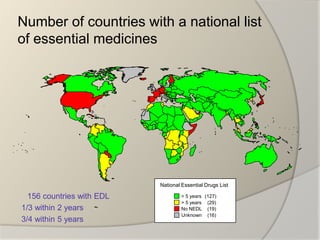
Number of countries with a national list
of essential medicines
National Essential Drugs List
< 5 years (127)
> 5 years (29)
No NEDL (19)
Unknown (16)
156 countries with EDL
1/3 within 2 years
3/4 within 5 years
Full description of essential drugs
(Expert Committee Report, April 2002)
Definition: Essential medicines are those that satisfy the
priority health care needs of the population
Selection criteria: Essential medicines are selected with
due regard to disease prevalence, evidence on efficacy and
safety, and comparative cost-effectiveness
Purpose: Essential medicines are intended to be available
within the context of functioning health systems at all times, in
adequate amounts, in the appropriate dosage forms, with
assured quality, and at a price the individual and the community
can afford.
Implementation: The implementation of the concept of
essential medicines is intended to be flexible and adaptable to
many different situations; exactly which medicines are regarded
as essential remains a national responsibility.
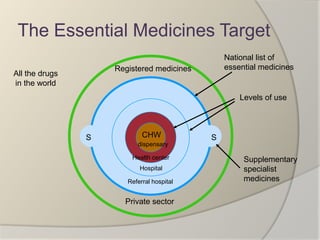
The Essential Medicines Target
S S
All the drugs
in the world
Registered medicines
National list of
essential medicines
Levels of use
Supplementary
specialist
medicines
CHW
dispensary
Health center
Hospital
Referral hospital
Private sector
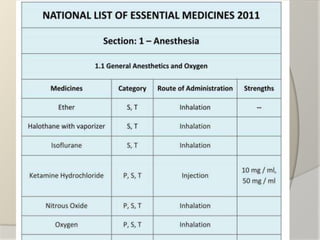
National List of Essential
Medicines of India
 The first National List of Essential Medicines of India was
prepared and released in 1996.
 The list was subsequently revised in 2003.
 2011, publication of revised list containing 348 drugs.
 In comparison to NLEM 2003, number of medicines deleted
is 47 and 43 medicines was added.
 3 category included
 P→ Primary
 S → Secondary
 T → Tartiary
o P,S,T containing 181 drugs
o S,T containing 106 drugs
o T containing 61 drugs.
The WHO Model List of Essential Medicines is a
model product, model process and public health
tool
Model product: list of essential drugs with information
Core list: minimum drug needs for a basic health care
system, listing the most cost-effective drugs for priority
conditions (selected on the basis of burden of disease
and potential for safe and cost-effective treatment).
Complementary list: essential drugs for priority diseases
which are cost-effective but not necessarily affordable or
for which specialised health care facilities may be
needed; and essential drugs for less frequent diseases
Seven steps to get a new medicine on
the WHO Model List of Essential Drugs
1. Identification of public-health need for a medicine
2. Development of the medicine; phase I - II - III trials
3. Regulatory approval in a number of countries
> Effective and safe medicine on the market
4. More experience under different field circumstances; post-marketing
surveillance
5. Price indication for public sector use
6. Review by WHO disease programme; define comparative
effectiveness and safety in real-life situations, comparative cost-
effectiveness and public health relevance
> Medicine included in WHO treatment guideline
7. Submission to WHO Expert Committee on Essential Drugs
> Medicine included in WHO Model List
PROCESS ADOPTED FOR REVISION OF
NLEM India (2011)
National List of Essential Medicines 2003
(Base document)
Consultation meetings with Experts
Deliberation on Evidence based criteria for addition and deletion of
medicines from the NLEM
Therapeutic area wise group discussion
(Group composition: Clinicians, Pharmacologists, Pharmacists,
Scientists and Regulators)
REVISION PROCESS contd…
Presentation by groups in open house discussion
Deliberations/ discussion and reasoning for additions/
deletions/modifications
Draft recommendations for NLEM
Consideration and adoption of NLEM by the Core
Committee
Resource Materials:
WHO Model List of Essential
Medicines 2010,
WHO model formulary,
National Formulary of India
2010 (Pre print Version),
Textbooks of Pharmacology,
Internal Medicine,
Drug compendia,
Indian Pharmacopoeia,
Internet facility
Resource Support:
Scientists, Senior Residents,
Junior Residents and PhD
Scholar of Dept of
Pharmacology, AIIMS, New
Delhi
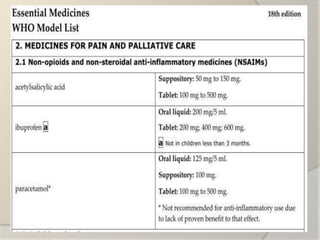
Content of EDL
 1 Anaesthetics
 1.1 General anaesthetics and oxygen
 1.2 Local anaesthetics
 1.3 Preoperative medication and sedation for short-term procedures
 2 Medicines for pain and palliative care
 2.1 Non-opioids and non-steroidal anti-inflammatory drugs (NSAIDs)
 2.2 Opioid analgesics
 2.3 Medicines for other common symptoms in palliative care
 3 Antiallergics and medicines used in anaphylaxis
 4 Antidotes and other substances used in poisonings
 4.1 Non-specific
 4.2 Specific
 5 Anticonvulsants/antiepileptics
 6 Anti-infective medicines
 6.1 Antihelminthics
 6.2 Antibacterials
 6.3 Antifungal medicines
 6.4 Antiviral medicines
 6.5 Antiprotozoal medicines
 7 Antimigraine medicines
 7.1 For treatment of acute attack
 7.2 For prophylaxis
 etc,……………………………………….
Contents….
 Hormones, other endocrine medicines and cont
 Immunologicals
 Ophthalmological preparations
 Vitamins and minerals
 Medicines for diseases of joints
 Ear, nose and throat medicines in children
 Cardiovascular medicines
 Antiparkinsonism medicines
 Diagnostic agents
 Diuretics
 Gastrointestinal medicines
etc…………………………
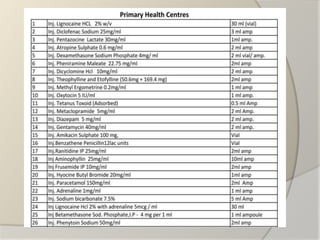
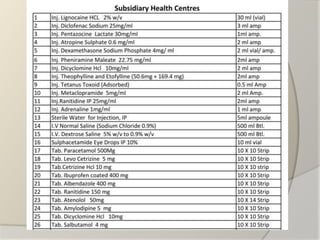
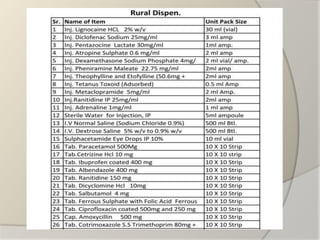
State EDL (Punjab)
Rational use of drugs
Rational use of Drug
 The rational use of drugs requires that patients receive medications
appropriate to their clinical needs, in doses that meet their own individual
requirements for an adequate period of time, and at the lowest cost to them
and their community.
WHO conference of experts Nairobi 1985
 correct drug
 appropriate indication
 appropriate drug considering efficacy, safety, suitability for the
patient, and cost
 appropriate dosage, administration, duration
 no contraindications
 correct dispensing, including appropriate information for patients
 patient adherence to treatment
Examples of Irrational Drug use
 Prescribing drugs of no proven value.
 Prescribing empirically.
 Unnecessary prescribing for self limiting
conditions.
 Over dosing and under dosing.
 Prescribing costly drugs.
 Using injections when oral drugs would sufficient.
Why does irrational use continue?
Very few countries regularly monitor drug use
because…
 They have insufficient funds.
 They lack of awareness.
 There is insufficient knowledge of concerning the
cost-effectiveness of interventions.
Many Factors Influence Use of Medicines
Treatment
Choices
Prior
Knowledge
Habits
Scientific
Information
Relationships
With Peers
Influence
of Drug
Industry
Workload &
Staffing
Infra-
structure
Authority &
Supervision
Societal
Information
Intrinsic
Workplace
Workgroup
Social &
Cultural
Factors
Economic &
Legal Factors
Overview of Rational use of Drug
Strategies to Improve Use of Drugs
Economic:
 Offer incentives
– Institutions
– Providers and patients
Managerial:
 Guide clinical practice
– Information systems
– Drug supply / lab capacity
Regulatory:
 Restrict choices
– Market or practice controls
– Enforcement
Educational:
 Inform or persuade
– Health providers
– Consumers
Use of Medicines
Educational Strategies
Goal: to inform or persuade
 Training for Providers
 Undergraduate education
 Continuing in-service medical education (seminars, workshops)
 Face-to-face persuasive outreach e.g. academic detailing
 Clinical supervision or consultation
 Printed Materials
 Clinical literature and newsletters
 Formularies or therapeutics manuals
 Persuasive print materials
 Media-Based Approaches
 Posters
 Audio tapes, plays
 Radio, television
Managerial strategies
Goal: to structure or guide decisions
 Changes in selection, procurement, distribution to
ensure availability of essential drugs
 Essential Drug Lists, morbidity-based quantification, kit systems
 Strategies aimed at prescribers
 targeted face-to-face supervision with audit, peer group
monitoring, structured order forms, evidence-based standard
treatment guidelines
 Dispensing strategies
 course of treatment packaging, labelling, generic substitution
Economic strategies:
 Goal: to offer incentives to providers an
consumers
 Avoid perverse financial incentives
Regulatory strategies
Goal: to restrict or limit decisions
 Drug registration
 Banning unsafe drugs - but beware unexpected results
 substitution of a second inappropriate drug after banning a first
inappropriate or unsafe drug
 Regulating the use of different drugs to different
levels of the health sector e.g.
 licensing prescribers and drug outlets
 scheduling drugs into prescription-only & over-the-counter
 Regulating pharmaceutical promotional activities
PHARMACIST’S ROLE
A) Drug Selection :
 The selection and range of drugs should be
based on the essential drug concept.
 Strict inventory control and cost effective
procurement should be practiced.
 Procure the most cost effective drugs in the right
quantities.
 Select reliable suppliers of high quality products.
 Ensure timely delivery.
 Achieve the lowest possible total cost.
B) Inventory control :
 Monitoring of drug stocks and
minimizing out of stock.
 Restrict the number and brands of
drugs.
 Drugs with overdue expiry dates should
not be dispensed or stored.
 All the drugs required to health facility
should be kept in stock.
C) Information and education
 Interact with other healthcare
professionals and inform them about
new drugs and availability of drugs.
 Suitable programes should be evolved
to raise awareness of ADR.
 Patient should be counseled.
D) Pharmaceutical care :
 This aims to optimize the patients health
related quality of life and achieve
positive and cost effective clinical
outcomes.
 An evidence based approach must be
adopted.
 Pharmacists must collect subjective
information regarding the patient’s
health.
Essential drug list

Essential drug list

  • 1.
    Essential Drug List& Rational Use of Drug Presented By- Santu M.Pharm (p’cology) ISCP Moga.
  • 2.
     The conceptof essential medicines A limited range of carefully selected essential drugs leads to Better health care Better drug management Lower costs  Definition of essential medicines Essential medicines are those that satisfy the priority health care needs of the population at all time. Essential medicines
  • 3.
    History of theWHO Model List of Essential Drugs  1977 First Model list published, ± 200 active substances  List is revised every two years by WHO Expert Committee  April 2003 revised Model list contains 315 active substances  2007, a separate list for children up to 12 years was included.  Latest, The 18th edition for adults and the 4th edition for children were released in April 2013
  • 4.
    Number of countrieswith a national list of essential medicines National Essential Drugs List < 5 years (127) > 5 years (29) No NEDL (19) Unknown (16) 156 countries with EDL 1/3 within 2 years 3/4 within 5 years
  • 5.
    Full description ofessential drugs (Expert Committee Report, April 2002) Definition: Essential medicines are those that satisfy the priority health care needs of the population Selection criteria: Essential medicines are selected with due regard to disease prevalence, evidence on efficacy and safety, and comparative cost-effectiveness Purpose: Essential medicines are intended to be available within the context of functioning health systems at all times, in adequate amounts, in the appropriate dosage forms, with assured quality, and at a price the individual and the community can afford. Implementation: The implementation of the concept of essential medicines is intended to be flexible and adaptable to many different situations; exactly which medicines are regarded as essential remains a national responsibility.
  • 6.
    The Essential MedicinesTarget S S All the drugs in the world Registered medicines National list of essential medicines Levels of use Supplementary specialist medicines CHW dispensary Health center Hospital Referral hospital Private sector
  • 7.
    National List ofEssential Medicines of India  The first National List of Essential Medicines of India was prepared and released in 1996.  The list was subsequently revised in 2003.  2011, publication of revised list containing 348 drugs.  In comparison to NLEM 2003, number of medicines deleted is 47 and 43 medicines was added.  3 category included  P→ Primary  S → Secondary  T → Tartiary o P,S,T containing 181 drugs o S,T containing 106 drugs o T containing 61 drugs.
  • 8.
    The WHO ModelList of Essential Medicines is a model product, model process and public health tool Model product: list of essential drugs with information Core list: minimum drug needs for a basic health care system, listing the most cost-effective drugs for priority conditions (selected on the basis of burden of disease and potential for safe and cost-effective treatment). Complementary list: essential drugs for priority diseases which are cost-effective but not necessarily affordable or for which specialised health care facilities may be needed; and essential drugs for less frequent diseases
  • 9.
    Seven steps toget a new medicine on the WHO Model List of Essential Drugs 1. Identification of public-health need for a medicine 2. Development of the medicine; phase I - II - III trials 3. Regulatory approval in a number of countries > Effective and safe medicine on the market 4. More experience under different field circumstances; post-marketing surveillance 5. Price indication for public sector use 6. Review by WHO disease programme; define comparative effectiveness and safety in real-life situations, comparative cost- effectiveness and public health relevance > Medicine included in WHO treatment guideline 7. Submission to WHO Expert Committee on Essential Drugs > Medicine included in WHO Model List
  • 10.
    PROCESS ADOPTED FORREVISION OF NLEM India (2011) National List of Essential Medicines 2003 (Base document) Consultation meetings with Experts Deliberation on Evidence based criteria for addition and deletion of medicines from the NLEM Therapeutic area wise group discussion (Group composition: Clinicians, Pharmacologists, Pharmacists, Scientists and Regulators) REVISION PROCESS contd…
  • 11.
    Presentation by groupsin open house discussion Deliberations/ discussion and reasoning for additions/ deletions/modifications Draft recommendations for NLEM Consideration and adoption of NLEM by the Core Committee Resource Materials: WHO Model List of Essential Medicines 2010, WHO model formulary, National Formulary of India 2010 (Pre print Version), Textbooks of Pharmacology, Internal Medicine, Drug compendia, Indian Pharmacopoeia, Internet facility Resource Support: Scientists, Senior Residents, Junior Residents and PhD Scholar of Dept of Pharmacology, AIIMS, New Delhi
  • 12.
    Content of EDL 1 Anaesthetics  1.1 General anaesthetics and oxygen  1.2 Local anaesthetics  1.3 Preoperative medication and sedation for short-term procedures  2 Medicines for pain and palliative care  2.1 Non-opioids and non-steroidal anti-inflammatory drugs (NSAIDs)  2.2 Opioid analgesics  2.3 Medicines for other common symptoms in palliative care  3 Antiallergics and medicines used in anaphylaxis  4 Antidotes and other substances used in poisonings  4.1 Non-specific  4.2 Specific  5 Anticonvulsants/antiepileptics  6 Anti-infective medicines  6.1 Antihelminthics  6.2 Antibacterials  6.3 Antifungal medicines  6.4 Antiviral medicines  6.5 Antiprotozoal medicines  7 Antimigraine medicines  7.1 For treatment of acute attack  7.2 For prophylaxis  etc,……………………………………….
  • 13.
    Contents….  Hormones, otherendocrine medicines and cont  Immunologicals  Ophthalmological preparations  Vitamins and minerals  Medicines for diseases of joints  Ear, nose and throat medicines in children  Cardiovascular medicines  Antiparkinsonism medicines  Diagnostic agents  Diuretics  Gastrointestinal medicines etc…………………………
  • 17.
  • 21.
  • 22.
    Rational use ofDrug  The rational use of drugs requires that patients receive medications appropriate to their clinical needs, in doses that meet their own individual requirements for an adequate period of time, and at the lowest cost to them and their community. WHO conference of experts Nairobi 1985  correct drug  appropriate indication  appropriate drug considering efficacy, safety, suitability for the patient, and cost  appropriate dosage, administration, duration  no contraindications  correct dispensing, including appropriate information for patients  patient adherence to treatment
  • 23.
    Examples of IrrationalDrug use  Prescribing drugs of no proven value.  Prescribing empirically.  Unnecessary prescribing for self limiting conditions.  Over dosing and under dosing.  Prescribing costly drugs.  Using injections when oral drugs would sufficient.
  • 24.
    Why does irrationaluse continue? Very few countries regularly monitor drug use because…  They have insufficient funds.  They lack of awareness.  There is insufficient knowledge of concerning the cost-effectiveness of interventions.
  • 25.
    Many Factors InfluenceUse of Medicines Treatment Choices Prior Knowledge Habits Scientific Information Relationships With Peers Influence of Drug Industry Workload & Staffing Infra- structure Authority & Supervision Societal Information Intrinsic Workplace Workgroup Social & Cultural Factors Economic & Legal Factors
  • 26.
  • 27.
    Strategies to ImproveUse of Drugs Economic:  Offer incentives – Institutions – Providers and patients Managerial:  Guide clinical practice – Information systems – Drug supply / lab capacity Regulatory:  Restrict choices – Market or practice controls – Enforcement Educational:  Inform or persuade – Health providers – Consumers Use of Medicines
  • 28.
    Educational Strategies Goal: toinform or persuade  Training for Providers  Undergraduate education  Continuing in-service medical education (seminars, workshops)  Face-to-face persuasive outreach e.g. academic detailing  Clinical supervision or consultation  Printed Materials  Clinical literature and newsletters  Formularies or therapeutics manuals  Persuasive print materials  Media-Based Approaches  Posters  Audio tapes, plays  Radio, television
  • 29.
    Managerial strategies Goal: tostructure or guide decisions  Changes in selection, procurement, distribution to ensure availability of essential drugs  Essential Drug Lists, morbidity-based quantification, kit systems  Strategies aimed at prescribers  targeted face-to-face supervision with audit, peer group monitoring, structured order forms, evidence-based standard treatment guidelines  Dispensing strategies  course of treatment packaging, labelling, generic substitution
  • 30.
    Economic strategies:  Goal:to offer incentives to providers an consumers  Avoid perverse financial incentives
  • 31.
    Regulatory strategies Goal: torestrict or limit decisions  Drug registration  Banning unsafe drugs - but beware unexpected results  substitution of a second inappropriate drug after banning a first inappropriate or unsafe drug  Regulating the use of different drugs to different levels of the health sector e.g.  licensing prescribers and drug outlets  scheduling drugs into prescription-only & over-the-counter  Regulating pharmaceutical promotional activities
  • 32.
    PHARMACIST’S ROLE A) DrugSelection :  The selection and range of drugs should be based on the essential drug concept.  Strict inventory control and cost effective procurement should be practiced.  Procure the most cost effective drugs in the right quantities.  Select reliable suppliers of high quality products.  Ensure timely delivery.  Achieve the lowest possible total cost.
  • 33.
    B) Inventory control:  Monitoring of drug stocks and minimizing out of stock.  Restrict the number and brands of drugs.  Drugs with overdue expiry dates should not be dispensed or stored.  All the drugs required to health facility should be kept in stock.
  • 34.
    C) Information andeducation  Interact with other healthcare professionals and inform them about new drugs and availability of drugs.  Suitable programes should be evolved to raise awareness of ADR.  Patient should be counseled.
  • 35.
    D) Pharmaceutical care:  This aims to optimize the patients health related quality of life and achieve positive and cost effective clinical outcomes.  An evidence based approach must be adopted.  Pharmacists must collect subjective information regarding the patient’s health.