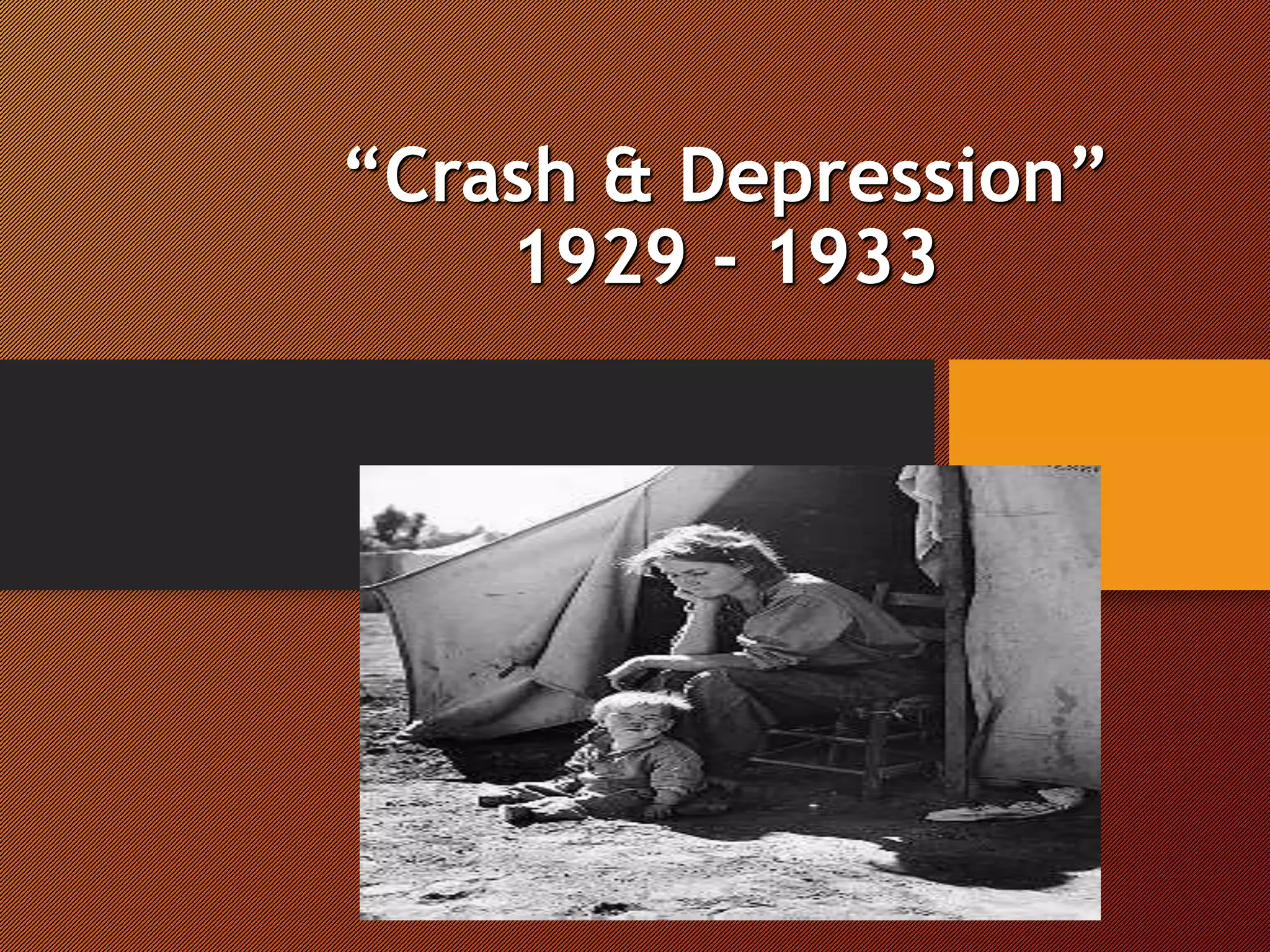



“Crash & Depression”
1929 - 1933
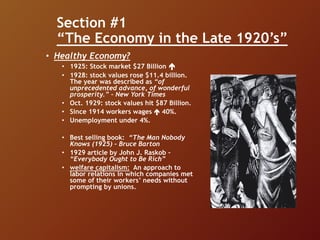
Section #1
“The Economy in the Late 1920’s”
• Healthy Economy?
• 1925: Stock market $27 Billion 
• 1928: stock values rose $11.4 billion.
The year was described as “of
unprecedented advance, of wonderful
prosperity.” – New York Times
• Oct. 1929: stock values hit $87 Billion.
• Since 1914 workers wages  40%.
• Unemployment under 4%.
• Best selling book: “The Man Nobody
Knows (1925) – Bruce Barton
• 1929 article by John J. Raskob –
“Everybody Ought to Be Rich”
• welfare capitalism: An approach to
labor relations in which companies met
some of their workers’ needs without
prompting by unions.
Uneven Prosperity
• The Rich get richer!
• Huge corporations
• 200 large companies
controlled 49% of
American industry.
• 24,000 families (0.1%)
had incomes of more
than $100,000 & held
more than 34% of the
country’s total savings.
• The Poor get poorer!
• 71% of individuals and
families earned less than
$2,500.
• 80% of families had no
savings.
• Everyone in the family,
including children, had
to work to get by.
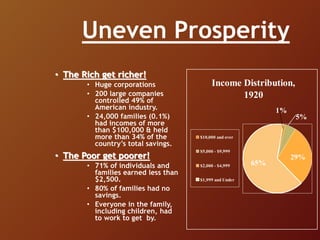
Income Distribution,
1920
1%
5%
29%
65%
$10,000 and over
$5,000 - $9,999
$2,000 - $4,999
$1,999 and Under
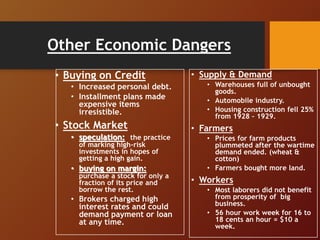
Other Economic Dangers
• Buying on Credit
• Increased personal debt.
• Installment plans made
expensive items
irresistible.
• Stock Market
• speculation: the practice
of marking high-risk
investments in hopes of
getting a high gain.
• buying on margin:
purchase a stock for only a
fraction of its price and
borrow the rest.
• Brokers charged high
interest rates and could
demand payment or loan
at any time.
• Supply & Demand
• Warehouses full of unbought
goods.
• Automobile industry.
• Housing construction fell 25%
from 1928 – 1929.
• Farmers
• Prices for farm products
plummeted after the wartime
demand ended. (wheat &
cotton)
• Farmers bought more land.
• Workers
• Most laborers did not benefit
from prosperity of big
business.
• 56 hour work week for 16 to
18 cents an hour = $10 a
week.
Section #2:
“The Stock Market Crash”
• Dow Jones Industrial Average: an average of
stock prices of major industries.
• Early 1928 = 191.
• Hoover’s inauguration day, March 4, 1929 = 313.
• September 3rd, all time high at 381.
• The Market Crashes
• Black Thursday: October 24, 1929, worried investors began to
sell and stock prices fell. (ex. GE $400 down to $283)
• Black Tuesday: October 29, 16.4 million shares were sold.
• By Nov. 13, 1929, the Dow Jones had fallen from 381 to
198.7 = losses totaling $30 billion. Known as the Great
Crash.
• business cycle: the periodic growth and contraction of a
nation’s economy. See page #636.
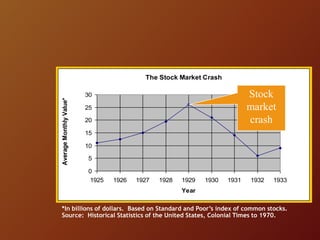
*In billions of dollars. Based on Standard and Poor’s index of common stocks.
Source: Historical Statistics of the United States, Colonial Times to 1970.
The Stock Market Crash
0
5
10
15
20
25
30
1925 1926 1927 1928 1929 1930 1931 1932 1933
Year
AverageMonthlyValue*
Stock
market
crash
Effects of the Crash
• Great Depression: a severe economic decline
that lasted from 1929 until the United States’
entry into World War II in 1941.
• Millions of Americans lost their jobs, homes, and farms.
• 1931 Henry Ford closed down his Detroit plants, 75,000
unemployed.
• Gross National Product (GNP): the total value of goods and
services a country produces annually.
• $103 billion in 1929.
• By 1933 it was only $56 billion.
• Bushel of wheat went from $1.04 in 1929 to 38 cents in
1932.
• Banks close
• 5,000 banks closed.
• By 1933, 9 million savings accounts vanished.
Impact on the World
• When the world’s leading economy fell, the
global economic system began to crumble.
• U.S. insisted that Britain and France repay war
debts.
• Congress kept wartime tariffs high.
• Allies had to rely on Germany’s reparations
payments for income.
• German banks failed when U.S. companies investments
failed.
• Europeans could no longer afford to buy American
made goods.
• American stock market crash caused a downward
cycle in the global economy.
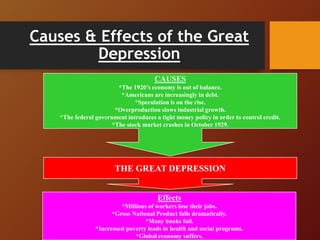
Causes & Effects of the Great
Depression
CAUSES
*The 1920’s economy is out of balance.
*Americans are increasingly in debt.
*Speculation is on the rise.
*Overproduction slows industrial growth.
*The federal government introduces a tight money policy in order to control credit.
*The stock market crashes in October 1929.
THE GREAT DEPRESSION
Effects
*Millions of workers lose their jobs.
*Gross National Product falls dramatically.
*Many banks fail.
*Increased poverty leads to health and social programs.
*Global economy suffers.
Section #3 Social Effects – Great
Depression
• Immediate impact did not hit all – 1931-
32 all were effected.
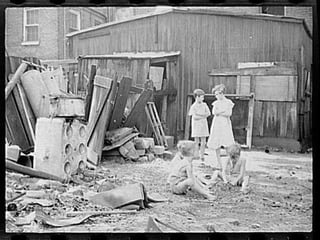
• Professional, white collar, blue collar-
ALL lost jobs, savings accounts, &
homes. Poverty did not discriminate.
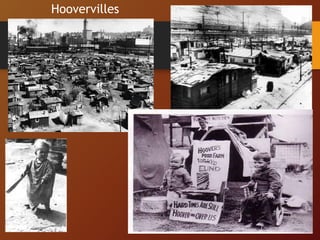
• “Hooverville”
• What environmental condition
compounded the Great Depression?
Hoovervilles
Hoovervilles
Children eating their Christmas dinner
during the Great Dep: turnips and
cabbage.
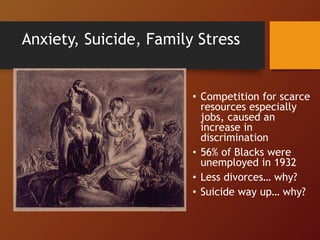
Anxiety, Suicide, Family Stress
• Competition for scarce
resources especially
jobs, caused an
increase in
discrimination
• 56% of Blacks were
unemployed in 1932
• Less divorces… why?
• Suicide way up… why?
Section 3 - continued
• The Grapes of Wrath – John Steinbeck
• What was the Dust Bowl?
The Dust Bowl:
1930’s, “dirty thirties”
• Great Plains (average of
20 in. rain/year)
• TX, OK, KS, NM, CO
• Black blizzards
• Heights of 8,000 feet
• Single storms could carry
more than 300 million lbs
of dust
• Rabbits, birds, field mice
suffocated
• “We live with the dust,
eat it, sleep with it.”
• Destroyed 5 million acres
of wheat
• Okies – dust bowl
refugees
• Dams eventually help as
does the gov’t (subsidies)
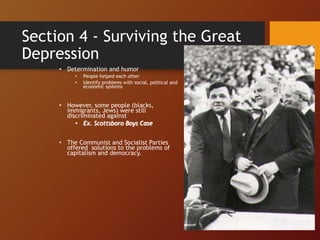
Section 4 - Surviving the Great
Depression
• Determination and humor
• People helped each other
• Identify problems with social, political and
economic systems
• However, some people (blacks,
immigrants, Jews) were still
discriminated against
• Ex. Scottsboro Boys Case
• The Communist and Socialist Parties
offered solutions to the problems of
capitalism and democracy.
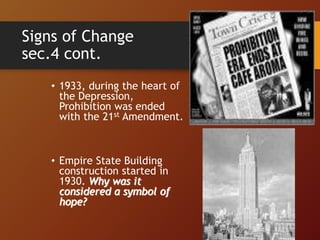
Signs of Change
sec.4 cont.
• 1933, during the heart of
the Depression,
Prohibition was ended
with the 21st Amendment.
• Empire State Building
construction started in
1930. Why was it
considered a symbol of
hope?
What was Hoover doing?!
• Hoover’s response to the Depression – “world-
wide economic conditions beyond our control”
• Voluntary action by businesses to keep wages up
was Hoover’s “fix-it” plan; businesses did not
continue to voluntarily help
• Gov’t stimulated the Depression economy with
public works projects (i.e. Hoover Dam)
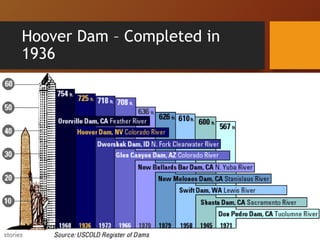
Hoover Dam!
Hoover Dam – Completed in
1936
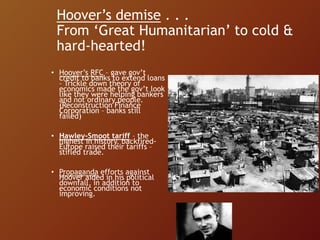
Hoover’s demise . . .
From ‘Great Humanitarian’ to cold &
hard-hearted!
• Hoover’s RFC – gave gov’t
credit to banks to extend loans
– Trickle down theory of
economics made the gov’t look
like they were helping bankers
and not ordinary people.
(Reconstruction Finance
Corporation – banks still
failed)
• Hawley-Smoot tariff – the
highest in history, backfired-
Europe raised their tariffs –
stifled trade.
• Propaganda efforts against
Hoover aided in his political
downfall, in addition to
economic conditions not
improving.
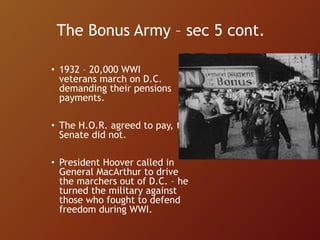
The Bonus Army – sec 5 cont.
• 1932 – 20,000 WWI
veterans march on D.C.
demanding their pensions
payments.
• The H.O.R. agreed to pay, the
Senate did not.
• President Hoover called in
General MacArthur to drive
the marchers out of D.C. – he
turned the military against
those who fought to defend
freedom during WWI.
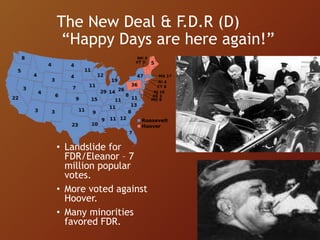
The New Deal & F.D.R (D)
“Happy Days are here again!”
• Landslide for
FDR/Eleanor – 7
million popular
votes.
• More voted against
Hoover.
• Many minorities
favored FDR.

The Great Depression

  • 1.
  • 2.
    Section #1 “The Economyin the Late 1920’s” • Healthy Economy? • 1925: Stock market $27 Billion  • 1928: stock values rose $11.4 billion. The year was described as “of unprecedented advance, of wonderful prosperity.” – New York Times • Oct. 1929: stock values hit $87 Billion. • Since 1914 workers wages  40%. • Unemployment under 4%. • Best selling book: “The Man Nobody Knows (1925) – Bruce Barton • 1929 article by John J. Raskob – “Everybody Ought to Be Rich” • welfare capitalism: An approach to labor relations in which companies met some of their workers’ needs without prompting by unions.
  • 3.
    Uneven Prosperity • TheRich get richer! • Huge corporations • 200 large companies controlled 49% of American industry. • 24,000 families (0.1%) had incomes of more than $100,000 & held more than 34% of the country’s total savings. • The Poor get poorer! • 71% of individuals and families earned less than $2,500. • 80% of families had no savings. • Everyone in the family, including children, had to work to get by. Income Distribution, 1920 1% 5% 29% 65% $10,000 and over $5,000 - $9,999 $2,000 - $4,999 $1,999 and Under
  • 4.
    Other Economic Dangers •Buying on Credit • Increased personal debt. • Installment plans made expensive items irresistible. • Stock Market • speculation: the practice of marking high-risk investments in hopes of getting a high gain. • buying on margin: purchase a stock for only a fraction of its price and borrow the rest. • Brokers charged high interest rates and could demand payment or loan at any time. • Supply & Demand • Warehouses full of unbought goods. • Automobile industry. • Housing construction fell 25% from 1928 – 1929. • Farmers • Prices for farm products plummeted after the wartime demand ended. (wheat & cotton) • Farmers bought more land. • Workers • Most laborers did not benefit from prosperity of big business. • 56 hour work week for 16 to 18 cents an hour = $10 a week.
  • 5.
    Section #2: “The StockMarket Crash” • Dow Jones Industrial Average: an average of stock prices of major industries. • Early 1928 = 191. • Hoover’s inauguration day, March 4, 1929 = 313. • September 3rd, all time high at 381. • The Market Crashes • Black Thursday: October 24, 1929, worried investors began to sell and stock prices fell. (ex. GE $400 down to $283) • Black Tuesday: October 29, 16.4 million shares were sold. • By Nov. 13, 1929, the Dow Jones had fallen from 381 to 198.7 = losses totaling $30 billion. Known as the Great Crash. • business cycle: the periodic growth and contraction of a nation’s economy. See page #636.
  • 6.
    *In billions ofdollars. Based on Standard and Poor’s index of common stocks. Source: Historical Statistics of the United States, Colonial Times to 1970. The Stock Market Crash 0 5 10 15 20 25 30 1925 1926 1927 1928 1929 1930 1931 1932 1933 Year AverageMonthlyValue* Stock market crash
  • 7.
    Effects of theCrash • Great Depression: a severe economic decline that lasted from 1929 until the United States’ entry into World War II in 1941. • Millions of Americans lost their jobs, homes, and farms. • 1931 Henry Ford closed down his Detroit plants, 75,000 unemployed. • Gross National Product (GNP): the total value of goods and services a country produces annually. • $103 billion in 1929. • By 1933 it was only $56 billion. • Bushel of wheat went from $1.04 in 1929 to 38 cents in 1932. • Banks close • 5,000 banks closed. • By 1933, 9 million savings accounts vanished.
  • 8.
    Impact on theWorld • When the world’s leading economy fell, the global economic system began to crumble. • U.S. insisted that Britain and France repay war debts. • Congress kept wartime tariffs high. • Allies had to rely on Germany’s reparations payments for income. • German banks failed when U.S. companies investments failed. • Europeans could no longer afford to buy American made goods. • American stock market crash caused a downward cycle in the global economy.
  • 9.
    Causes & Effectsof the Great Depression CAUSES *The 1920’s economy is out of balance. *Americans are increasingly in debt. *Speculation is on the rise. *Overproduction slows industrial growth. *The federal government introduces a tight money policy in order to control credit. *The stock market crashes in October 1929. THE GREAT DEPRESSION Effects *Millions of workers lose their jobs. *Gross National Product falls dramatically. *Many banks fail. *Increased poverty leads to health and social programs. *Global economy suffers.
  • 10.
    Section #3 SocialEffects – Great Depression • Immediate impact did not hit all – 1931- 32 all were effected. • Professional, white collar, blue collar- ALL lost jobs, savings accounts, & homes. Poverty did not discriminate. • “Hooverville” • What environmental condition compounded the Great Depression?
  • 11.
  • 12.
  • 13.
    Children eating theirChristmas dinner during the Great Dep: turnips and cabbage.
  • 14.
    Anxiety, Suicide, FamilyStress • Competition for scarce resources especially jobs, caused an increase in discrimination • 56% of Blacks were unemployed in 1932 • Less divorces… why? • Suicide way up… why?
  • 15.
    Section 3 -continued • The Grapes of Wrath – John Steinbeck • What was the Dust Bowl?
  • 16.
    The Dust Bowl: 1930’s,“dirty thirties” • Great Plains (average of 20 in. rain/year) • TX, OK, KS, NM, CO • Black blizzards • Heights of 8,000 feet • Single storms could carry more than 300 million lbs of dust • Rabbits, birds, field mice suffocated • “We live with the dust, eat it, sleep with it.” • Destroyed 5 million acres of wheat • Okies – dust bowl refugees • Dams eventually help as does the gov’t (subsidies)
  • 17.
    Section 4 -Surviving the Great Depression • Determination and humor • People helped each other • Identify problems with social, political and economic systems • However, some people (blacks, immigrants, Jews) were still discriminated against • Ex. Scottsboro Boys Case • The Communist and Socialist Parties offered solutions to the problems of capitalism and democracy.
  • 18.
    Signs of Change sec.4cont. • 1933, during the heart of the Depression, Prohibition was ended with the 21st Amendment. • Empire State Building construction started in 1930. Why was it considered a symbol of hope?
  • 19.
    What was Hooverdoing?! • Hoover’s response to the Depression – “world- wide economic conditions beyond our control” • Voluntary action by businesses to keep wages up was Hoover’s “fix-it” plan; businesses did not continue to voluntarily help • Gov’t stimulated the Depression economy with public works projects (i.e. Hoover Dam)
  • 20.
  • 21.
    Hoover Dam –Completed in 1936
  • 22.
    Hoover’s demise .. . From ‘Great Humanitarian’ to cold & hard-hearted! • Hoover’s RFC – gave gov’t credit to banks to extend loans – Trickle down theory of economics made the gov’t look like they were helping bankers and not ordinary people. (Reconstruction Finance Corporation – banks still failed) • Hawley-Smoot tariff – the highest in history, backfired- Europe raised their tariffs – stifled trade. • Propaganda efforts against Hoover aided in his political downfall, in addition to economic conditions not improving.
  • 23.
    The Bonus Army– sec 5 cont. • 1932 – 20,000 WWI veterans march on D.C. demanding their pensions payments. • The H.O.R. agreed to pay, the Senate did not. • President Hoover called in General MacArthur to drive the marchers out of D.C. – he turned the military against those who fought to defend freedom during WWI.
  • 24.
    The New Deal& F.D.R (D) “Happy Days are here again!” • Landslide for FDR/Eleanor – 7 million popular votes. • More voted against Hoover. • Many minorities favored FDR.