Chapter 8


            Evaluate Deductive
            Reasoning and Spot
            Deductive Fallacies
Deductive Validity and Language

  • An argument is deductively valid if there is
    no possibility, real or imaginable:
     – Short of changing the very meanings of the
       terms and the rules of grammar:
     – That will make the premises all true and the
       conclusion false


© 2013 Pearson Education, Inc. All
Deductive Validity and Language

  • Certain configurations of language form
    deductively valid argument templates
  • Without violating the meanings of the
    words/grammatical rules of the language:
     – There is no possible way for the premises all
       to be true and the conclusion false


© 2013 Pearson Education, Inc. All
Deductive Validity and Language

  • Reasoning Deductively about Declarative
    Statements
     – Denying the Consequent
     – Affirming the Antecedent
     – Disjunctive Syllogism
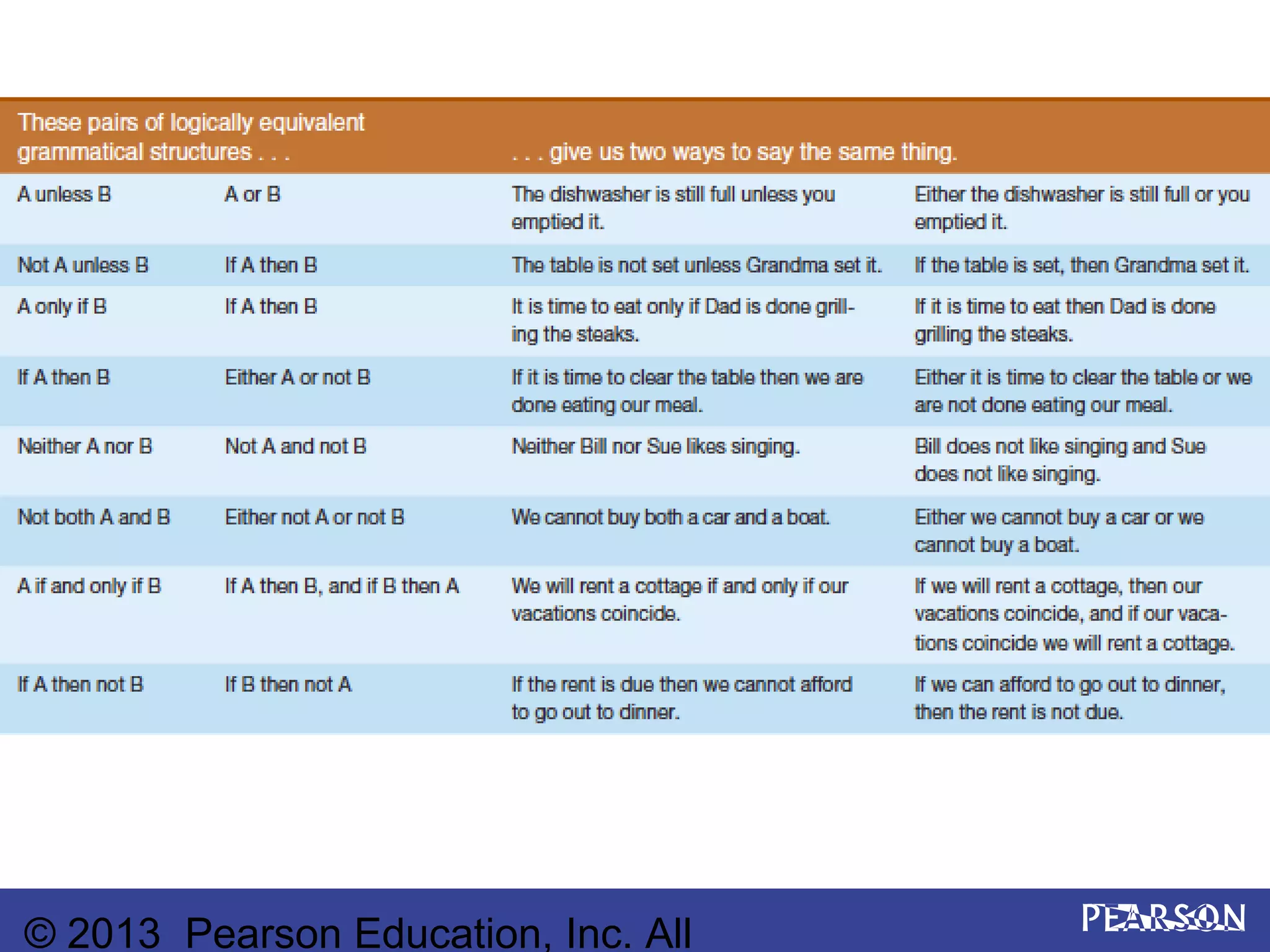
     – Neither, Unless, and Only


© 2013 Pearson Education, Inc. All
Deductive Validity and Language

  • Reasoning Deductively about Classes of
    Objects
     – Applying a Generalization
     – Applying an Exception
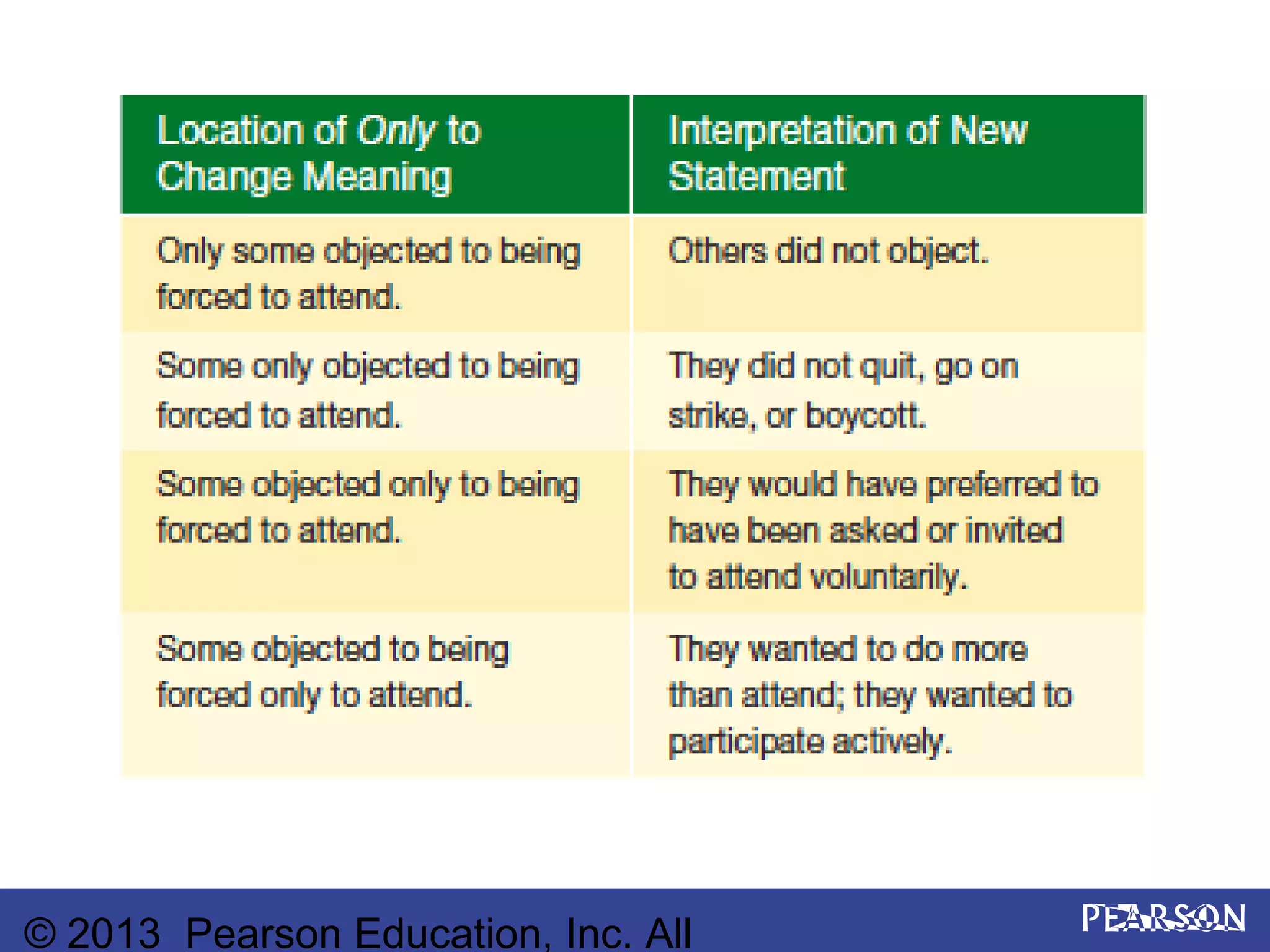
     – The Power of Only
         • One of the most interesting words in the language:


© 2013 Pearson Education, Inc. All
Deductive Validity and Language
            – Only has the power to change the meaning of a
              sentence depending on where it is placed
         • Classes and Objects
  • Reasoning Deductively about
    Relationships
     – Natural languages are rich with terms that
       describe relationships


© 2013 Pearson Education, Inc. All
Deductive Validity and Language

     – Our understanding of the logical implications
       of relational terms is part of:
         • Our comprehension of language
     – Transitivity, Reflexivity, and Identity
         • Transitivity Relationship
         • Reflexivity Relationship
         • Identity Relationship


© 2013 Pearson Education, Inc. All
Fallacies Masquerading as Valid
  Deductive Arguments
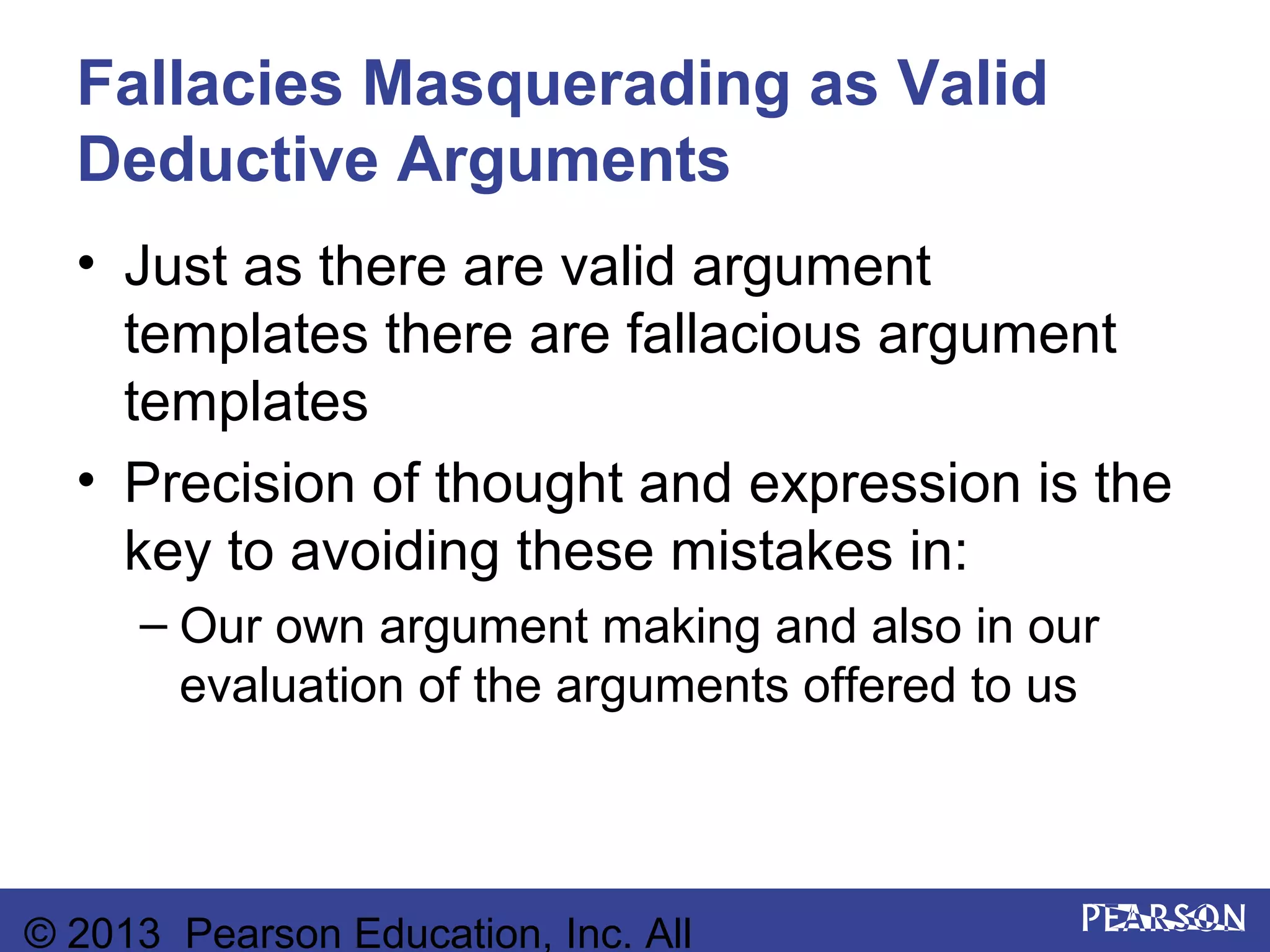
  • Just as there are valid argument
    templates there are fallacious argument
    templates
  • Precision of thought and expression is the
    key to avoiding these mistakes in:
     – Our own argument making and also in our
       evaluation of the arguments offered to us


© 2013 Pearson Education, Inc. All
Fallacies Masquerading as Valid
  Deductive Arguments
  • Fallacies When Reasoning with
    Declarative Statements
     – Affirming the Consequent
     – Denying the Antecedent
     – The House M.D. Fallacy
  • Fallacies When Reasoning about Classes
    of Objects


© 2013 Pearson Education, Inc. All
Fallacies Masquerading as Valid
  Deductive Arguments
     – There are logically correct ways of reasoning
       about classes of objects & their members:
         • There are familiar mistakes we often hear being
           made
     – False Classification
         • Examples of False Classification seem remarkably
           abundant


© 2013 Pearson Education, Inc. All
Fallacies Masquerading as Valid
  Deductive Arguments
     – Fallacies of Composition and Division
         • Reasoning about the relationships of parts and
           wholes can appear to be deductively valid:
            – But fail because the attribute that applies to the parts
              may not apply to the whole, or vice versa
     – Mistaken Identity


© 2013 Pearson Education, Inc. All
Fallacies Masquerading as Valid
  Deductive Arguments
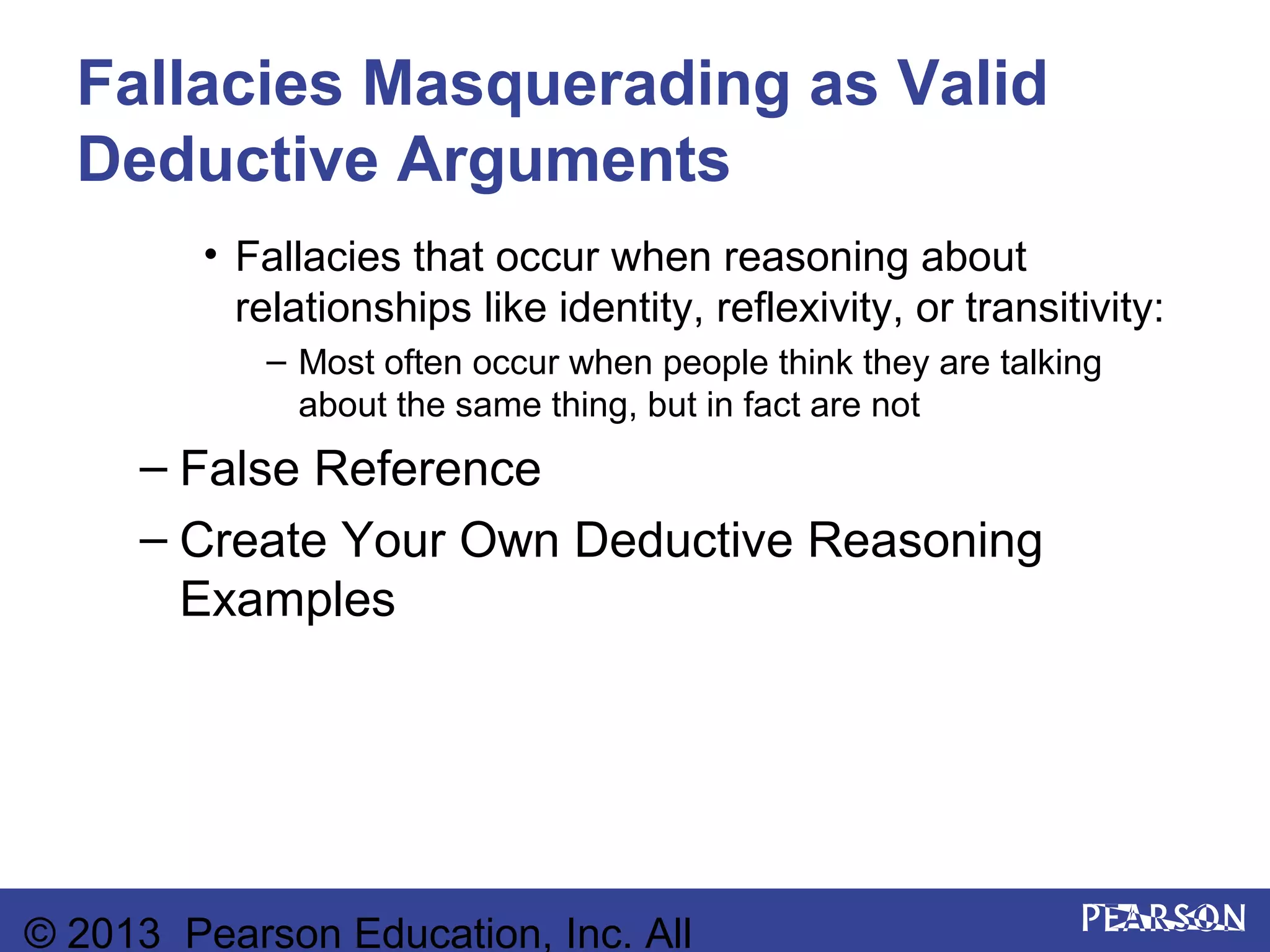
         • Fallacies that occur when reasoning about
           relationships like identity, reflexivity, or transitivity:
            – Most often occur when people think they are talking
              about the same thing, but in fact are not
     – False Reference
     – Create Your Own Deductive Reasoning
       Examples


© 2013 Pearson Education, Inc. All

Evaluating deductive reasoning and fallacies

  • 1.
    Chapter 8 Evaluate Deductive Reasoning and Spot Deductive Fallacies
  • 2.
    Deductive Validity andLanguage • An argument is deductively valid if there is no possibility, real or imaginable: – Short of changing the very meanings of the terms and the rules of grammar: – That will make the premises all true and the conclusion false © 2013 Pearson Education, Inc. All
  • 3.
    Deductive Validity andLanguage • Certain configurations of language form deductively valid argument templates • Without violating the meanings of the words/grammatical rules of the language: – There is no possible way for the premises all to be true and the conclusion false © 2013 Pearson Education, Inc. All
  • 4.
    Deductive Validity andLanguage • Reasoning Deductively about Declarative Statements – Denying the Consequent – Affirming the Antecedent – Disjunctive Syllogism – Neither, Unless, and Only © 2013 Pearson Education, Inc. All
  • 5.
    Deductive Validity andLanguage • Reasoning Deductively about Classes of Objects – Applying a Generalization – Applying an Exception – The Power of Only • One of the most interesting words in the language: © 2013 Pearson Education, Inc. All
  • 6.
    Deductive Validity andLanguage – Only has the power to change the meaning of a sentence depending on where it is placed • Classes and Objects • Reasoning Deductively about Relationships – Natural languages are rich with terms that describe relationships © 2013 Pearson Education, Inc. All
  • 7.
    Deductive Validity andLanguage – Our understanding of the logical implications of relational terms is part of: • Our comprehension of language – Transitivity, Reflexivity, and Identity • Transitivity Relationship • Reflexivity Relationship • Identity Relationship © 2013 Pearson Education, Inc. All
  • 8.
    © 2013 PearsonEducation, Inc. All
  • 9.
    © 2013 PearsonEducation, Inc. All
  • 10.
    © 2013 PearsonEducation, Inc. All
  • 11.
    Fallacies Masquerading asValid Deductive Arguments • Just as there are valid argument templates there are fallacious argument templates • Precision of thought and expression is the key to avoiding these mistakes in: – Our own argument making and also in our evaluation of the arguments offered to us © 2013 Pearson Education, Inc. All
  • 12.
    Fallacies Masquerading asValid Deductive Arguments • Fallacies When Reasoning with Declarative Statements – Affirming the Consequent – Denying the Antecedent – The House M.D. Fallacy • Fallacies When Reasoning about Classes of Objects © 2013 Pearson Education, Inc. All
  • 13.
    Fallacies Masquerading asValid Deductive Arguments – There are logically correct ways of reasoning about classes of objects & their members: • There are familiar mistakes we often hear being made – False Classification • Examples of False Classification seem remarkably abundant © 2013 Pearson Education, Inc. All
  • 14.
    Fallacies Masquerading asValid Deductive Arguments – Fallacies of Composition and Division • Reasoning about the relationships of parts and wholes can appear to be deductively valid: – But fail because the attribute that applies to the parts may not apply to the whole, or vice versa – Mistaken Identity © 2013 Pearson Education, Inc. All
  • 15.
    Fallacies Masquerading asValid Deductive Arguments • Fallacies that occur when reasoning about relationships like identity, reflexivity, or transitivity: – Most often occur when people think they are talking about the same thing, but in fact are not – False Reference – Create Your Own Deductive Reasoning Examples © 2013 Pearson Education, Inc. All

Editor's Notes

  • #9 Grammatically Equivalent Structures