© 2007 McGraw-Hill Higher Education. All rights reserved.
Chapter 2
Making the Most of
Your Time
© 2007 McGraw-Hill Higher Education. All rights reserved.
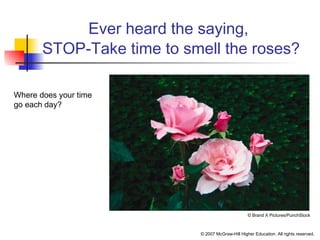
Ever heard the saying,
STOP-Take time to smell the roses?
Where does your time
go each day?
© Brand X Pictures/PunchStock
© 2007 McGraw-Hill Higher Education. All rights reserved.
Time for Success
 PPreparerepare:: Learning Where Time is GoingLearning Where Time is Going
 OOrganizerganize:: MasteringMastering the Momentthe Moment
 WWorkork:: ControllingControlling TimeTime
 EEvaluatevaluate:: CheckingChecking Your TimeYour Time
 RRethinkethink:: ReflectingReflecting on your Personalon your Personal
Style of Time ManagementStyle of Time Management
© 2007 McGraw-Hill Higher Education. All rights reserved.
Time Style
How can you make informed choices
about how to use your time?
© 2007 McGraw-Hill Higher Education. All rights reserved.
Time Goes On
 Internal Clock
 Time management permits us to make
informed choices as to how to use our
time.
 First step in management time
 How do you manage your time now?
© 2007 McGraw-Hill Higher Education. All rights reserved.
Prepare
 Create a time log
 Record of how you spend your time
 Increments of 15 minutes
 Document either 1 day or 1 week
 Identify your Prime Time
 Identify the Black Holes
 Setting Priorities
© 2007 McGraw-Hill Higher Education. All rights reserved.
Organize
 Keep a master calendar
 Weekly timetable
 Daily to-do list
© 2007 McGraw-Hill Higher Education. All rights reserved.
Work
 Mark items off your schedule in order to provide
you with quality time
 Get away from it all when necessary
 Enjoy the sound of silence
 Control your communications - take an “e-break”
 Expect unexpected interruptions
 Do not procrastinate
 Balance school and family
© 2007 McGraw-Hill Higher Education. All rights reserved.
Time Killer-Procrastination
Turn to Try It #5 in Chapter 2
 circle the number that best applies for
each question
© 2007 McGraw-Hill Higher Education. All rights reserved.
Balance Your Time With Children
 If you have children, provide them with
activities so you can have free time
 Schedule quality time with your children
 Allow your children to help
 Invite a playmate to visit
 Use television appropriately
© 2007 McGraw-Hill Higher Education. All rights reserved.
Balance Your Time With Children
 Find quality babysitters
 Use nap time to catch up
 Accept that study time may be more
difficult with children
© 2007 McGraw-Hill Higher Education. All rights reserved.
Balancing Time with Work
 Make to-do lists for on-the-job tasks
 Study during slack time at work
(if allowed)
 Use lunch hour effectively
 Ask employer about flextime
 Accept new responsibilities carefully
 Keep in mind why you are working
© 2007 McGraw-Hill Higher Education. All rights reserved.
Evaluate
 Did you accomplish your tasks?
 Why or why not?
© 2007 McGraw-Hill Higher Education. All rights reserved.
Rethink
 Should you decide an alternative way
to manage your time?
 Do you have too much time on your
hands?
 Do you need to do less by canceling
tasks that are not a priority?
 Reassess your priorities
© 2007 McGraw-Hill Higher Education. All rights reserved.
Take a Long-Term View of Time
To reach your long-term goals for a career, consider the
steps needed to prepare for the career.
What courses do you need in college?
What work experience would be beneficial?
What organizations should you join?
© 2007 McGraw-Hill Higher Education. All rights reserved.
Discussion
 How can you manage your time more
effectively?
 How do you deal with distractions?
 How do you balance competing
priorities?
© 2007 McGraw-Hill Higher Education. All rights reserved.
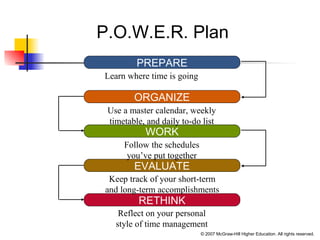
PREPARE
ORGANIZE
WORK
EVALUATE
RETHINK
Learn where time is going
Use a master calendar, weekly
timetable, and daily to-do list
Follow the schedules
you’ve put together
Keep track of your short-term
and long-term accomplishments
Reflect on your personal
style of time management
P.O.W.E.R. Plan
© 2007 McGraw-Hill Higher Education. All rights reserved.
Resources for Time
Management
The Seven Habits of Highly Successful
People by Stephen Covey (Fireside, 1990)
Eat That Frog: 21 Great Ways to Stop
Procrastinating and Get More Done in Less
Time by Alan Axelrod and Brian Tracy
(Berrett-Kohler, 2002)
© 2007 McGraw-Hill Higher Education. All rights reserved.
www.mhhe.com/power
http://www.coun.uvic.ca/learn/program/hndouts/plan_h
http://www.mindtools.com/page5.html
Web Links

Time mangement

  • 1.
    © 2007 McGraw-HillHigher Education. All rights reserved. Chapter 2 Making the Most of Your Time
  • 2.
    © 2007 McGraw-HillHigher Education. All rights reserved. Ever heard the saying, STOP-Take time to smell the roses? Where does your time go each day? © Brand X Pictures/PunchStock
  • 3.
    © 2007 McGraw-HillHigher Education. All rights reserved. Time for Success  PPreparerepare:: Learning Where Time is GoingLearning Where Time is Going  OOrganizerganize:: MasteringMastering the Momentthe Moment  WWorkork:: ControllingControlling TimeTime  EEvaluatevaluate:: CheckingChecking Your TimeYour Time  RRethinkethink:: ReflectingReflecting on your Personalon your Personal Style of Time ManagementStyle of Time Management
  • 4.
    © 2007 McGraw-HillHigher Education. All rights reserved. Time Style How can you make informed choices about how to use your time?
  • 5.
    © 2007 McGraw-HillHigher Education. All rights reserved. Time Goes On  Internal Clock  Time management permits us to make informed choices as to how to use our time.  First step in management time  How do you manage your time now?
  • 6.
    © 2007 McGraw-HillHigher Education. All rights reserved. Prepare  Create a time log  Record of how you spend your time  Increments of 15 minutes  Document either 1 day or 1 week  Identify your Prime Time  Identify the Black Holes  Setting Priorities
  • 7.
    © 2007 McGraw-HillHigher Education. All rights reserved. Organize  Keep a master calendar  Weekly timetable  Daily to-do list
  • 8.
    © 2007 McGraw-HillHigher Education. All rights reserved. Work  Mark items off your schedule in order to provide you with quality time  Get away from it all when necessary  Enjoy the sound of silence  Control your communications - take an “e-break”  Expect unexpected interruptions  Do not procrastinate  Balance school and family
  • 9.
    © 2007 McGraw-HillHigher Education. All rights reserved. Time Killer-Procrastination Turn to Try It #5 in Chapter 2  circle the number that best applies for each question
  • 10.
    © 2007 McGraw-HillHigher Education. All rights reserved. Balance Your Time With Children  If you have children, provide them with activities so you can have free time  Schedule quality time with your children  Allow your children to help  Invite a playmate to visit  Use television appropriately
  • 11.
    © 2007 McGraw-HillHigher Education. All rights reserved. Balance Your Time With Children  Find quality babysitters  Use nap time to catch up  Accept that study time may be more difficult with children
  • 12.
    © 2007 McGraw-HillHigher Education. All rights reserved. Balancing Time with Work  Make to-do lists for on-the-job tasks  Study during slack time at work (if allowed)  Use lunch hour effectively  Ask employer about flextime  Accept new responsibilities carefully  Keep in mind why you are working
  • 13.
    © 2007 McGraw-HillHigher Education. All rights reserved. Evaluate  Did you accomplish your tasks?  Why or why not?
  • 14.
    © 2007 McGraw-HillHigher Education. All rights reserved. Rethink  Should you decide an alternative way to manage your time?  Do you have too much time on your hands?  Do you need to do less by canceling tasks that are not a priority?  Reassess your priorities
  • 15.
    © 2007 McGraw-HillHigher Education. All rights reserved. Take a Long-Term View of Time To reach your long-term goals for a career, consider the steps needed to prepare for the career. What courses do you need in college? What work experience would be beneficial? What organizations should you join?
  • 16.
    © 2007 McGraw-HillHigher Education. All rights reserved. Discussion  How can you manage your time more effectively?  How do you deal with distractions?  How do you balance competing priorities?
  • 17.
    © 2007 McGraw-HillHigher Education. All rights reserved. PREPARE ORGANIZE WORK EVALUATE RETHINK Learn where time is going Use a master calendar, weekly timetable, and daily to-do list Follow the schedules you’ve put together Keep track of your short-term and long-term accomplishments Reflect on your personal style of time management P.O.W.E.R. Plan
  • 18.
    © 2007 McGraw-HillHigher Education. All rights reserved. Resources for Time Management The Seven Habits of Highly Successful People by Stephen Covey (Fireside, 1990) Eat That Frog: 21 Great Ways to Stop Procrastinating and Get More Done in Less Time by Alan Axelrod and Brian Tracy (Berrett-Kohler, 2002)
  • 19.
    © 2007 McGraw-HillHigher Education. All rights reserved. www.mhhe.com/power http://www.coun.uvic.ca/learn/program/hndouts/plan_h http://www.mindtools.com/page5.html Web Links

Editor's Notes

  • #5 The instructor may choose to have students complete Try It #1 at this time. Discuss with students why it is important to be efficient users of time rather than victims of time.
  • #6 A person ’ s internal clock regulates their breathing and heartbeat, as well as the discharge of chemicals within their bloodstream. The goal of time management is not to schedule every moment, but instead to make informed choices to meet our personal needs. Students should complete the Journal Reflections in class or discuss their answers if assigned as prior homework. An instructor may also pair or group students to discuss their journal reflections.
  • #7 Try It #2 provides a form for the time log. Each person has an internal clock that dictates if morning or evening is their prime time in which they accomplish much of their work. Black holes are time-eaters of unimportant activities that keep us from doing the things that we need to get done. Try It #3 allows individual or group work to identify the black holes in a student ’ s life. Priorities are the tasks and activities you need and want to do. Students may use Try It #4 to set their priorities.
  • #8 Most students have a word processor on your computer that will create an electronic calendar. Microsoft Word has a calendar wizard. Encourage students to create a master calendar making sure that their priorities are listed. The weekly timetable may be more detailed showing all the regularly scheduled activities. The daily to-do list may be a small portable calendar or small notebook.
  • #9 Discuss with your students how effective time management deals with the inevitable surprises. Traffic congestion, unexpected visitors or phone calls, sickness, and computer crashes contribute to time management problems. Plan for the unexpected. Leave time for surprises. Take an e-break from cell phones, instant messages, and email.
  • #10 Divide the class into groups to discuss their findings. Ask each group to find 3 strategies to avoid procrastination. Suggest the following strategies if they are not brought up by the students: 1) start with the easiest and simplest part of the task; 2) work with others; 3) keep the costs of procrastination in mind.
  • #13 Flextime allows an individual to set their own hours by coming in earlier or later, as long as the job gets done. Don ’ t take on more work than you can handle while attending school. If work is a means to pay for your education, it is more important than if it is for spending money only.
  • #14 Discuss the importance of the check-off list to provide an objective record of what has been accomplished.
  • #17 Discuss setting clear priorities, using time management tools, avoiding procrastination, and dealing with surprises.
  • #20 The P.O.W.E.R. Learning website provides online versions of time management forms in this chapter. Forms can be completed online. The University of Victoria ’ s Office of Counseling Services provides two sites with effective hints on planning study time.