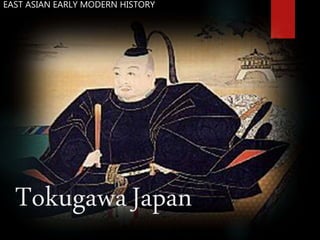
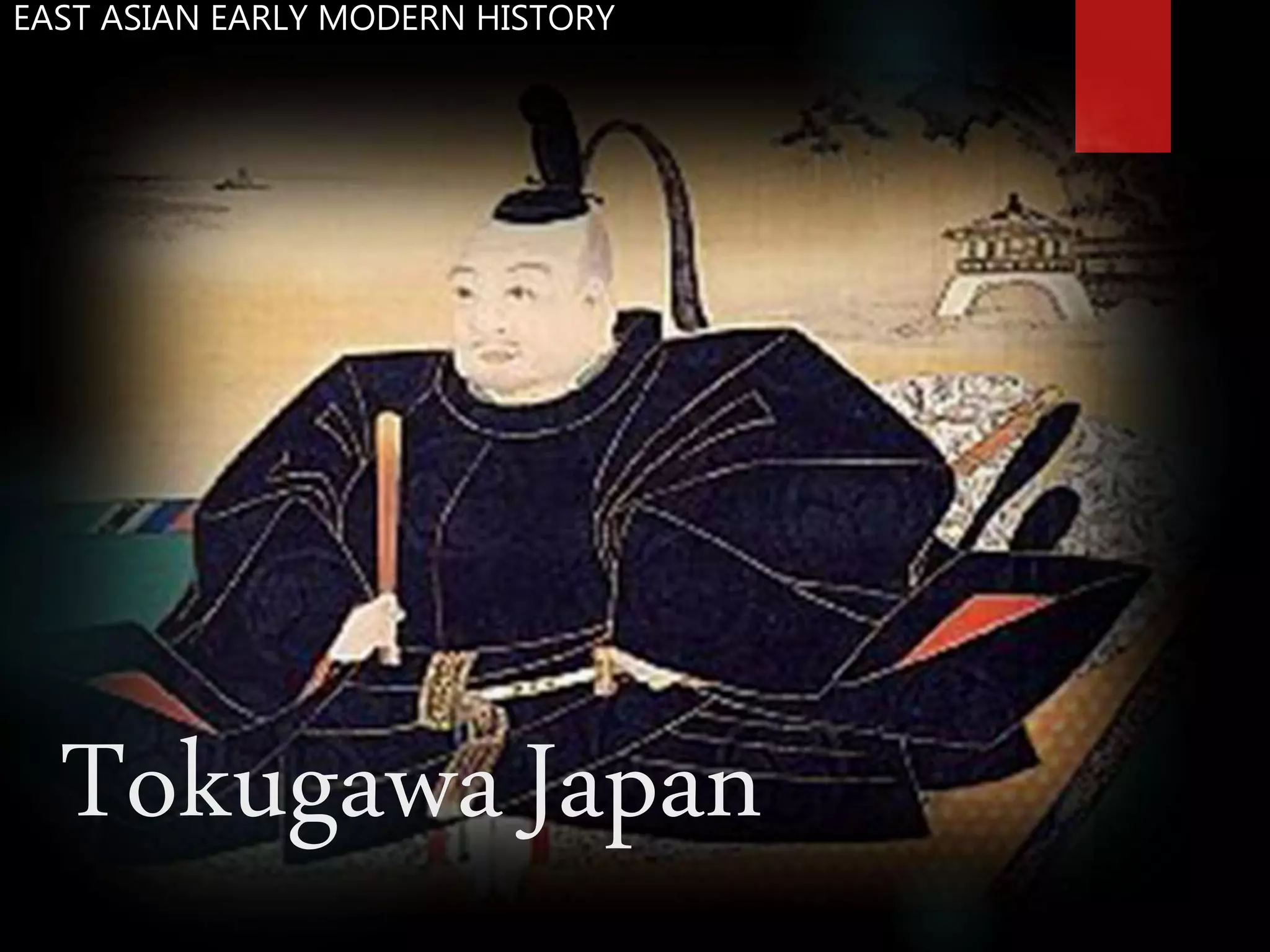
TokugawaJapan
EAST ASIAN EARLY MODERN HISTORY
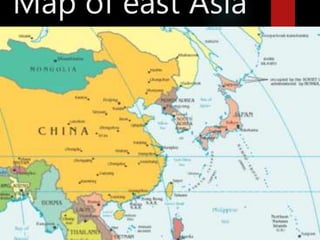
Map of east Asia
Japan Background
lasted from 1603
to 1867.
Focused on
establishing social-
political order, and
international
affairs.
Japans Tokugawa
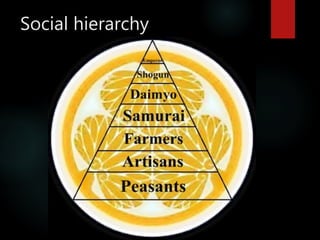
Social hierarchy
•The Christian rebellion in 1637-1638
undoubtedly helped harden the Tokugawa to strictly limit all
sources of possible foreign interference.
• After a century and half of
incessant warfare the Tokugawa Shogunate
was obsessed with maintaining order.
THE TOKUGAWA SHOGUNATE OF JAPAN
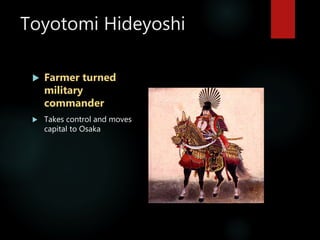
Toyotomi Hideyoshi
 Farmer turned
military
commander
 Takes control and moves
capital to Osaka
•This marked the beginning of Japan's first true pop
culture, a mass-production
culture of the marketplace.
•Theatres came into being – women were
banned from acting and acting was
hereditary.
•Books written in the Japanese language
rather than in class Chinese were published in great numbers
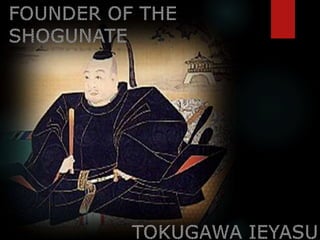
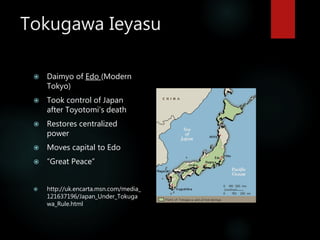
Tokugawa Ieyasu
 Daimyo of Edo (Modern
Tokyo)
 Took control of Japan
after Toyotomi’s death
 Restores centralized
power
 Moves capital to Edo
 “Great Peace”
 http://uk.encarta.msn.com/media_
121637196/Japan_Under_Tokuga
wa_Rule.html
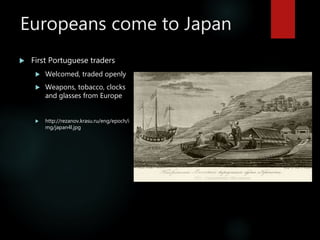
Europeans come to Japan
 First Portuguese traders
 Welcomed, traded openly
 Weapons, tobacco, clocks
and glasses from Europe
 http://rezanov.krasu.ru/eng/epoch/i
mg/japan4l.jpg
Europeans get kicked out
http://www.artsales.com/ARTistory/Xavier/Xavier_1.html
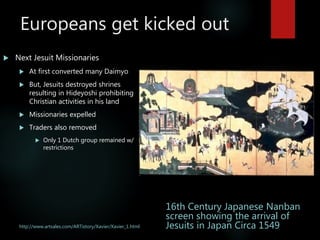
 Next Jesuit Missionaries
 At first converted many Daimyo
 But, Jesuits destroyed shrines
resulting in Hideyoshi prohibiting
Christian activities in his land
 Missionaries expelled
 Traders also removed
 Only 1 Dutch group remained w/
restrictions
16th Century Japanese Nanban
screen showing the arrival of
Jesuits in Japan Circa 1549
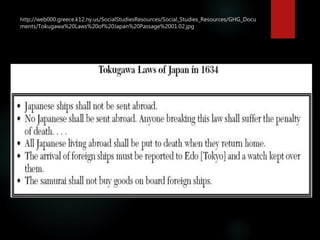
http://web000.greece.k12.ny.us/SocialStudiesResources/Social_Studies_Resources/GHG_Docu
ments/Tokugawa%20Laws%20of%20Japan%20Passage%2001.02.jpg
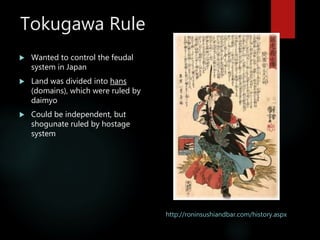
Tokugawa Rule
 Wanted to control the feudal
system in Japan
 Land was divided into hans
(domains), which were ruled by
daimyo
 Could be independent, but
shogunate ruled by hostage
system
http://roninsushiandbar.com/history.aspx
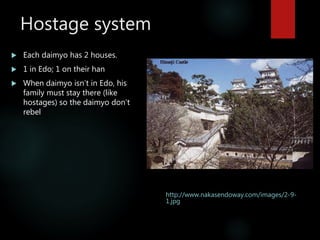
Hostage system
 Each daimyo has 2 houses.
 1 in Edo; 1 on their han
 When daimyo isn’t in Edo, his
family must stay there (like
hostages) so the daimyo don’t
rebel
http://www.nakasendoway.com/images/2-9-
1.jpg
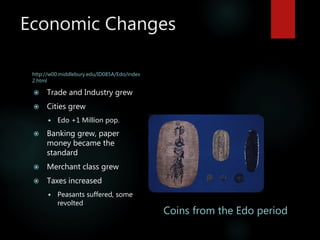
Economic Changes
http://w00.middlebury.edu/ID085A/Edo/index
2.html
 Trade and Industry grew
 Cities grew
 Edo +1 Million pop.
 Banking grew, paper
money became the
standard
 Merchant class grew
 Taxes increased
 Peasants suffered, some
revolted
Coins from the Edo period
Social Changes
http://www.flickr.com/photos/2444396
5@N08/2862111344/
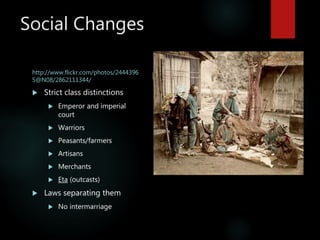
 Strict class distinctions
 Emperor and imperial
court
 Warriors
 Peasants/farmers
 Artisans
 Merchants
 Eta (outcasts)
 Laws separating them
 No intermarriage
Eta skinning deer
Role of women
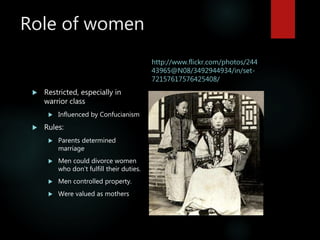
 Restricted, especially in
warrior class
 Influenced by Confucianism
 Rules:
 Parents determined
marriage
 Men could divorce women
who don’t fulfill their duties.
 Men controlled property.
 Were valued as mothers
http://www.flickr.com/photos/244
43965@N08/3492944934/in/set-
72157617576425408/
Cultural Changes
 Literature
 Popular in cities
 Lighthearted, for fun
 Ihara Saikaku
 “Five Women who Loved
Love”
 Poetry
 More serious
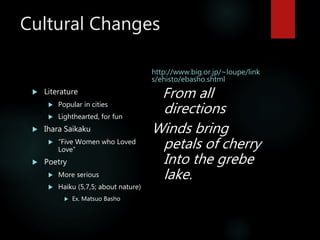
 Haiku (5,7,5; about nature)
 Ex. Matsuo Basho
http://www.big.or.jp/~loupe/link
s/ehisto/ebasho.shtml
From all
directions
Winds bring
petals of cherry
Into the grebe
lake.
Theater
http://www.traveltokyo.info/kabuki1.jp
g
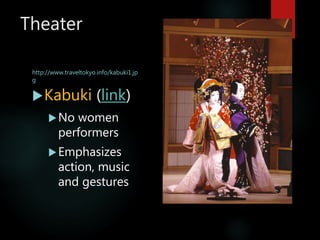
Kabuki (link)
No women
performers
Emphasizes
action, music
and gestures
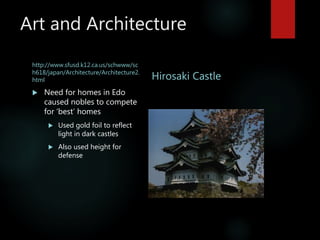
Art and Architecture
http://www.sfusd.k12.ca.us/schwww/sc
h618/japan/Architecture/Architecture2.
html
 Need for homes in Edo
caused nobles to compete
for ‘best’ homes
 Used gold foil to reflect
light in dark castles
 Also used height for
defense
Hirosaki Castle
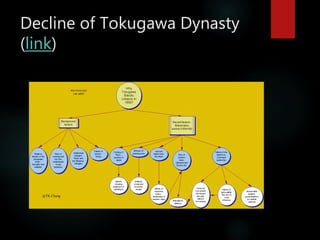
Decline of Tokugawa Dynasty
(link)
Pictures
wiki[edia.org
TOKUGAWA-SHOGUNATE.WEEBLY.COM/HIERARCHY
INSPIRATION
 http://images.google.com/imgres?imgurl=http://upload.wikimedia.org/wikipedia/
commons/4/4e/Toyotomi_Hideyoshi_on_his_horse.jpg&imgrefurl=http://common
s.wikimedia.org/wiki/File:Toyotomi_Hideyoshi_on_his_horse.j
pg&usg=__cxRJjbxybqWLpB3s-
bAzG2s2_Vs=&h=468&w=468&sz=83&hl=en&start=20&um=1&tbnid=2NoW
darkRyYifM:&tbnh=128&tbnw=128&prev=/images%3Fq%3Dtoyotomi%2Bhide
yoshi%26hl%3Den%26safe%3Dstrict%26client%3Dfirefox-
a%26rls%3Dorg.mozilla:en-US:official%26sa%3DN%26um%3D1&safe=strict
Kirsten Lodge
, Associate Professor of Humanities and English at Midwestern State University

Tokugawa japan ppt[1]