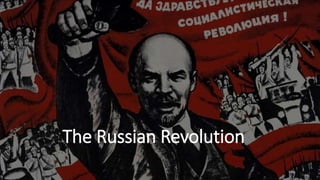
The Russian Revolution
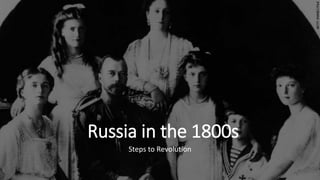
Russia in the 1800s
Steps to Revolution
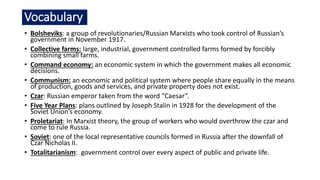
Vocabulary
• Bolsheviks: a group of revolutionaries/Russian Marxists who took control of Russian’s
government in November 1917.
• Collective farms: large, industrial, government controlled farms formed by forcibly
combining small farms.
• Command economy: an economic system in which the government makes all economic
decisions.
• Communism: an economic and political system where people share equally in the means
of production, goods and services, and private property does not exist.
• Czar: Russian emperor taken from the word “Caesar”.
• Five Year Plans: plans outlined by Joseph Stalin in 1928 for the development of the
Soviet Union’s economy.
• Proletariat: In Marxist theory, the group of workers who would overthrow the czar and
come to rule Russia.
• Soviet: one of the local representative councils formed in Russia after the downfall of
Czar Nicholas II.
• Totalitarianism: government control over every aspect of public and private life.
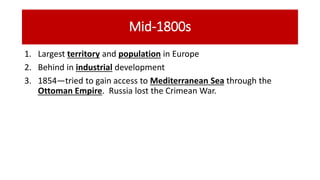
Mid-1800s
1. Largest territory and population in Europe
2. Behind in industrial development
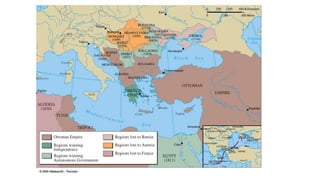
3. 1854—tried to gain access to Mediterranean Sea through the
Ottoman Empire. Russia lost the Crimean War.
Politically
1. Country led by an absolute ruler—the czar
2. Spread of liberalism and ideas of self-rule among ethnic groups
challenged Russian rule
3. 1830s Czar Nicholas I began program of Russification
4. Foreign Policy—Increased influence over the Slavic people in the
Baltic states and wanted to extend south into the Ottoman Empire
Alexander II and Reforms
1. Reformed the court system and gave greater
freedom of press and expanded education
2. Radicals: some wanted to eliminate the government
and start over (nihilists). In 1870 a radical group
known as the People’s Will assassinate Czar
Alexander II
Successors
1. Alexander’s successors overturned his reforms and tried to
eliminate liberalism
2. Pogroms—massacre of Jews in riots.
3. Revolution of 1905:
a) Japan served a humiliating military defeat to Russia
b) Renewed pogroms against the Jews
c) “Bloody Sunday”—Jan. 22, 1905—Czar’s troops shot unarmed strikers on
their way to deliver a petition to the Czar.
d) October Manifesto—issued by Czar Nicholas II. In it he promised individual
liberties, and election of a Parliament called the Duma
e) Population still unhappy and the Czar maintained an autocracy
World War I and the Bolshevik
Revolution
World War I and the March Revolution
1. End of 1914: 4 million Russians were killed, captured, or wounded.
2. Russian people angry about war and conditions at home
3. Germany helped smuggle Lenin back into Russia in hopes he would
cause unrest
4. Bread shortages and rising food prices led to riots
5. March Revolution 1917: the Czar abdicated his throne.
6. The provisional government was chosen by the Duma: legislative
branch in Russia. Made mistake of continuing to fight in World War I
Bell Activity 2/16
Why were the Russian
people upset with the Czar
Nicholas II.
The Bolsheviks Overthrow the Provisional
Government
1. Bolsheviks gained support with two promises
a. would withdraw from World War I
b. would not allow the Czar to return to the throne
2. Vladimir Lenin declared new socialist order
3. Land was redistributed to the peasants and factories controlled by
workers
4. Many Russians angry when with the Bolsheviks for signing the treaty
with Germany and the murder of the Czar and his family.
Civil War Divided Russia
1. White Army (European supported) versus Red Army (Bolsheviks)
2. 1918-1920: 15 million Russians died from influenza, war, and hunger
3. The Bolsheviks won
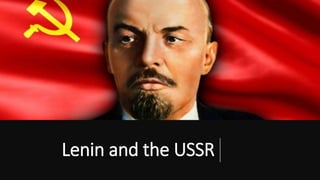
Lenin and the USSR
Comparing Types of Communism
Marxism Lenin’s Communism
Predicted the proletariat
would lead spontaneous
revolutions
Believed the proletariats and
the peasants needed to be
led by professional
revolutionaries
Proletariats would rule
sharing power and wealth
State needed to be run by a
single party with strict
discipline (idea of
paternalism)
A. Lenin’s Russia
1. 1922 changed the name of Russia to Soviet Union or USSR.
2. New Economic Policy (NEP)
a. Russian ECONOMY was destroyed by war
b. Lenin’s economic system closer to CAPITALISM than COMMUNISM
c. allowed some PRIVATE OWNERSHIP of businesses
d. government controlled major industries, BANKS, and communication.
3. 1922—Lenin suffered a stroke—concern grew on who would take over after his
death.
4. Lenin did not want JOSEPH STALIN to take power because saw him as DANGEROUS
5. 1924—Lenin dies, STALIN takes over USSR.
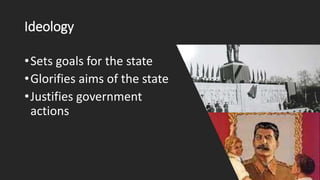
Ideology
•Sets goals for the state
•Glorifies aims of the state
•Justifies government
actions
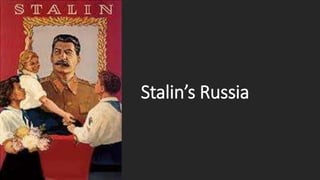
Stalin’s Russia
Stalin Builds a Totalitarian State
1. Secret Police arrested and executed millions.
2. Monitored all citizens through phones, mail, and informants.
3. The Great Purge 1937-1938
a. Stalin turned against the Communist party
b. Thousands of original Bolsheviks executed or sent to labor camps
c. Led to 8-13 million deaths
4. Propaganda: censored all forms of media and used it to glorify Stalin.
5. Controlled Education: to indoctrinate the youth
6. Attacked Religion: many religious leaders executed or sent to labor
camps. Destroyed churches and synagogues.
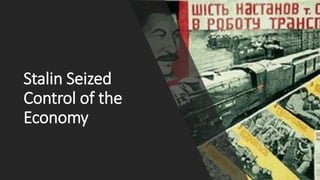
Stalin Seized
Control of the
Economy
Five Year Plans
a. set impossible quotas to increase output of steel, coal, oil
b. limited production of consumer goods and shortages of necessary
goods.
c. made huge gains in industrial production
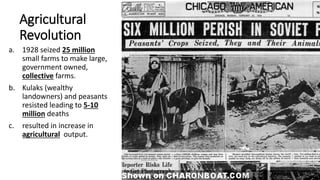
Agricultural
Revolution
a. 1928 seized 25 million
small farms to make large,
government owned,
collective farms.
b. Kulaks (wealthy
landowners) and peasants
resisted leading to 5-10
million deaths
c. resulted in increase in
agricultural output.
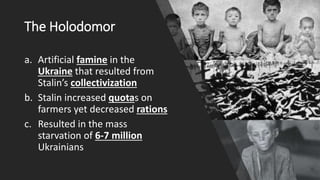
The Holodomor
a. Artificial famine in the
Ukraine that resulted from
Stalin’s collectivization
b. Stalin increased quotas on
farmers yet decreased rations
c. Resulted in the mass
starvation of 6-7 million
Ukrainians

Russian revolution

  • 1.
  • 2.
    Russia in the1800s Steps to Revolution
  • 3.
    Vocabulary • Bolsheviks: agroup of revolutionaries/Russian Marxists who took control of Russian’s government in November 1917. • Collective farms: large, industrial, government controlled farms formed by forcibly combining small farms. • Command economy: an economic system in which the government makes all economic decisions. • Communism: an economic and political system where people share equally in the means of production, goods and services, and private property does not exist. • Czar: Russian emperor taken from the word “Caesar”. • Five Year Plans: plans outlined by Joseph Stalin in 1928 for the development of the Soviet Union’s economy. • Proletariat: In Marxist theory, the group of workers who would overthrow the czar and come to rule Russia. • Soviet: one of the local representative councils formed in Russia after the downfall of Czar Nicholas II. • Totalitarianism: government control over every aspect of public and private life.
  • 4.
    Mid-1800s 1. Largest territoryand population in Europe 2. Behind in industrial development 3. 1854—tried to gain access to Mediterranean Sea through the Ottoman Empire. Russia lost the Crimean War.
  • 6.
    Politically 1. Country ledby an absolute ruler—the czar 2. Spread of liberalism and ideas of self-rule among ethnic groups challenged Russian rule 3. 1830s Czar Nicholas I began program of Russification 4. Foreign Policy—Increased influence over the Slavic people in the Baltic states and wanted to extend south into the Ottoman Empire
  • 7.
    Alexander II andReforms 1. Reformed the court system and gave greater freedom of press and expanded education 2. Radicals: some wanted to eliminate the government and start over (nihilists). In 1870 a radical group known as the People’s Will assassinate Czar Alexander II
  • 8.
    Successors 1. Alexander’s successorsoverturned his reforms and tried to eliminate liberalism 2. Pogroms—massacre of Jews in riots. 3. Revolution of 1905: a) Japan served a humiliating military defeat to Russia b) Renewed pogroms against the Jews c) “Bloody Sunday”—Jan. 22, 1905—Czar’s troops shot unarmed strikers on their way to deliver a petition to the Czar. d) October Manifesto—issued by Czar Nicholas II. In it he promised individual liberties, and election of a Parliament called the Duma e) Population still unhappy and the Czar maintained an autocracy
  • 9.
    World War Iand the Bolshevik Revolution
  • 10.
    World War Iand the March Revolution 1. End of 1914: 4 million Russians were killed, captured, or wounded. 2. Russian people angry about war and conditions at home 3. Germany helped smuggle Lenin back into Russia in hopes he would cause unrest 4. Bread shortages and rising food prices led to riots 5. March Revolution 1917: the Czar abdicated his throne. 6. The provisional government was chosen by the Duma: legislative branch in Russia. Made mistake of continuing to fight in World War I
  • 11.
    Bell Activity 2/16 Whywere the Russian people upset with the Czar Nicholas II.
  • 12.
    The Bolsheviks Overthrowthe Provisional Government 1. Bolsheviks gained support with two promises a. would withdraw from World War I b. would not allow the Czar to return to the throne 2. Vladimir Lenin declared new socialist order 3. Land was redistributed to the peasants and factories controlled by workers 4. Many Russians angry when with the Bolsheviks for signing the treaty with Germany and the murder of the Czar and his family.
  • 13.
    Civil War DividedRussia 1. White Army (European supported) versus Red Army (Bolsheviks) 2. 1918-1920: 15 million Russians died from influenza, war, and hunger 3. The Bolsheviks won
  • 14.
  • 15.
    Comparing Types ofCommunism Marxism Lenin’s Communism Predicted the proletariat would lead spontaneous revolutions Believed the proletariats and the peasants needed to be led by professional revolutionaries Proletariats would rule sharing power and wealth State needed to be run by a single party with strict discipline (idea of paternalism)
  • 16.
    A. Lenin’s Russia 1.1922 changed the name of Russia to Soviet Union or USSR. 2. New Economic Policy (NEP) a. Russian ECONOMY was destroyed by war b. Lenin’s economic system closer to CAPITALISM than COMMUNISM c. allowed some PRIVATE OWNERSHIP of businesses d. government controlled major industries, BANKS, and communication. 3. 1922—Lenin suffered a stroke—concern grew on who would take over after his death. 4. Lenin did not want JOSEPH STALIN to take power because saw him as DANGEROUS 5. 1924—Lenin dies, STALIN takes over USSR.
  • 17.
    Ideology •Sets goals forthe state •Glorifies aims of the state •Justifies government actions
  • 18.
  • 19.
    Stalin Builds aTotalitarian State 1. Secret Police arrested and executed millions. 2. Monitored all citizens through phones, mail, and informants. 3. The Great Purge 1937-1938 a. Stalin turned against the Communist party b. Thousands of original Bolsheviks executed or sent to labor camps c. Led to 8-13 million deaths 4. Propaganda: censored all forms of media and used it to glorify Stalin. 5. Controlled Education: to indoctrinate the youth 6. Attacked Religion: many religious leaders executed or sent to labor camps. Destroyed churches and synagogues.
  • 20.
  • 21.
    Five Year Plans a.set impossible quotas to increase output of steel, coal, oil b. limited production of consumer goods and shortages of necessary goods. c. made huge gains in industrial production
  • 22.
    Agricultural Revolution a. 1928 seized25 million small farms to make large, government owned, collective farms. b. Kulaks (wealthy landowners) and peasants resisted leading to 5-10 million deaths c. resulted in increase in agricultural output.
  • 23.
    The Holodomor a. Artificialfamine in the Ukraine that resulted from Stalin’s collectivization b. Stalin increased quotas on farmers yet decreased rations c. Resulted in the mass starvation of 6-7 million Ukrainians