1959 – 1976Cultural RevolutionHoward Liu and Isabel Chun
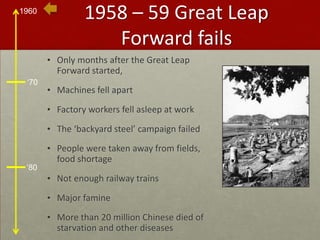
1958 – 59 Great Leap Forward failsOnly months after the Great Leap Forward started,Machines fell apartFactory workers fell asleep at workThe ‘backyard steel’ campaign failedPeople were taken away from fields, food shortageNot enough railway trainsMajor famineMore than 20 million Chinese died of starvation and other diseases
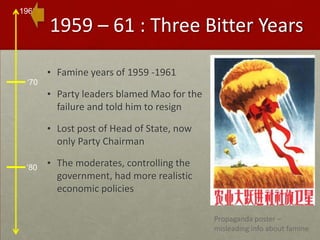
1959 – 61 : Three Bitter YearsFamine years of 1959 -1961Party leaders blamed Mao for the failure and told him to resignLost post of Head of State, now only Party ChairmanThe moderates, controlling the government, had more realistic economic policiesPropaganda poster – misleading info about famine
Late 1960s – Abandonment of Great Leap ForwardCommunes were reduced in size to make more manageablePeasants were sent back to fieldsPeasants were given their private plotsWages were increasedModerates ran the economy but Mao still was regarded as a revolutionary hero
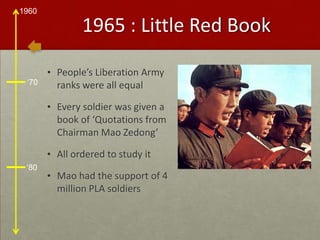
1965 : Little Red BookPeople’s Liberation Army ranks were all equalEvery soldier was given a book of ‘Quotations from Chairman Mao Zedong’All ordered to study itMao had the support of 4 million PLA soldiers
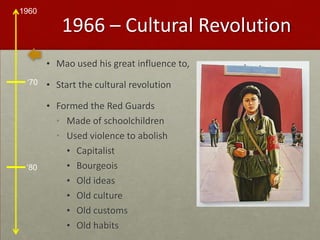
1966 – Cultural RevolutionMao used his great influence to,Start the cultural revolutionFormed the Red GuardsMade of schoolchildrenUsed violence to abolishCapitalistBourgeoisOld ideasOld cultureOld customsOld habits
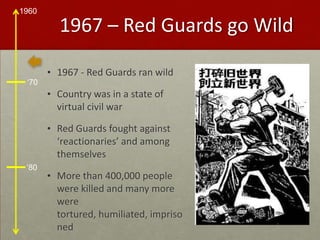
1967 – Red Guards go Wild1967 - Red Guards ran wildCountry was in a state of virtual civil warRed Guards fought against ‘reactionaries’ and among themselvesMore than 400,000 people were killed and many more were tortured, humiliated, imprisoned
1967 : Restoring OrderMao attempted to restore orderSchools and colleges reopenedRed Guards sent to country side to be re-educatedMany young people lost out on their education and were illiterate1969 – Mao announces cultural revolution is over.
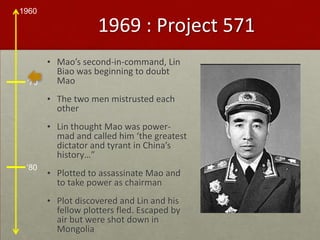
1969 : Project 571Mao’s second-in-command, Lin Biao was beginning to doubt MaoThe two men mistrusted each otherLin thought Mao was power-mad and called him ‘the greatest dictator and tyrant in China’s history…”Plotted to assassinate Mao and to take power as chairmanPlot discovered and Lin and his fellow plotters fled. Escaped by air but were shot down in Mongolia
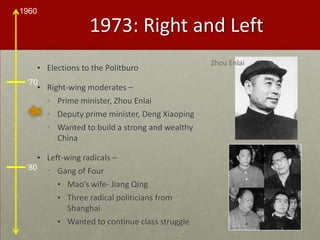
1973: Right and LeftZhou EnlaiElections to the PolitburoRight-wing moderates – Prime minister, Zhou EnlaiDeputy prime minister, Deng XiaopingWanted to build a strong and wealthy ChinaLeft-wing radicals –Gang of FourMao’s wife- Jiang QingThree radical politicians from ShanghaiWanted to continue class struggle
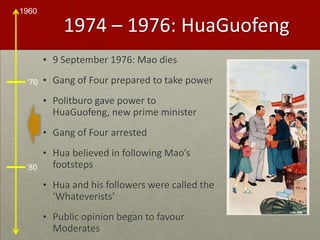
1974 – 1976: HuaGuofeng9 September 1976: Mao diesGang of Four prepared to take powerPolitburo gave power to HuaGuofeng, new prime ministerGang of Four arrestedHua believed in following Mao’s footstepsHua and his followers were called the ‘Whateverists’Public opinion began to favour Moderates

Timeline: Cultural Revolution

  • 1.
    1959 – 1976CulturalRevolutionHoward Liu and Isabel Chun
  • 2.
    1958 – 59Great Leap Forward failsOnly months after the Great Leap Forward started,Machines fell apartFactory workers fell asleep at workThe ‘backyard steel’ campaign failedPeople were taken away from fields, food shortageNot enough railway trainsMajor famineMore than 20 million Chinese died of starvation and other diseases
  • 3.
    1959 – 61: Three Bitter YearsFamine years of 1959 -1961Party leaders blamed Mao for the failure and told him to resignLost post of Head of State, now only Party ChairmanThe moderates, controlling the government, had more realistic economic policiesPropaganda poster – misleading info about famine
  • 4.
    Late 1960s –Abandonment of Great Leap ForwardCommunes were reduced in size to make more manageablePeasants were sent back to fieldsPeasants were given their private plotsWages were increasedModerates ran the economy but Mao still was regarded as a revolutionary hero
  • 5.
    1965 : LittleRed BookPeople’s Liberation Army ranks were all equalEvery soldier was given a book of ‘Quotations from Chairman Mao Zedong’All ordered to study itMao had the support of 4 million PLA soldiers
  • 6.
    1966 – CulturalRevolutionMao used his great influence to,Start the cultural revolutionFormed the Red GuardsMade of schoolchildrenUsed violence to abolishCapitalistBourgeoisOld ideasOld cultureOld customsOld habits
  • 7.
    1967 – RedGuards go Wild1967 - Red Guards ran wildCountry was in a state of virtual civil warRed Guards fought against ‘reactionaries’ and among themselvesMore than 400,000 people were killed and many more were tortured, humiliated, imprisoned
  • 8.
    1967 : RestoringOrderMao attempted to restore orderSchools and colleges reopenedRed Guards sent to country side to be re-educatedMany young people lost out on their education and were illiterate1969 – Mao announces cultural revolution is over.
  • 9.
    1969 : Project571Mao’s second-in-command, Lin Biao was beginning to doubt MaoThe two men mistrusted each otherLin thought Mao was power-mad and called him ‘the greatest dictator and tyrant in China’s history…”Plotted to assassinate Mao and to take power as chairmanPlot discovered and Lin and his fellow plotters fled. Escaped by air but were shot down in Mongolia
  • 10.
    1973: Right andLeftZhou EnlaiElections to the PolitburoRight-wing moderates – Prime minister, Zhou EnlaiDeputy prime minister, Deng XiaopingWanted to build a strong and wealthy ChinaLeft-wing radicals –Gang of FourMao’s wife- Jiang QingThree radical politicians from ShanghaiWanted to continue class struggle
  • 11.
    1974 – 1976:HuaGuofeng9 September 1976: Mao diesGang of Four prepared to take powerPolitburo gave power to HuaGuofeng, new prime ministerGang of Four arrestedHua believed in following Mao’s footstepsHua and his followers were called the ‘Whateverists’Public opinion began to favour Moderates