1
CHICAGO MANUAL OF STYLE ASSIGNMENT
Student’s Name
Course
Institution
Submission Date
2
Thesis statement
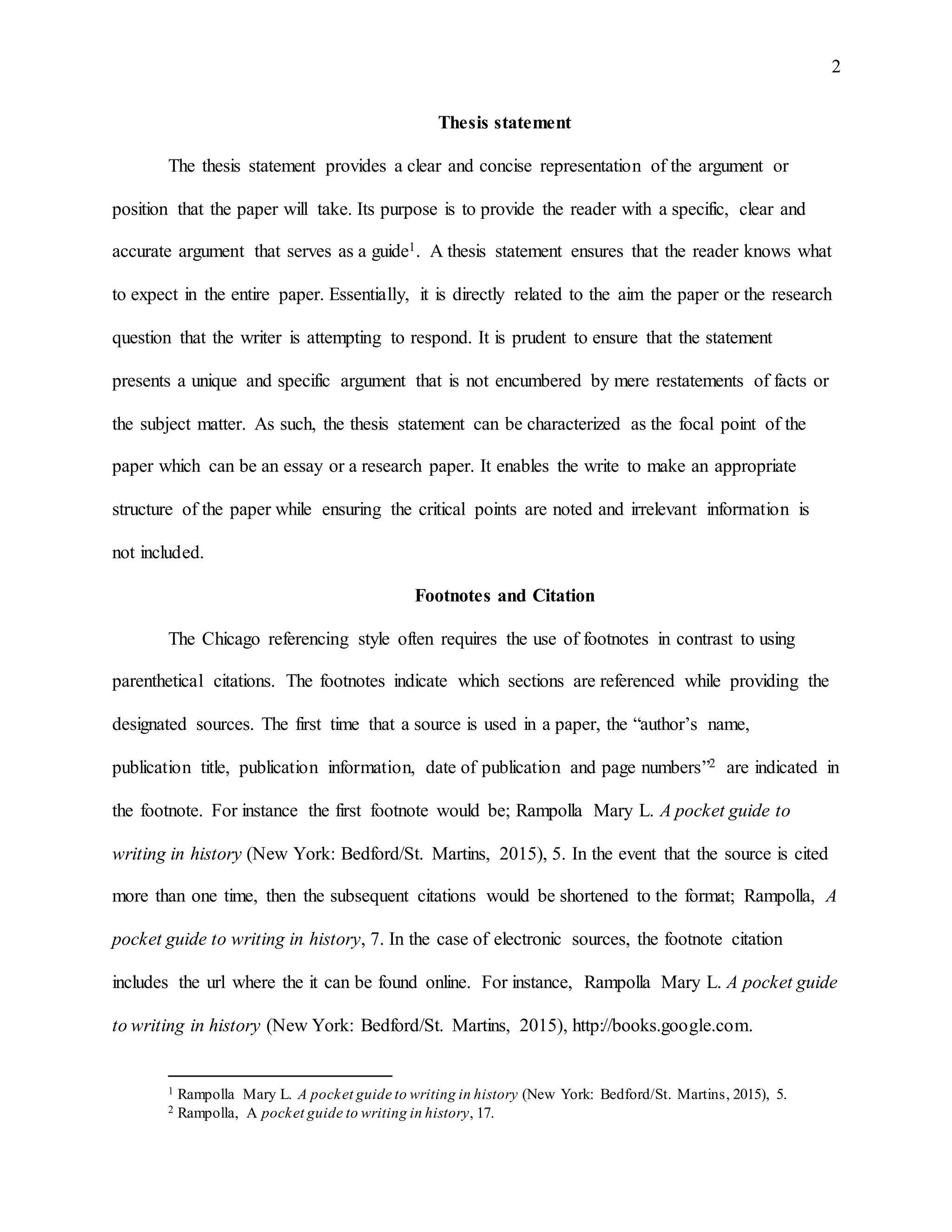
The thesis statement provides a clear and concise representation of the argument or
position that the paper will take. Its purpose is to provide the reader with a specific, clear and
accurate argument that serves as a guide1. A thesis statement ensures that the reader knows what
to expect in the entire paper. Essentially, it is directly related to the aim the paper or the research
question that the writer is attempting to respond. It is prudent to ensure that the statement
presents a unique and specific argument that is not encumbered by mere restatements of facts or
the subject matter. As such, the thesis statement can be characterized as the focal point of the
paper which can be an essay or a research paper. It enables the write to make an appropriate
structure of the paper while ensuring the critical points are noted and irrelevant information is
not included.
Footnotes and Citation
The Chicago referencing style often requires the use of footnotes in contrast to using
parenthetical citations. The footnotes indicate which sections are referenced while providing the
designated sources. The first time that a source is used in a paper, the “author’s name,
publication title, publication information, date of publication and page numbers”2 are indicated in
the footnote. For instance the first footnote would be; Rampolla Mary L. A pocket guide to
writing in history (New York: Bedford/St. Martins, 2015), 5. In the event that the source is cited
more than one time, then the subsequent citations would be shortened to the format; Rampolla, A
pocket guide to writing in history, 7. In the case of electronic sources, the footnote citation
includes the url where the it can be found online. For instance, Rampolla Mary L. A pocket guide
to writing in history (New York: Bedford/St. Martins, 2015), http://books.google.com.
1 Rampolla Mary L. A pocket guide to writing in history (New York: Bedford/St. Martins, 2015), 5.
2 Rampolla, A pocket guide to writing in history, 17.
3
Meanwhile, quotes that are made in-text are referenced in the footnotes by indicating the author,
title of the work and the page number.
Primary sources include books, periodicals such as journals and scientific or scholarly
web sources. Secondary resources include public and unpublished materials and web sources.
Bibliographic sources are listed chronologically in an ascending criteria. The source is listed
beginning with the authors names beginning with the surname. The title, publication information
and the year of publication respectively.
4
Bibliography
Rampolla Mary L. A pocket guide to writing in history (New York: Bedford/St. Martins, 2015), 5

Chicago format

  • 1.
    1 CHICAGO MANUAL OFSTYLE ASSIGNMENT Student’s Name Course Institution Submission Date
  • 2.
    2 Thesis statement The thesisstatement provides a clear and concise representation of the argument or position that the paper will take. Its purpose is to provide the reader with a specific, clear and accurate argument that serves as a guide1. A thesis statement ensures that the reader knows what to expect in the entire paper. Essentially, it is directly related to the aim the paper or the research question that the writer is attempting to respond. It is prudent to ensure that the statement presents a unique and specific argument that is not encumbered by mere restatements of facts or the subject matter. As such, the thesis statement can be characterized as the focal point of the paper which can be an essay or a research paper. It enables the write to make an appropriate structure of the paper while ensuring the critical points are noted and irrelevant information is not included. Footnotes and Citation The Chicago referencing style often requires the use of footnotes in contrast to using parenthetical citations. The footnotes indicate which sections are referenced while providing the designated sources. The first time that a source is used in a paper, the “author’s name, publication title, publication information, date of publication and page numbers”2 are indicated in the footnote. For instance the first footnote would be; Rampolla Mary L. A pocket guide to writing in history (New York: Bedford/St. Martins, 2015), 5. In the event that the source is cited more than one time, then the subsequent citations would be shortened to the format; Rampolla, A pocket guide to writing in history, 7. In the case of electronic sources, the footnote citation includes the url where the it can be found online. For instance, Rampolla Mary L. A pocket guide to writing in history (New York: Bedford/St. Martins, 2015), http://books.google.com. 1 Rampolla Mary L. A pocket guide to writing in history (New York: Bedford/St. Martins, 2015), 5. 2 Rampolla, A pocket guide to writing in history, 17.
  • 3.
    3 Meanwhile, quotes thatare made in-text are referenced in the footnotes by indicating the author, title of the work and the page number. Primary sources include books, periodicals such as journals and scientific or scholarly web sources. Secondary resources include public and unpublished materials and web sources. Bibliographic sources are listed chronologically in an ascending criteria. The source is listed beginning with the authors names beginning with the surname. The title, publication information and the year of publication respectively.
  • 4.
    4 Bibliography Rampolla Mary L.A pocket guide to writing in history (New York: Bedford/St. Martins, 2015), 5