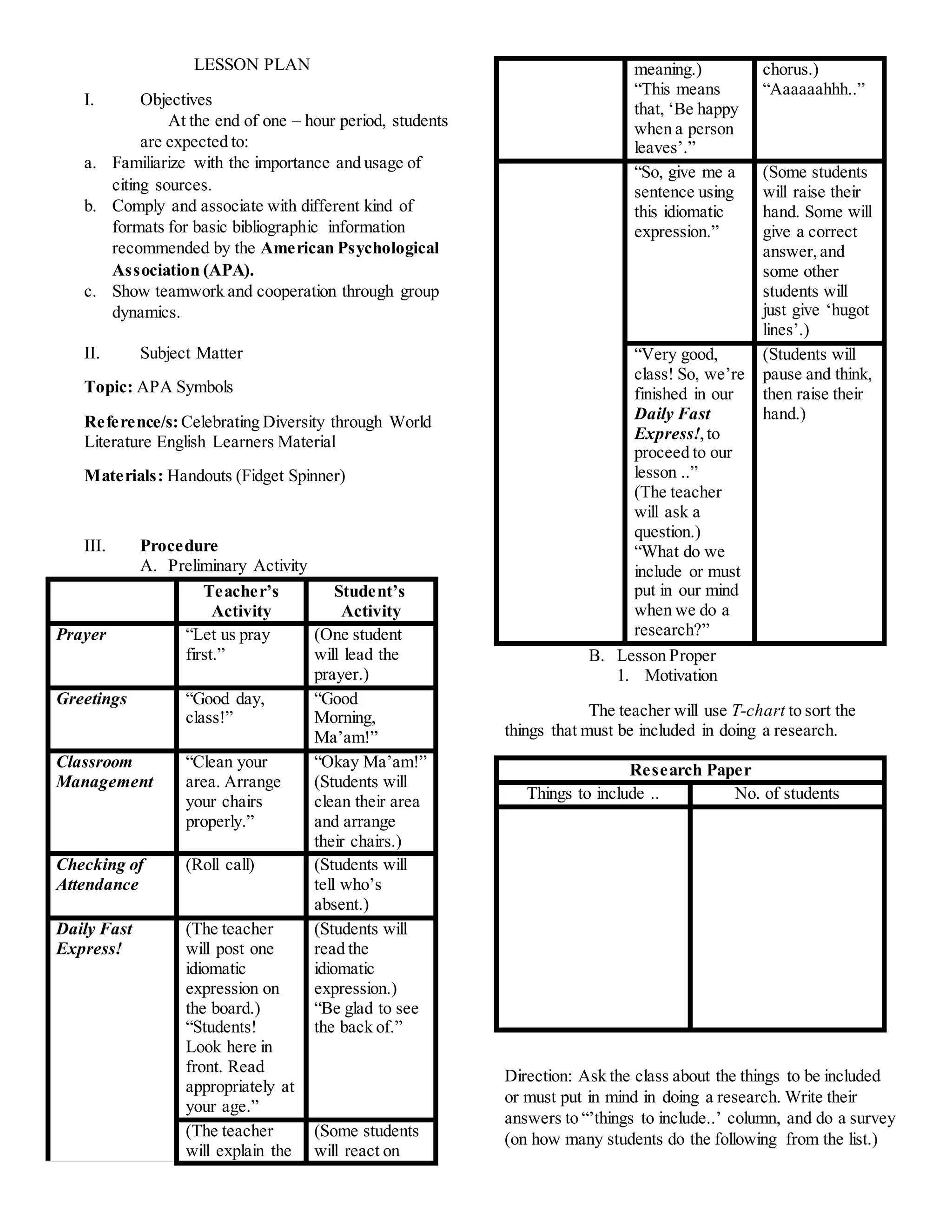
LESSON PLAN
I. Objectives
At the end of one – hour period, students
are expected to:
a. Familiarize with the importance and usage of
citing sources.
b. Comply and associate with different kind of
formats for basic bibliographic information
recommended by the American Psychological
Association (APA).
c. Show teamwork and cooperation through group
dynamics.
II. Subject Matter
Topic: APA Symbols
Reference/s:Celebrating Diversity through World
Literature English Learners Material
Materials: Handouts (Fidget Spinner)
III. Procedure
A. Preliminary Activity
Teacher’s
Activity
Student’s
Activity
Prayer “Let us pray
first.”
(One student
will lead the
prayer.)
Greetings “Good day,
class!”
“Good
Morning,
Ma’am!”
Classroom
Management
“Clean your
area. Arrange
your chairs
properly.”
“Okay Ma’am!”
(Students will
clean their area
and arrange
their chairs.)
Checking of
Attendance
(Roll call) (Students will
tell who’s
absent.)
Daily Fast
Express!
(The teacher
will post one
idiomatic
expression on
the board.)
“Students!
Look here in
front. Read
appropriately at
your age.”
(Students will
read the
idiomatic
expression.)
“Be glad to see
the back of.”
(The teacher
will explain the
(Some students
will react on
meaning.)
“This means
that, ‘Be happy
when a person
leaves’.”
chorus.)
“Aaaaaahhh..”
“So, give me a
sentence using
this idiomatic
expression.”
(Some students
will raise their
hand. Some will
give a correct
answer,and
some other
students will
just give ‘hugot
lines’.)
“Very good,
class! So, we’re
finished in our
Daily Fast
Express!,to
proceed to our
lesson ..”
(The teacher
will ask a
question.)
“What do we
include or must
put in our mind
when we do a
research?”
(Students will
pause and think,
then raise their
hand.)
B. Lesson Proper
1. Motivation
The teacher will use T-chart to sort the
things that must be included in doing a research.
Research Paper
Things to include .. No. of students
Direction: Ask the class about the things to be included
or must put in mind in doing a research. Write their
answers to “’things to include..’ column, and do a survey
(on how many students do the following from the list.)
GroupName: __________________________________________
Group No. : _____
2. Presentation
The teacher will divide the class into three
groups. Each group will be given a handout (Fidget
spinner – Fill the spin!) The teacher will ask some
questions and their answers will be written on designated
circle of the fidget spinner.
1. Could anything bad happen to you if you copied
someone else’s idea or words and didn’t give
them credit?
2. How does it help YOU when you cite sources?
3. How would you feel if you posted something
really cool on Facebook and a bunch of people
shared it as if it was their own witty comment,
not giving you credit?
3. Discussion
The teacher will discuss referencing and its
importance, and standard formats and examples
of basic bibliographic information recommended
by the American Psychological Association
(APA).
The terms cite and refer (or citation and
referencing) are often used to same thing since
to cite a piece of work is to provide a reference
to its source.
Why is a bibliography and referencing
important?
 Preparing bibliographies helps
researchers keep track of the sources
they consulted or cited for their written
material and gives readers a framework
of how the writers' arguments were
formed.
 Referencing allows you to
acknowledge the contribution of other
writers and researcher in your work.
Any university assignments that draw on
the ideas, words or research of other
writers must contain citations.
 Referencing is also a way to give
credit to the writers from whom you
have borrowed words and ideas.
 Give credit whenever you use:
1. Another person’s idea
opinion or theory.
2. Any facts,statistics, graphs,
drawings – any pieces of
information - that are not common
knowledge.
3. Quotations of another
person’s spoken or written words.
4. Paraphrases of another person’s
spoken or written words..
Below are standard formats and
examples for basic bibliographic
information recommended by the
American Psychological
Association (APA).
Format
Examples
Format Examples
Books Author’s last
name, first
initial.
(Publication
date). Book title.
Allen, T. (1974).
Vanishing wildlife of
North America.
Washington, D.C.:
National Geographic
1.
2.
3.
Fidget spinner – Fill the spin!
Additional
information. City
of publication:
Publishing
company.
Society.
Boorstin, D. (1992).
The creators:A
History of the Heroes
of the Imagination.
New York: Random
House.
Encycloped
ia &
Dictionary
Author’s last
name, first
initial. (Date).
Title of Article.
Title of
Encyclopedia
(Volume pages).
City of
publication:
Publishing
company.
Bergmann, P.G.
(1993). Relativity. In
the New
Encyclopedia
Britannica (Vol. 26,
pp. 501-508).
Chicago:
Encyclopedia
Britannica.
Merriam-Webster’s
Collegiate Dictionary
(10th
ed.). (1993).
Springfield, MA:
Merriam-Webster.
Pettingill. O.S., Jr.
(1980). Falco and
Falconry. World
Book
Encyclopedia.(pp.
150-155). Chicago:
World Book.
Magazine
&
Newspaper
Articles
Author’s last
name, first
initial.
(Publication
Date). Article
title. Periodical
title, volume
number (issue
number if
available),
inclusive pages.
Note: Do not
enclose the title
in quotation
Harlow, H. F. (1983).
Fundamentals for
preparing psychology
journal articles.
Journal of
Comparative and
Physiological
Psychology,55, 893-
896.
Henry, W. A., III.
(1990, April 9).
Making the grade in
today’s schools.
marks. Put a
period after the
title. If a
periodical
includes a
volume number,
italize it and then
give the page
range (in regular
type) without
“pp.” If the
periodical does
not use volume
numbers, as in
newspapers,use
p. or pp. for page
numbers.
Note: Unlike
other periodicals,
p or pp. precedes
page numbers for
a newspaper
reference in APA
style.
Time, 135, 28-31.
Kallete, D. (1996,
July 21). California
town counts town to
big quake. USA
Today, 9, p. A1.
Website or
Webpage
Online
periodical:
Author’s name.
(Date of
publication).
Title of article.
Title of
periodical,
volume number,
Retrieved month
day, year,from
full URL
Online
document:
Author’s name.
(Date of
publication).
Title of work.
Retrieved month
day, year from
full URL
Devitt, T. (2001,
August 2). Lightning
injures for at music
festival.The Why?
Files. Retrieved
January 23, 2002,
from
http://whyfiles.org/13
7lightning/index.html
Dove, R. (1998).
Lady freedom among
us. The electronic
Text Center.
Retrieved June 19,
1998, from Alderman
Library, University of
Virginia website:
http://etext.lib.virgini
a.edu/subjects/afam.h
tml
Fredrickson, B.L.
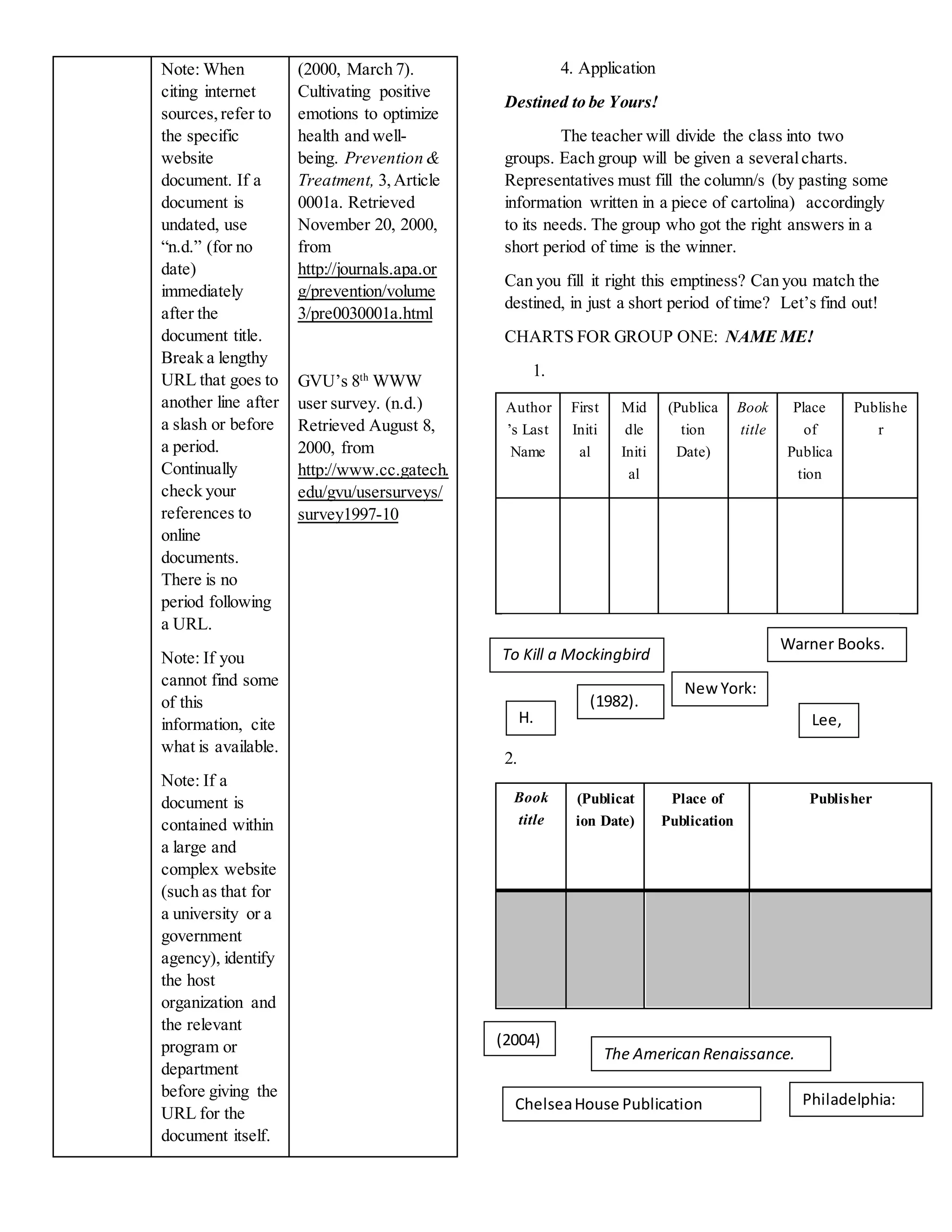
Note: When
citing internet
sources,refer to
the specific
website
document. If a
document is
undated, use
“n.d.” (for no
date)
immediately
after the
document title.
Break a lengthy
URL that goes to
another line after
a slash or before
a period.
Continually
check your
references to
online
documents.
There is no
period following
a URL.
Note: If you
cannot find some
of this
information, cite
what is available.
Note: If a
document is
contained within
a large and
complex website
(such as that for
a university or a
government
agency), identify
the host
organization and
the relevant
program or
department
before giving the
URL for the
document itself.
(2000, March 7).
Cultivating positive
emotions to optimize
health and well-
being. Prevention &
Treatment, 3,Article
0001a. Retrieved
November 20, 2000,
from
http://journals.apa.or
g/prevention/volume
3/pre0030001a.html
GVU’s 8th
WWW
user survey. (n.d.)
Retrieved August 8,
2000, from
http://www.cc.gatech.
edu/gvu/usersurveys/
survey1997-10
4. Application
Destined to be Yours!
The teacher will divide the class into two
groups. Each group will be given a severalcharts.
Representatives must fill the column/s (by pasting some
information written in a piece of cartolina) accordingly
to its needs. The group who got the right answers in a
short period of time is the winner.
Can you fill it right this emptiness? Can you match the
destined, in just a short period of time? Let’s find out!
CHARTS FOR GROUP ONE: NAME ME!
1.
Author
’s Last
Name
First
Initi
al
Mid
dle
Initi
al
(Publica
tion
Date)
Book
title
Place
of
Publica
tion
Publishe
r
2.
Book
title
(Publicat
ion Date)
Place of
Publication
Publisher
To Kill a Mockingbird
Lee,
(1982).
New York:
Warner Books.
H.
(2004)
. The American Renaissance.
Philadelphia:ChelseaHouse Publication
3.Author1’sLastName
FirstInitial
MiddleInitial
Author2’sLastName
FirstInitial
MiddleInitial
(PublicationDate)
Booktitle
PlaceofPublication
Publisher
CHARTS FOR GROUP TWO:
WHERE ARE YOU?
1.
New
York
:
To
Killa
Mocki
ngbir
d.
Lee,(1982
)
War
ner
Book
s.
H
.
2.
Philadelp
hia:
Chelsea
House
nPublish
eers.
(2004)The
American
Renaissa
nce.
3.
P.H.,Hopper
,
(1982)Fun
with
physics
.
Hopper,
H., Gwunn,
P.(1997). Fun with physics.
NewYork:
Harper & Row.
Author’sLast Name
FirstInitial
Middle Initial
(Publication
date)BookTitile
Publisher Place of
Publication
(Publication
date)
BookTitile
Publisher
Place of
Publication
New
York
:
(1997
)
Gwun
n,
Hopper
&Row.
RUBRICS:
PRESENTAION: 50
TIME PERIOD: 50
PLUS
CORRECT ANSWERS
5. Generalization
The teacher will ask the following questions:
 How important to cite sources?
 What have you learned the most in our lesson
for today?
6. Evaluation
Arrange the following:
1. Author(s): Lynn Smith
Year:2010
Title: A Study of Undergraduate Students
Page number: article pgs. 170-191; quote pg.
172
Journal: Collegiate Learning Review
Reference:
_____________________________________________
____________________________________
2. Author(s): Steven Marisol
Publisher: McGraw-Hill Publishing
Title: Mathematical Concepts for Non-Math Majors
City of Publication: New York City, New York
Year: 2008
Page number: quote pg. 214
Reference:
_____________________________________________
____________________________________
3. . Author(s): Jan Plumm and Carol Neischke
Publisher: Harley Publishing, Inc.
Title: A Creationist View of Sexuality City of
Publication: New Brunswick, New Jersey
Year:2008 Page
number: quote pg. 113-114
Reference:
_____________________________________________
____________________________________
4. Author(s): John P. Ackran
Date of Publication: September 21, 2013
Title of webpage: Statistics of Insurance Coverage of
Elderly Date of Access:April 3, 2014
Sponsoring Organization: Organization for Medical
Reform
URL:
http://www.medreform.org/statistics/insurance/elderly-
coverage/233
Reference:
_____________________________________________
____________________________________
5. . Author(s): No specific author
Date of Publication: May 3,
2011
Title: Coordinating Grassroot Campaigns for Liberal
Conservatives Date of Access:June 28, 2014
Main Page Title: Grassroot Strategies
Sponsoring Organization: Grassroots of America
URL:
http://www.grassrootsofamerica.org/strategies/campaign
s/0012/abd
Author1’sLast Name
Author2’s
FirstInitial
(Publication
date)
BookTitile
Publisher
Place of
Publication
Author2’sLast Name
Author1’s
FirstInitial
Reference:
_____________________________________________
____________________________________
IV. Assignment
Write all your answers in your assignment
notebook.
 Copy ten bibliography/references
from different books.
 What is MLA? Elaborate and give
ten examples.

SAMPLE: Grade 10 - APA Bibliography Detailed Lesson Plan

  • 1.
    LESSON PLAN I. Objectives Atthe end of one – hour period, students are expected to: a. Familiarize with the importance and usage of citing sources. b. Comply and associate with different kind of formats for basic bibliographic information recommended by the American Psychological Association (APA). c. Show teamwork and cooperation through group dynamics. II. Subject Matter Topic: APA Symbols Reference/s:Celebrating Diversity through World Literature English Learners Material Materials: Handouts (Fidget Spinner) III. Procedure A. Preliminary Activity Teacher’s Activity Student’s Activity Prayer “Let us pray first.” (One student will lead the prayer.) Greetings “Good day, class!” “Good Morning, Ma’am!” Classroom Management “Clean your area. Arrange your chairs properly.” “Okay Ma’am!” (Students will clean their area and arrange their chairs.) Checking of Attendance (Roll call) (Students will tell who’s absent.) Daily Fast Express! (The teacher will post one idiomatic expression on the board.) “Students! Look here in front. Read appropriately at your age.” (Students will read the idiomatic expression.) “Be glad to see the back of.” (The teacher will explain the (Some students will react on meaning.) “This means that, ‘Be happy when a person leaves’.” chorus.) “Aaaaaahhh..” “So, give me a sentence using this idiomatic expression.” (Some students will raise their hand. Some will give a correct answer,and some other students will just give ‘hugot lines’.) “Very good, class! So, we’re finished in our Daily Fast Express!,to proceed to our lesson ..” (The teacher will ask a question.) “What do we include or must put in our mind when we do a research?” (Students will pause and think, then raise their hand.) B. Lesson Proper 1. Motivation The teacher will use T-chart to sort the things that must be included in doing a research. Research Paper Things to include .. No. of students Direction: Ask the class about the things to be included or must put in mind in doing a research. Write their answers to “’things to include..’ column, and do a survey (on how many students do the following from the list.)
  • 2.
    GroupName: __________________________________________ Group No.: _____ 2. Presentation The teacher will divide the class into three groups. Each group will be given a handout (Fidget spinner – Fill the spin!) The teacher will ask some questions and their answers will be written on designated circle of the fidget spinner. 1. Could anything bad happen to you if you copied someone else’s idea or words and didn’t give them credit? 2. How does it help YOU when you cite sources? 3. How would you feel if you posted something really cool on Facebook and a bunch of people shared it as if it was their own witty comment, not giving you credit? 3. Discussion The teacher will discuss referencing and its importance, and standard formats and examples of basic bibliographic information recommended by the American Psychological Association (APA). The terms cite and refer (or citation and referencing) are often used to same thing since to cite a piece of work is to provide a reference to its source. Why is a bibliography and referencing important?  Preparing bibliographies helps researchers keep track of the sources they consulted or cited for their written material and gives readers a framework of how the writers' arguments were formed.  Referencing allows you to acknowledge the contribution of other writers and researcher in your work. Any university assignments that draw on the ideas, words or research of other writers must contain citations.  Referencing is also a way to give credit to the writers from whom you have borrowed words and ideas.  Give credit whenever you use: 1. Another person’s idea opinion or theory. 2. Any facts,statistics, graphs, drawings – any pieces of information - that are not common knowledge. 3. Quotations of another person’s spoken or written words. 4. Paraphrases of another person’s spoken or written words.. Below are standard formats and examples for basic bibliographic information recommended by the American Psychological Association (APA). Format Examples Format Examples Books Author’s last name, first initial. (Publication date). Book title. Allen, T. (1974). Vanishing wildlife of North America. Washington, D.C.: National Geographic 1. 2. 3. Fidget spinner – Fill the spin!
  • 3.
    Additional information. City of publication: Publishing company. Society. Boorstin,D. (1992). The creators:A History of the Heroes of the Imagination. New York: Random House. Encycloped ia & Dictionary Author’s last name, first initial. (Date). Title of Article. Title of Encyclopedia (Volume pages). City of publication: Publishing company. Bergmann, P.G. (1993). Relativity. In the New Encyclopedia Britannica (Vol. 26, pp. 501-508). Chicago: Encyclopedia Britannica. Merriam-Webster’s Collegiate Dictionary (10th ed.). (1993). Springfield, MA: Merriam-Webster. Pettingill. O.S., Jr. (1980). Falco and Falconry. World Book Encyclopedia.(pp. 150-155). Chicago: World Book. Magazine & Newspaper Articles Author’s last name, first initial. (Publication Date). Article title. Periodical title, volume number (issue number if available), inclusive pages. Note: Do not enclose the title in quotation Harlow, H. F. (1983). Fundamentals for preparing psychology journal articles. Journal of Comparative and Physiological Psychology,55, 893- 896. Henry, W. A., III. (1990, April 9). Making the grade in today’s schools. marks. Put a period after the title. If a periodical includes a volume number, italize it and then give the page range (in regular type) without “pp.” If the periodical does not use volume numbers, as in newspapers,use p. or pp. for page numbers. Note: Unlike other periodicals, p or pp. precedes page numbers for a newspaper reference in APA style. Time, 135, 28-31. Kallete, D. (1996, July 21). California town counts town to big quake. USA Today, 9, p. A1. Website or Webpage Online periodical: Author’s name. (Date of publication). Title of article. Title of periodical, volume number, Retrieved month day, year,from full URL Online document: Author’s name. (Date of publication). Title of work. Retrieved month day, year from full URL Devitt, T. (2001, August 2). Lightning injures for at music festival.The Why? Files. Retrieved January 23, 2002, from http://whyfiles.org/13 7lightning/index.html Dove, R. (1998). Lady freedom among us. The electronic Text Center. Retrieved June 19, 1998, from Alderman Library, University of Virginia website: http://etext.lib.virgini a.edu/subjects/afam.h tml Fredrickson, B.L.
  • 4.
    Note: When citing internet sources,referto the specific website document. If a document is undated, use “n.d.” (for no date) immediately after the document title. Break a lengthy URL that goes to another line after a slash or before a period. Continually check your references to online documents. There is no period following a URL. Note: If you cannot find some of this information, cite what is available. Note: If a document is contained within a large and complex website (such as that for a university or a government agency), identify the host organization and the relevant program or department before giving the URL for the document itself. (2000, March 7). Cultivating positive emotions to optimize health and well- being. Prevention & Treatment, 3,Article 0001a. Retrieved November 20, 2000, from http://journals.apa.or g/prevention/volume 3/pre0030001a.html GVU’s 8th WWW user survey. (n.d.) Retrieved August 8, 2000, from http://www.cc.gatech. edu/gvu/usersurveys/ survey1997-10 4. Application Destined to be Yours! The teacher will divide the class into two groups. Each group will be given a severalcharts. Representatives must fill the column/s (by pasting some information written in a piece of cartolina) accordingly to its needs. The group who got the right answers in a short period of time is the winner. Can you fill it right this emptiness? Can you match the destined, in just a short period of time? Let’s find out! CHARTS FOR GROUP ONE: NAME ME! 1. Author ’s Last Name First Initi al Mid dle Initi al (Publica tion Date) Book title Place of Publica tion Publishe r 2. Book title (Publicat ion Date) Place of Publication Publisher To Kill a Mockingbird Lee, (1982). New York: Warner Books. H. (2004) . The American Renaissance. Philadelphia:ChelseaHouse Publication
  • 5.
    3.Author1’sLastName FirstInitial MiddleInitial Author2’sLastName FirstInitial MiddleInitial (PublicationDate) Booktitle PlaceofPublication Publisher CHARTS FOR GROUPTWO: WHERE ARE YOU? 1. New York : To Killa Mocki ngbir d. Lee,(1982 ) War ner Book s. H . 2. Philadelp hia: Chelsea House nPublish eers. (2004)The American Renaissa nce. 3. P.H.,Hopper , (1982)Fun with physics . Hopper, H., Gwunn, P.(1997). Fun with physics. NewYork: Harper & Row. Author’sLast Name FirstInitial Middle Initial (Publication date)BookTitile Publisher Place of Publication (Publication date) BookTitile Publisher Place of Publication
  • 6.
    New York : (1997 ) Gwun n, Hopper &Row. RUBRICS: PRESENTAION: 50 TIME PERIOD:50 PLUS CORRECT ANSWERS 5. Generalization The teacher will ask the following questions:  How important to cite sources?  What have you learned the most in our lesson for today? 6. Evaluation Arrange the following: 1. Author(s): Lynn Smith Year:2010 Title: A Study of Undergraduate Students Page number: article pgs. 170-191; quote pg. 172 Journal: Collegiate Learning Review Reference: _____________________________________________ ____________________________________ 2. Author(s): Steven Marisol Publisher: McGraw-Hill Publishing Title: Mathematical Concepts for Non-Math Majors City of Publication: New York City, New York Year: 2008 Page number: quote pg. 214 Reference: _____________________________________________ ____________________________________ 3. . Author(s): Jan Plumm and Carol Neischke Publisher: Harley Publishing, Inc. Title: A Creationist View of Sexuality City of Publication: New Brunswick, New Jersey Year:2008 Page number: quote pg. 113-114 Reference: _____________________________________________ ____________________________________ 4. Author(s): John P. Ackran Date of Publication: September 21, 2013 Title of webpage: Statistics of Insurance Coverage of Elderly Date of Access:April 3, 2014 Sponsoring Organization: Organization for Medical Reform URL: http://www.medreform.org/statistics/insurance/elderly- coverage/233 Reference: _____________________________________________ ____________________________________ 5. . Author(s): No specific author Date of Publication: May 3, 2011 Title: Coordinating Grassroot Campaigns for Liberal Conservatives Date of Access:June 28, 2014 Main Page Title: Grassroot Strategies Sponsoring Organization: Grassroots of America URL: http://www.grassrootsofamerica.org/strategies/campaign s/0012/abd Author1’sLast Name Author2’s FirstInitial (Publication date) BookTitile Publisher Place of Publication Author2’sLast Name Author1’s FirstInitial
  • 7.
    Reference: _____________________________________________ ____________________________________ IV. Assignment Write allyour answers in your assignment notebook.  Copy ten bibliography/references from different books.  What is MLA? Elaborate and give ten examples.