HOW TO WRITE A
LITERATURE
REVIEW
MID-TERM PROJECT
A literature review paper consisting :
- Abstract
- Introduction
- Discussion (literature review)
- Conclusion and recommendation
- Reference list
WHAT IS LITERATURE
REVIEW?
LITERATURE REVIEW
A literature review “re-views” – looks again
– at what others have said, done, found in a
particular area.
The “literature” you choose will inform and
underpin everything you write, so plan
searches carefully.
WHAT IS A “LITERATURE”?
WHAT IS A “REVIEW”?
REVIEW OF RELATED
LITERATURE
• Review of related literature shows how the study builds on
prior knowledge by presenting and evaluating what is already
known about the topic.
• Thus, the goal is to explain the logical continuity between
previous and present work. To do so, the candidates must
show a good understanding of relevant theories which may
trigger them to discuss the issue.
• This section is followed by an interpretation of the results
which must be of an appropriate depth in order to support the
subsequent conclusions.
(PBI Thesis Guideline, 2016)
HOW’S THE EXAMPLE?
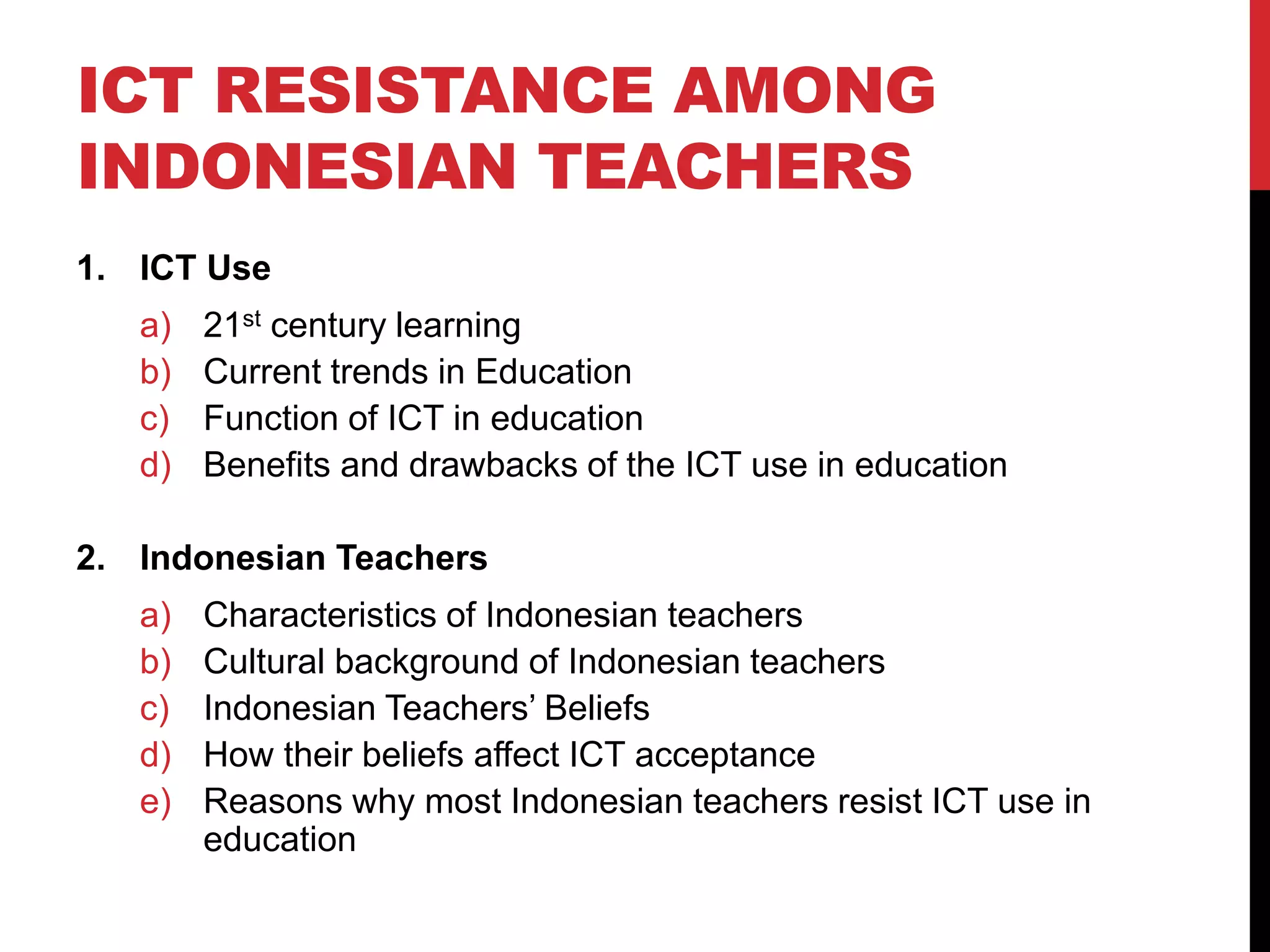
ICT RESISTANCE AMONG
INDONESIAN TEACHERS
1. ICT Use
a) 21st century learning
b) Current trends in Education
c) Function of ICT in education
d) Benefits and drawbacks of the ICT use in education
2. Indonesian Teachers
a) Characteristics of Indonesian teachers
b) Cultural background of Indonesian teachers
c) Indonesian Teachers’ Beliefs
d) How their beliefs affect ICT acceptance
e) Reasons why most Indonesian teachers resist ICT use in
education
THE INFLUENCE OF TOEFL SCORE
ON STUDENTS’ GRAMMAR ABILITY
1. …….
a. …..
b. …..
c. …..
2. …..
a. …..
b. …..
c. …..
3. …..
a. …..
b. …..
c. …..
CITATION
Why?
• Give credit to the author of the original information
• Easily find original information again –
• Think of it as a map
Where?
• Reference List
• In-Text
TO CITE OR NOT TO
CITE….
You do not need to cite common knowledge
• The White House is located in Washington D.C.
You do not need to cite information found
in numerous sources
• Pearl Harbor was bombed on December 7, 1941.
Common knowledge can change
• Medical journal article vs. Freshman biology paper
When in doubt - Cite
TYPES OF IN TEXT
CITATION
Direct Quote
• “Preschool children do not have to be diagnosed
with and reported under one of the traditional
disability categories (e.g., mental retardation,
emotional disturbance, orthopedic impairments) to
receive services” (Heward, 2009, p. 544).
Paraphrasing
• Before kindergarten, children can be serviced
without a specific diagnosis (Heward, 2009).
Heward, W.L. (2009). Exceptional children: An introduction to special education. Upper Saddle River,
NJ: Pearson.
DIRECT QUOTE
• Quote word by word, beginning and
ending the quote with “…” marks
• Use page number for books or pdfs
• Use paragraph number for online
sources
• When using the author’s name as an
introduction, include the year in the
introduction, save the page number for
the end.
IN-TEXT CITATION
Paraphrasing
One idea is to surround quotations with big Q’s to
distinguish the author’s words from your own ideas
(Lipson, 2004).
In Doing honest work in college, Lipson (2004) suggests
surrounding quotations with big Q’s to distinguish the
author’s words from your own ideas.
___________________________________________
Lipson, C. (2004). Doing honest work in college.
Chicago: The University of Chicago Press.
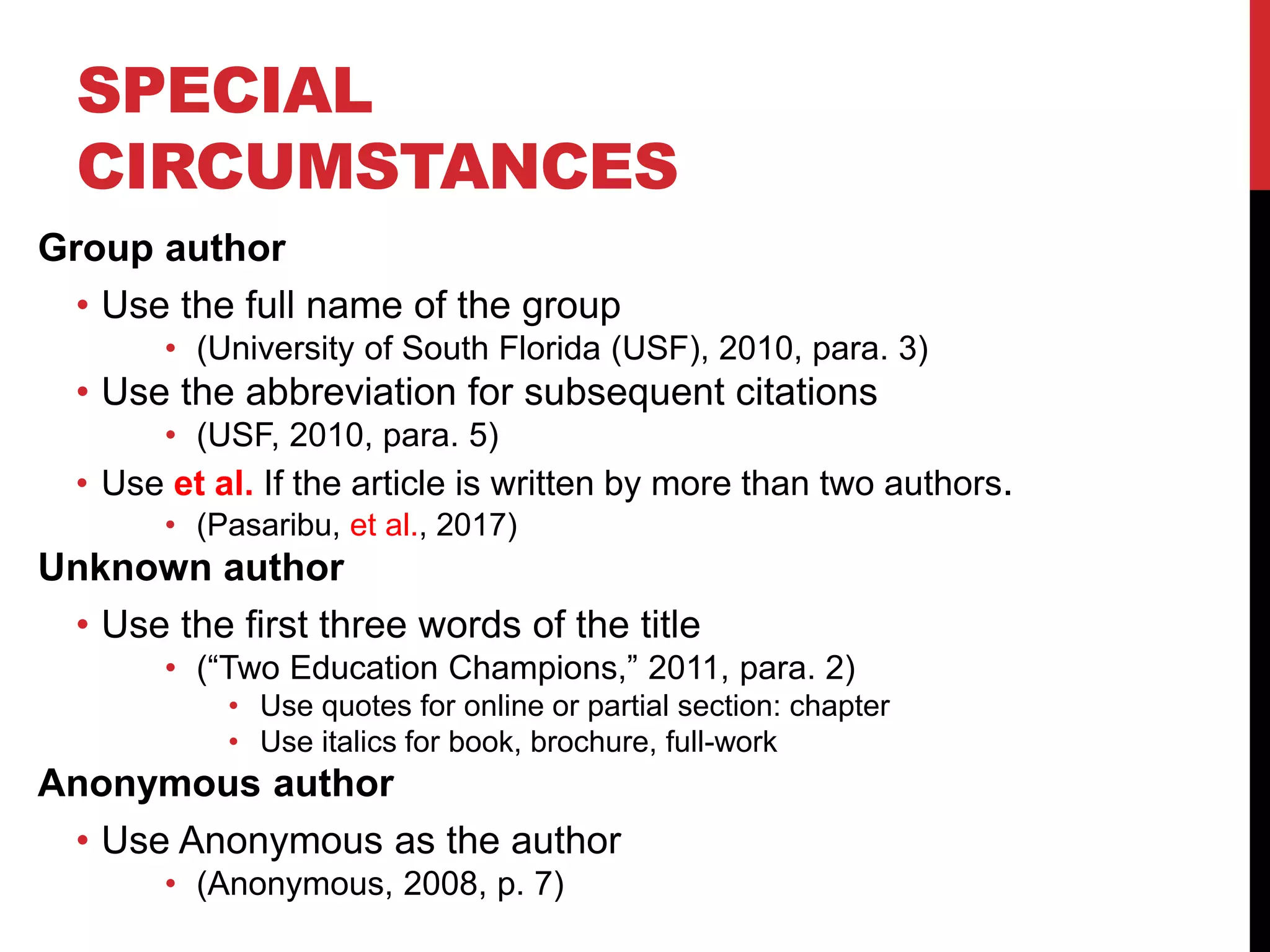
SPECIAL
CIRCUMSTANCES
Group author
• Use the full name of the group
• (University of South Florida (USF), 2010, para. 3)
• Use the abbreviation for subsequent citations
• (USF, 2010, para. 5)
• Use et al. If the article is written by more than two authors.
• (Pasaribu, et al., 2017)
Unknown author
• Use the first three words of the title
• (“Two Education Champions,” 2011, para. 2)
• Use quotes for online or partial section: chapter
• Use italics for book, brochure, full-work
Anonymous author
• Use Anonymous as the author
• (Anonymous, 2008, p. 7)
REFERENCE LIST /
BIBLIOGRAPHY
List alphabetically by author’s last name (or title, if author
not known).
APA style is used in the social sciences, education,
engineering and business.
Authors’ first names are always reduced to initials.
Examples:
Author, A. A. (Year). Title of work. Location: Publisher.
Lipson, C. (2004). Doing honest work in college. Chicago:
University of Chicago Press.
REFERENCE LIST
Article with DOI assigned
Author, A. A., & Author, B. B. (Year). Title of
article. Title of Periodical, xx, xxx-xxx. doi:
Bram, B. (2007). Nuking food:
Contamination fears and market
possibilities spur an irradiation revival. E:
The Environmental Magazine, 18 (4), 136-
142. doi: 10.1037/0002-9432.76.4.482
AVOID PLAGIARISM
Try to self-check your manuscript with
a plagiarism-detection software, and
rephrase flagged text.
FORMAT AND LAYOUT OF
THE PROJECT 1
The following are the format of each project:
• Title
• Name and student’s number
• Abstract : Consisting of 150 words and containing Thesis Statement,
Background,and Conclusion
• Introduction
• Discussion
• Conclusion
• Reference list
• Each project is no longer than five pages excluded the reference page.
• The projects are typed using A4 size paper and the font type is Times
New Roman/Calibri/Cambria, 12pts, with 1,5 spaces.
• The minimum number of the references is 5 (consists of 2 books and 3
journals).
WANT TO SEE EXAMPLES?
• Try Google scholar
• Type the keyword(s) and add
“literature review”

AEW Meeting 5

  • 1.
    HOW TO WRITEA LITERATURE REVIEW
  • 2.
    MID-TERM PROJECT A literaturereview paper consisting : - Abstract - Introduction - Discussion (literature review) - Conclusion and recommendation - Reference list
  • 3.
  • 4.
    LITERATURE REVIEW A literaturereview “re-views” – looks again – at what others have said, done, found in a particular area. The “literature” you choose will inform and underpin everything you write, so plan searches carefully.
  • 5.
    WHAT IS A“LITERATURE”?
  • 6.
    WHAT IS A“REVIEW”?
  • 7.
    REVIEW OF RELATED LITERATURE •Review of related literature shows how the study builds on prior knowledge by presenting and evaluating what is already known about the topic. • Thus, the goal is to explain the logical continuity between previous and present work. To do so, the candidates must show a good understanding of relevant theories which may trigger them to discuss the issue. • This section is followed by an interpretation of the results which must be of an appropriate depth in order to support the subsequent conclusions. (PBI Thesis Guideline, 2016)
  • 8.
  • 9.
    ICT RESISTANCE AMONG INDONESIANTEACHERS 1. ICT Use a) 21st century learning b) Current trends in Education c) Function of ICT in education d) Benefits and drawbacks of the ICT use in education 2. Indonesian Teachers a) Characteristics of Indonesian teachers b) Cultural background of Indonesian teachers c) Indonesian Teachers’ Beliefs d) How their beliefs affect ICT acceptance e) Reasons why most Indonesian teachers resist ICT use in education
  • 10.
    THE INFLUENCE OFTOEFL SCORE ON STUDENTS’ GRAMMAR ABILITY 1. ……. a. ….. b. ….. c. ….. 2. ….. a. ….. b. ….. c. ….. 3. ….. a. ….. b. ….. c. …..
  • 11.
    CITATION Why? • Give creditto the author of the original information • Easily find original information again – • Think of it as a map Where? • Reference List • In-Text
  • 12.
    TO CITE ORNOT TO CITE…. You do not need to cite common knowledge • The White House is located in Washington D.C. You do not need to cite information found in numerous sources • Pearl Harbor was bombed on December 7, 1941. Common knowledge can change • Medical journal article vs. Freshman biology paper When in doubt - Cite
  • 13.
    TYPES OF INTEXT CITATION Direct Quote • “Preschool children do not have to be diagnosed with and reported under one of the traditional disability categories (e.g., mental retardation, emotional disturbance, orthopedic impairments) to receive services” (Heward, 2009, p. 544). Paraphrasing • Before kindergarten, children can be serviced without a specific diagnosis (Heward, 2009). Heward, W.L. (2009). Exceptional children: An introduction to special education. Upper Saddle River, NJ: Pearson.
  • 14.
    DIRECT QUOTE • Quoteword by word, beginning and ending the quote with “…” marks • Use page number for books or pdfs • Use paragraph number for online sources • When using the author’s name as an introduction, include the year in the introduction, save the page number for the end.
  • 15.
    IN-TEXT CITATION Paraphrasing One ideais to surround quotations with big Q’s to distinguish the author’s words from your own ideas (Lipson, 2004). In Doing honest work in college, Lipson (2004) suggests surrounding quotations with big Q’s to distinguish the author’s words from your own ideas. ___________________________________________ Lipson, C. (2004). Doing honest work in college. Chicago: The University of Chicago Press.
  • 16.
    SPECIAL CIRCUMSTANCES Group author • Usethe full name of the group • (University of South Florida (USF), 2010, para. 3) • Use the abbreviation for subsequent citations • (USF, 2010, para. 5) • Use et al. If the article is written by more than two authors. • (Pasaribu, et al., 2017) Unknown author • Use the first three words of the title • (“Two Education Champions,” 2011, para. 2) • Use quotes for online or partial section: chapter • Use italics for book, brochure, full-work Anonymous author • Use Anonymous as the author • (Anonymous, 2008, p. 7)
  • 17.
    REFERENCE LIST / BIBLIOGRAPHY Listalphabetically by author’s last name (or title, if author not known). APA style is used in the social sciences, education, engineering and business. Authors’ first names are always reduced to initials. Examples: Author, A. A. (Year). Title of work. Location: Publisher. Lipson, C. (2004). Doing honest work in college. Chicago: University of Chicago Press.
  • 18.
    REFERENCE LIST Article withDOI assigned Author, A. A., & Author, B. B. (Year). Title of article. Title of Periodical, xx, xxx-xxx. doi: Bram, B. (2007). Nuking food: Contamination fears and market possibilities spur an irradiation revival. E: The Environmental Magazine, 18 (4), 136- 142. doi: 10.1037/0002-9432.76.4.482
  • 19.
    AVOID PLAGIARISM Try toself-check your manuscript with a plagiarism-detection software, and rephrase flagged text.
  • 20.
    FORMAT AND LAYOUTOF THE PROJECT 1 The following are the format of each project: • Title • Name and student’s number • Abstract : Consisting of 150 words and containing Thesis Statement, Background,and Conclusion • Introduction • Discussion • Conclusion • Reference list • Each project is no longer than five pages excluded the reference page. • The projects are typed using A4 size paper and the font type is Times New Roman/Calibri/Cambria, 12pts, with 1,5 spaces. • The minimum number of the references is 5 (consists of 2 books and 3 journals).
  • 21.
    WANT TO SEEEXAMPLES? • Try Google scholar • Type the keyword(s) and add “literature review”

Editor's Notes

  • #5 Underpin : support, justify, or form the basis
  • #6 Collection of scholarly works done by others that are relevant to our topic
  • #7 Keep up with current trends or major findings
  • #8 Try to connect between what others have researched and what you are trying to find out.
  • #10 Use outline