Surname 1
Student name:
Instructor name:
Course:
Date:
The Mockingbird as a Symbol of Humanity
Introduction
To Kill a Mockingbird by Harper Lee is a novel about a dysfunctional American society
that is maimed by prejudice which culminates to extensive racial and social division. After
reading the book’s title, the reader might be tempted to make a literal understanding yet the plot
has a very little literal connection to it. This essay will identify and analyze the author’s use of
the mockingbird in carrying a symbolic weight through three characters whose kindness was
destroyed when they came into contact with evil. Therefore, the mockingbird signifies the idea of
kind-heartedness which is destroyed through interaction with evil. As proclaimed by Atticus to
his children, “shoot all the blue-jays you want, if you can hit them but remember it is a sin to
slaughter a mockingbird” (Lee 96). Miss Maudie further elucidates this concept by saying,
“Mockingbirds don’t do one thing but make music for us to enjoy. They don’t eat people’s
gardens, don’t nest in corncribs, they don’t do one thing but sing their hearts out for us” (Lee
96).
The Destruction of Innocence
Boo Radley exemplifies a mockingbird that is slain by the prejudice in the society
towards individuals who fail to conform to its norms. Although he is a harmless and thoughtful
man, he falls victim to ridicule and cruelty by his neighbors (Haggerty and OverdriveInc.100).
His innocence is seen when Scout describes him as shy and harmless, traits which make him
Surname 2
vulnerable. He becomes a source of childhood superstition at the beginning of the book when the
neighbors refer to him as the ‘malevolent phantom’ (Lee 9), and as the story progresses, he
becomes real to Gem and Scout when he gives them presents and mends Jem’s pants even when
they were taunting him. He also drapes a blanket over Scout and saved the children’s lives. It is
only at the end of the story that Scout sees Radley’s true-self, a revelation that did not occur to
many of his neighbors. Rumors about him spread in Maycomb as a recluse who failed to meet
the town’s standards and his neighbors alienated him because of their intolerance to his
differences (Shackelford 101). He was used as a scapegoat for all the crimes around town and
people regarded him as evil. Moreover, he was not given an opportunity to defend his reputation.
Despite all the rejection and hate that he faced, Boo continued being good (Meyer 165).
Therefore, a Mockingbird, Boo Radley who is righteous and innocent, is shot by the society in
the form of their alienation and hatred.
Tom Robinson is another illustration of a mockingbird whose kind-heartedness is slain by
injustice and racial bigotry. He was wrongfully accused of a crime that he did not commit, and
although he was innocent, the society assumed he was guilty, solely because of his race (Kemp
98). Being a caring man, Tom had genuine concerns for Mayella’s welfare. He neither pushes the
lady away nor harms her for her approaches, rather, he opts to run away. Scout ascertains the
level of prejudice in the society by saying, “Tom was a dead man the moment Mayella Ewell
screamed” (Lee 241). The townspeople made an attempt to lynch him for entertainment
purposes, a common occurrence to any African-American male blamed of raping a white
woman, hence he was to suffer the fury of this unfairness (Hovet and Hovet 67). It was in this
regard that Tom was declared guilty by the jury. Thus, further enhancing the argument, Tom is
another mockingbird who gets shot by the racial discrimination in his society.
Surname 3
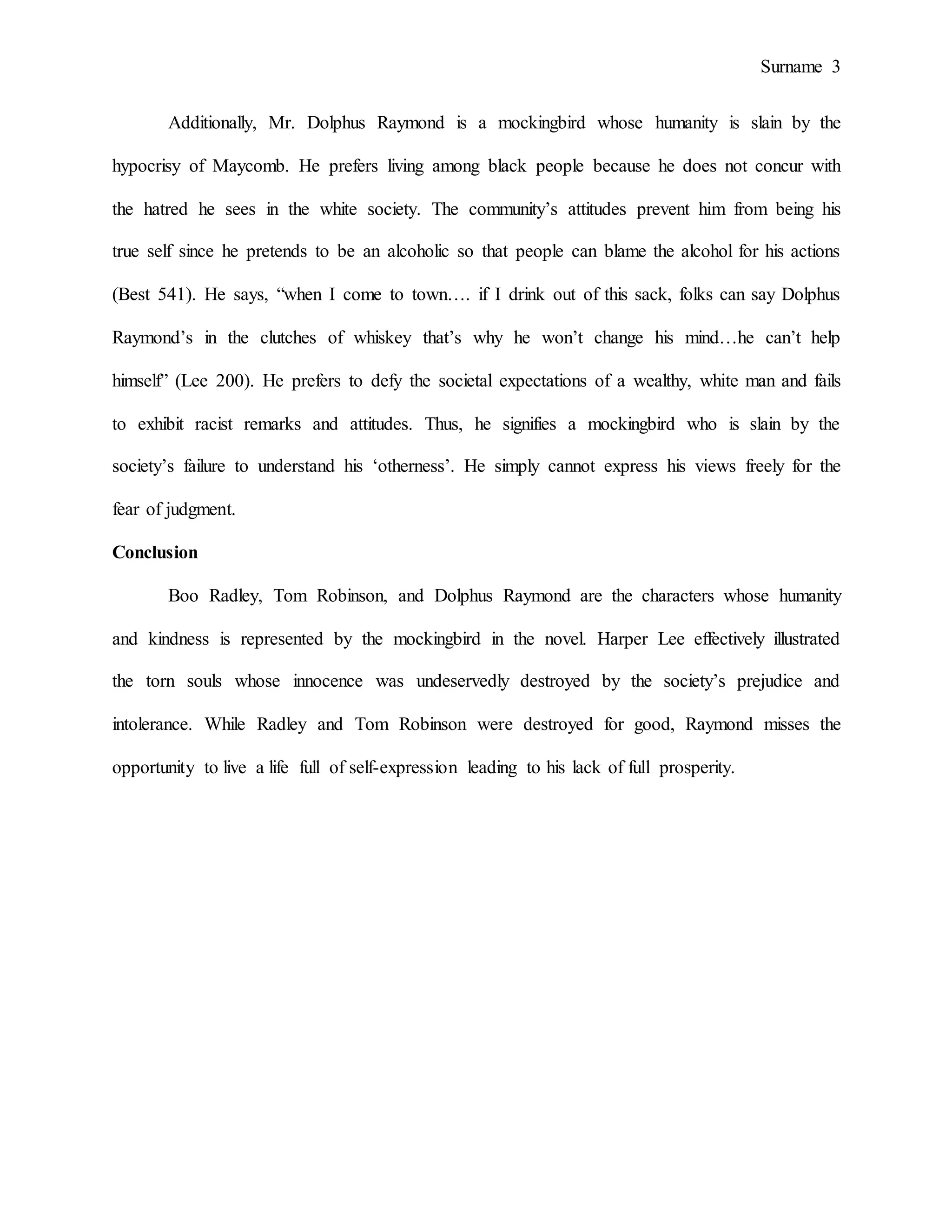
Additionally, Mr. Dolphus Raymond is a mockingbird whose humanity is slain by the
hypocrisy of Maycomb. He prefers living among black people because he does not concur with
the hatred he sees in the white society. The community’s attitudes prevent him from being his
true self since he pretends to be an alcoholic so that people can blame the alcohol for his actions
(Best 541). He says, “when I come to town…. if I drink out of this sack, folks can say Dolphus
Raymond’s in the clutches of whiskey that’s why he won’t change his mind…he can’t help
himself” (Lee 200). He prefers to defy the societal expectations of a wealthy, white man and fails
to exhibit racist remarks and attitudes. Thus, he signifies a mockingbird who is slain by the
society’s failure to understand his ‘otherness’. He simply cannot express his views freely for the
fear of judgment.
Conclusion
Boo Radley, Tom Robinson, and Dolphus Raymond are the characters whose humanity
and kindness is represented by the mockingbird in the novel. Harper Lee effectively illustrated
the torn souls whose innocence was undeservedly destroyed by the society’s prejudice and
intolerance. While Radley and Tom Robinson were destroyed for good, Raymond misses the
opportunity to live a life full of self-expression leading to his lack of full prosperity.
Surname 4
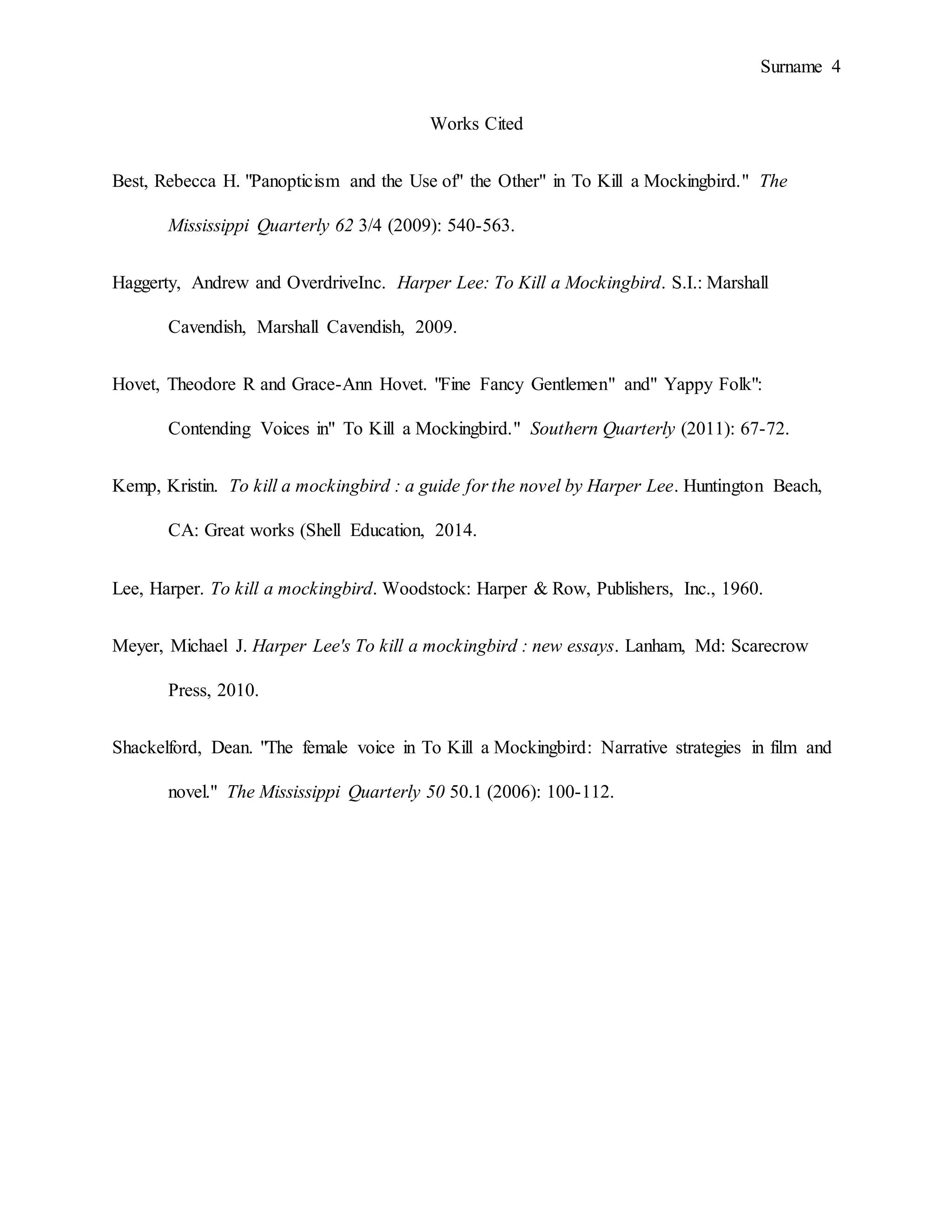
Works Cited
Best, Rebecca H. "Panopticism and the Use of" the Other" in To Kill a Mockingbird." The
Mississippi Quarterly 62 3/4 (2009): 540-563.
Haggerty, Andrew and OverdriveInc. Harper Lee: To Kill a Mockingbird. S.I.: Marshall
Cavendish, Marshall Cavendish, 2009.
Hovet, Theodore R and Grace-Ann Hovet. "Fine Fancy Gentlemen" and" Yappy Folk":
Contending Voices in" To Kill a Mockingbird." Southern Quarterly (2011): 67-72.
Kemp, Kristin. To kill a mockingbird : a guide for the novel by Harper Lee. Huntington Beach,
CA: Great works (Shell Education, 2014.
Lee, Harper. To kill a mockingbird. Woodstock: Harper & Row, Publishers, Inc., 1960.
Meyer, Michael J. Harper Lee's To kill a mockingbird : new essays. Lanham, Md: Scarecrow
Press, 2010.
Shackelford, Dean. "The female voice in To Kill a Mockingbird: Narrative strategies in film and
novel." The Mississippi Quarterly 50 50.1 (2006): 100-112.

To kill a mockingbird essay questions

  • 1.
    Surname 1 Student name: Instructorname: Course: Date: The Mockingbird as a Symbol of Humanity Introduction To Kill a Mockingbird by Harper Lee is a novel about a dysfunctional American society that is maimed by prejudice which culminates to extensive racial and social division. After reading the book’s title, the reader might be tempted to make a literal understanding yet the plot has a very little literal connection to it. This essay will identify and analyze the author’s use of the mockingbird in carrying a symbolic weight through three characters whose kindness was destroyed when they came into contact with evil. Therefore, the mockingbird signifies the idea of kind-heartedness which is destroyed through interaction with evil. As proclaimed by Atticus to his children, “shoot all the blue-jays you want, if you can hit them but remember it is a sin to slaughter a mockingbird” (Lee 96). Miss Maudie further elucidates this concept by saying, “Mockingbirds don’t do one thing but make music for us to enjoy. They don’t eat people’s gardens, don’t nest in corncribs, they don’t do one thing but sing their hearts out for us” (Lee 96). The Destruction of Innocence Boo Radley exemplifies a mockingbird that is slain by the prejudice in the society towards individuals who fail to conform to its norms. Although he is a harmless and thoughtful man, he falls victim to ridicule and cruelty by his neighbors (Haggerty and OverdriveInc.100). His innocence is seen when Scout describes him as shy and harmless, traits which make him
  • 2.
    Surname 2 vulnerable. Hebecomes a source of childhood superstition at the beginning of the book when the neighbors refer to him as the ‘malevolent phantom’ (Lee 9), and as the story progresses, he becomes real to Gem and Scout when he gives them presents and mends Jem’s pants even when they were taunting him. He also drapes a blanket over Scout and saved the children’s lives. It is only at the end of the story that Scout sees Radley’s true-self, a revelation that did not occur to many of his neighbors. Rumors about him spread in Maycomb as a recluse who failed to meet the town’s standards and his neighbors alienated him because of their intolerance to his differences (Shackelford 101). He was used as a scapegoat for all the crimes around town and people regarded him as evil. Moreover, he was not given an opportunity to defend his reputation. Despite all the rejection and hate that he faced, Boo continued being good (Meyer 165). Therefore, a Mockingbird, Boo Radley who is righteous and innocent, is shot by the society in the form of their alienation and hatred. Tom Robinson is another illustration of a mockingbird whose kind-heartedness is slain by injustice and racial bigotry. He was wrongfully accused of a crime that he did not commit, and although he was innocent, the society assumed he was guilty, solely because of his race (Kemp 98). Being a caring man, Tom had genuine concerns for Mayella’s welfare. He neither pushes the lady away nor harms her for her approaches, rather, he opts to run away. Scout ascertains the level of prejudice in the society by saying, “Tom was a dead man the moment Mayella Ewell screamed” (Lee 241). The townspeople made an attempt to lynch him for entertainment purposes, a common occurrence to any African-American male blamed of raping a white woman, hence he was to suffer the fury of this unfairness (Hovet and Hovet 67). It was in this regard that Tom was declared guilty by the jury. Thus, further enhancing the argument, Tom is another mockingbird who gets shot by the racial discrimination in his society.
  • 3.
    Surname 3 Additionally, Mr.Dolphus Raymond is a mockingbird whose humanity is slain by the hypocrisy of Maycomb. He prefers living among black people because he does not concur with the hatred he sees in the white society. The community’s attitudes prevent him from being his true self since he pretends to be an alcoholic so that people can blame the alcohol for his actions (Best 541). He says, “when I come to town…. if I drink out of this sack, folks can say Dolphus Raymond’s in the clutches of whiskey that’s why he won’t change his mind…he can’t help himself” (Lee 200). He prefers to defy the societal expectations of a wealthy, white man and fails to exhibit racist remarks and attitudes. Thus, he signifies a mockingbird who is slain by the society’s failure to understand his ‘otherness’. He simply cannot express his views freely for the fear of judgment. Conclusion Boo Radley, Tom Robinson, and Dolphus Raymond are the characters whose humanity and kindness is represented by the mockingbird in the novel. Harper Lee effectively illustrated the torn souls whose innocence was undeservedly destroyed by the society’s prejudice and intolerance. While Radley and Tom Robinson were destroyed for good, Raymond misses the opportunity to live a life full of self-expression leading to his lack of full prosperity.
  • 4.
    Surname 4 Works Cited Best,Rebecca H. "Panopticism and the Use of" the Other" in To Kill a Mockingbird." The Mississippi Quarterly 62 3/4 (2009): 540-563. Haggerty, Andrew and OverdriveInc. Harper Lee: To Kill a Mockingbird. S.I.: Marshall Cavendish, Marshall Cavendish, 2009. Hovet, Theodore R and Grace-Ann Hovet. "Fine Fancy Gentlemen" and" Yappy Folk": Contending Voices in" To Kill a Mockingbird." Southern Quarterly (2011): 67-72. Kemp, Kristin. To kill a mockingbird : a guide for the novel by Harper Lee. Huntington Beach, CA: Great works (Shell Education, 2014. Lee, Harper. To kill a mockingbird. Woodstock: Harper & Row, Publishers, Inc., 1960. Meyer, Michael J. Harper Lee's To kill a mockingbird : new essays. Lanham, Md: Scarecrow Press, 2010. Shackelford, Dean. "The female voice in To Kill a Mockingbird: Narrative strategies in film and novel." The Mississippi Quarterly 50 50.1 (2006): 100-112.