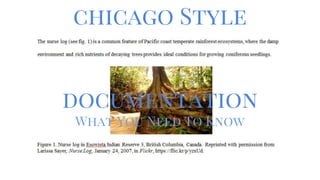
chicago Style
documentation
What You Need To Know
When to Cite:
● Using quotations
● Paraphrasing an idea from another
author
● Summarizing an idea from another
author
● Stating facts, statistics, quantitative
and qualitative data
● Featuring visuals, such as photos,
artwork, charts, tables, or graphs
If you are confused about whether or
not to cite a source, go ahead and cite
it just in case in order to prevent
accidental plagiarism.
Types of Sources
● Books
● Periodicals
● Websites
● A/V Recordings
● Multimedia
● Personal communication
● Interviews
Disciplines & Definitions
(1) Notes/Bibliography System:
● Used in the humanities, literature, history,
and the arts
● Requires footnotes and endnotes to cite
sources, or footnotes and bibliography
● Uses a number to indicate a citation
(2) Author-Date/References System:
● Used in social sciences
● Requires author’s last name and date of
publication
Notes: a form of citation that shows the reader where you got your information and how to find it; notes
are placed at the end of a sentence and after closing punctuation
Footnotes: indicated by a number located at the bottom of the page which matches a corresponding
superscript in the body paragraphs; footnotes are the same font and size as the rest of the paper
Endnotes: located at the end of the paper
Footnotes
Each superscript matches a corresponding footnote located at
the bottom of the page.
Creating Footnotes: Click on the “References” tab located on the toolbar. Then, click
“Insert Footnote” and a line and superscript number will appear at the bottom of the
page.
Formatting Footnotes:
1. Author name (First, Last), Title of Source,
Publisher/Website name, last date edited, page number,
URL.
● Use commas to separate items in a footnote. Only use a period after the last
item is listed.
● Indent the first line only in footnotes.
Example:
1. Susan Dunn, Dominion of Memories: Jefferson,
Madison, & the Decline of Virginia (New York, NY: Basic Books, 2007), 141.
Footnotes In a letter penned on December 20, 1787, Jefferson detailed to Madison his
objection to the lack of a Bill of Rights.1 After professing that sentiment,
Jefferson expounded that, "I have little to fill a letter. I will therefore make up
the deficiency by adding a few words on the Constitution...." He then went on
to offer his critiques:
I like the organization of the government into Legislature, Judiciary, &
Executive... [and]...the power given to the Legislature to levy taxes and
for that reason solely approve of the greater house being chosen by the
people directly, for... a house chosen by them will be very ill qualified to
legislate for the Union....yet this evil does not weigh against the good of
preserving inviolate the fundamental principle that the people are not
to be taxed but by representatives chosen immediately by themselves.2
1. Thomas Jefferson to James Madison on lack of Bill of Rights,
Dec. 20, 1887, in The Thomas Jefferson Papers at the Library of
Congress, https://www.loc.gov/item/mtjbib003193/.
2. Thomas Jefferson to James Madison on lack of Bill of Rights.
Examples
of
footnotes:
Note: block quotes
and footnotes are
single spaced
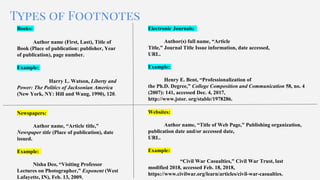
Types of Footnotes
Books:
Author name (First, Last), Title of
Book (Place of publication: publisher, Year
of publication), page number.
Example:
Harry L. Watson, Liberty and
Power: The Politics of Jacksonian America
(New York, NY: Hill and Wang, 1990), 120.
Newspapers:
Author name, “Article title,”
Newspaper title (Place of publication), date
issued.
Example:
Nisha Deo, “Visiting Professor
Lectures on Photographer,” Exponent (West
Lafayette, IN), Feb. 13, 2009.
Electronic Journals:
Author(s) full name, “Article
Title,” Journal Title Issue information, date accessed,
URL.
Example:
Henry E. Bent, “Professionalization of
the Ph.D. Degree,” College Composition and Communication 58, no. 4
(2007): 141, accessed Dec. 4, 2017,
http://www.jstor. org/stable/1978286.
Websites:
Author name, “Title of Web Page,” Publishing organization,
publication date and/or accessed date,
URL.
Example:
“Civil War Casualties," Civil War Trust, last
modified 2018, accessed Feb. 18, 2018,
https://www.civilwar.org/learn/articles/civil-war-casualties.
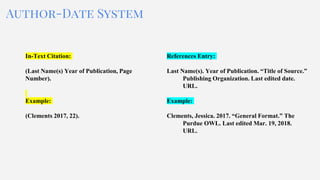
Author-Date System
In-Text Citation:
(Last Name(s) Year of Publication, Page
Number).
Example:
(Clements 2017, 22).
References Entry:
Last Name(s). Year of Publication. “Title of Source.”
Publishing Organization. Last edited date.
URL.
Example:
Clements, Jessica. 2017. “General Format.” The
Purdue OWL. Last edited Mar. 19, 2018.
URL.
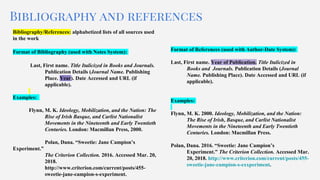
Bibliography and references
Bibliography/References: alphabetized lists of all sources used
in the work
Format of Bibliography (used with Notes System):
Last, First name. Title Italicized in Books and Journals.
Publication Details (Journal Name. Publishing
Place. Year). Date Accessed and URL (if
applicable).
Examples:
Flynn, M. K. Ideology, Mobilization, and the Nation: The
Rise of Irish Basque, and Carlist Nationalist
Movements in the Nineteenth and Early Twentieth
Centuries. London: Macmillan Press, 2000.
Polan, Dana. “Sweetie: Jane Campion’s
Experiment.”
The Criterion Collection. 2016. Accessed Mar. 20,
2018.
http://www.criterion.com/current/posts/455-
sweetie-jane-campion-s-experiment.
Format of References (used with Author-Date System):
Last, First name. Year of Publication. Title Italicized in
Books and Journals. Publication Details (Journal
Name. Publishing Place). Date Accessed and URL (if
applicable).
Examples:
Flynn, M. K. 2000. Ideology, Mobilization, and the Nation:
The Rise of Irish, Basque, and Carlist Nationalist
Movements in the Nineteenth and Early Twentieth
Centuries. London: Macmillan Press.
Polan, Dana. 2016. “Sweetie: Jane Campion’s
Experiment.” The Criterion Collection. Accessed Mar.
20, 2018. http://www.criterion.com/current/posts/455-
sweetie-jane-campion-s-exxperiment.
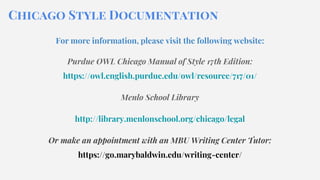
Chicago Style Documentation
For more information, please visit the following website:
Purdue OWL Chicago Manual of Style 17th Edition:
https://owl.english.purdue.edu/owl/resource/717/01/
Menlo School Library
http://library.menlonschool.org/chicago/legal
Or make an appointment with an MBU Writing Center Tutor:
https://go.marybaldwin.edu/writing-center/
Chicago Style Documentation

Chicago Style Documentation

  • 1.
  • 3.
    When to Cite: ●Using quotations ● Paraphrasing an idea from another author ● Summarizing an idea from another author ● Stating facts, statistics, quantitative and qualitative data ● Featuring visuals, such as photos, artwork, charts, tables, or graphs If you are confused about whether or not to cite a source, go ahead and cite it just in case in order to prevent accidental plagiarism.
  • 4.
    Types of Sources ●Books ● Periodicals ● Websites ● A/V Recordings ● Multimedia ● Personal communication ● Interviews
  • 5.
    Disciplines & Definitions (1)Notes/Bibliography System: ● Used in the humanities, literature, history, and the arts ● Requires footnotes and endnotes to cite sources, or footnotes and bibliography ● Uses a number to indicate a citation (2) Author-Date/References System: ● Used in social sciences ● Requires author’s last name and date of publication Notes: a form of citation that shows the reader where you got your information and how to find it; notes are placed at the end of a sentence and after closing punctuation Footnotes: indicated by a number located at the bottom of the page which matches a corresponding superscript in the body paragraphs; footnotes are the same font and size as the rest of the paper Endnotes: located at the end of the paper
  • 6.
    Footnotes Each superscript matchesa corresponding footnote located at the bottom of the page. Creating Footnotes: Click on the “References” tab located on the toolbar. Then, click “Insert Footnote” and a line and superscript number will appear at the bottom of the page. Formatting Footnotes: 1. Author name (First, Last), Title of Source, Publisher/Website name, last date edited, page number, URL. ● Use commas to separate items in a footnote. Only use a period after the last item is listed. ● Indent the first line only in footnotes. Example: 1. Susan Dunn, Dominion of Memories: Jefferson, Madison, & the Decline of Virginia (New York, NY: Basic Books, 2007), 141.
  • 8.
    Footnotes In aletter penned on December 20, 1787, Jefferson detailed to Madison his objection to the lack of a Bill of Rights.1 After professing that sentiment, Jefferson expounded that, "I have little to fill a letter. I will therefore make up the deficiency by adding a few words on the Constitution...." He then went on to offer his critiques: I like the organization of the government into Legislature, Judiciary, & Executive... [and]...the power given to the Legislature to levy taxes and for that reason solely approve of the greater house being chosen by the people directly, for... a house chosen by them will be very ill qualified to legislate for the Union....yet this evil does not weigh against the good of preserving inviolate the fundamental principle that the people are not to be taxed but by representatives chosen immediately by themselves.2 1. Thomas Jefferson to James Madison on lack of Bill of Rights, Dec. 20, 1887, in The Thomas Jefferson Papers at the Library of Congress, https://www.loc.gov/item/mtjbib003193/. 2. Thomas Jefferson to James Madison on lack of Bill of Rights. Examples of footnotes: Note: block quotes and footnotes are single spaced
  • 9.
    Types of Footnotes Books: Authorname (First, Last), Title of Book (Place of publication: publisher, Year of publication), page number. Example: Harry L. Watson, Liberty and Power: The Politics of Jacksonian America (New York, NY: Hill and Wang, 1990), 120. Newspapers: Author name, “Article title,” Newspaper title (Place of publication), date issued. Example: Nisha Deo, “Visiting Professor Lectures on Photographer,” Exponent (West Lafayette, IN), Feb. 13, 2009. Electronic Journals: Author(s) full name, “Article Title,” Journal Title Issue information, date accessed, URL. Example: Henry E. Bent, “Professionalization of the Ph.D. Degree,” College Composition and Communication 58, no. 4 (2007): 141, accessed Dec. 4, 2017, http://www.jstor. org/stable/1978286. Websites: Author name, “Title of Web Page,” Publishing organization, publication date and/or accessed date, URL. Example: “Civil War Casualties," Civil War Trust, last modified 2018, accessed Feb. 18, 2018, https://www.civilwar.org/learn/articles/civil-war-casualties.
  • 11.
    Author-Date System In-Text Citation: (LastName(s) Year of Publication, Page Number). Example: (Clements 2017, 22). References Entry: Last Name(s). Year of Publication. “Title of Source.” Publishing Organization. Last edited date. URL. Example: Clements, Jessica. 2017. “General Format.” The Purdue OWL. Last edited Mar. 19, 2018. URL.
  • 12.
    Bibliography and references Bibliography/References:alphabetized lists of all sources used in the work Format of Bibliography (used with Notes System): Last, First name. Title Italicized in Books and Journals. Publication Details (Journal Name. Publishing Place. Year). Date Accessed and URL (if applicable). Examples: Flynn, M. K. Ideology, Mobilization, and the Nation: The Rise of Irish Basque, and Carlist Nationalist Movements in the Nineteenth and Early Twentieth Centuries. London: Macmillan Press, 2000. Polan, Dana. “Sweetie: Jane Campion’s Experiment.” The Criterion Collection. 2016. Accessed Mar. 20, 2018. http://www.criterion.com/current/posts/455- sweetie-jane-campion-s-experiment. Format of References (used with Author-Date System): Last, First name. Year of Publication. Title Italicized in Books and Journals. Publication Details (Journal Name. Publishing Place). Date Accessed and URL (if applicable). Examples: Flynn, M. K. 2000. Ideology, Mobilization, and the Nation: The Rise of Irish, Basque, and Carlist Nationalist Movements in the Nineteenth and Early Twentieth Centuries. London: Macmillan Press. Polan, Dana. 2016. “Sweetie: Jane Campion’s Experiment.” The Criterion Collection. Accessed Mar. 20, 2018. http://www.criterion.com/current/posts/455- sweetie-jane-campion-s-exxperiment.
  • 14.
    Chicago Style Documentation Formore information, please visit the following website: Purdue OWL Chicago Manual of Style 17th Edition: https://owl.english.purdue.edu/owl/resource/717/01/ Menlo School Library http://library.menlonschool.org/chicago/legal Or make an appointment with an MBU Writing Center Tutor: https://go.marybaldwin.edu/writing-center/