“Cite is right”
PRESENTED BY
ABDUL MOID
RESEARCH SCHOLAR
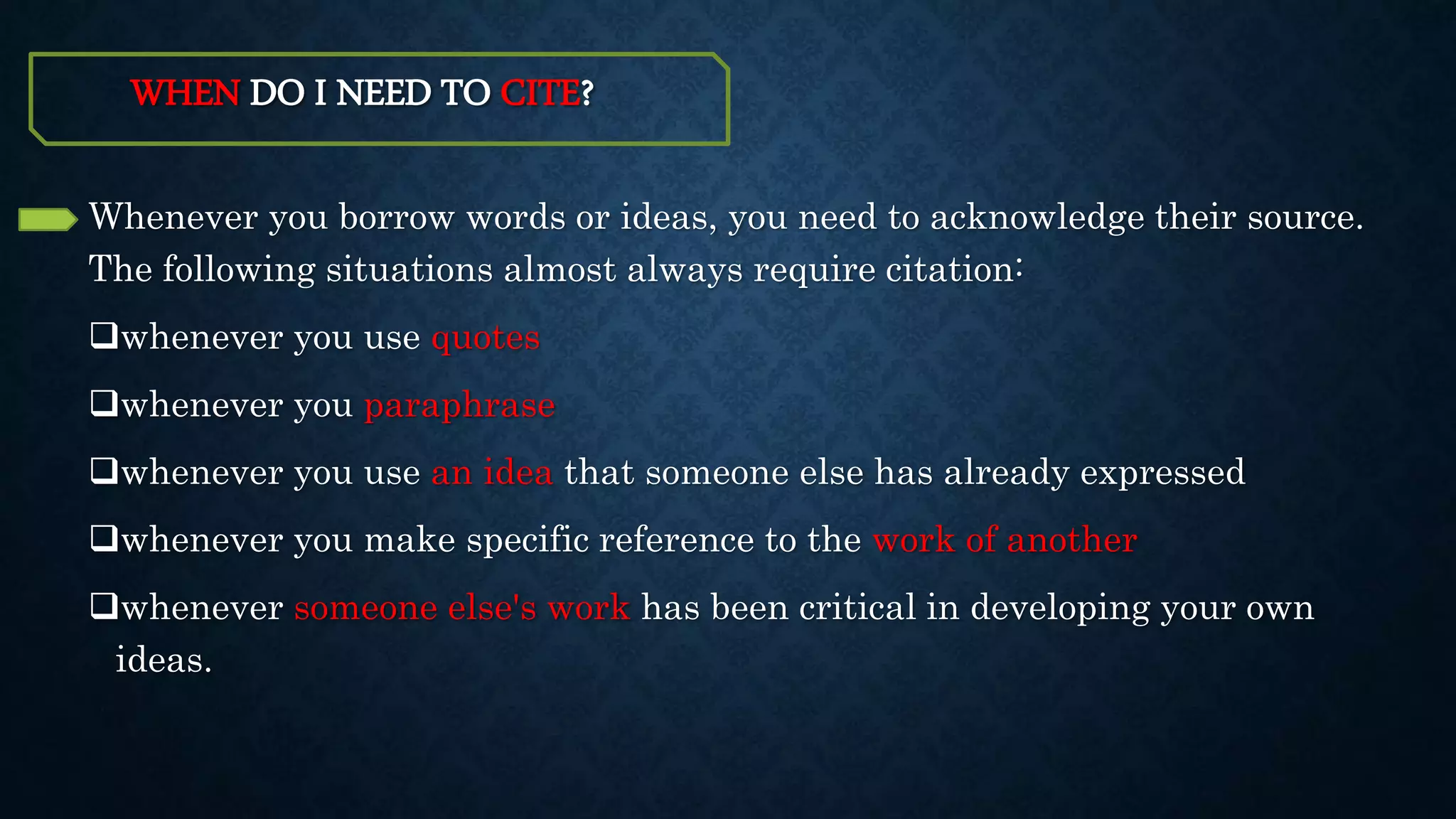
What is Citation?
When do I need to cite?
What and How to cite?
A "citation" is the way you tell your readers that certain material in your
work came from another source. It also gives your readers the information
necessary to find that source again, including:
 information about the author
 the title of the work
 the name and location of the company that published your copy of the
source
 the date your copy was published
 the page numbers of the material you are borrowing
What is Citation?
WHEN DO I NEED TO CITE?
Whenever you borrow words or ideas, you need to acknowledge their source.
The following situations almost always require citation:
whenever you use quotes
whenever you paraphrase
whenever you use an idea that someone else has already expressed
whenever you make specific reference to the work of another
whenever someone else's work has been critical in developing your own
ideas.
WHAT AND HOW TO CITE?
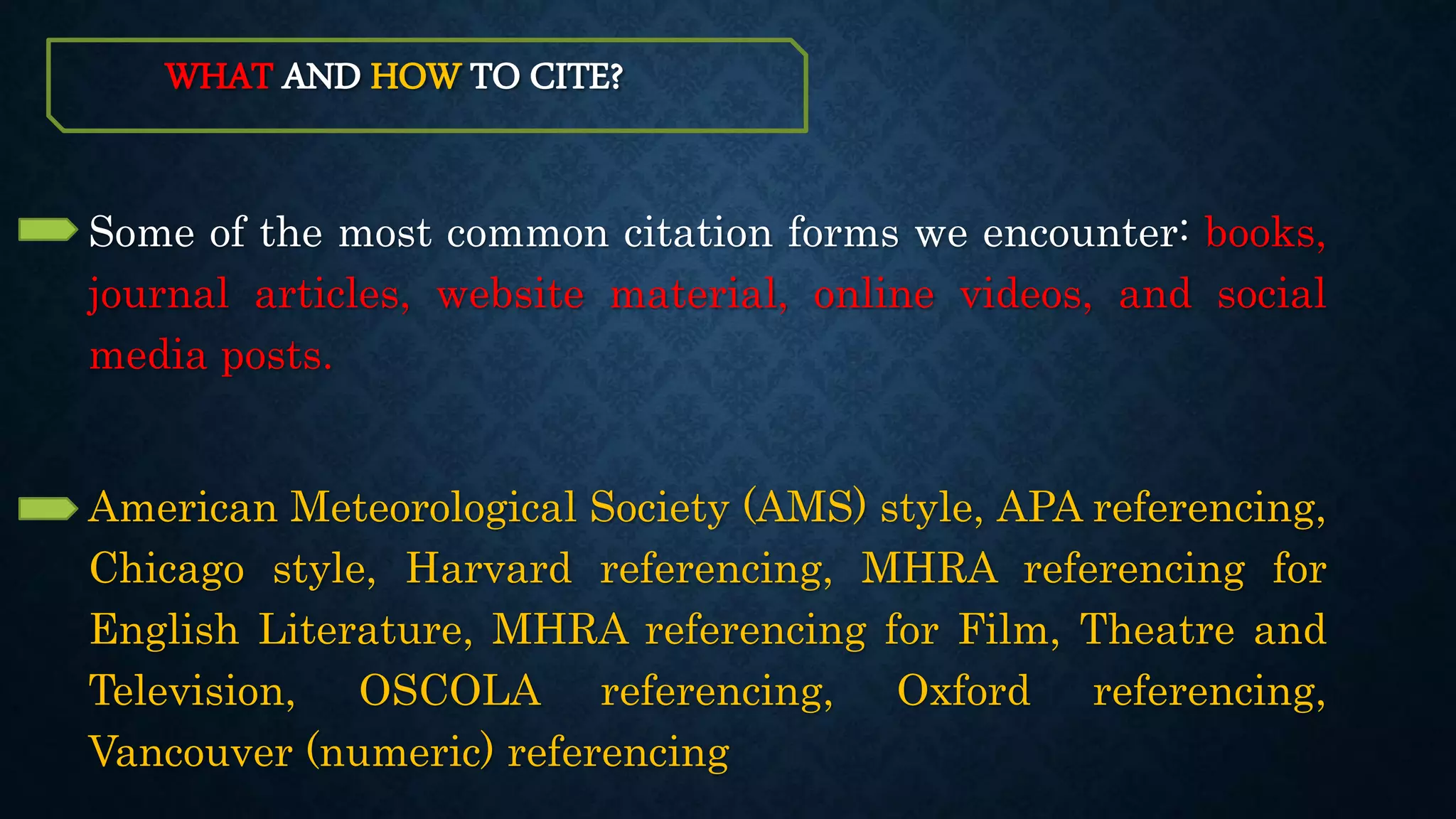
Some of the most common citation forms we encounter: books,
journal articles, website material, online videos, and social
media posts.
American Meteorological Society (AMS) style, APA referencing,
Chicago style, Harvard referencing, MHRA referencing for
English Literature, MHRA referencing for Film, Theatre and
Television, OSCOLA referencing, Oxford referencing,
Vancouver (numeric) referencing
CHICAGO-STYLE OF REFERENCING
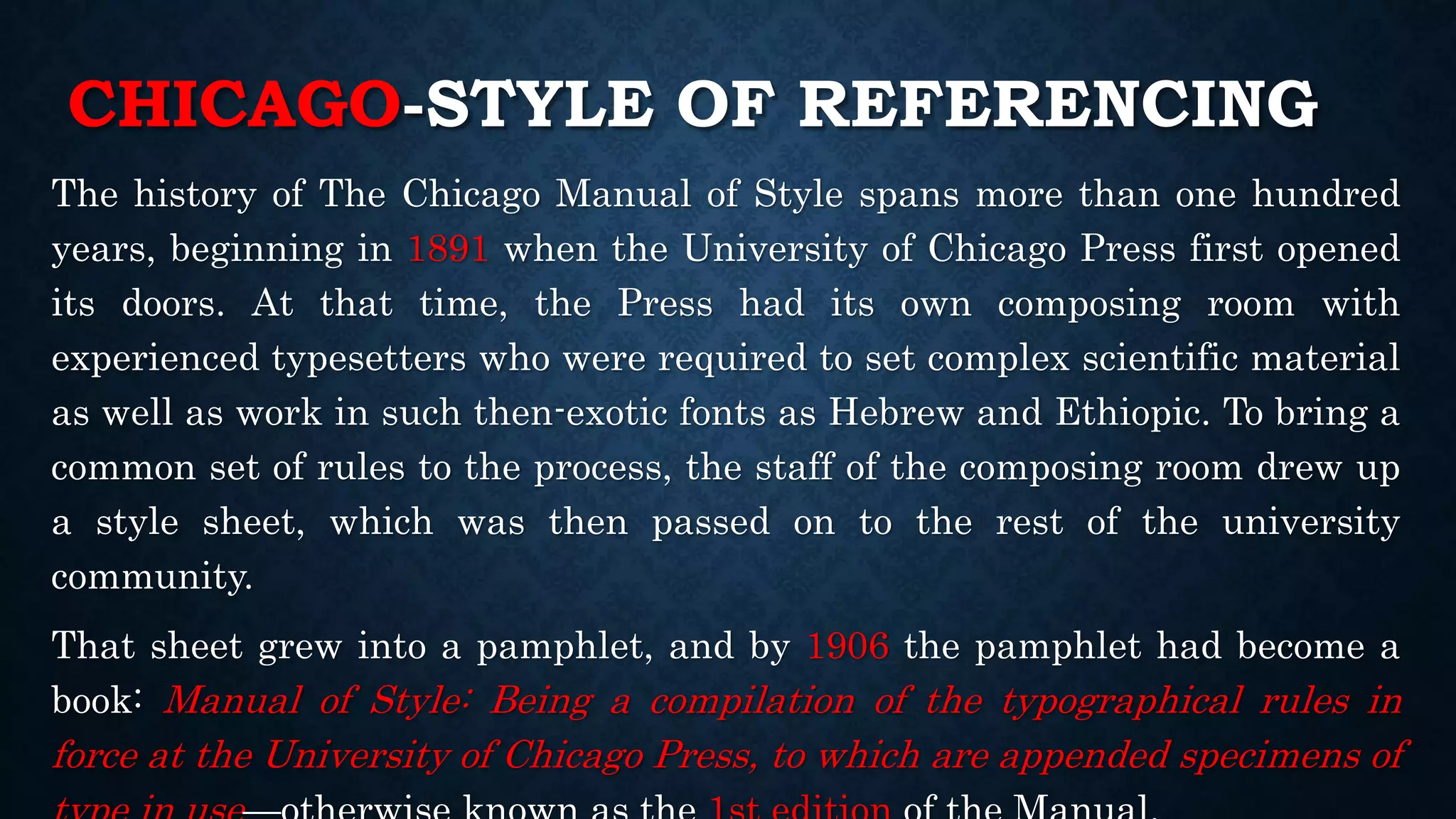
The history of The Chicago Manual of Style spans more than one hundred
years, beginning in 1891 when the University of Chicago Press first opened
its doors. At that time, the Press had its own composing room with
experienced typesetters who were required to set complex scientific material
as well as work in such then-exotic fonts as Hebrew and Ethiopic. To bring a
common set of rules to the process, the staff of the composing room drew up
a style sheet, which was then passed on to the rest of the university
community.
That sheet grew into a pamphlet, and by 1906 the pamphlet had become a
book: Manual of Style: Being a compilation of the typographical rules in
force at the University of Chicago Press, to which are appended specimens of
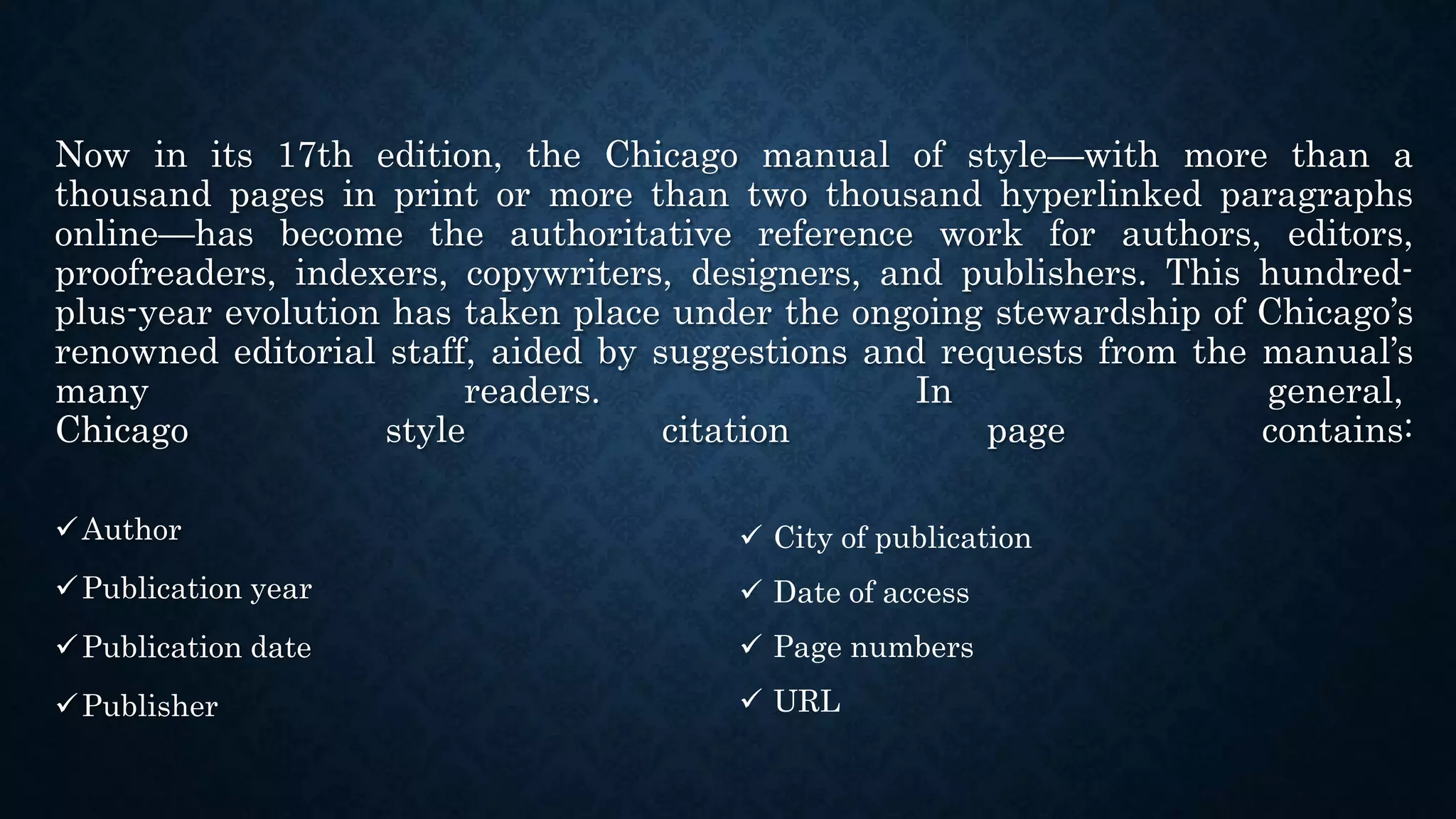
Now in its 17th edition, the Chicago manual of style—with more than a
thousand pages in print or more than two thousand hyperlinked paragraphs
online—has become the authoritative reference work for authors, editors,
proofreaders, indexers, copywriters, designers, and publishers. This hundred-
plus-year evolution has taken place under the ongoing stewardship of Chicago’s
renowned editorial staff, aided by suggestions and requests from the manual’s
many readers. In general,
Chicago style citation page contains:
Author
Publication year
Publication date
Publisher
 City of publication
 Date of access
 Page numbers
 URL
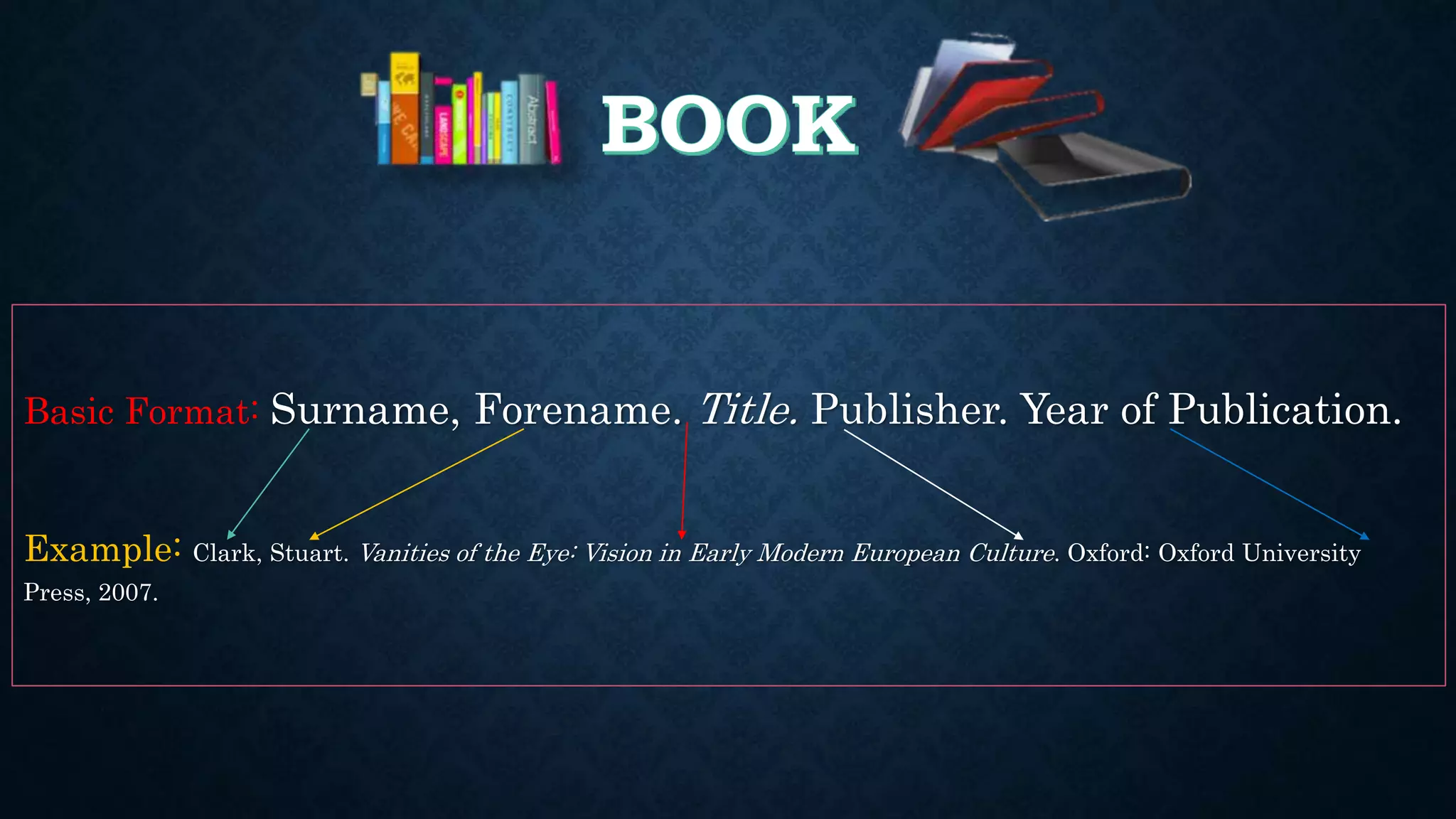
Basic Format: Surname, Forename. Title. Publisher. Year of Publication.
Example: Clark, Stuart. Vanities of the Eye: Vision in Early Modern European Culture. Oxford: Oxford University
Press, 2007.
ARTICLES IN
JOURNALS
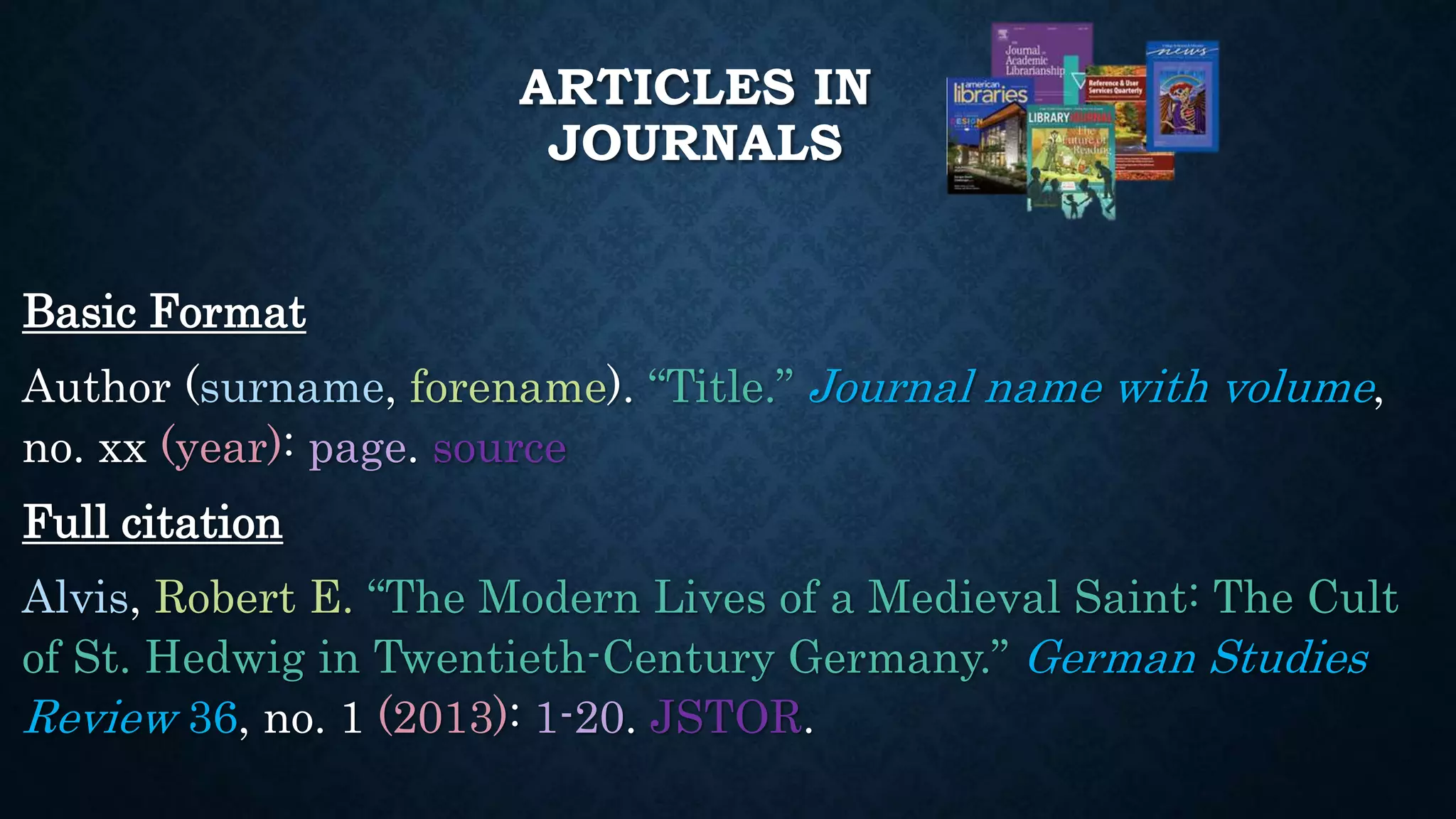
Basic Format
Author (surname, forename). “Title.” Journal name with volume,
no. xx (year): page. source
Full citation
Alvis, Robert E. “The Modern Lives of a Medieval Saint: The Cult
of St. Hedwig in Twentieth-Century Germany.” German Studies
Review 36, no. 1 (2013): 1-20. JSTOR.
WEBSITES
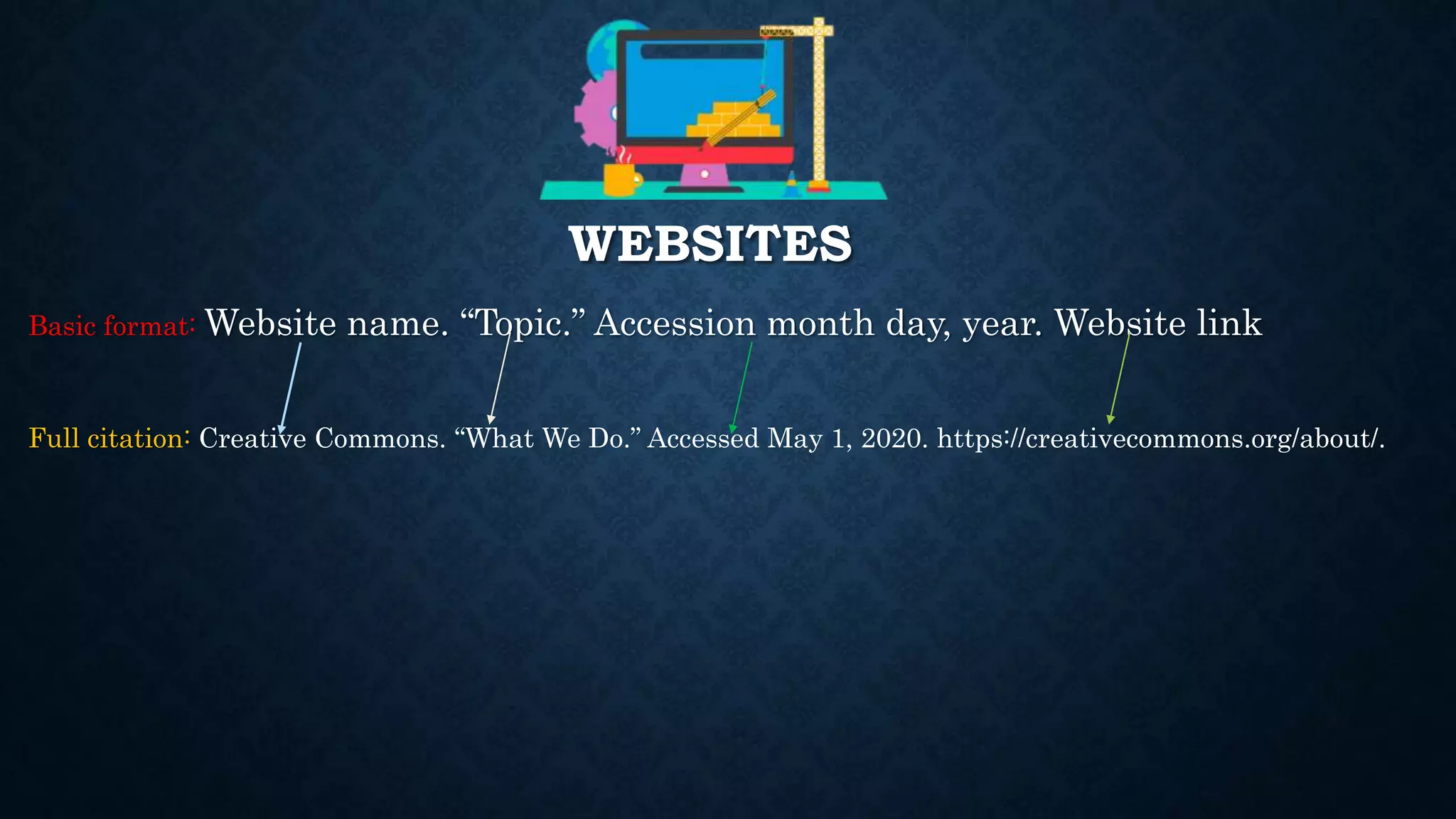
Basic format: Website name. “Topic.” Accession month day, year. Website link
Full citation: Creative Commons. “What We Do.” Accessed May 1, 2020. https://creativecommons.org/about/.
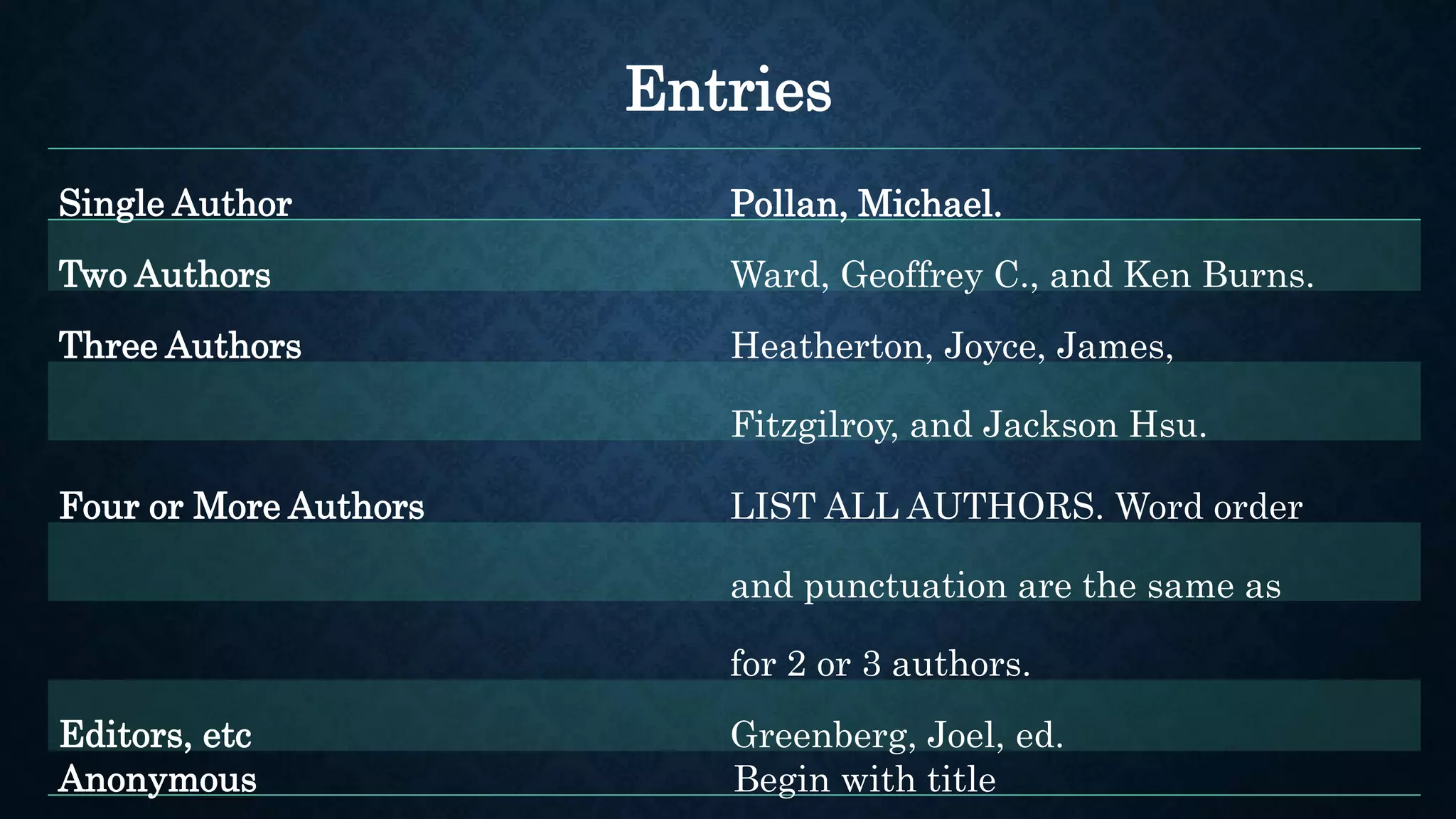
Single Author Pollan, Michael.
Two Authors Ward, Geoffrey C., and Ken Burns.
Three Authors Heatherton, Joyce, James,
Fitzgilroy, and Jackson Hsu.
Four or More Authors LIST ALL AUTHORS. Word order
and punctuation are the same as
for 2 or 3 authors.
Editors, etc Greenberg, Joel, ed.
Anonymous Begin with title
Entries
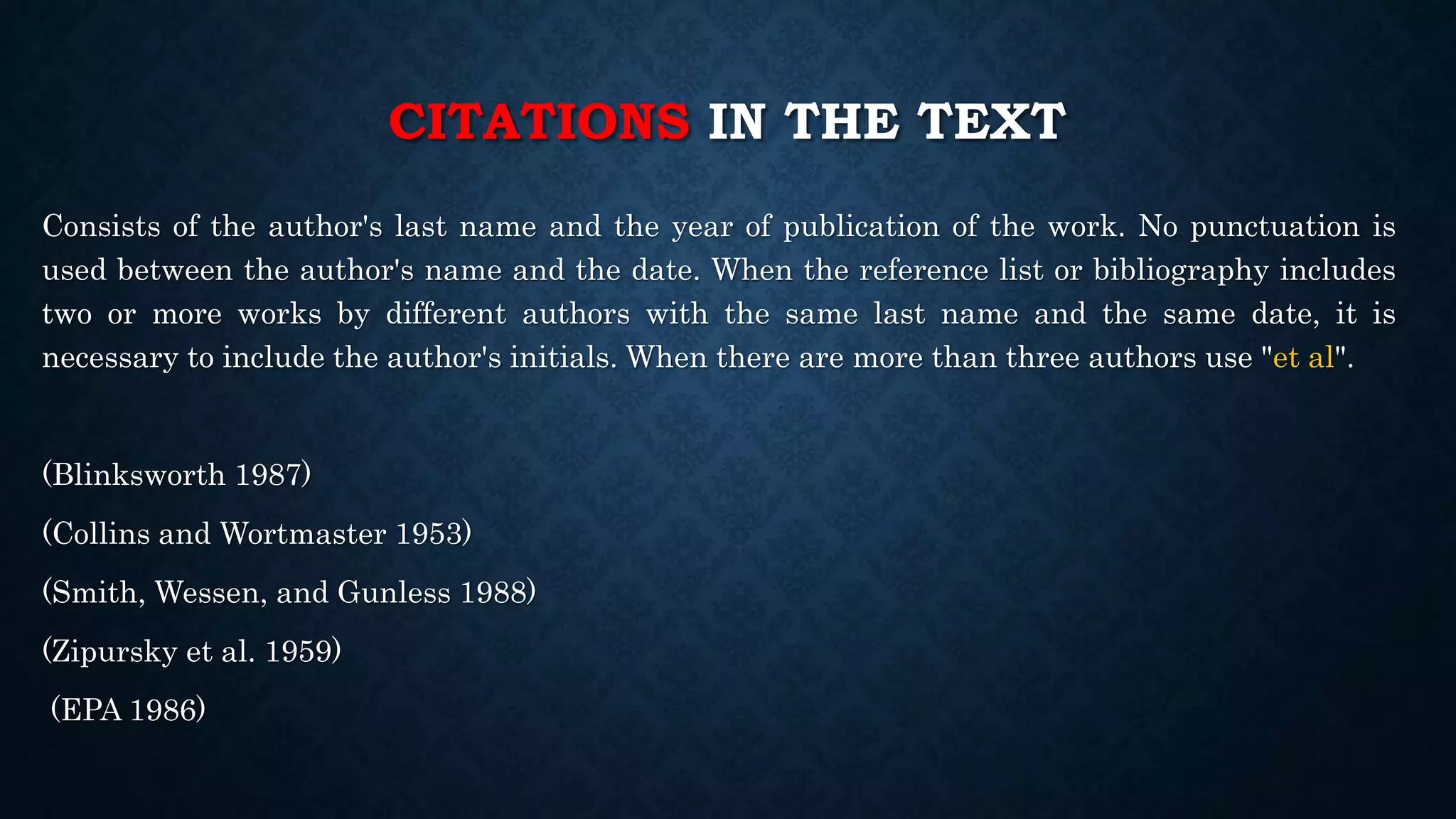
CITATIONS IN THE TEXT
Consists of the author's last name and the year of publication of the work. No punctuation is
used between the author's name and the date. When the reference list or bibliography includes
two or more works by different authors with the same last name and the same date, it is
necessary to include the author's initials. When there are more than three authors use "et al".
(Blinksworth 1987)
(Collins and Wortmaster 1953)
(Smith, Wessen, and Gunless 1988)
(Zipursky et al. 1959)
(EPA 1986)
Thank you

Chicago style of referencing

  • 1.
    “Cite is right” PRESENTEDBY ABDUL MOID RESEARCH SCHOLAR What is Citation? When do I need to cite? What and How to cite?
  • 2.
    A "citation" isthe way you tell your readers that certain material in your work came from another source. It also gives your readers the information necessary to find that source again, including:  information about the author  the title of the work  the name and location of the company that published your copy of the source  the date your copy was published  the page numbers of the material you are borrowing What is Citation?
  • 3.
    WHEN DO INEED TO CITE? Whenever you borrow words or ideas, you need to acknowledge their source. The following situations almost always require citation: whenever you use quotes whenever you paraphrase whenever you use an idea that someone else has already expressed whenever you make specific reference to the work of another whenever someone else's work has been critical in developing your own ideas.
  • 4.
    WHAT AND HOWTO CITE? Some of the most common citation forms we encounter: books, journal articles, website material, online videos, and social media posts. American Meteorological Society (AMS) style, APA referencing, Chicago style, Harvard referencing, MHRA referencing for English Literature, MHRA referencing for Film, Theatre and Television, OSCOLA referencing, Oxford referencing, Vancouver (numeric) referencing
  • 5.
    CHICAGO-STYLE OF REFERENCING Thehistory of The Chicago Manual of Style spans more than one hundred years, beginning in 1891 when the University of Chicago Press first opened its doors. At that time, the Press had its own composing room with experienced typesetters who were required to set complex scientific material as well as work in such then-exotic fonts as Hebrew and Ethiopic. To bring a common set of rules to the process, the staff of the composing room drew up a style sheet, which was then passed on to the rest of the university community. That sheet grew into a pamphlet, and by 1906 the pamphlet had become a book: Manual of Style: Being a compilation of the typographical rules in force at the University of Chicago Press, to which are appended specimens of
  • 6.
    Now in its17th edition, the Chicago manual of style—with more than a thousand pages in print or more than two thousand hyperlinked paragraphs online—has become the authoritative reference work for authors, editors, proofreaders, indexers, copywriters, designers, and publishers. This hundred- plus-year evolution has taken place under the ongoing stewardship of Chicago’s renowned editorial staff, aided by suggestions and requests from the manual’s many readers. In general, Chicago style citation page contains: Author Publication year Publication date Publisher  City of publication  Date of access  Page numbers  URL
  • 7.
    Basic Format: Surname,Forename. Title. Publisher. Year of Publication. Example: Clark, Stuart. Vanities of the Eye: Vision in Early Modern European Culture. Oxford: Oxford University Press, 2007.
  • 8.
    ARTICLES IN JOURNALS Basic Format Author(surname, forename). “Title.” Journal name with volume, no. xx (year): page. source Full citation Alvis, Robert E. “The Modern Lives of a Medieval Saint: The Cult of St. Hedwig in Twentieth-Century Germany.” German Studies Review 36, no. 1 (2013): 1-20. JSTOR.
  • 9.
    WEBSITES Basic format: Websitename. “Topic.” Accession month day, year. Website link Full citation: Creative Commons. “What We Do.” Accessed May 1, 2020. https://creativecommons.org/about/.
  • 10.
    Single Author Pollan,Michael. Two Authors Ward, Geoffrey C., and Ken Burns. Three Authors Heatherton, Joyce, James, Fitzgilroy, and Jackson Hsu. Four or More Authors LIST ALL AUTHORS. Word order and punctuation are the same as for 2 or 3 authors. Editors, etc Greenberg, Joel, ed. Anonymous Begin with title Entries
  • 11.
    CITATIONS IN THETEXT Consists of the author's last name and the year of publication of the work. No punctuation is used between the author's name and the date. When the reference list or bibliography includes two or more works by different authors with the same last name and the same date, it is necessary to include the author's initials. When there are more than three authors use "et al". (Blinksworth 1987) (Collins and Wortmaster 1953) (Smith, Wessen, and Gunless 1988) (Zipursky et al. 1959) (EPA 1986)
  • 12.