Created by Candice Benjes-Small
Presented by Sarah Smith
APA 6th
for RU Students
Citations and References
What’s the difference?
Reference is the entry in the bibliography at the end of the
paper
Citation is the in-text parenthetical notation alerting readers to
where a particular quote or piece of information came from
Why do we cite?
To prevent plagiarism
To give credit
To support our arguments
When do we cite?
Quotations
Word for word (used rarely in health sciences)
Paraphrases
Putting a sentence or paragraph into your own words
Summaries
Providing a short sentence or two summing up an article,
usually emphasizing what the conclusion of the article was
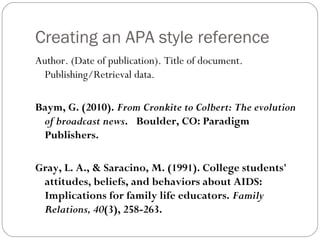
Creating an APA style reference
Author. (Date of publication). Title of document.
Publishing/Retrieval data.
Baym, G. (2010). From Cronkite to Colbert: The evolution
of broadcast news.  Boulder, CO: Paradigm
Publishers.
Gray, L. A., & Saracino, M. (1991). College students'
attitudes, beliefs, and behaviors about AIDS:
Implications for family life educators. Family
Relations, 40(3), 258-263.
Secret to Success
Find an example of what you wish to cite and follow the
format in the example
Order the parts like in the example
Use capitalization like in the example
Use italics like in the example
FOLLOW THE EXAMPLE!
Finding Examples
The APA Publication Manual
Note that the back cover is a guide to reference examples
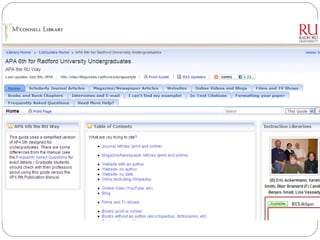
RU’s color-coded APA Guide
Intended for undergraduates, but still useful for examples
If you can’t find example there, be sure to check the Manual
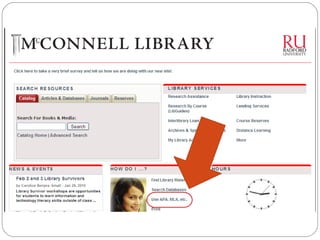
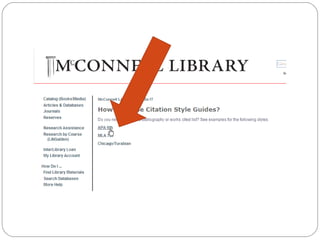
Next two slides show you how to find the Color-Coded Guide
from the library home page: http://library.radford.edu
Using the Color-Coded Guide
Decide what kind of item you are trying to cite
Choose the tab that corresponds to that type of item
Also look at the tabs for in-text citations and formatting your
paper for further help
Social Work students most often use JOURNAL ARTICLES
In your manual or on the color-coded guide, find an example
of an APA reference for scholarly journal articles
In the next two slides, compare the original article with an
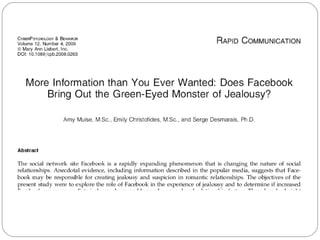
APA reference of the article. What is different?
APA reference for the article
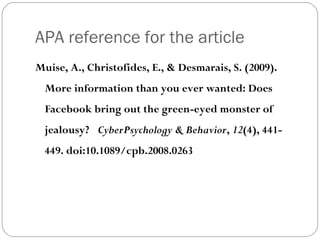
Muise, A., Christofides, E., & Desmarais, S. (2009).
More information than you ever wanted: Does
Facebook bring out the green-eyed monster of
jealousy?  CyberPsychology & Behavior, 12(4), 441-
449. doi:10.1089/cpb.2008.0263
Differences
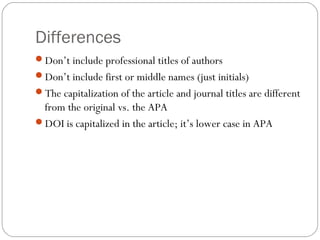
Don’t include professional titles of authors
Don’t include first or middle names (just initials)
The capitalization of the article and journal titles are different
from the original vs. the APA
DOI is capitalized in the article; it’s lower case in APA
In-Text Citation
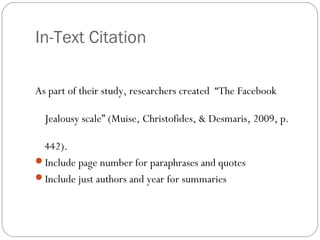
As part of their study, researchers created “The Facebook
Jealousy scale” (Muise, Christofides, & Desmaris, 2009, p.
442).
Include page number for paraphrases and quotes
Include just authors and year for summaries
Multiple Authors
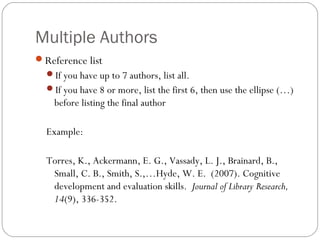
Reference list
If you have up to 7 authors, list all.
If you have 8 or more, list the first 6, then use the ellipse (…)
before listing the final author
Example:
Torres, K., Ackermann, E. G., Vassady, L. J., Brainard, B.,
Small, C. B., Smith, S.,…Hyde, W. E. (2007). Cognitive
development and evaluation skills. Journal of Library Research,
14(9), 336-352.
Multiple Authors
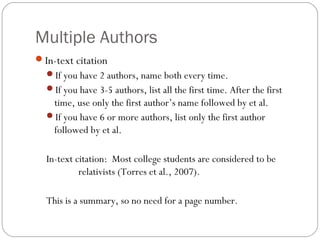
In-text citation
If you have 2 authors, name both every time.
If you have 3-5 authors, list all the first time. After the first
time, use only the first author’s name followed by et al.
If you have 6 or more authors, list only the first author
followed by et al.
In-text citation: Most college students are considered to be
relativists (Torres et al., 2007).
This is a summary, so no need for a page number.
No author
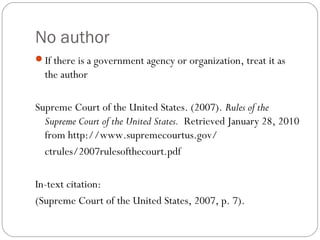
If there is a government agency or organization, treat it as
the author
Supreme Court of the United States. (2007). Rules of the
Supreme Court of the United States. Retrieved January 28, 2010
from http://www.supremecourtus.gov/
ctrules/2007rulesofthecourt.pdf
In-text citation:
(Supreme Court of the United States, 2007, p. 7).
No author at all- I swear!
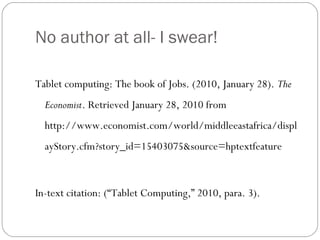
Tablet computing: The book of Jobs. (2010, January 28). The
Economist. Retrieved January 28, 2010 from
http://www.economist.com/world/middleeastafrica/displ
ayStory.cfm?story_id=15403075&source=hptextfeature
In-text citation: (“Tablet Computing,” 2010, para. 3).
No author continued
NEVER start with the date! Instead, the title moves into the
first spot, followed by the date.
Citing indirect sources
Sheets, Fredendall, and Claypool created categories for
different situations that could cause jealousy (as cited in
Muise, Christofides, & Desmarais, 2009, p. 442).
*In your reference list, you would have an entry for the Muise,
Christofides, & Desmarais article. You would not have an
entry for the Sheets, Fredendall, and Claypool article.
Citing legal sources
Follow models from:
http://www.lib.wsc.ma.edu/legalapa.htm
APA Publication Manual, Appendix 7.1 (pgs. 216-224)
Reference to a U.S. Supreme Court case:
Brown v. Board of Educ., 347 U.S. 483 (1954).
In-text citation:
In the case of Brown v. Board of Educ. (1954), the court decided…
~or~ (Brown v. Board of Educ., 1954)
McConnell Library
 IM: RULibSpot
 E-mail: refdesk@radford.edu
APA Color-Coded Guide:
http://libguides.radford.edu/apastyle
For more help

Apa 6th for ru students swk

  • 1.
    Created by CandiceBenjes-Small Presented by Sarah Smith APA 6th for RU Students
  • 2.
    Citations and References What’sthe difference? Reference is the entry in the bibliography at the end of the paper Citation is the in-text parenthetical notation alerting readers to where a particular quote or piece of information came from
  • 3.
    Why do wecite? To prevent plagiarism To give credit To support our arguments
  • 4.
    When do wecite? Quotations Word for word (used rarely in health sciences) Paraphrases Putting a sentence or paragraph into your own words Summaries Providing a short sentence or two summing up an article, usually emphasizing what the conclusion of the article was
  • 5.
    Creating an APAstyle reference Author. (Date of publication). Title of document. Publishing/Retrieval data. Baym, G. (2010). From Cronkite to Colbert: The evolution of broadcast news.  Boulder, CO: Paradigm Publishers. Gray, L. A., & Saracino, M. (1991). College students' attitudes, beliefs, and behaviors about AIDS: Implications for family life educators. Family Relations, 40(3), 258-263.
  • 6.
    Secret to Success Findan example of what you wish to cite and follow the format in the example Order the parts like in the example Use capitalization like in the example Use italics like in the example FOLLOW THE EXAMPLE!
  • 7.
    Finding Examples The APAPublication Manual Note that the back cover is a guide to reference examples RU’s color-coded APA Guide Intended for undergraduates, but still useful for examples If you can’t find example there, be sure to check the Manual Next two slides show you how to find the Color-Coded Guide from the library home page: http://library.radford.edu
  • 11.
    Using the Color-CodedGuide Decide what kind of item you are trying to cite Choose the tab that corresponds to that type of item Also look at the tabs for in-text citations and formatting your paper for further help
  • 12.
    Social Work studentsmost often use JOURNAL ARTICLES In your manual or on the color-coded guide, find an example of an APA reference for scholarly journal articles In the next two slides, compare the original article with an APA reference of the article. What is different?
  • 14.
    APA reference forthe article Muise, A., Christofides, E., & Desmarais, S. (2009). More information than you ever wanted: Does Facebook bring out the green-eyed monster of jealousy?  CyberPsychology & Behavior, 12(4), 441- 449. doi:10.1089/cpb.2008.0263
  • 15.
    Differences Don’t include professionaltitles of authors Don’t include first or middle names (just initials) The capitalization of the article and journal titles are different from the original vs. the APA DOI is capitalized in the article; it’s lower case in APA
  • 16.
    In-Text Citation As partof their study, researchers created “The Facebook Jealousy scale” (Muise, Christofides, & Desmaris, 2009, p. 442). Include page number for paraphrases and quotes Include just authors and year for summaries
  • 17.
    Multiple Authors Reference list Ifyou have up to 7 authors, list all. If you have 8 or more, list the first 6, then use the ellipse (…) before listing the final author Example: Torres, K., Ackermann, E. G., Vassady, L. J., Brainard, B., Small, C. B., Smith, S.,…Hyde, W. E. (2007). Cognitive development and evaluation skills. Journal of Library Research, 14(9), 336-352.
  • 18.
    Multiple Authors In-text citation Ifyou have 2 authors, name both every time. If you have 3-5 authors, list all the first time. After the first time, use only the first author’s name followed by et al. If you have 6 or more authors, list only the first author followed by et al. In-text citation: Most college students are considered to be relativists (Torres et al., 2007). This is a summary, so no need for a page number.
  • 19.
    No author If thereis a government agency or organization, treat it as the author Supreme Court of the United States. (2007). Rules of the Supreme Court of the United States. Retrieved January 28, 2010 from http://www.supremecourtus.gov/ ctrules/2007rulesofthecourt.pdf In-text citation: (Supreme Court of the United States, 2007, p. 7).
  • 20.
    No author atall- I swear! Tablet computing: The book of Jobs. (2010, January 28). The Economist. Retrieved January 28, 2010 from http://www.economist.com/world/middleeastafrica/displ ayStory.cfm?story_id=15403075&source=hptextfeature In-text citation: (“Tablet Computing,” 2010, para. 3).
  • 21.
    No author continued NEVERstart with the date! Instead, the title moves into the first spot, followed by the date.
  • 22.
    Citing indirect sources Sheets,Fredendall, and Claypool created categories for different situations that could cause jealousy (as cited in Muise, Christofides, & Desmarais, 2009, p. 442). *In your reference list, you would have an entry for the Muise, Christofides, & Desmarais article. You would not have an entry for the Sheets, Fredendall, and Claypool article.
  • 23.
    Citing legal sources Followmodels from: http://www.lib.wsc.ma.edu/legalapa.htm APA Publication Manual, Appendix 7.1 (pgs. 216-224) Reference to a U.S. Supreme Court case: Brown v. Board of Educ., 347 U.S. 483 (1954). In-text citation: In the case of Brown v. Board of Educ. (1954), the court decided… ~or~ (Brown v. Board of Educ., 1954)
  • 24.
    McConnell Library  IM:RULibSpot  E-mail: refdesk@radford.edu APA Color-Coded Guide: http://libguides.radford.edu/apastyle For more help

Editor's Notes

  • #6 Go to Libguide and show Scholarly journal, Magazine/Newspaper, Books and Websites very quickly- point out how similar the format is. The devil is usually in the details. Find the closest example and go with that.
  • #14 Here’s the original article- note differences from final citation: Don’t include the titles of the authors; don’t include “rapid communication”; DOI is capitalized; capitalization of title is different.