1
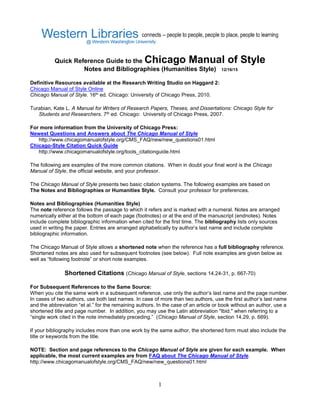
Quick Reference Guide to the Chicago Manual of Style
Notes and Bibliographies (Humanities Style) 12/16/15
Definitive Resources available at the Research Writing Studio on Haggard 2:
Chicago Manual of Style Online
Chicago Manual of Style. 16th ed. Chicago: University of Chicago Press, 2010.
Turabian, Kate L. A Manual for Writers of Research Papers, Theses, and Dissertations: Chicago Style for
Students and Researchers. 7th ed. Chicago: University of Chicago Press, 2007.
For more information from the University of Chicago Press:
Newest Questions and Answers about The Chicago Manual of Style
http://www.chicagomanualofstyle.org/CMS_FAQ/new/new_questions01.html
Chicago-Style Citation Quick Guide
http://www.chicagomanualofstyle.org/tools_citationguide.html
The following are examples of the more common citations. When in doubt your final word is the Chicago
Manual of Style, the official website, and your professor.
The Chicago Manual of Style presents two basic citation systems. The following examples are based on
The Notes and Bibliographies or Humanities Style. Consult your professor for preferences.
Notes and Bibliographies (Humanities Style)
The note reference follows the passage to which it refers and is marked with a numeral. Notes are arranged
numerically either at the bottom of each page (footnotes) or at the end of the manuscript (endnotes). Notes
include complete bibliographic information when cited for the first time. The bibliography lists only sources
used in writing the paper. Entries are arranged alphabetically by author’s last name and include complete
bibliographic information.
The Chicago Manual of Style allows a shortened note when the reference has a full bibliography reference.
Shortened notes are also used for subsequent footnotes (see below). Full note examples are given below as
well as “following footnote” or short note examples.
Shortened Citations (Chicago Manual of Style, sections 14.24-31, p. 667-70)
For Subsequent References to the Same Source:
When you cite the same work in a subsequent reference, use only the author’s last name and the page number.
In cases of two authors, use both last names. In case of more than two authors, use the first author’s last name
and the abbreviation “et al.” for the remaining authors. In the case of an article or book without an author, use a
shortened title and page number. In addition, you may use the Latin abbreviation "Ibid." when referring to a
“single work cited in the note immediately preceding.” (Chicago Manual of Style, section 14.29, p. 669).
If your bibliography includes more than one work by the same author, the shortened form must also include the
title or keywords from the title.
NOTE: Section and page references to the Chicago Manual of Style are given for each example. When
applicable, the most current examples are from FAQ about The Chicago Manual of Style.
http://www.chicagomanualofstyle.org/CMS_FAQ/new/new_questions01.html
2
Journals/Magazines/Newspapers
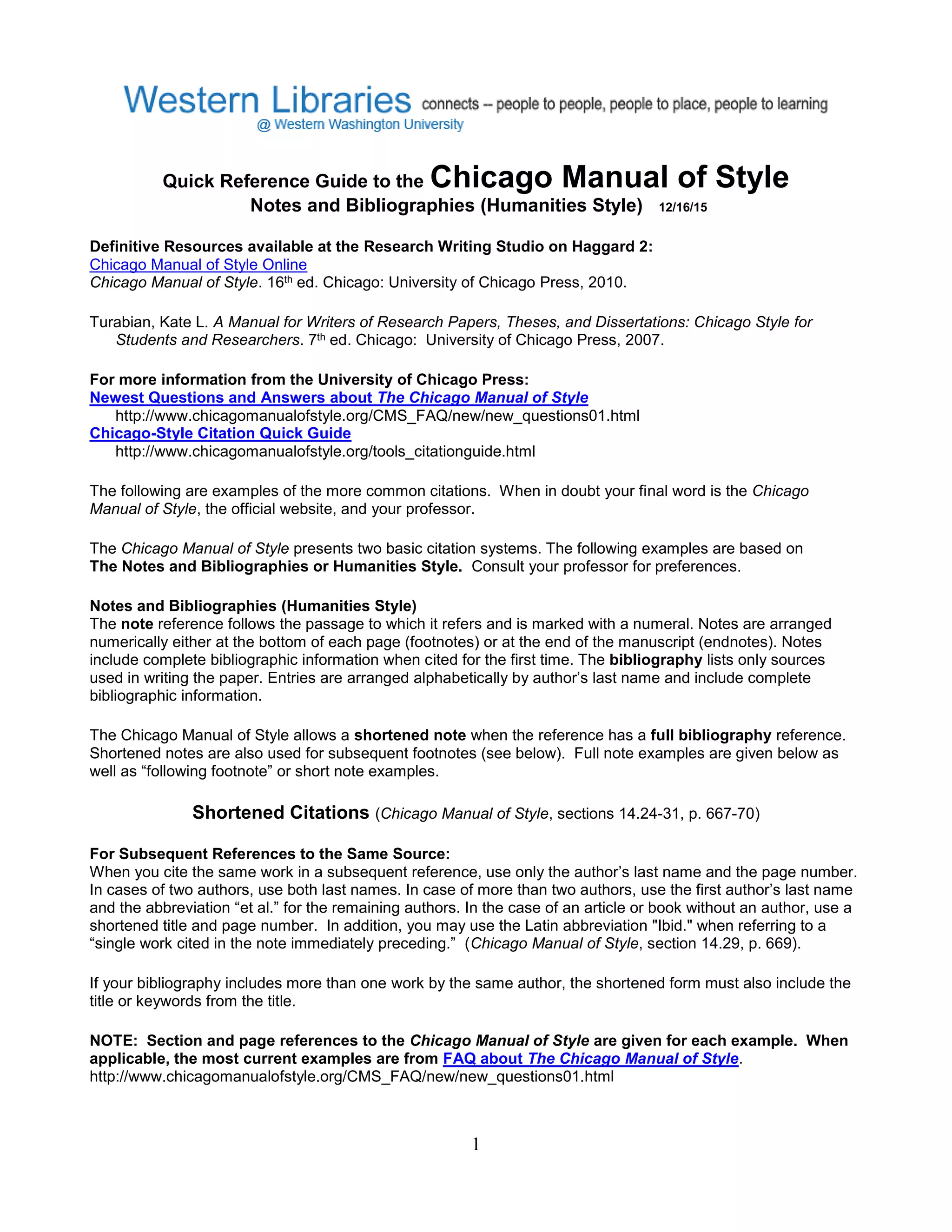
Basic Example
Note:
1. First Name Last Name, “Title of Article,” Name of Journal volume number, issue
number (year):page number.
Bibliography:
Last Name, First Name. “ Title of Article.”Name of Journal volume number, issue
number.
Journal Article, Print
14.175-14.198, pp. 730-38
Chicago Manual of Style
recommends furnishing all elements
of a citation (volume, issue number
or month, year, page numbers) when
possible as a hedge against an error
in one or another of these elements.
However, the issue number can be
left out if the paging is continuous
throughout the volume.
Note:
1. Sean Hanretta, "Women, Marginality and the Zulu State: Women’s
Institutions and Power in the Early Nineteenth Century," Journal of African
History 39, no. 3 (1998): 389.
Following footnote:
2. Hanretta, “Zulu State,” 390.
Bibliography:
Hanretta, Sean. "Women, Marginality and the Zulu State: Women’s
Institutions and Power in the Early Nineteenth Century." Journal
of African History 39, no. 3 (1998):389-415.
Online Article from Academic
Search Complete or another
Database
14.184, pp. 733-35
Use the Digital Object Identifier (doi)
for the article when available. When
there is no doi and the URL is not
stable, treat as a print journal
(example above).
Use access date only if required by
your professor.
Note:
3. Doug Mercer, “Future-Histories of Hanford:The Material and
Semiotic Production of a Landscape,” Cultural Geographies 9, no. 1
(2002):35, doi:10.1191/1474474002eu232oa.
Following footnote:
4. Mercer, Future-Histories of Hanford,” 40.
Bibliography:
Mercer, Doug. “Future-Histories of Hanford:The Material and Semiotic
Production of a Landscape.” Cultural Geographies 9, no.1(2002):35-
67. doi:10.1191/1474474002eu232oa.
Online Article from a Database,
No DOI but with a Stable Article
URL (JSTOR)
14.184, pp. 733-34
Use access date only if required by
your professor.
Note:
6. Dancy Chapman Turner, and Marcus A. M. Bell, “The Ethnobotany
of the Coast Salish Indians of Vancouver Island,” Economic Botany 25,
(1971):63-104, http://jstor.org/stable/4253212.
Following footnote:
7. Dancy and Bell, “Ethnobotany of the Coast Salish,” 101.
Bibliography:
Turner, Dancy Chapman, and Marcus A. M. Bell. “The Ethnobotany of the
Coast Salish Indians of Vancouver Island.” Economic Botany 25, no.
1(1971):63-104. http://jstor.org/stable/4253212.
3
Magazine Article
14.199-14.202, pp. 739-39
(Often cited in text and commonly
omitted from the Bibliography)
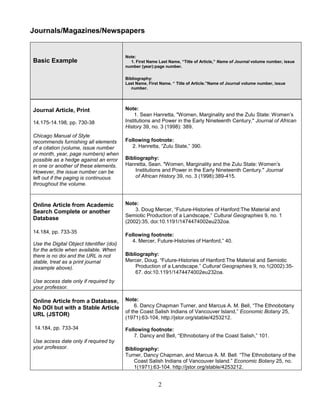
Note:
8. Adam Rogers, "Thinking Differently: Brain Scans Give New Hope of
Diagnosing ADHD," Newsweek, December 25, 1998, 61.
Following footnote:
9. Rogers, “Thinking Differently,” 61.
Bibliography:
Rogers, Adam. "Thinking Differently: Brain Scans Give New Hope of
Diagnosing ADHD." Newsweek, December 25,1998.
Online Magazine
14.200, p. 739
(Often cited in-text and commonly
omitted from the Bibliography)
Note:
10. Kate Abbott, “A Brief History of Intolerance in America,” Time,
August 30, 2010, http://web.ebscohost.com/ehost/.
Following footnote: Abbott, “A Brief History.”
(Page numbers may not be given in an online magazine.)
Bibliography:
Abbott, Kate. “A Brief History of Intolerance in America. Time, August 30,
2010. http://web.ebscohost.com/ehost/.
Newspaper Article with Author
14.203, pp. 739-40
News items from daily papers are
rarely listed separately in a
bibliography when using this style. In
a work containing both a bibliography
and notes, citations to specific items
may be given in the notes or in the
text and not listed in the bibliography
Note:
11. Tanya Kerstiens, "Pick a Color: Children of Mixed Race Struggle to
Find Identity," Bellingham Herald, sec. C1., January 10, 1999.
Following footnote:
12. Kerstiens, “Pick a Color.”
Page numbers are omitted because of the variety of editions with different
page numbering. Include the edition where given, such as “final edition” or
“Eastern edition.” For example:
13. Teri Karush Rogers, “A Wall to Enlighten, Not Obstruct,” New York
Times, July 6, 2005, late edition.
Newspaper Article without
Author
14.207, p. 741
Note:
14. “Pakistan: 50 Years of Upheaval, Corruption and Civil War,” New
York Times, August 15, 1997, sec. B7.
News items from daily papers are rarely listed separately in a bibliography.
When a bibliography reference is needed for an article with an
anonymous source, use the following example where the name of the
newspaper comes first:
Bibliography:
New York Times, “Pakistan: 50 Years of Upheaval, Corruption and Civil
War,” August 15, 1997.
4
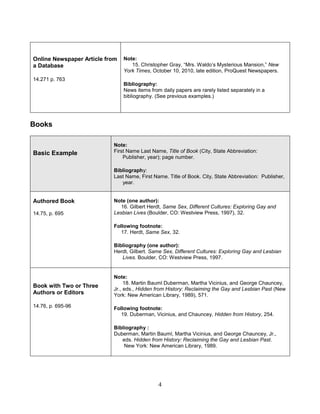
Online Newspaper Article from
a Database
14.271 p. 763
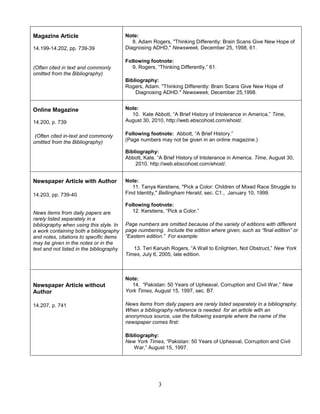
Note:
15. Christopher Gray, “Mrs. Waldo’s Mysterious Mansion,” New
York Times, October 10, 2010, late edition, ProQuest Newspapers.
Bibliography:
News items from daily papers are rarely listed separately in a
bibliography. (See previous examples.)
Books
Basic Example
Note:
First Name Last Name, Title of Book (City, State Abbreviation:
Publisher, year); page number.
Bibliography:
Last Name, First Name. Title of Book. City, State Abbreviation: Publisher,
year.
Authored Book
14.75, p. 695
Note (one author):
16. Gilbert Herdt, Same Sex, Different Cultures: Exploring Gay and
Lesbian Lives (Boulder, CO: Westview Press, 1997), 32.
Following footnote:
17. Herdt, Same Sex, 32.
Bibliography (one author):
Herdt, Gilbert. Same Sex, Different Cultures: Exploring Gay and Lesbian
Lives. Boulder, CO: Westview Press, 1997.
Book with Two or Three
Authors or Editors
14.76, p. 695-96
Note:
18. Martin Bauml Duberman, Martha Vicinius, and George Chauncey,
Jr., eds., Hidden from History: Reclaiming the Gay and Lesbian Past (New
York: New American Library, 1989), 571.
Following footnote:
19. Duberman, Vicinius, and Chauncey, Hidden from History, 254.
Bibliography :
Duberman, Martin Bauml, Martha Vicinius, and George Chauncey, Jr.,
eds. Hidden from History: Reclaiming the Gay and Lesbian Past.
New York: New American Library, 1989.
5
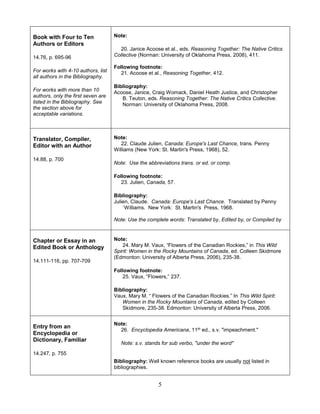
Book with Four to Ten
Authors or Editors
14.76, p. 695-96
For works with 4-10 authors, list
all authors in the Bibliography.
For works with more than 10
authors, only the first seven are
listed in the Bibliography. See
the section above for
acceptable variations.
Note:
20. Janice Acoose et al., eds. Reasoning Together: The Native Critics
Collective (Norman: University of Oklahoma Press, 2008), 411.
Following footnote:
21. Acoose et al., Reasoning Together, 412.
Bibliography:
Acoose, Janice, Craig Womack, Daniel Heath Justice, and Christopher
B. Teuton, eds. Reasoning Together: The Native Critics Collective.
Norman: University of Oklahoma Press, 2008.
Translator, Compiler,
Editor with an Author
14.88, p. 700
Note:
22. Claude Julien, Canada: Europe's Last Chance, trans. Penny
Williams (New York: St. Martin's Press, 1968), 52.
Note: Use the abbreviations trans. or ed. or comp.
Following footnote:
23. Julien, Canada, 57.
Bibliography:
Julien, Claude. Canada: Europe's Last Chance. Translated by Penny
`Williams. New York: St. Martin's Press, 1968.
Note: Use the complete words: Translated by, Edited by, or Compiled by
Chapter or Essay in an
Edited Book or Anthology
14.111-116, pp. 707-709
Note:
24. Mary M. Vaux, “Flowers of the Canadian Rockies,” in This Wild
Spirit: Women in the Rocky Mountains of Canada, ed. Colleen Skidmore
(Edmonton: University of Alberta Press, 2006), 235-38.
Following footnote:
25. Vaux, “Flowers,” 237.
Bibliography:
Vaux, Mary M. “ Flowers of the Canadian Rockies.” In This Wild Spirit:
Women in the Rocky Mountains of Canada, edited by Colleen
Skidmore, 235-38. Edmonton: University of Alberta Press, 2006.
Entry from an
Encyclopedia or
Dictionary, Familiar
14.247, p. 755
Note:
26. Encyclopedia Americana, 11th ed., s.v. "impeachment."
Note: s.v. stands for sub verbo, "under the word"
Bibliography: Well known reference books are usually not listed in
bibliographies.
6
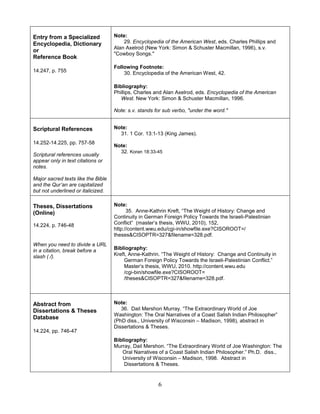
Entry from a Specialized
Encyclopedia, Dictionary
or
Reference Book
14.247, p. 755
Note:
29. Encyclopedia of the American West, eds. Charles Phillips and
Alan Axelrod (New York: Simon & Schuster Macmillan, 1996), s.v.
"Cowboy Songs."
Following Footnote:
30. Encyclopedia of the American West, 42.
Bibliography:
Phillips, Charles and Alan Axelrod, eds. Encyclopedia of the American
West. New York: Simon & Schuster Macmillan, 1996.
Note: s.v. stands for sub verbo, "under the word."
Scriptural References
14.252-14.225, pp. 757-58
Scriptural references usually
appear only in text citations or
notes.
Major sacred texts like the Bible
and the Qur’an are capitalized
but not underlined or italicized.
Note:
31. 1 Cor. 13:1-13 (King James).
Note:
32. Koran 18:33-45
Theses, Dissertations
(Online)
14.224, p. 746-48
When you need to divide a URL
in a citation, break before a
slash ( /).
Note:
35. Anne-Kathrin Kreft, “The Weight of History: Change and
Continuity in German Foreign Policy Towards the Israeli-Palestinian
Conflict” (master’s thesis, WWU, 2010), 152,
http://content.wwu.edu/cgi-in/showfile.exe?CISOROOT=/
theses&CISOPTR=327&filename=328.pdf.
Bibliography:
Kreft, Anne-Kathrin. “The Weight of History: Change and Continuity in
German Foreign Policy Towards the Israeli-Palestinian Conflict.”
Master’s thesis, WWU, 2010. http://content.wwu.edu
/cgi-bin/showfile.exe?CISOROOT=
/theses&CISOPTR=327&filename=328.pdf.
Abstract from
Dissertations & Theses
Database
14.224, pp. 746-47
Note:
36. Dail Mershon Murray. “The Extraordinary World of Joe
Washington: The Oral Narratives of a Coast Salish Indian Philosopher”
(PhD diss., University of Wisconsin – Madison, 1998), abstract in
Dissertations & Theses.
Bibliography:
Murray, Dail Mershon. “The Extraordinary World of Joe Washington: The
Oral Narratives of a Coast Salish Indian Philosopher.” Ph.D. diss.,
University of Wisconsin – Madison, 1998. Abstract in
Dissertations & Theses.
7
Online and Selected Non-Print Sources
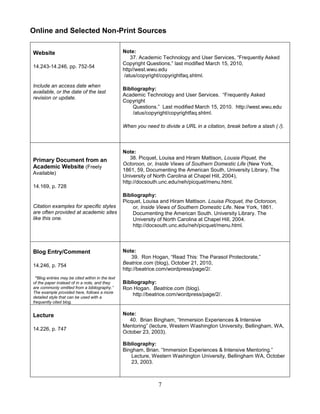
Website
14.243-14.246, pp. 752-54
Include an access date when
available, or the date of the last
revision or update.
Note:
37. Academic Technology and User Services, “Frequently Asked
Copyright Questions,” last modified March 15, 2010,
http//west.wwu.edu
/atus/copyright/copyrightfaq.shtml.
Bibliography:
Academic Technology and User Services. “Frequently Asked
Copyright
Questions.” Last modified March 15, 2010. http://west.wwu.edu
/atus/copyright/copyrightfaq.shtml.
When you need to divide a URL in a citation, break before a slash ( /).
Primary Document from an
Academic Website (Freely
Available)
14.169, p. 728
Citation examples for specific styles
are often provided at academic sites
like this one.
Note:
38. Picquet, Louisa and Hiram Mattison, Lousia Piquet, the
Octoroon, or, Inside Views of Southern Domestic Life (New York,
1861, 59, Documenting the American South, University Library, The
University of North Carolina at Chapel Hill, 2004),
http://docsouth.unc.edu/neh/picquet/menu.html.
Bibliography:
Picquet, Louisa and Hiram Mattison. Louisa Picquet, the Octoroon,
or, Inside Views of Southern Domestic Life. New York, 1861.
Documenting the American South. University Library. The
University of North Carolina at Chapel Hill, 2004.
http://docsouth.unc.edu/neh/picquet/menu.html.
Blog Entry/Comment
14.246, p. 754
“Blog entries may be cited within in the text
of the paper instead of in a note, and they
are commonly omitted from a bibliography.”
The example provided here, follows a more
detailed style that can be used with a
frequently cited blog.
Note:
39. Ron Hogan, “Read This: The Parasol Protectorate,”
Beatrice.com (blog), October 21, 2010,
http://beatrice.com/wordpress/page/2/.
Bibliography:
Ron Hogan. Beatrice.com (blog).
http://beatrice.com/wordpress/page/2/.
Lecture
14.226, p. 747
Note:
40. Brian Bingham, “Immersion Experiences & Intensive
Mentoring” (lecture, Western Washington University, Bellingham, WA,
October 23, 2003).
Bibliography:
Bingham, Brian. “Immersion Experiences & Intensive Mentoring.”
Lecture, Western Washington University, Bellingham WA, October
23, 2003.
8
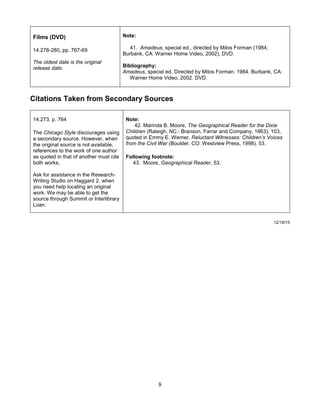
Films (DVD)
14.278-280, pp. 767-69
The oldest date is the original
release date.
Note:
41. Amadeus, special ed., directed by Milos Forman (1984;
Burbank, CA: Warner Home Video, 2002), DVD.
Bibliography:
Amadeus, special ed. Directed by Milos Forman. 1984. Burbank, CA:
Warner Home Video, 2002. DVD.
Citations Taken from Secondary Sources
14.273. p. 764
The Chicago Style discourages using
a secondary source. However, when
the original source is not available,
references to the work of one author
as quoted in that of another must cite
both works.
Ask for assistance in the Research-
Writing Studio on Haggard 2, when
you need help locating an original
work. We may be able to get the
source through Summit or Interlibrary
Loan.
Note:
42. Marinda B. Moore, The Geographical Reader for the Dixie
Children (Raleigh, NC.: Branson, Farrar and Company, 1863), 103,
quoted in Emmy E. Werner, Reluctant Witnesses: Children’s Voices
from the Civil War (Boulder, CO: Westview Press, 1998), 53.
Following footnote:
43. Moore, Geographical Reader, 53.
12/16/15

Newestchicago.pdf

  • 1.
    1 Quick Reference Guideto the Chicago Manual of Style Notes and Bibliographies (Humanities Style) 12/16/15 Definitive Resources available at the Research Writing Studio on Haggard 2: Chicago Manual of Style Online Chicago Manual of Style. 16th ed. Chicago: University of Chicago Press, 2010. Turabian, Kate L. A Manual for Writers of Research Papers, Theses, and Dissertations: Chicago Style for Students and Researchers. 7th ed. Chicago: University of Chicago Press, 2007. For more information from the University of Chicago Press: Newest Questions and Answers about The Chicago Manual of Style http://www.chicagomanualofstyle.org/CMS_FAQ/new/new_questions01.html Chicago-Style Citation Quick Guide http://www.chicagomanualofstyle.org/tools_citationguide.html The following are examples of the more common citations. When in doubt your final word is the Chicago Manual of Style, the official website, and your professor. The Chicago Manual of Style presents two basic citation systems. The following examples are based on The Notes and Bibliographies or Humanities Style. Consult your professor for preferences. Notes and Bibliographies (Humanities Style) The note reference follows the passage to which it refers and is marked with a numeral. Notes are arranged numerically either at the bottom of each page (footnotes) or at the end of the manuscript (endnotes). Notes include complete bibliographic information when cited for the first time. The bibliography lists only sources used in writing the paper. Entries are arranged alphabetically by author’s last name and include complete bibliographic information. The Chicago Manual of Style allows a shortened note when the reference has a full bibliography reference. Shortened notes are also used for subsequent footnotes (see below). Full note examples are given below as well as “following footnote” or short note examples. Shortened Citations (Chicago Manual of Style, sections 14.24-31, p. 667-70) For Subsequent References to the Same Source: When you cite the same work in a subsequent reference, use only the author’s last name and the page number. In cases of two authors, use both last names. In case of more than two authors, use the first author’s last name and the abbreviation “et al.” for the remaining authors. In the case of an article or book without an author, use a shortened title and page number. In addition, you may use the Latin abbreviation "Ibid." when referring to a “single work cited in the note immediately preceding.” (Chicago Manual of Style, section 14.29, p. 669). If your bibliography includes more than one work by the same author, the shortened form must also include the title or keywords from the title. NOTE: Section and page references to the Chicago Manual of Style are given for each example. When applicable, the most current examples are from FAQ about The Chicago Manual of Style. http://www.chicagomanualofstyle.org/CMS_FAQ/new/new_questions01.html
  • 2.
    2 Journals/Magazines/Newspapers Basic Example Note: 1. FirstName Last Name, “Title of Article,” Name of Journal volume number, issue number (year):page number. Bibliography: Last Name, First Name. “ Title of Article.”Name of Journal volume number, issue number. Journal Article, Print 14.175-14.198, pp. 730-38 Chicago Manual of Style recommends furnishing all elements of a citation (volume, issue number or month, year, page numbers) when possible as a hedge against an error in one or another of these elements. However, the issue number can be left out if the paging is continuous throughout the volume. Note: 1. Sean Hanretta, "Women, Marginality and the Zulu State: Women’s Institutions and Power in the Early Nineteenth Century," Journal of African History 39, no. 3 (1998): 389. Following footnote: 2. Hanretta, “Zulu State,” 390. Bibliography: Hanretta, Sean. "Women, Marginality and the Zulu State: Women’s Institutions and Power in the Early Nineteenth Century." Journal of African History 39, no. 3 (1998):389-415. Online Article from Academic Search Complete or another Database 14.184, pp. 733-35 Use the Digital Object Identifier (doi) for the article when available. When there is no doi and the URL is not stable, treat as a print journal (example above). Use access date only if required by your professor. Note: 3. Doug Mercer, “Future-Histories of Hanford:The Material and Semiotic Production of a Landscape,” Cultural Geographies 9, no. 1 (2002):35, doi:10.1191/1474474002eu232oa. Following footnote: 4. Mercer, Future-Histories of Hanford,” 40. Bibliography: Mercer, Doug. “Future-Histories of Hanford:The Material and Semiotic Production of a Landscape.” Cultural Geographies 9, no.1(2002):35- 67. doi:10.1191/1474474002eu232oa. Online Article from a Database, No DOI but with a Stable Article URL (JSTOR) 14.184, pp. 733-34 Use access date only if required by your professor. Note: 6. Dancy Chapman Turner, and Marcus A. M. Bell, “The Ethnobotany of the Coast Salish Indians of Vancouver Island,” Economic Botany 25, (1971):63-104, http://jstor.org/stable/4253212. Following footnote: 7. Dancy and Bell, “Ethnobotany of the Coast Salish,” 101. Bibliography: Turner, Dancy Chapman, and Marcus A. M. Bell. “The Ethnobotany of the Coast Salish Indians of Vancouver Island.” Economic Botany 25, no. 1(1971):63-104. http://jstor.org/stable/4253212.
  • 3.
    3 Magazine Article 14.199-14.202, pp.739-39 (Often cited in text and commonly omitted from the Bibliography) Note: 8. Adam Rogers, "Thinking Differently: Brain Scans Give New Hope of Diagnosing ADHD," Newsweek, December 25, 1998, 61. Following footnote: 9. Rogers, “Thinking Differently,” 61. Bibliography: Rogers, Adam. "Thinking Differently: Brain Scans Give New Hope of Diagnosing ADHD." Newsweek, December 25,1998. Online Magazine 14.200, p. 739 (Often cited in-text and commonly omitted from the Bibliography) Note: 10. Kate Abbott, “A Brief History of Intolerance in America,” Time, August 30, 2010, http://web.ebscohost.com/ehost/. Following footnote: Abbott, “A Brief History.” (Page numbers may not be given in an online magazine.) Bibliography: Abbott, Kate. “A Brief History of Intolerance in America. Time, August 30, 2010. http://web.ebscohost.com/ehost/. Newspaper Article with Author 14.203, pp. 739-40 News items from daily papers are rarely listed separately in a bibliography when using this style. In a work containing both a bibliography and notes, citations to specific items may be given in the notes or in the text and not listed in the bibliography Note: 11. Tanya Kerstiens, "Pick a Color: Children of Mixed Race Struggle to Find Identity," Bellingham Herald, sec. C1., January 10, 1999. Following footnote: 12. Kerstiens, “Pick a Color.” Page numbers are omitted because of the variety of editions with different page numbering. Include the edition where given, such as “final edition” or “Eastern edition.” For example: 13. Teri Karush Rogers, “A Wall to Enlighten, Not Obstruct,” New York Times, July 6, 2005, late edition. Newspaper Article without Author 14.207, p. 741 Note: 14. “Pakistan: 50 Years of Upheaval, Corruption and Civil War,” New York Times, August 15, 1997, sec. B7. News items from daily papers are rarely listed separately in a bibliography. When a bibliography reference is needed for an article with an anonymous source, use the following example where the name of the newspaper comes first: Bibliography: New York Times, “Pakistan: 50 Years of Upheaval, Corruption and Civil War,” August 15, 1997.
  • 4.
    4 Online Newspaper Articlefrom a Database 14.271 p. 763 Note: 15. Christopher Gray, “Mrs. Waldo’s Mysterious Mansion,” New York Times, October 10, 2010, late edition, ProQuest Newspapers. Bibliography: News items from daily papers are rarely listed separately in a bibliography. (See previous examples.) Books Basic Example Note: First Name Last Name, Title of Book (City, State Abbreviation: Publisher, year); page number. Bibliography: Last Name, First Name. Title of Book. City, State Abbreviation: Publisher, year. Authored Book 14.75, p. 695 Note (one author): 16. Gilbert Herdt, Same Sex, Different Cultures: Exploring Gay and Lesbian Lives (Boulder, CO: Westview Press, 1997), 32. Following footnote: 17. Herdt, Same Sex, 32. Bibliography (one author): Herdt, Gilbert. Same Sex, Different Cultures: Exploring Gay and Lesbian Lives. Boulder, CO: Westview Press, 1997. Book with Two or Three Authors or Editors 14.76, p. 695-96 Note: 18. Martin Bauml Duberman, Martha Vicinius, and George Chauncey, Jr., eds., Hidden from History: Reclaiming the Gay and Lesbian Past (New York: New American Library, 1989), 571. Following footnote: 19. Duberman, Vicinius, and Chauncey, Hidden from History, 254. Bibliography : Duberman, Martin Bauml, Martha Vicinius, and George Chauncey, Jr., eds. Hidden from History: Reclaiming the Gay and Lesbian Past. New York: New American Library, 1989.
  • 5.
    5 Book with Fourto Ten Authors or Editors 14.76, p. 695-96 For works with 4-10 authors, list all authors in the Bibliography. For works with more than 10 authors, only the first seven are listed in the Bibliography. See the section above for acceptable variations. Note: 20. Janice Acoose et al., eds. Reasoning Together: The Native Critics Collective (Norman: University of Oklahoma Press, 2008), 411. Following footnote: 21. Acoose et al., Reasoning Together, 412. Bibliography: Acoose, Janice, Craig Womack, Daniel Heath Justice, and Christopher B. Teuton, eds. Reasoning Together: The Native Critics Collective. Norman: University of Oklahoma Press, 2008. Translator, Compiler, Editor with an Author 14.88, p. 700 Note: 22. Claude Julien, Canada: Europe's Last Chance, trans. Penny Williams (New York: St. Martin's Press, 1968), 52. Note: Use the abbreviations trans. or ed. or comp. Following footnote: 23. Julien, Canada, 57. Bibliography: Julien, Claude. Canada: Europe's Last Chance. Translated by Penny `Williams. New York: St. Martin's Press, 1968. Note: Use the complete words: Translated by, Edited by, or Compiled by Chapter or Essay in an Edited Book or Anthology 14.111-116, pp. 707-709 Note: 24. Mary M. Vaux, “Flowers of the Canadian Rockies,” in This Wild Spirit: Women in the Rocky Mountains of Canada, ed. Colleen Skidmore (Edmonton: University of Alberta Press, 2006), 235-38. Following footnote: 25. Vaux, “Flowers,” 237. Bibliography: Vaux, Mary M. “ Flowers of the Canadian Rockies.” In This Wild Spirit: Women in the Rocky Mountains of Canada, edited by Colleen Skidmore, 235-38. Edmonton: University of Alberta Press, 2006. Entry from an Encyclopedia or Dictionary, Familiar 14.247, p. 755 Note: 26. Encyclopedia Americana, 11th ed., s.v. "impeachment." Note: s.v. stands for sub verbo, "under the word" Bibliography: Well known reference books are usually not listed in bibliographies.
  • 6.
    6 Entry from aSpecialized Encyclopedia, Dictionary or Reference Book 14.247, p. 755 Note: 29. Encyclopedia of the American West, eds. Charles Phillips and Alan Axelrod (New York: Simon & Schuster Macmillan, 1996), s.v. "Cowboy Songs." Following Footnote: 30. Encyclopedia of the American West, 42. Bibliography: Phillips, Charles and Alan Axelrod, eds. Encyclopedia of the American West. New York: Simon & Schuster Macmillan, 1996. Note: s.v. stands for sub verbo, "under the word." Scriptural References 14.252-14.225, pp. 757-58 Scriptural references usually appear only in text citations or notes. Major sacred texts like the Bible and the Qur’an are capitalized but not underlined or italicized. Note: 31. 1 Cor. 13:1-13 (King James). Note: 32. Koran 18:33-45 Theses, Dissertations (Online) 14.224, p. 746-48 When you need to divide a URL in a citation, break before a slash ( /). Note: 35. Anne-Kathrin Kreft, “The Weight of History: Change and Continuity in German Foreign Policy Towards the Israeli-Palestinian Conflict” (master’s thesis, WWU, 2010), 152, http://content.wwu.edu/cgi-in/showfile.exe?CISOROOT=/ theses&CISOPTR=327&filename=328.pdf. Bibliography: Kreft, Anne-Kathrin. “The Weight of History: Change and Continuity in German Foreign Policy Towards the Israeli-Palestinian Conflict.” Master’s thesis, WWU, 2010. http://content.wwu.edu /cgi-bin/showfile.exe?CISOROOT= /theses&CISOPTR=327&filename=328.pdf. Abstract from Dissertations & Theses Database 14.224, pp. 746-47 Note: 36. Dail Mershon Murray. “The Extraordinary World of Joe Washington: The Oral Narratives of a Coast Salish Indian Philosopher” (PhD diss., University of Wisconsin – Madison, 1998), abstract in Dissertations & Theses. Bibliography: Murray, Dail Mershon. “The Extraordinary World of Joe Washington: The Oral Narratives of a Coast Salish Indian Philosopher.” Ph.D. diss., University of Wisconsin – Madison, 1998. Abstract in Dissertations & Theses.
  • 7.
    7 Online and SelectedNon-Print Sources Website 14.243-14.246, pp. 752-54 Include an access date when available, or the date of the last revision or update. Note: 37. Academic Technology and User Services, “Frequently Asked Copyright Questions,” last modified March 15, 2010, http//west.wwu.edu /atus/copyright/copyrightfaq.shtml. Bibliography: Academic Technology and User Services. “Frequently Asked Copyright Questions.” Last modified March 15, 2010. http://west.wwu.edu /atus/copyright/copyrightfaq.shtml. When you need to divide a URL in a citation, break before a slash ( /). Primary Document from an Academic Website (Freely Available) 14.169, p. 728 Citation examples for specific styles are often provided at academic sites like this one. Note: 38. Picquet, Louisa and Hiram Mattison, Lousia Piquet, the Octoroon, or, Inside Views of Southern Domestic Life (New York, 1861, 59, Documenting the American South, University Library, The University of North Carolina at Chapel Hill, 2004), http://docsouth.unc.edu/neh/picquet/menu.html. Bibliography: Picquet, Louisa and Hiram Mattison. Louisa Picquet, the Octoroon, or, Inside Views of Southern Domestic Life. New York, 1861. Documenting the American South. University Library. The University of North Carolina at Chapel Hill, 2004. http://docsouth.unc.edu/neh/picquet/menu.html. Blog Entry/Comment 14.246, p. 754 “Blog entries may be cited within in the text of the paper instead of in a note, and they are commonly omitted from a bibliography.” The example provided here, follows a more detailed style that can be used with a frequently cited blog. Note: 39. Ron Hogan, “Read This: The Parasol Protectorate,” Beatrice.com (blog), October 21, 2010, http://beatrice.com/wordpress/page/2/. Bibliography: Ron Hogan. Beatrice.com (blog). http://beatrice.com/wordpress/page/2/. Lecture 14.226, p. 747 Note: 40. Brian Bingham, “Immersion Experiences & Intensive Mentoring” (lecture, Western Washington University, Bellingham, WA, October 23, 2003). Bibliography: Bingham, Brian. “Immersion Experiences & Intensive Mentoring.” Lecture, Western Washington University, Bellingham WA, October 23, 2003.
  • 8.
    8 Films (DVD) 14.278-280, pp.767-69 The oldest date is the original release date. Note: 41. Amadeus, special ed., directed by Milos Forman (1984; Burbank, CA: Warner Home Video, 2002), DVD. Bibliography: Amadeus, special ed. Directed by Milos Forman. 1984. Burbank, CA: Warner Home Video, 2002. DVD. Citations Taken from Secondary Sources 14.273. p. 764 The Chicago Style discourages using a secondary source. However, when the original source is not available, references to the work of one author as quoted in that of another must cite both works. Ask for assistance in the Research- Writing Studio on Haggard 2, when you need help locating an original work. We may be able to get the source through Summit or Interlibrary Loan. Note: 42. Marinda B. Moore, The Geographical Reader for the Dixie Children (Raleigh, NC.: Branson, Farrar and Company, 1863), 103, quoted in Emmy E. Werner, Reluctant Witnesses: Children’s Voices from the Civil War (Boulder, CO: Westview Press, 1998), 53. Following footnote: 43. Moore, Geographical Reader, 53. 12/16/15