chicago style
footnotes and bibliographic citations
the nb system
The Chicago NB (Notes-Bibliography) system is often used
in the humanities and provides writers with a system for
referencing their sources through footnote or endnote
citation in their writing and through bibliography pages.
The NB system is most commonly used in the discipline of
history.
footnotes
You should include a footnote each time you use a
source, whether through a direct quote or through a
paraphrase or summary. Footnotes will be added at the
end of the page on which the source is referenced.
A superscript number corresponding to a note with the
bibliographic information for that source should be placed
in the text following the end of the sentence or clause in
which the source is referenced.
first & subsequent footnotes
The first note for each source should include all relevant information
about the source: author’s full name, source title, and facts of
publication.
If you cite the same source again, the note need only include the
surname of the author, a shortened form of the title (if more than four
words), and page number(s).
If you cite the same source and page number(s) from a single source
two or more times consecutively, the corresponding note should use
the word “Ibid.,” an abbreviated form of the Latin “ibidem,” which
means “in the same place.”
If you use the same source but a different page number, the
corresponding note should use “Ibid.” followed by a comma and the
new page number(s).
bibliography
The bibliography provides an alphabetical list of all sources
used in a given work. This page, titled “Bibliography,” is
placed at the end of your paper. It should include all sources
cited within the work.
All included sources (books, articles, websites, etc.) are
arranged alphabetically by author’s (or editor’s) last name.
If no author or editor is listed, the title may be used instead.
example: book
format
Footnote or Endnote (N):
1. Firstname Lastname, Title of Book (Place of publication:
Publisher, Year of publication), page number.
Corresponding Bibliographical Entry (B):
Lastname, Firstname. Title of Book. Place of publication:
Publisher, Year of publication.
example: web source
Footnote or Endnote (N):
1. Firstname Lastname, “Title of Web Page,” Publishing
Organization or Name of Web Site in Italics, publication date
and/or access date if available, URL.
Corresponding Bibliographical Entry (B):
Lastname, Firstname. “Title of Web Page.” Publishing
Organization or Name of Web Site in Italics. Publication date
and/or access date if available. URL.
noodle gives you both
NoodleTools will provide you with both the Note form, and
the Bibliography form.
remember:
noodletools is good, but...
It’s still your responsibility to look
over everything and make sure
each citation is correctly formatted.
Use the Citations and Style
Formatting Guide on the Library
portal for help. It includes all of the
information you will need to
correctly format your citations.
the chicago
manual
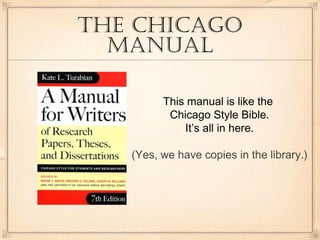
This manual is like the
Chicago Style Bible.
It’s all in here.
(Yes, we have copies in the library.)

Chicago style overview

  • 1.
    chicago style footnotes andbibliographic citations
  • 2.
    the nb system TheChicago NB (Notes-Bibliography) system is often used in the humanities and provides writers with a system for referencing their sources through footnote or endnote citation in their writing and through bibliography pages. The NB system is most commonly used in the discipline of history.
  • 3.
    footnotes You should includea footnote each time you use a source, whether through a direct quote or through a paraphrase or summary. Footnotes will be added at the end of the page on which the source is referenced. A superscript number corresponding to a note with the bibliographic information for that source should be placed in the text following the end of the sentence or clause in which the source is referenced.
  • 4.
    first & subsequentfootnotes The first note for each source should include all relevant information about the source: author’s full name, source title, and facts of publication. If you cite the same source again, the note need only include the surname of the author, a shortened form of the title (if more than four words), and page number(s). If you cite the same source and page number(s) from a single source two or more times consecutively, the corresponding note should use the word “Ibid.,” an abbreviated form of the Latin “ibidem,” which means “in the same place.” If you use the same source but a different page number, the corresponding note should use “Ibid.” followed by a comma and the new page number(s).
  • 5.
    bibliography The bibliography providesan alphabetical list of all sources used in a given work. This page, titled “Bibliography,” is placed at the end of your paper. It should include all sources cited within the work. All included sources (books, articles, websites, etc.) are arranged alphabetically by author’s (or editor’s) last name. If no author or editor is listed, the title may be used instead.
  • 6.
    example: book format Footnote orEndnote (N): 1. Firstname Lastname, Title of Book (Place of publication: Publisher, Year of publication), page number. Corresponding Bibliographical Entry (B): Lastname, Firstname. Title of Book. Place of publication: Publisher, Year of publication.
  • 7.
    example: web source Footnoteor Endnote (N): 1. Firstname Lastname, “Title of Web Page,” Publishing Organization or Name of Web Site in Italics, publication date and/or access date if available, URL. Corresponding Bibliographical Entry (B): Lastname, Firstname. “Title of Web Page.” Publishing Organization or Name of Web Site in Italics. Publication date and/or access date if available. URL.
  • 8.
    noodle gives youboth NoodleTools will provide you with both the Note form, and the Bibliography form.
  • 9.
    remember: noodletools is good,but... It’s still your responsibility to look over everything and make sure each citation is correctly formatted. Use the Citations and Style Formatting Guide on the Library portal for help. It includes all of the information you will need to correctly format your citations.
  • 10.
    the chicago manual This manualis like the Chicago Style Bible. It’s all in here. (Yes, we have copies in the library.)