
Formatting Styles APA, MLA, IEEE
http://www.bedfordstmartins.com/online/index.html http://owl.english.purdue.edu/owl/resource/560/01/ http://www.ecf.utoronto.ca/~writing/handbook-docum1b.html Links to important sites
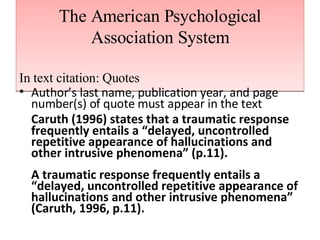
The American Psychological Association System In text citation: Quotes Author’s last name, publication year, and page number(s) of quote must appear in the text Caruth (1996) states that a traumatic response frequently entails a “delayed, uncontrolled repetitive appearance of hallucinations and other intrusive phenomena” (p.11). A traumatic response frequently entails a “delayed, uncontrolled repetitive appearance of hallucinations and other intrusive phenomena” (Caruth, 1996, p.11).
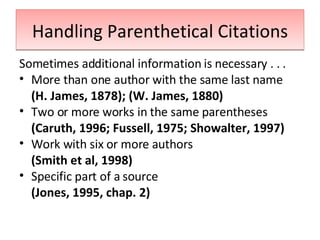
Handling Parenthetical Citations Sometimes additional information is necessary . . . More than one author with the same last name (H. James, 1878); (W. James, 1880) Two or more works in the same parentheses (Caruth, 1996; Fussell, 1975; Showalter, 1997) Work with six or more authors (Smith et al, 1998) Specific part of a source (Jones, 1995, chap. 2)
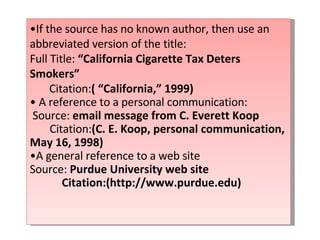
• If the source has no known author, then use an abbreviated version of the title: Full Title:  “California Cigarette Tax Deters Smokers” Citation: ( “California,” 1999) •  A reference to a personal communication: Source:  email message from C. Everett Koop Citation: (C. E. Koop, personal communication, May 16, 1998) • A general reference to a web site Source:  Purdue University web site Citation:(http://www.purdue.edu)
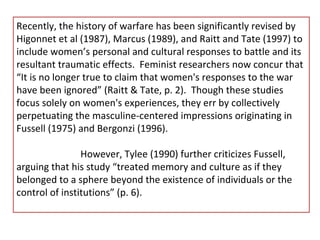
Recently, the history of warfare has been significantly revised by Higonnet et al (1987), Marcus (1989), and Raitt and Tate (1997) to include women’s personal and cultural responses to battle and its resultant traumatic effects.  Feminist researchers now concur that “It is no longer true to claim that women's responses to the war have been ignored” (Raitt & Tate, p. 2).  Though these studies focus solely on women's experiences, they err by collectively perpetuating the masculine-centered impressions originating in Fussell (1975) and Bergonzi (1996). However, Tylee (1990) further criticizes Fussell, arguing that his study “treated memory and culture as if they belonged to a sphere beyond the existence of individuals or the control of institutions” (p. 6).
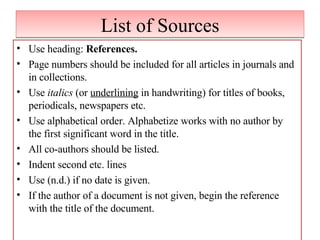
List of Sources Use heading:  References. Page numbers should be included for all articles in journals and in collections. Use  italics  (or  underlining  in handwriting) for titles of books, periodicals, newspapers etc. Use alphabetical order. Alphabetize works with no author by the first significant word in the title. All co-authors should be listed. Indent second etc. lines Use (n.d.) if no date is given. If the author of a document is not given, begin the reference with the title of the document.  
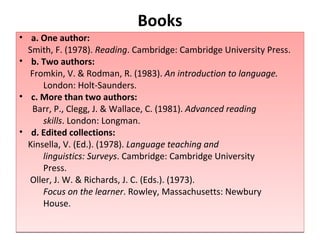
Books a. One author: Smith, F. (1978).  Reading . Cambridge: Cambridge University Press.  b. Two authors: Fromkin, V. & Rodman, R. (1983).  An introduction to language.   London: Holt-Saunders.  c. More than two authors: Barr, P., Clegg, J. & Wallace, C. (1981).  Advanced reading  skills . London: Longman.  d. Edited collections: Kinsella, V. (Ed.). (1978).  Language teaching and  linguistics: Surveys . Cambridge: Cambridge University  Press. Oller, J. W. & Richards, J. C. (Eds.). (1973).  Focus on the learner . Rowley, Massachusetts: Newbury  House.
Periodical articles a. One author: Abercrombie, D. (1968). Paralanguage.  British Journal of Disorders of   Communication, 3,  55-59.  b. Two authors: Lipinsky, E. & Bender, R. (1980). Critical voices on the economy.  Survey, 25,  38-42.  c. More than two authors: Guiora, A. Z., Paluszny, M., Beit-Hallahmi, B., Catford, J. C., Cooley, R. E. & Dull, C. Y. (1975). Language and person: Studies in language behaviour.  Language Learning, 25 , 43-61.  d. Review of a book: Carmody, T. P. (1982). A new look at medicine from a social perspective [Review of the book  Social contexts of health, illness and patient care ].  Contemporary Psychology, 27 , 208-209.
Documents obtained from the Internet All references begin with the same information that would be provided for a printed source (or as much of that information as possible). The WWW information is then placed at the end of the reference in the same way as publishing information is given for books. It is important to give the date of retrieval because documents on the Web may change in content, move, or be removed from a site altogether. The object of this is the same as all referencing - to supply the information needed to allow a user to find a source. If you do not know the author or the date and it does not have a clear title, think carefully before using it.
a.  An article: Jacobson, J. W., Mulick, J. A. Schwartz, A. A. (1995). A history of  facilitated communication: Science, pseudoscience, and  antiscience: Science working group on facilitated communication. American Psychologist, 50,  750-765. Retrieved January 25, 1996,  from  http://www.apa.org/journals/jacobson.html  b.  A newspaper article: Sleek, S. (1996, January). Psychologists build a culture of peace.  APA Monitor,  pp. 1, 33 [Newspaper, selected stories on-line].  Retrieved January 25, 1996, from  http://www.apa.org/monitor/peacea.html  c.  WWW Document: Li, X. & Crane, N. (1996, May 20).  Bibliographic formats for citing  electronic information . Retrieved March 10, 1997, from  http://www.uvm.edu/~xli/reference/estyles.html
Others a. Government report: National Institute of Mental Health. (1982).  Television and  behaviour: Ten years of scientific progress and implications for the eighties  (DHHS Publication No. ADM82-1195). Washington DC: US Government Printing Office.  b. Unpublished dissertation or thesis: Devins, G. M. (1981).  Helplessness, depression, and mood in end-stage renal disease . Unpublished doctoral dissertation, McGill University, Montreal.  c. Unpublished conference paper: Howarth, P. (1995, March).  Phraseological standards in EAP.  Paper presented at the meeting of the British Association of Lecturers in English for Academic Purposes, Nottingham
Modern Language Association System In text citation: Quotes Author’s last name and page number(s) of quote must appear in the text Romantic poetry is characterized by the “spontaneous overflow of powerful feelings” (Wordsworth 263). Wordsworth stated that Romantic poetry was marked by a “spontaneous overflow of powerful feelings” (263).
Handling Parenthetical Citations Sometimes   more information is necessary More than one author with the same last name (W. Wordsworth 23); (D. Wordsworth 224) More than one work by the same author (Joyce,  Portrait  121); (Joyce,  Ulysses  556) Different volumes of a multivolume work (1: 336) Citing indirect sources  (Johnson qtd. in Boswell 2:450)
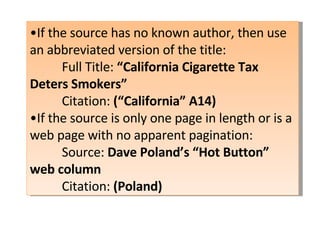
• If the source has no known author, then use an abbreviated version of the title: Full Title:  “California Cigarette Tax Deters Smokers” Citation:  (“California” A14) • If the source is only one page in length or is a web page with no apparent pagination: Source:  Dave Poland’s “Hot Button” web column Citation:  (Poland)
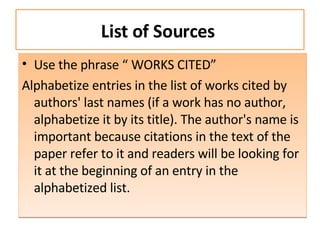
List of Sources  Use the phrase “ WORKS CITED” Alphabetize entries in the list of works cited by authors' last names (if a work has no author, alphabetize it by its title). The author's name is important because citations in the text of the paper refer to it and readers will be looking for it at the beginning of an entry in the alphabetized list.
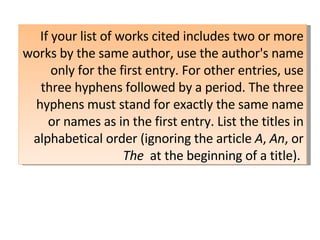
If your list of works cited includes two or more works by the same author, use the author's name only for the first entry. For other entries, use three hyphens followed by a period. The three hyphens must stand for exactly the same name or names as in the first entry. List the titles in alphabetical order (ignoring the article  A ,  An , or  The   at the beginning of a title).
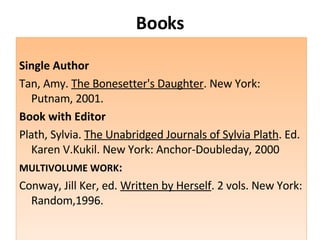
Books Single Author Tan, Amy.  The Bonesetter's Daughter . New York: Putnam, 2001. Book with Editor Plath, Sylvia.  The Unabridged Journals of Sylvia Plath . Ed. Karen V.Kukil. New York: Anchor-Doubleday, 2000 MULTIVOLUME WORK :  Conway, Jill Ker, ed.  Written by Herself . 2 vols. New York: Random,1996.
AUTHOR WITH A TRANSLATOR: Allende, Isabel.  Daughter of Fortune . Trans. Margaret Sayers  Peden. New York: Harper, 2000. EDITOR: Craig, Patricia, ed.  The Oxford Book of Travel Stories . Oxford:  Oxford UP, BOOK IN A SERIES Malena, Anne.  The Dynamics of Identity in Francophone  Caribbean   Narrative . Francophone Cultures and Lits. Ser. 24.  New York: Lang,1998 .  ARTICLE IN A MAGAZINE Fay, J. Michael. "Land of the Surfing Hippos."  National  Geographic  Aug . ARTICLE IN A DAILY NEWSPAPER Brummitt, Chris. "Indonesia's Food Needs Expected to Soar."  Boston   Globe  1 Feb. 2005: A7
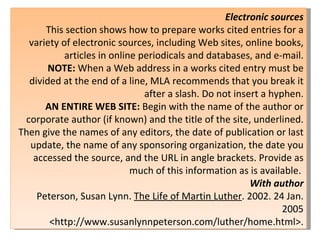
Electronic sources This section shows how to prepare works cited entries for a variety of electronic sources, including Web sites, online books, articles in online periodicals and databases, and e-mail. NOTE:  When a Web address in a works cited entry must be divided at the end of a line, MLA recommends that you break it after a slash. Do not insert a hyphen. AN ENTIRE WEB SITE:  Begin with the name of the author or corporate author (if known) and the title of the site, underlined. Then give the names of any editors, the date of publication or last update, the name of any sponsoring organization, the date you accessed the source, and the URL in angle brackets. Provide as much of this information as is available.  With author Peterson, Susan Lynn.  The Life of Martin Luther . 2002. 24 Jan. 2005 <http://www.susanlynnpeterson.com/luther/home.html>.
With corporate (group) author United States. Environmental Protection Agency.  Drinking Water Standards . 8 July 2004. 24 Jan. 2005 < http://www.epa.gov/safewater/standards.html > Author unknown Margaret Sanger Papers Project . 18 Oct. 2000. History  Dept., New York U. 6 Dec. 2004  <http://www.nyu.edu/projects/sanger>.   ONLINE BOOK Rawlins, Gregory J. E.  Moths to the Flame . Cambridge:  MIT P, 1996.11 Nov. 2004  <http://mitpress.mit.edu/e-books/Moths/contents.html>
Institute of Electrical and Electronics Engineers  System The major difference between IEEE and other styles is that IEEE style encloses citation numbers within the text of a paper in square brackets [1]  rather than as superscripts 1   or in bracketed form (Jones 98) .  All other bibliographical information regarding the citation is reserved for the list of references at the end of the document.   
Author-Name Substitution • IEEE style  encourages  substituting reference numbers for the name of the author whenever appropriate.  As Smith, Wesson, and Williams demonstrate, the natural course of microprocessor evolution will likely lead to computers with . .X As [1], [2], and [3] demonstrate, the natural course of microprocessor evolution will likely lead to computers with . .  .  Citation Note Placement   •Place note numbers directly after the reference rather than at the end of a clause or sentence,  unless  the reference ends at the end of a clause or sentence.  Place all punctuation outside the square brackets, except commas used to separate multiple references  One study examined the mRNA levels of jun C, Jun B, and Jun D in mouse tissues [2]. X One study [2] examined the mRNA levels of Jun C, Jun B, and Jun D in mouse tissues.
Multi-reference Citations   When more than one work is involved in the same citation, separate citation numbers with commas and  without  any spaces.  If a sequence of three of more citation numbers occurs in the reference, use a single range separated by a hyphen. Though unlikely, the same effects were reported by [2], [7], [12].X Though unlikely, the same effects was reported by [2,7,12].  
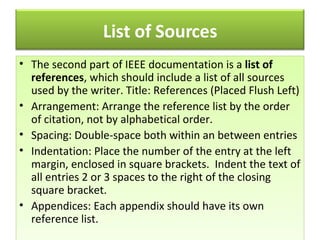
The   second part of IEEE documentation is a  list of references , which should include a list of all sources used by the writer. Title: References (Placed Flush Left)  Arrangement: Arrange the reference list by the order of citation, not by alphabetical order.  Spacing: Double-space both within an between entries  Indentation: Place the number of the entry at the left margin, enclosed in square brackets.  Indent the text of all entries 2 or 3 spaces to the right of the closing square bracket.  Appendices: Each appendix should have its own reference list.  List of Sources
References    [1]  D. Jones,  Technical Writing Style ,  Toronto: Allyn and Bacon, 1998.   [2]  H. Inose and J.R. Pierce,  Information Technology and Civilization , New York: Freeman, 1984.  [3]  D. Beer, R.F. Martin, and P. Fingle,  Photosensory Transduction , New York: Willey, 1993.  [ 4]  W. Heisenberg,  The Physical Principles of the Quantum Theory , C. Eckhart and F.C. Hoyt, Trans., Chicago: University of Chicago Press,1930.   [5]  W. Heisenberg,  The Physical Principles of the Quantum Theory , C. Eckart and F.C. Hoyt, Trans., 2nd.ed., New York: Dover, 1949. 

Fromatting Styles

  • 1.
  • 2.
  • 3.
    The American PsychologicalAssociation System In text citation: Quotes Author’s last name, publication year, and page number(s) of quote must appear in the text Caruth (1996) states that a traumatic response frequently entails a “delayed, uncontrolled repetitive appearance of hallucinations and other intrusive phenomena” (p.11). A traumatic response frequently entails a “delayed, uncontrolled repetitive appearance of hallucinations and other intrusive phenomena” (Caruth, 1996, p.11).
  • 4.
    Handling Parenthetical CitationsSometimes additional information is necessary . . . More than one author with the same last name (H. James, 1878); (W. James, 1880) Two or more works in the same parentheses (Caruth, 1996; Fussell, 1975; Showalter, 1997) Work with six or more authors (Smith et al, 1998) Specific part of a source (Jones, 1995, chap. 2)
  • 5.
    • If thesource has no known author, then use an abbreviated version of the title: Full Title: “California Cigarette Tax Deters Smokers” Citation: ( “California,” 1999) • A reference to a personal communication: Source: email message from C. Everett Koop Citation: (C. E. Koop, personal communication, May 16, 1998) • A general reference to a web site Source: Purdue University web site Citation:(http://www.purdue.edu)
  • 6.
    Recently, the historyof warfare has been significantly revised by Higonnet et al (1987), Marcus (1989), and Raitt and Tate (1997) to include women’s personal and cultural responses to battle and its resultant traumatic effects. Feminist researchers now concur that “It is no longer true to claim that women's responses to the war have been ignored” (Raitt & Tate, p. 2). Though these studies focus solely on women's experiences, they err by collectively perpetuating the masculine-centered impressions originating in Fussell (1975) and Bergonzi (1996). However, Tylee (1990) further criticizes Fussell, arguing that his study “treated memory and culture as if they belonged to a sphere beyond the existence of individuals or the control of institutions” (p. 6).
  • 7.
    List of SourcesUse heading: References. Page numbers should be included for all articles in journals and in collections. Use italics (or underlining in handwriting) for titles of books, periodicals, newspapers etc. Use alphabetical order. Alphabetize works with no author by the first significant word in the title. All co-authors should be listed. Indent second etc. lines Use (n.d.) if no date is given. If the author of a document is not given, begin the reference with the title of the document.  
  • 8.
    Books a. Oneauthor: Smith, F. (1978). Reading . Cambridge: Cambridge University Press. b. Two authors: Fromkin, V. & Rodman, R. (1983). An introduction to language. London: Holt-Saunders. c. More than two authors: Barr, P., Clegg, J. & Wallace, C. (1981). Advanced reading skills . London: Longman. d. Edited collections: Kinsella, V. (Ed.). (1978). Language teaching and linguistics: Surveys . Cambridge: Cambridge University Press. Oller, J. W. & Richards, J. C. (Eds.). (1973). Focus on the learner . Rowley, Massachusetts: Newbury House.
  • 9.
    Periodical articles a.One author: Abercrombie, D. (1968). Paralanguage. British Journal of Disorders of Communication, 3, 55-59. b. Two authors: Lipinsky, E. & Bender, R. (1980). Critical voices on the economy. Survey, 25, 38-42. c. More than two authors: Guiora, A. Z., Paluszny, M., Beit-Hallahmi, B., Catford, J. C., Cooley, R. E. & Dull, C. Y. (1975). Language and person: Studies in language behaviour. Language Learning, 25 , 43-61. d. Review of a book: Carmody, T. P. (1982). A new look at medicine from a social perspective [Review of the book Social contexts of health, illness and patient care ]. Contemporary Psychology, 27 , 208-209.
  • 10.
    Documents obtained fromthe Internet All references begin with the same information that would be provided for a printed source (or as much of that information as possible). The WWW information is then placed at the end of the reference in the same way as publishing information is given for books. It is important to give the date of retrieval because documents on the Web may change in content, move, or be removed from a site altogether. The object of this is the same as all referencing - to supply the information needed to allow a user to find a source. If you do not know the author or the date and it does not have a clear title, think carefully before using it.
  • 11.
    a. Anarticle: Jacobson, J. W., Mulick, J. A. Schwartz, A. A. (1995). A history of facilitated communication: Science, pseudoscience, and antiscience: Science working group on facilitated communication. American Psychologist, 50, 750-765. Retrieved January 25, 1996, from http://www.apa.org/journals/jacobson.html b. A newspaper article: Sleek, S. (1996, January). Psychologists build a culture of peace. APA Monitor, pp. 1, 33 [Newspaper, selected stories on-line]. Retrieved January 25, 1996, from http://www.apa.org/monitor/peacea.html c. WWW Document: Li, X. & Crane, N. (1996, May 20). Bibliographic formats for citing electronic information . Retrieved March 10, 1997, from http://www.uvm.edu/~xli/reference/estyles.html
  • 12.
    Others a. Governmentreport: National Institute of Mental Health. (1982). Television and behaviour: Ten years of scientific progress and implications for the eighties (DHHS Publication No. ADM82-1195). Washington DC: US Government Printing Office. b. Unpublished dissertation or thesis: Devins, G. M. (1981). Helplessness, depression, and mood in end-stage renal disease . Unpublished doctoral dissertation, McGill University, Montreal. c. Unpublished conference paper: Howarth, P. (1995, March). Phraseological standards in EAP. Paper presented at the meeting of the British Association of Lecturers in English for Academic Purposes, Nottingham
  • 13.
    Modern Language AssociationSystem In text citation: Quotes Author’s last name and page number(s) of quote must appear in the text Romantic poetry is characterized by the “spontaneous overflow of powerful feelings” (Wordsworth 263). Wordsworth stated that Romantic poetry was marked by a “spontaneous overflow of powerful feelings” (263).
  • 14.
    Handling Parenthetical CitationsSometimes more information is necessary More than one author with the same last name (W. Wordsworth 23); (D. Wordsworth 224) More than one work by the same author (Joyce, Portrait 121); (Joyce, Ulysses 556) Different volumes of a multivolume work (1: 336) Citing indirect sources (Johnson qtd. in Boswell 2:450)
  • 15.
    • If thesource has no known author, then use an abbreviated version of the title: Full Title: “California Cigarette Tax Deters Smokers” Citation: (“California” A14) • If the source is only one page in length or is a web page with no apparent pagination: Source: Dave Poland’s “Hot Button” web column Citation: (Poland)
  • 16.
    List of Sources Use the phrase “ WORKS CITED” Alphabetize entries in the list of works cited by authors' last names (if a work has no author, alphabetize it by its title). The author's name is important because citations in the text of the paper refer to it and readers will be looking for it at the beginning of an entry in the alphabetized list.
  • 17.
    If your listof works cited includes two or more works by the same author, use the author's name only for the first entry. For other entries, use three hyphens followed by a period. The three hyphens must stand for exactly the same name or names as in the first entry. List the titles in alphabetical order (ignoring the article A , An , or The at the beginning of a title).
  • 18.
    Books Single AuthorTan, Amy. The Bonesetter's Daughter . New York: Putnam, 2001. Book with Editor Plath, Sylvia. The Unabridged Journals of Sylvia Plath . Ed. Karen V.Kukil. New York: Anchor-Doubleday, 2000 MULTIVOLUME WORK : Conway, Jill Ker, ed. Written by Herself . 2 vols. New York: Random,1996.
  • 19.
    AUTHOR WITH ATRANSLATOR: Allende, Isabel. Daughter of Fortune . Trans. Margaret Sayers Peden. New York: Harper, 2000. EDITOR: Craig, Patricia, ed. The Oxford Book of Travel Stories . Oxford: Oxford UP, BOOK IN A SERIES Malena, Anne. The Dynamics of Identity in Francophone Caribbean Narrative . Francophone Cultures and Lits. Ser. 24. New York: Lang,1998 . ARTICLE IN A MAGAZINE Fay, J. Michael. &quot;Land of the Surfing Hippos.&quot; National Geographic Aug . ARTICLE IN A DAILY NEWSPAPER Brummitt, Chris. &quot;Indonesia's Food Needs Expected to Soar.&quot; Boston Globe 1 Feb. 2005: A7
  • 20.
    Electronic sources Thissection shows how to prepare works cited entries for a variety of electronic sources, including Web sites, online books, articles in online periodicals and databases, and e-mail. NOTE: When a Web address in a works cited entry must be divided at the end of a line, MLA recommends that you break it after a slash. Do not insert a hyphen. AN ENTIRE WEB SITE: Begin with the name of the author or corporate author (if known) and the title of the site, underlined. Then give the names of any editors, the date of publication or last update, the name of any sponsoring organization, the date you accessed the source, and the URL in angle brackets. Provide as much of this information as is available. With author Peterson, Susan Lynn. The Life of Martin Luther . 2002. 24 Jan. 2005 <http://www.susanlynnpeterson.com/luther/home.html>.
  • 21.
    With corporate (group)author United States. Environmental Protection Agency. Drinking Water Standards . 8 July 2004. 24 Jan. 2005 < http://www.epa.gov/safewater/standards.html > Author unknown Margaret Sanger Papers Project . 18 Oct. 2000. History Dept., New York U. 6 Dec. 2004 <http://www.nyu.edu/projects/sanger>. ONLINE BOOK Rawlins, Gregory J. E. Moths to the Flame . Cambridge: MIT P, 1996.11 Nov. 2004 <http://mitpress.mit.edu/e-books/Moths/contents.html>
  • 22.
    Institute of Electricaland Electronics Engineers System The major difference between IEEE and other styles is that IEEE style encloses citation numbers within the text of a paper in square brackets [1]  rather than as superscripts 1  or in bracketed form (Jones 98) . All other bibliographical information regarding the citation is reserved for the list of references at the end of the document.  
  • 23.
    Author-Name Substitution •IEEE style encourages substituting reference numbers for the name of the author whenever appropriate. As Smith, Wesson, and Williams demonstrate, the natural course of microprocessor evolution will likely lead to computers with . .X As [1], [2], and [3] demonstrate, the natural course of microprocessor evolution will likely lead to computers with . . . Citation Note Placement •Place note numbers directly after the reference rather than at the end of a clause or sentence, unless the reference ends at the end of a clause or sentence.  Place all punctuation outside the square brackets, except commas used to separate multiple references One study examined the mRNA levels of jun C, Jun B, and Jun D in mouse tissues [2]. X One study [2] examined the mRNA levels of Jun C, Jun B, and Jun D in mouse tissues.
  • 24.
    Multi-reference Citations When more than one work is involved in the same citation, separate citation numbers with commas and without any spaces.  If a sequence of three of more citation numbers occurs in the reference, use a single range separated by a hyphen. Though unlikely, the same effects were reported by [2], [7], [12].X Though unlikely, the same effects was reported by [2,7,12].  
  • 25.
    The second part of IEEE documentation is a list of references , which should include a list of all sources used by the writer. Title: References (Placed Flush Left) Arrangement: Arrange the reference list by the order of citation, not by alphabetical order. Spacing: Double-space both within an between entries Indentation: Place the number of the entry at the left margin, enclosed in square brackets.  Indent the text of all entries 2 or 3 spaces to the right of the closing square bracket. Appendices: Each appendix should have its own reference list. List of Sources
  • 26.
    References   [1]  D. Jones, Technical Writing Style ,  Toronto: Allyn and Bacon, 1998.  [2]  H. Inose and J.R. Pierce, Information Technology and Civilization , New York: Freeman, 1984. [3]  D. Beer, R.F. Martin, and P. Fingle, Photosensory Transduction , New York: Willey, 1993.  [ 4]  W. Heisenberg, The Physical Principles of the Quantum Theory , C. Eckhart and F.C. Hoyt, Trans., Chicago: University of Chicago Press,1930.  [5]  W. Heisenberg, The Physical Principles of the Quantum Theory , C. Eckart and F.C. Hoyt, Trans., 2nd.ed., New York: Dover, 1949.