Stoichiometry
By George Xu
What is
Stoichiometr
y?
Stoichiometry
Stoicheion [Gr. “element” or “part”]
Metron [Gr. “measure”]
Study of quantitative aspects of chemical
formulas and reactions
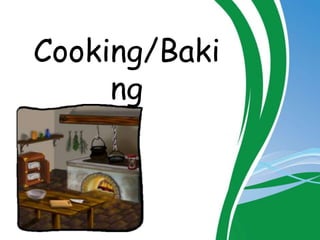
Cooking/Baki
ng
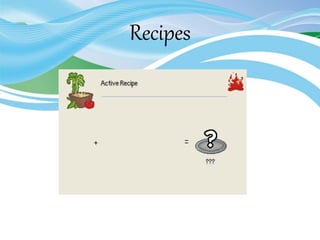
Recipes
+
Recipes
+
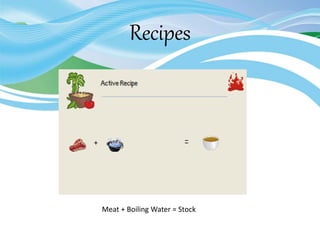
Meat + Boiling Water = Stock
Recipes
+
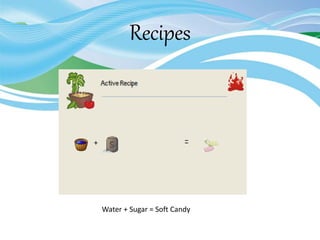
Water + Sugar = Soft Candy
Recipes
+
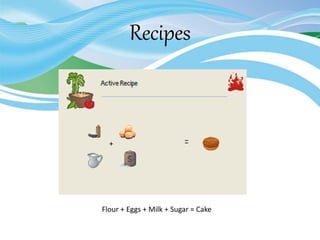
Flour + Eggs + Milk + Sugar = Cake
Similarly…
Chemical reactions have ingredients
(reactants) and finished products.
Some are simple while others are complex.
Both obey the Law of Conservation of Mass.
(What you put in is what you get)
Chemical Reactions
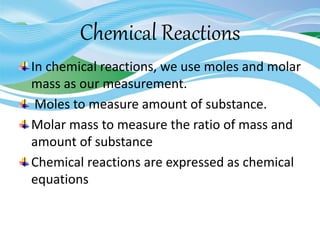
In chemical reactions, we use moles and molar
mass as our measurement.
Moles to measure amount of substance.
Molar mass to measure the ratio of mass and
amount of substance
Chemical reactions are expressed as chemical
equations
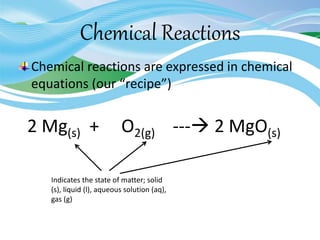
Chemical Reactions
Chemical reactions are expressed in chemical
equations (our “recipe”)
2 Mg(s) + O2(g) --- 2 MgO(s)
Indicates the state of matter; solid
(s), liquid (l), aqueous solution (aq),
gas (g)
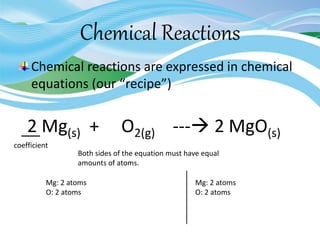
Chemical Reactions
Chemical reactions are expressed in chemical
equations (our “recipe”)
2 Mg(s) + O2(g) --- 2 MgO(s)
Both sides of the equation must have equal
amounts of atoms.
Mg: 2 atoms
O: 2 atoms
Mg: 2 atoms
O: 2 atoms
coefficient
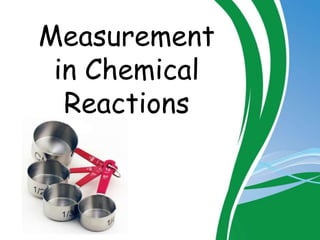
Measurement
in Chemical
Reactions
Measurement
In baking, we measure ingredients using
measuring cups
Instead, in chemistry, we measure reactants and
products in moles
The Mole (mol)
SI unit for amount of substance
Defined as the amount of a substance that
contains the same number of entities as there are
atoms in exactly 12 grams of carbon-12. That is
6.022 x10²³ [called Avogrado’s number]
∴ 1 mol of carbon-12 contains 6.022 x10²³
carbon-12 atoms
1 mol of H2O contains 6.022 x10²³ H2O molecules
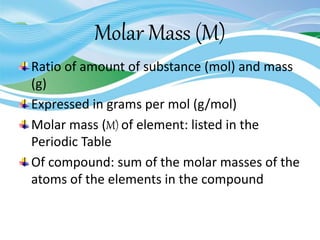
Molar Mass (M)
Ratio of amount of substance (mol) and mass
(g)
Expressed in grams per mol (g/mol)
Molar mass (M) of element: listed in the
Periodic Table
Of compound: sum of the molar masses of the
atoms of the elements in the compound
Molar Mass (M)
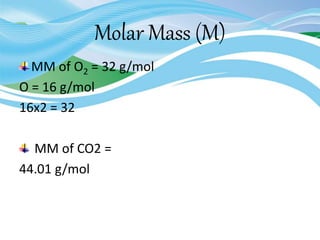
MM of O2 = 32 g/mol
O = 16 g/mol
16x2 = 32
MM of CO2 =
44.01 g/mol
Problems
Related
toChemical
Reactions
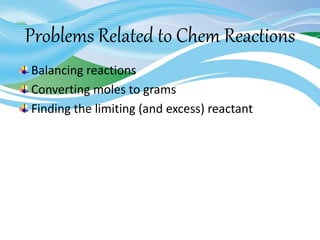
Problems Related to Chem Reactions
Balancing reactions
Converting moles to grams
Finding the limiting (and excess) reactant
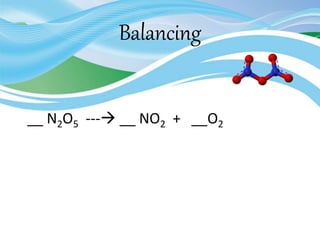
Balancing
__ N2O5 --- __ NO2 + __O2
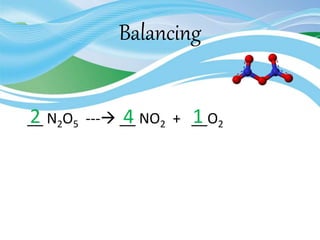
Balancing
__ N2O5 --- __ NO2 + __O22 4 1
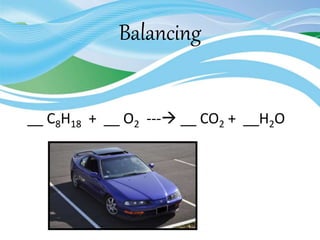
Balancing
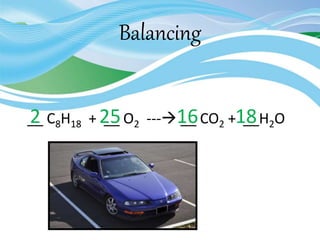
__ C8H18 + __ O2 --- __ CO2 + __H2O
Balancing
__ C8H18 + __ O2 --- __ CO2 + __H2O2 25 16 18
Balancing
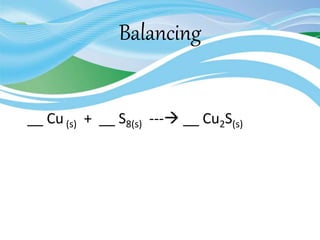
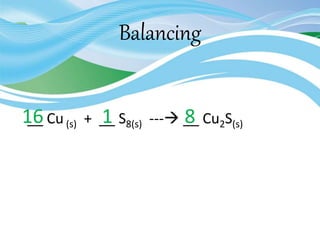
__ Cu(s) + __ S8(s) --- __ Cu2S(s)
Balancing
__ Cu(s) + __ S8(s) --- __ Cu2S(s)16 1 8
Conversion
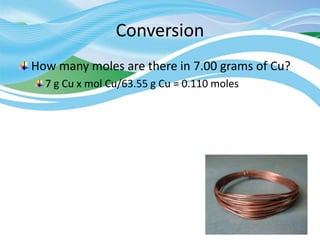
How many moles are there in 7.00 grams of Cu?
7 g Cu x mol Cu/63.55 g Cu = 0.110 moles
Conversion
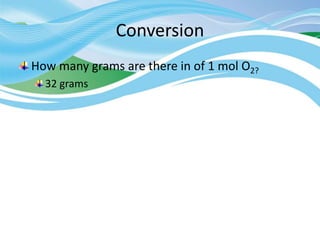
How many grams are there in of 1 mol O2?
32 grams
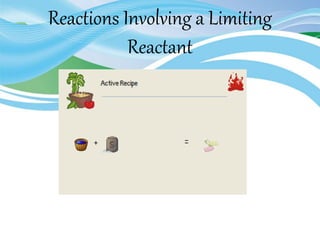
Reactions Involving a Limiting
Reactant
+
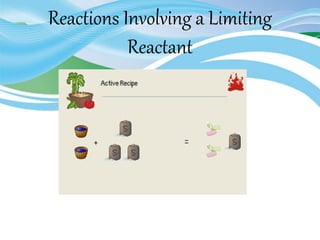
Reactions Involving a Limiting
Reactant
+
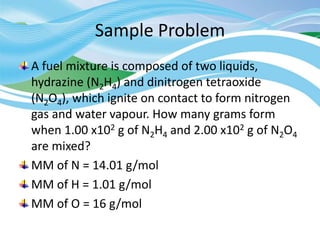
Sample Problem
A fuel mixture is composed of two liquids,
hydrazine (N2H4) and dinitrogen tetraoxide
(N2O4), which ignite on contact to form nitrogen
gas and water vapour. How many grams form
when 1.00 x10² g of N2H4 and 2.00 x10² g of N2O4
are mixed?
MM of N = 14.01 g/mol
MM of H = 1.01 g/mol
MM of O = 16 g/mol
Sample Problem
• Plan:
– Write the balanced equation
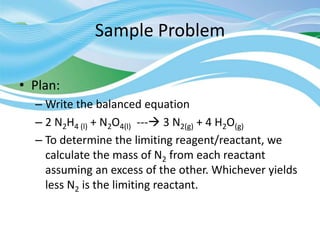
– 2 N2H4 (l) + N2O4(l) --- 3 N2(g) + 4 H2O(g)
– To determine the limiting reagent/reactant, we
calculate the mass of N2 from each reactant
assuming an excess of the other. Whichever yields
less N2 is the limiting reactant.
Sample Problem
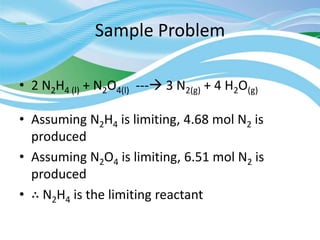
• 2 N2H4 (l) + N2O4(l) --- 3 N2(g) + 4 H2O(g)
• Assuming N2H4 is limiting, 4.68 mol N2 is
produced
• Assuming N2O4 is limiting, 6.51 mol N2 is
produced
• ∴ N2H4 is the limiting reactant
Sample Problem
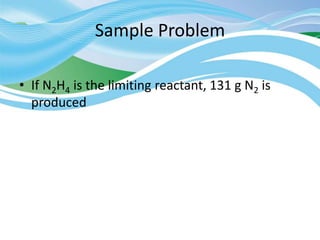
• If N2H4 is the limiting reactant, 131 g N2 is
produced
Sample Problem
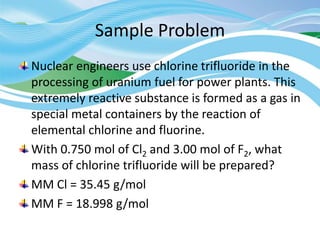
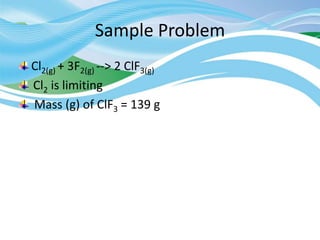
Nuclear engineers use chlorine trifluoride in the
processing of uranium fuel for power plants. This
extremely reactive substance is formed as a gas in
special metal containers by the reaction of
elemental chlorine and fluorine.
With 0.750 mol of Cl2 and 3.00 mol of F2, what
mass of chlorine trifluoride will be prepared?
MM Cl = 35.45 g/mol
MM F = 18.998 g/mol
Sample Problem
Cl2(g) + 3F2(g) --> 2 ClF3(g)
Cl2 is limiting
Mass (g) of ClF3 = 139 g
Sources
• Dragon Cave Holiday Cooking 2012. [Photos]
• Silberberg, Martin S. “Stoichiometry of Formulas and
Equations”. Principles of General Chemistry. McGraw-Hill,
2010.

Chemistry stoichiometry