What is plagiarism?
(And why you should care!)
1
Plagiarism is the act of
presenting the words, ideas,
images, sounds, or the
creative expression of others
as your own.
2
Definition:
Two types of plagiarism:
3
Intentional
Copying a friend’s work.
Doing your friend’s
homework.
Buying or borrowing
papers.
Cutting and pasting blocks
of text from electronic
sources without
documenting them.
Media “borrowing” without
documentation.
Web publishing without
permissions of creators
Reusing papers from other
classes
Unintentional
Careless paraphrasing
Poor documentation
Quoting excessively
Failure to use your own
“voice”
Historians: Plaigarism damaged the reputation of two prominent
historians, Stephen Ambrose and Doris Kearns Goodwin.
Kearns left television position and stepped down as Pulitzer
Prize judge for “lifting” 50 passages for her 1987 book The
Fitzgeralds and the Kennedys.
Politicians: Senator Joseph Biden dropped his 1987 campaign
for the Democratic presidential nomination.
Copied in law school and borrowed from campaign speeches
of Robert Kennedy.
Journalists: Boston Globe journalist Mike Barnicle forced to
resign for plagiarism in his columns (“Boston Columnist . . .”)
Probe of plagiarism at University of Virginia--45 students
dismissed, 3 graduate degrees revoked
4
Real life consequences:
New York Times senior reporter Jayson Blair
forced to resign after being accused of
plagiarism and fraud.
“The newspaper said at least 36 of the 73
articles he had written had problems with
accuracy, calling the deception a "low point"
in the newspaper's history.”
5
Consequences (cont’d)
Controversial New Jersey high
school valedictorian denied her
seat as a Harvard freshman
when it discovered she
plagiarized in a local
newspaper.
6
Consequences (cont’d)
What if…
Your architect cheated his way through math
class. Will your new home be safe?
Your lawyer paid for a copy of the bar exam to
study. Will the contract she wrote for you stand
up in court?
The accountant who does your taxes hired
someone to write his papers and paid a stand-in to
take his major tests? Does he know enough to
complete your tax forms properly?
7
Is this important?
 Plagiarism is theft of intellectual property.
 Plagiarism is cheating.
 Plagiarism may result in receiving a failing
grade or zero for the assignment.
 Plagiarism could result in a disciplinary
referral. Students caught plagiarizing may
be denied admittance to or removal from
the National Honor Society.
8
What Does This Mean?
I was too busy to do the assignment.
My parents expect A’s.
I have to have good grades to… (work, play sports, etc.)
This assignment was boring.
The assignment was too hard.
Teachers expect too much.
John, Adam, Miranda, Stephanie, whoever did it!
Everyone does it.
Where is your bridge?
9
Don’t Fool Yourself
Putting the information in YOUR OWN
WORDS!
List of works cited
Matches the sources you used and your in-text
citations.
In-text citations (you don’t have to do this now, but in
the future you will.)
Right after you give some information that you
learned or got from a source, name the source in
parenthesis.
10
This is what you need!
11
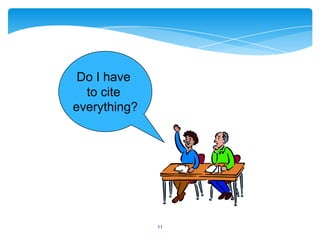
Do I have
to cite
everything?
If you are doing in-text citations, you
don’t have to cite:
Facts that are widely known, or
Information or judgments considered
“common knowledge”
Do NOT have to be documented.
12
Nope!
Hooray for
common
knowledge!
John Adams was our second president
The Japanese attacked Pearl Harbor on
December 7, 1941
13
Examples of common
knowledge
If you see a fact in three or more sources, and
you are fairly certain your readers already
know this information, it is likely to be
“common knowledge.”
But when in doubt, cite!
You are discussing your own experiences,
observations, or reactions
Compiling the results of original research,
from science experiments, etc.
You are using common knowledge
14
No need to document when:
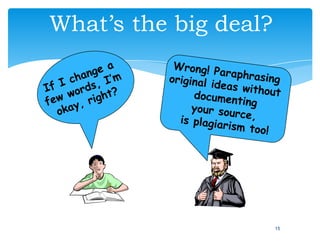
What’s the big deal?
15
You can “borrow” from
the works of others in
your own work! Just
do it correctly!
16
Quoting
Paraphrasing
Summarizing
To blend source materials in with your
own, making sure your own voice is
heard.
17
Use these three strategies
Quotations are the exact words of an author, copied directly
from a source, word for word. Quotations must be cited!
Use quotations when:
You want to add the power of an author’s words to support your
argument
You want to disagree with an author’s argument
You want to highlight particularly eloquent or powerful phrases or
passages
You are comparing and contrasting specific points of view
You want to note the important research that precedes your own
18
Quoting
Paraphrasing means rephrasing the words of an author, putting
his/her thoughts in your own words. When you paraphrase,
you rework the source’s ideas, words, phrases, and sentence
structures with your own. Like quotations, paraphrased
material must be followed with in-text documentation and
cited on your Works-Cited page.
Paraphrase when:
You plan to use information on your note cards/fact sheet and
wish to avoid plagiarizing
You want to avoid overusing quotations
You want to use your own voice to present information
19
Paraphrasing
Summarizing involves putting the main idea(s) of
one or several writers into your own
words, including only the main point(s). Summaries
are significantly shorter than the original and take
a broad overview of the source material. Again, it is
necessary to attribute summarized ideas to their
original sources.
Summarize when:
You want to establish background or offer an overview of a topic
You want to describe knowledge (from several sources) about a topic
You want to determine the main ideas of a single source
20
Summarizing
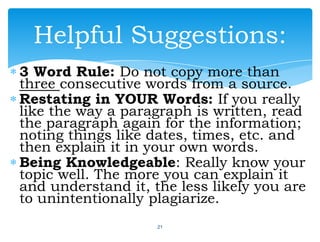
3 Word Rule: Do not copy more than
three consecutive words from a source.
Restating in YOUR Words: If you really
like the way a paragraph is written, read
the paragraph again for the information;
noting things like dates, times, etc. and
then explain it in your own words.
Being Knowledgeable: Really know your
topic well. The more you can explain it
and understand it, the less likely you are
to unintentionally plagiarize.
21
Helpful Suggestions:
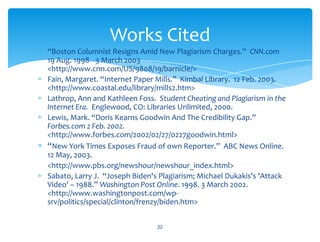
“Boston Columnist Resigns Amid New Plagiarism Charges.” CNN.com
19 Aug. 1998 3 March 2003
<http://www.cnn.com/US/9808/19/barnicle/>
Fain, Margaret. “Internet Paper Mills.” Kimbal Library. 12 Feb. 2003.
<http://www.coastal.edu/library/mills2.htm>
Lathrop, Ann and Kathleen Foss. Student Cheating and Plagiarism in the
Internet Era. Englewood, CO: Libraries Unlimited, 2000.
Lewis, Mark. “Doris Kearns Goodwin And The Credibility Gap.”
Forbes.com 2 Feb. 2002.
<http://www.forbes.com/2002/02/27/0227goodwin.html>
“New York Times Exposes Fraud of own Reporter.” ABC News Online.
12 May, 2003.
<http://www.pbs.org/newshour/newshour_index.html>
Sabato, Larry J. “Joseph Biden's Plagiarism; Michael Dukakis's 'Attack
Video' – 1988.” Washington Post Online. 1998. 3 March 2002.
<http://www.washingtonpost.com/wp-
srv/politics/special/clinton/frenzy/biden.htm>
22
Works Cited
“What is Plagiarism”. Montgomery County
Intermediate Unit 3 Sept. 03 2 Dec 04.
<mciu.org/~spjvweb/ plagiarism.ppt>
23
This presentation has been brought to
you by:
24

Plagiarism Presentation

  • 1.
    What is plagiarism? (Andwhy you should care!) 1
  • 2.
    Plagiarism is theact of presenting the words, ideas, images, sounds, or the creative expression of others as your own. 2 Definition:
  • 3.
    Two types ofplagiarism: 3 Intentional Copying a friend’s work. Doing your friend’s homework. Buying or borrowing papers. Cutting and pasting blocks of text from electronic sources without documenting them. Media “borrowing” without documentation. Web publishing without permissions of creators Reusing papers from other classes Unintentional Careless paraphrasing Poor documentation Quoting excessively Failure to use your own “voice”
  • 4.
    Historians: Plaigarism damagedthe reputation of two prominent historians, Stephen Ambrose and Doris Kearns Goodwin. Kearns left television position and stepped down as Pulitzer Prize judge for “lifting” 50 passages for her 1987 book The Fitzgeralds and the Kennedys. Politicians: Senator Joseph Biden dropped his 1987 campaign for the Democratic presidential nomination. Copied in law school and borrowed from campaign speeches of Robert Kennedy. Journalists: Boston Globe journalist Mike Barnicle forced to resign for plagiarism in his columns (“Boston Columnist . . .”) Probe of plagiarism at University of Virginia--45 students dismissed, 3 graduate degrees revoked 4 Real life consequences:
  • 5.
    New York Timessenior reporter Jayson Blair forced to resign after being accused of plagiarism and fraud. “The newspaper said at least 36 of the 73 articles he had written had problems with accuracy, calling the deception a "low point" in the newspaper's history.” 5 Consequences (cont’d)
  • 6.
    Controversial New Jerseyhigh school valedictorian denied her seat as a Harvard freshman when it discovered she plagiarized in a local newspaper. 6 Consequences (cont’d)
  • 7.
    What if… Your architectcheated his way through math class. Will your new home be safe? Your lawyer paid for a copy of the bar exam to study. Will the contract she wrote for you stand up in court? The accountant who does your taxes hired someone to write his papers and paid a stand-in to take his major tests? Does he know enough to complete your tax forms properly? 7 Is this important?
  • 8.
     Plagiarism istheft of intellectual property.  Plagiarism is cheating.  Plagiarism may result in receiving a failing grade or zero for the assignment.  Plagiarism could result in a disciplinary referral. Students caught plagiarizing may be denied admittance to or removal from the National Honor Society. 8 What Does This Mean?
  • 9.
    I was toobusy to do the assignment. My parents expect A’s. I have to have good grades to… (work, play sports, etc.) This assignment was boring. The assignment was too hard. Teachers expect too much. John, Adam, Miranda, Stephanie, whoever did it! Everyone does it. Where is your bridge? 9 Don’t Fool Yourself
  • 10.
    Putting the informationin YOUR OWN WORDS! List of works cited Matches the sources you used and your in-text citations. In-text citations (you don’t have to do this now, but in the future you will.) Right after you give some information that you learned or got from a source, name the source in parenthesis. 10 This is what you need!
  • 11.
    11 Do I have tocite everything?
  • 12.
    If you aredoing in-text citations, you don’t have to cite: Facts that are widely known, or Information or judgments considered “common knowledge” Do NOT have to be documented. 12 Nope! Hooray for common knowledge!
  • 13.
    John Adams wasour second president The Japanese attacked Pearl Harbor on December 7, 1941 13 Examples of common knowledge If you see a fact in three or more sources, and you are fairly certain your readers already know this information, it is likely to be “common knowledge.” But when in doubt, cite!
  • 14.
    You are discussingyour own experiences, observations, or reactions Compiling the results of original research, from science experiments, etc. You are using common knowledge 14 No need to document when:
  • 15.
  • 16.
    You can “borrow”from the works of others in your own work! Just do it correctly! 16
  • 17.
    Quoting Paraphrasing Summarizing To blend sourcematerials in with your own, making sure your own voice is heard. 17 Use these three strategies
  • 18.
    Quotations are theexact words of an author, copied directly from a source, word for word. Quotations must be cited! Use quotations when: You want to add the power of an author’s words to support your argument You want to disagree with an author’s argument You want to highlight particularly eloquent or powerful phrases or passages You are comparing and contrasting specific points of view You want to note the important research that precedes your own 18 Quoting
  • 19.
    Paraphrasing means rephrasingthe words of an author, putting his/her thoughts in your own words. When you paraphrase, you rework the source’s ideas, words, phrases, and sentence structures with your own. Like quotations, paraphrased material must be followed with in-text documentation and cited on your Works-Cited page. Paraphrase when: You plan to use information on your note cards/fact sheet and wish to avoid plagiarizing You want to avoid overusing quotations You want to use your own voice to present information 19 Paraphrasing
  • 20.
    Summarizing involves puttingthe main idea(s) of one or several writers into your own words, including only the main point(s). Summaries are significantly shorter than the original and take a broad overview of the source material. Again, it is necessary to attribute summarized ideas to their original sources. Summarize when: You want to establish background or offer an overview of a topic You want to describe knowledge (from several sources) about a topic You want to determine the main ideas of a single source 20 Summarizing
  • 21.
    3 Word Rule:Do not copy more than three consecutive words from a source. Restating in YOUR Words: If you really like the way a paragraph is written, read the paragraph again for the information; noting things like dates, times, etc. and then explain it in your own words. Being Knowledgeable: Really know your topic well. The more you can explain it and understand it, the less likely you are to unintentionally plagiarize. 21 Helpful Suggestions:
  • 22.
    “Boston Columnist ResignsAmid New Plagiarism Charges.” CNN.com 19 Aug. 1998 3 March 2003 <http://www.cnn.com/US/9808/19/barnicle/> Fain, Margaret. “Internet Paper Mills.” Kimbal Library. 12 Feb. 2003. <http://www.coastal.edu/library/mills2.htm> Lathrop, Ann and Kathleen Foss. Student Cheating and Plagiarism in the Internet Era. Englewood, CO: Libraries Unlimited, 2000. Lewis, Mark. “Doris Kearns Goodwin And The Credibility Gap.” Forbes.com 2 Feb. 2002. <http://www.forbes.com/2002/02/27/0227goodwin.html> “New York Times Exposes Fraud of own Reporter.” ABC News Online. 12 May, 2003. <http://www.pbs.org/newshour/newshour_index.html> Sabato, Larry J. “Joseph Biden's Plagiarism; Michael Dukakis's 'Attack Video' – 1988.” Washington Post Online. 1998. 3 March 2002. <http://www.washingtonpost.com/wp- srv/politics/special/clinton/frenzy/biden.htm> 22 Works Cited
  • 23.
    “What is Plagiarism”.Montgomery County Intermediate Unit 3 Sept. 03 2 Dec 04. <mciu.org/~spjvweb/ plagiarism.ppt> 23 This presentation has been brought to you by:
  • 24.