Tatyanna Lollies
  Pablo Rivera
Chemical bonds
              
 A chemical bond is an attraction between atoms that
  allows the formation of chemical substances that
  contain two or more atoms.
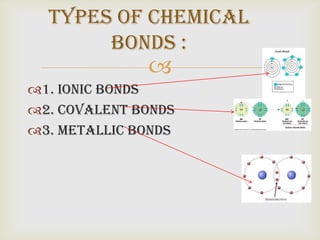
Types of chemical
       bonds :
              
1. Ionic bonds
2. covalent bonds
3. Metallic bonds
Ionic bonds
            
Ionic bonds: a chemical bond
 that occur when an atoms
 gains a valence electrons
 from another atom; forming
 an Anion, (negative ion) and a
 Cat ion (positive ion). They
 attracted each other
 forming an Ionic bond.
Covalent bond:
           
Covalent bonds: are formed when to
 atom share valence electrons.
There are 3 types of covalent bonds
 Single, Double and Triple.
Single: covalent bond formed by the
 mutual sharing of one electron pair
 between two atoms
Double: bond formed between 2 atoms
 sharing 2 electron pairs
Triple: covalent bond formed by the
Metallic Bonds
         
 chemical bond characteristic of
 metals, in which mobile valence
 electrons are shared among
 atoms in a usually stable
 metals
 “in which the valence electrons
 are free to move through the
 crystal”
http://www.thefreedictionary.com
physical properties of Ionic
          compounds:
                         
 Physical Properties: Solid
 Electrical conductivity: Solid: No Liquid: Yes
  Aqueous: Yes (if soluble)
 Boiling point and Melting Point: High
 Solubility in water: Often high
 Thermal conductivity: Low
Sources
                  
 http://chemistry.about.com/od/chemicalbonding/
  a/chemicalbonds.htm
 http://www.beyondbooks.com/psc92/3.asp
 http://www.citycollegiate.com/bondIXd.htm

Chemical bonds

  • 1.
    Tatyanna Lollies Pablo Rivera
  • 2.
    Chemical bonds   A chemical bond is an attraction between atoms that allows the formation of chemical substances that contain two or more atoms.
  • 3.
    Types of chemical bonds :  1. Ionic bonds 2. covalent bonds 3. Metallic bonds
  • 4.
    Ionic bonds  Ionic bonds: a chemical bond that occur when an atoms gains a valence electrons from another atom; forming an Anion, (negative ion) and a Cat ion (positive ion). They attracted each other forming an Ionic bond.
  • 5.
    Covalent bond:  Covalent bonds: are formed when to atom share valence electrons. There are 3 types of covalent bonds Single, Double and Triple. Single: covalent bond formed by the mutual sharing of one electron pair between two atoms Double: bond formed between 2 atoms sharing 2 electron pairs Triple: covalent bond formed by the
  • 6.
    Metallic Bonds   chemical bond characteristic of metals, in which mobile valence electrons are shared among atoms in a usually stable metals  “in which the valence electrons are free to move through the crystal” http://www.thefreedictionary.com
  • 7.
    physical properties ofIonic compounds:   Physical Properties: Solid  Electrical conductivity: Solid: No Liquid: Yes Aqueous: Yes (if soluble)  Boiling point and Melting Point: High  Solubility in water: Often high  Thermal conductivity: Low
  • 8.
    Sources   http://chemistry.about.com/od/chemicalbonding/ a/chemicalbonds.htm  http://www.beyondbooks.com/psc92/3.asp  http://www.citycollegiate.com/bondIXd.htm