"I think of life itself now as a wonderful play that I've written for myself... and so my purpose is to have the utmost fun playing my part…!" Shirley MacLaine, Actress and Author
Revision slides first …..


Etiology of Cancer Dr Ejaz Waris
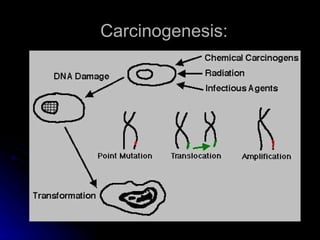
Non-lethal Genetic damage lies at the center of carcinogenesis. Loss/damage to suppressor genes, Duplication of promotor genes Loss/damage to Apoptosis genes Loss/damage of DNA repair genes.
Carcinogenesis:
We owe, Sir Percival Pott the knowledge of carcinogenesis. Pott, related the increased incidence of scrotal cancer in chimney sweeps. On his findings, Danish Chimney Sweeps Guild ruled that it’s members must  bathe daily . No public health measure since that time, has so successfully controlled a form of cancer……!!!
Etiology of Neoplasia Environmental causes: (Carcinogens) Chemicals  Viruses  Radiation  Hereditary causes- Genetic defects.
Point to be noted ! In males bronchogenic carcinoma and in females breast carcinoma are at the top !
Preneoplastic conditions Cirrhosis of liver Atypical hyperplasia of endometrium Leukoplakia Inflammatory bowel disease Adenomatous colonic polyps
CHEMICAL CARCINOGESIS
IT’S A MULTISTEP PROCESS CHEMICAL CARCINOGENESIS CONSISTS OF TWO PROCESSES: INITIATION PROMOTION
Chemical Carcinogenesis: Initiators-  Cause irreversible damage to DNA,but at maximum they can cause severe dysplasia.  eg.Benzopyrene Promoters – itself cannot induce cancer,they propagate or enhance the effects of initiators Alcohol,smoking (co-carcinogens) Thus resulting in Malignant transformation: Visible tumor formation – further DNA damage.
 
Chemical Carcinogenesis: Direct Acting Carcinogens: Alkylating Agents: Cyclophosphamide Indirect acting / Procarcinogenes (needs activation) Polycyclinc hydrocarbons – Benzopyrene Aromatic amines, dyes - Benzidine Natural products: Aflatoxin Others: Vinyl chloride, turpentine etc.
Known Chemical carcinogens A- Asbestos - Lung, mesothelioma. GI tract (esophagus, stomach, large intestine)  b- Arsenic - Lung, skin, hemangiosarcoma  c- Beryllium - Lung  d- Cadmium - prostate  e. Benzene - Leukemia
f. Chromium- Lung  g. Ethylene oxide   Leukemia  h. Nickel  .. Nose, Lung  i. Radon  .. Lungs  j. Vinyl chloride    Angiosarcoma  k.Aflatoxins – HCC l-Nitrates – Gastric carcinoma M.Aniline Dyes,B-naphthylamine – TCC of bladder
Lets see mode of action of any one of the chemical carcinogens ! The carcinogenicity of most aromatic amines and azo dyes is exerted mainly in the liver, where the "ultimate carcinogen" is formed by the action of the cytochrome P-450 oxygenase systems.
After absorption,azodyes like b naphthylamine  is hydroxylated into an active form, then detoxified by conjugation with glucuronic acid. When excreted in the urine, the nontoxic conjugate is split by the urinary enzyme glucuronidase to release the electrophilic reactant again, thus inducing bladder cancer.  Regrettably, humans are one of the few species to possess urinary glucuronidase.
Viral Oncogenesis: Insertion of viral nucleic acids    mutation Alterations in Oncogenes, cancer suppressor genes and genes regulating DNA repair resulting in up-regulation of cell division    Carcinogenesis.
Oncogenic DNA Viruses Human Papilloma Virus   Cervical neoplasia – warts, papilloma, ca cervix Epstein-Barr virus  –  Burkitts Lymphoma, Nasopharyngeal  ca,Hodgkin’s disease,B cell lymphoma Hepatitis B & C virus Hepatocellular carcinoma.
Oncogenic DNA Viruses Kaposi Sarcoma Hepes Virus Causes Kaposi Sarcoma
Oncogenic RNA viruses Human T-Cell Leukemia Virus
Radiation Carcinogenesis: Ionizing radiation    dysjunction    random fusion    mutation. X Ray workers – Leukemia Radio-isotopes – Thyroid carcinoma Atomic explosion – Skin cancer, Leukemia Mutations Neoplasia
 
Molecular Basis of Neoplasia: Proto-oncogene Oncogene V-Onc Other Heredity Radiation Chemical
Remember - Multi-step Process Tumor initiation and progression results from stepwise accumulation of DNA mutations.  Several characters of malignant neoplasm are the result of multiple genetic defects. Initial steps reversible(e.g. dysplasia), but final Malignant transformation is irreversible.  “Hit & Run”
Tumor Progression
Multi-step Theory Stage of  initiation Latent  stage Stage of  promotion Stage of  malignant  transformation
Summary DNA damage - loss of control over cell division. Radiation, Chemicals & Viral infections are some known causes of cancers. Cancer evolves in multiple steps by sequentially acquiring different DNA damages. Initiation, Latent stage, Promotion and Malignant transformation are recognizable stages in carcinogenesis. Each character of malignancy depends on unique DNA alteration.
It is easy to kill cancer cells, but the challenge is keeping the patient alive at the same time…..!
Do not fear mistakes… fear only the absence of constructive and corrective responses to those mistakes…

Carcinogenesis

  • 1.
    "I think oflife itself now as a wonderful play that I've written for myself... and so my purpose is to have the utmost fun playing my part…!" Shirley MacLaine, Actress and Author
  • 2.
  • 3.
  • 4.
  • 5.
  • 6.
    Etiology of CancerDr Ejaz Waris
  • 7.
    Non-lethal Genetic damagelies at the center of carcinogenesis. Loss/damage to suppressor genes, Duplication of promotor genes Loss/damage to Apoptosis genes Loss/damage of DNA repair genes.
  • 8.
  • 9.
    We owe, SirPercival Pott the knowledge of carcinogenesis. Pott, related the increased incidence of scrotal cancer in chimney sweeps. On his findings, Danish Chimney Sweeps Guild ruled that it’s members must bathe daily . No public health measure since that time, has so successfully controlled a form of cancer……!!!
  • 10.
    Etiology of NeoplasiaEnvironmental causes: (Carcinogens) Chemicals Viruses Radiation Hereditary causes- Genetic defects.
  • 11.
    Point to benoted ! In males bronchogenic carcinoma and in females breast carcinoma are at the top !
  • 12.
    Preneoplastic conditions Cirrhosisof liver Atypical hyperplasia of endometrium Leukoplakia Inflammatory bowel disease Adenomatous colonic polyps
  • 13.
  • 14.
    IT’S A MULTISTEPPROCESS CHEMICAL CARCINOGENESIS CONSISTS OF TWO PROCESSES: INITIATION PROMOTION
  • 15.
    Chemical Carcinogenesis: Initiators- Cause irreversible damage to DNA,but at maximum they can cause severe dysplasia. eg.Benzopyrene Promoters – itself cannot induce cancer,they propagate or enhance the effects of initiators Alcohol,smoking (co-carcinogens) Thus resulting in Malignant transformation: Visible tumor formation – further DNA damage.
  • 16.
  • 17.
    Chemical Carcinogenesis: DirectActing Carcinogens: Alkylating Agents: Cyclophosphamide Indirect acting / Procarcinogenes (needs activation) Polycyclinc hydrocarbons – Benzopyrene Aromatic amines, dyes - Benzidine Natural products: Aflatoxin Others: Vinyl chloride, turpentine etc.
  • 18.
    Known Chemical carcinogensA- Asbestos - Lung, mesothelioma. GI tract (esophagus, stomach, large intestine) b- Arsenic - Lung, skin, hemangiosarcoma c- Beryllium - Lung d- Cadmium - prostate e. Benzene - Leukemia
  • 19.
    f. Chromium- Lung g. Ethylene oxide  Leukemia h. Nickel  .. Nose, Lung i. Radon  .. Lungs j. Vinyl chloride  Angiosarcoma k.Aflatoxins – HCC l-Nitrates – Gastric carcinoma M.Aniline Dyes,B-naphthylamine – TCC of bladder
  • 20.
    Lets see modeof action of any one of the chemical carcinogens ! The carcinogenicity of most aromatic amines and azo dyes is exerted mainly in the liver, where the "ultimate carcinogen" is formed by the action of the cytochrome P-450 oxygenase systems.
  • 21.
    After absorption,azodyes likeb naphthylamine is hydroxylated into an active form, then detoxified by conjugation with glucuronic acid. When excreted in the urine, the nontoxic conjugate is split by the urinary enzyme glucuronidase to release the electrophilic reactant again, thus inducing bladder cancer. Regrettably, humans are one of the few species to possess urinary glucuronidase.
  • 22.
    Viral Oncogenesis: Insertionof viral nucleic acids  mutation Alterations in Oncogenes, cancer suppressor genes and genes regulating DNA repair resulting in up-regulation of cell division  Carcinogenesis.
  • 23.
    Oncogenic DNA VirusesHuman Papilloma Virus Cervical neoplasia – warts, papilloma, ca cervix Epstein-Barr virus – Burkitts Lymphoma, Nasopharyngeal ca,Hodgkin’s disease,B cell lymphoma Hepatitis B & C virus Hepatocellular carcinoma.
  • 24.
    Oncogenic DNA VirusesKaposi Sarcoma Hepes Virus Causes Kaposi Sarcoma
  • 25.
    Oncogenic RNA virusesHuman T-Cell Leukemia Virus
  • 26.
    Radiation Carcinogenesis: Ionizingradiation  dysjunction  random fusion  mutation. X Ray workers – Leukemia Radio-isotopes – Thyroid carcinoma Atomic explosion – Skin cancer, Leukemia Mutations Neoplasia
  • 27.
  • 28.
    Molecular Basis ofNeoplasia: Proto-oncogene Oncogene V-Onc Other Heredity Radiation Chemical
  • 29.
    Remember - Multi-stepProcess Tumor initiation and progression results from stepwise accumulation of DNA mutations. Several characters of malignant neoplasm are the result of multiple genetic defects. Initial steps reversible(e.g. dysplasia), but final Malignant transformation is irreversible. “Hit & Run”
  • 30.
  • 31.
    Multi-step Theory Stageof initiation Latent stage Stage of promotion Stage of malignant transformation
  • 32.
    Summary DNA damage- loss of control over cell division. Radiation, Chemicals & Viral infections are some known causes of cancers. Cancer evolves in multiple steps by sequentially acquiring different DNA damages. Initiation, Latent stage, Promotion and Malignant transformation are recognizable stages in carcinogenesis. Each character of malignancy depends on unique DNA alteration.
  • 33.
    It is easyto kill cancer cells, but the challenge is keeping the patient alive at the same time…..!
  • 34.
    Do not fearmistakes… fear only the absence of constructive and corrective responses to those mistakes…