

STOCK CHART -
CHART PATTERNS AND FORMATIONS -
ANALYSIS OF CHART PATTERN
AKBAR ALI.K
Dept. of Commerce
Pondicherry University
STOCK CHART
• A stock chart is a simple two-axis (x-y) plotted graph of price and
time.
• Each individual equity, market and index listed on a public exchange
has a chart that illustrates this movement of price over time.
• The study of stock charts, known as technical analysis, believes that
the past action of the market itself will determine the future course of
prices.
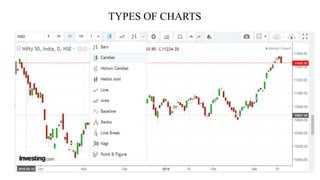
TYPES OF CHARTS
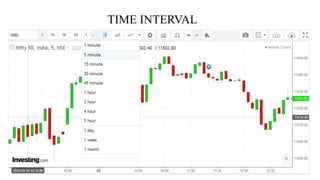
TIME INTERVAL
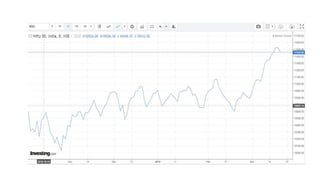
LINE CHARTS
• Simplest type of chart.
• Single line represents the security’s closing price on each time
interval.
• Dates are displayed along the bottom of chart and prices are displayed
on the side.
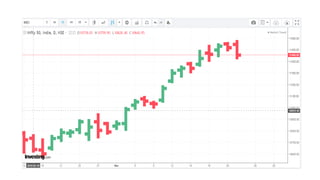
BAR CHARTS
• Bar charts are commonly used to convey price activity into a easily
readable chart.
• It display the open ,close, daily high and daily low price.
• The total vertical length/height of the bar represents the entire trading
range for the period.
• Top of the bar represents the highest price of the period and vice-
versa.
CANDLE STICK CHART
• Candle stick chart are much more visually appealing, and convey the
price information in a quicker, easier manner.
• It display the open ,close, daily high and daily low.
• The hollow or filled portion of the candlestick is called “the body”
(also referred to as “the real body”).
• The long thin lines above and below the body represent the high/low
range and are called “shadows” (also referred to as “wicks” and
“tails”).
• The high is marked by the top of the upper shadow and the low by the
bottom of the lower shadow.
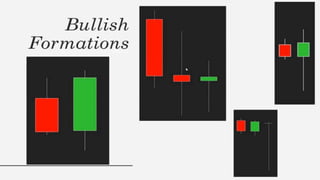
Bullish Candle
• Open at bottom of body.
• Close at top of body.
• High – Top of wick.
• Low – Bottom of wick.
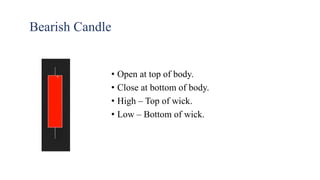
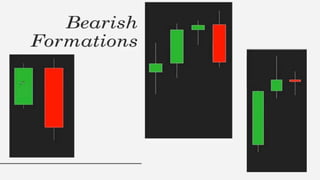
Bearish Candle
• Open at top of body.
• Close at bottom of body.
• High – Top of wick.
• Low – Bottom of wick.
CHART PATTERNS
• Chart patterns are a result of market psychology.
• It is a result of a mix of various emotions like fear and greed.
• It can be used to make short-term or long-term forecasts.
• The data can be intraday ,daily, weekly or monthly and the patterns
can be as short as one day or as long as many years.
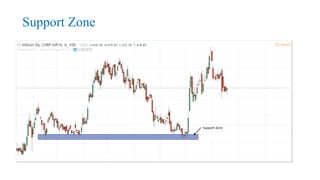
Support
 A support zone is an area where buying interest exits.
 As the price reaches the support zone, participants are more inclined
towards buying.
 As the times passes by, demand will overcome supply and prevent the
price from falling below support.
 It is not true that, support levels will always hold.
 Breaking a support level further increases bearishness in the market.
Support Zone
Resistance
• A resistance zone is an area where selling interest exits.
• As the price reaches the resistance zone, participants are more inclined
towards selling.
• As the times passes by, supply will overcome demand and prevent the
price from rising above resistance.
• Breaking a resistance level further increases bullishness in the market.
Resistance Zone
Support Becoming Resistance And Vice-versa
When a support zone is broken, it can become a resistance zone for the future
price movement and vice versa. One such example is shown below
Types of chart patterns
• Double Top and Double Bottom
• Head and shoulder & Inverse Head and shoulder
• Symmetric Triangle
• Rectangle
• Rising & Falling Channel
• Rising & Falling wedges
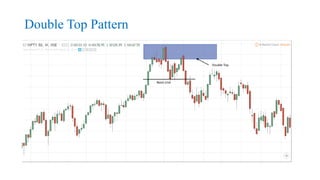
Double Top
 A double top is a reversal pattern which
occurs following an extended uptrend.
 A pair of peaks is formed in which the 2nd
peak is at a lower height compared to the 1st
one.
 This signifies the weakness in prices to reach
a new high and sustain the existing trend.
Double Top Pattern
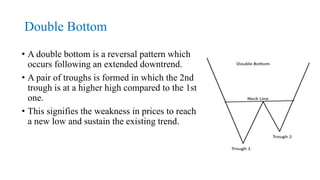
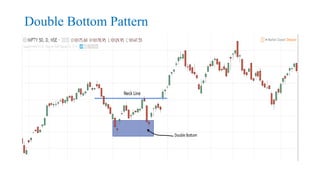
Double Bottom
• A double bottom is a reversal pattern which
occurs following an extended downtrend.
• A pair of troughs is formed in which the 2nd
trough is at a higher high compared to the 1st
one.
• This signifies the weakness in prices to reach
a new low and sustain the existing trend.
Double Bottom Pattern
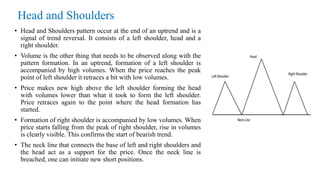
Head and Shoulders
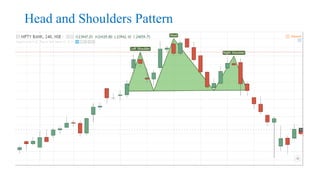
• Head and Shoulders pattern occur at the end of an uptrend and is a
signal of trend reversal. It consists of a left shoulder, head and a
right shoulder.
• Volume is the other thing that needs to be observed along with the
pattern formation. In an uptrend, formation of a left shoulder is
accompanied by high volumes. When the price reaches the peak
point of left shoulder it retraces a bit with low volumes.
• Price makes new high above the left shoulder forming the head
with volumes lower than what it took to form the left shoulder.
Price retraces again to the point where the head formation has
started.
• Formation of right shoulder is accompanied by low volumes. When
price starts falling from the peak of right shoulder, rise in volumes
is clearly visible. This confirms the start of bearish trend.
• The neck line that connects the base of left and right shoulders and
the head act as a support for the price. Once the neck line is
breached, one can initiate new short positions.
Head and Shoulders Pattern
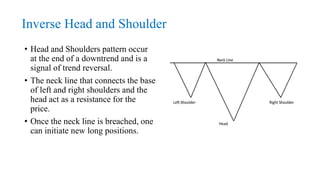
Inverse Head and Shoulder
• Head and Shoulders pattern occur
at the end of a downtrend and is a
signal of trend reversal.
• The neck line that connects the base
of left and right shoulders and the
head act as a resistance for the
price.
• Once the neck line is breached, one
can initiate new long positions.
Inverse Head and Shoulder Pattern
Symmetric Triangle
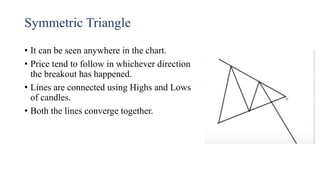
• It can be seen anywhere in the chart.
• Price tend to follow in whichever direction
the breakout has happened.
• Lines are connected using Highs and Lows
of candles.
• Both the lines converge together.
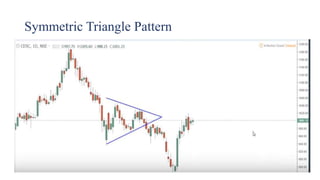
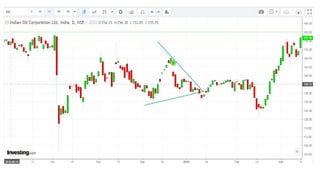
Symmetric Triangle Pattern
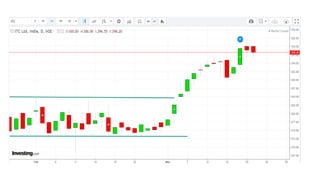
Rectangle
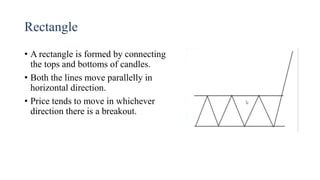
• A rectangle is formed by connecting
the tops and bottoms of candles.
• Both the lines move parallelly in
horizontal direction.
• Price tends to move in whichever
direction there is a breakout.
Rectangle Pattern
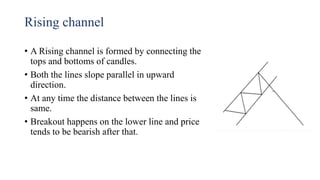
Rising channel
• A Rising channel is formed by connecting the
tops and bottoms of candles.
• Both the lines slope parallel in upward
direction.
• At any time the distance between the lines is
same.
• Breakout happens on the lower line and price
tends to be bearish after that.
Rising channel Pattern
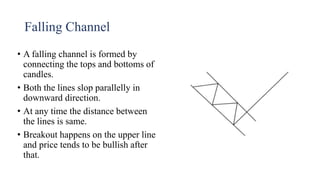
Falling Channel
• A falling channel is formed by
connecting the tops and bottoms of
candles.
• Both the lines slop parallelly in
downward direction.
• At any time the distance between
the lines is same.
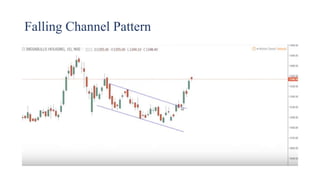
• Breakout happens on the upper line
and price tends to be bullish after
that.
Falling Channel Pattern
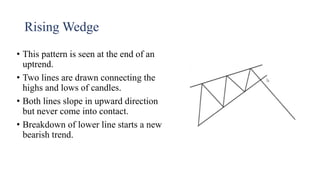
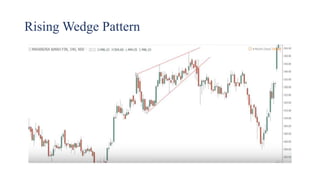
Rising Wedge
• This pattern is seen at the end of an
uptrend.
• Two lines are drawn connecting the
highs and lows of candles.
• Both lines slope in upward direction
but never come into contact.
• Breakdown of lower line starts a new
bearish trend.
Rising Wedge Pattern
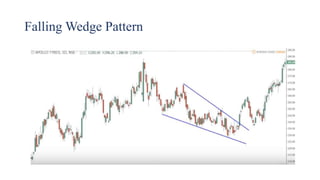
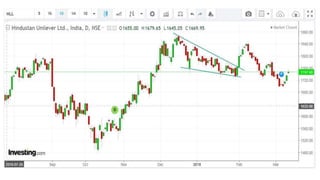
Falling Wedge
• This pattern is seen at the end of a
downtrend.
• Two lines are drawn connecting the
highs and lows of candles.
• Both line slope in downward direction
but never come into contact.
• Breakdown of upper line starts a new
bullish trend.
Falling Wedge Pattern
THANK YOU….

Stock chart-Chart patterns and formations-Analysis of chart pattern

  • 1.
    STOCK CHART - CHARTPATTERNS AND FORMATIONS - ANALYSIS OF CHART PATTERN AKBAR ALI.K Dept. of Commerce Pondicherry University
  • 2.
    STOCK CHART • Astock chart is a simple two-axis (x-y) plotted graph of price and time. • Each individual equity, market and index listed on a public exchange has a chart that illustrates this movement of price over time. • The study of stock charts, known as technical analysis, believes that the past action of the market itself will determine the future course of prices.
  • 3.
  • 4.
  • 5.
    LINE CHARTS • Simplesttype of chart. • Single line represents the security’s closing price on each time interval. • Dates are displayed along the bottom of chart and prices are displayed on the side.
  • 7.
    BAR CHARTS • Barcharts are commonly used to convey price activity into a easily readable chart. • It display the open ,close, daily high and daily low price. • The total vertical length/height of the bar represents the entire trading range for the period. • Top of the bar represents the highest price of the period and vice- versa.
  • 9.
    CANDLE STICK CHART •Candle stick chart are much more visually appealing, and convey the price information in a quicker, easier manner. • It display the open ,close, daily high and daily low. • The hollow or filled portion of the candlestick is called “the body” (also referred to as “the real body”). • The long thin lines above and below the body represent the high/low range and are called “shadows” (also referred to as “wicks” and “tails”). • The high is marked by the top of the upper shadow and the low by the bottom of the lower shadow.
  • 10.
    Bullish Candle • Openat bottom of body. • Close at top of body. • High – Top of wick. • Low – Bottom of wick.
  • 11.
    Bearish Candle • Openat top of body. • Close at bottom of body. • High – Top of wick. • Low – Bottom of wick.
  • 15.
    CHART PATTERNS • Chartpatterns are a result of market psychology. • It is a result of a mix of various emotions like fear and greed. • It can be used to make short-term or long-term forecasts. • The data can be intraday ,daily, weekly or monthly and the patterns can be as short as one day or as long as many years.
  • 16.
    Support  A supportzone is an area where buying interest exits.  As the price reaches the support zone, participants are more inclined towards buying.  As the times passes by, demand will overcome supply and prevent the price from falling below support.  It is not true that, support levels will always hold.  Breaking a support level further increases bearishness in the market.
  • 17.
  • 18.
    Resistance • A resistancezone is an area where selling interest exits. • As the price reaches the resistance zone, participants are more inclined towards selling. • As the times passes by, supply will overcome demand and prevent the price from rising above resistance. • Breaking a resistance level further increases bullishness in the market.
  • 19.
  • 20.
    Support Becoming ResistanceAnd Vice-versa When a support zone is broken, it can become a resistance zone for the future price movement and vice versa. One such example is shown below
  • 21.
    Types of chartpatterns • Double Top and Double Bottom • Head and shoulder & Inverse Head and shoulder • Symmetric Triangle • Rectangle • Rising & Falling Channel • Rising & Falling wedges
  • 22.
    Double Top  Adouble top is a reversal pattern which occurs following an extended uptrend.  A pair of peaks is formed in which the 2nd peak is at a lower height compared to the 1st one.  This signifies the weakness in prices to reach a new high and sustain the existing trend.
  • 23.
  • 24.
    Double Bottom • Adouble bottom is a reversal pattern which occurs following an extended downtrend. • A pair of troughs is formed in which the 2nd trough is at a higher high compared to the 1st one. • This signifies the weakness in prices to reach a new low and sustain the existing trend.
  • 25.
  • 26.
    Head and Shoulders •Head and Shoulders pattern occur at the end of an uptrend and is a signal of trend reversal. It consists of a left shoulder, head and a right shoulder. • Volume is the other thing that needs to be observed along with the pattern formation. In an uptrend, formation of a left shoulder is accompanied by high volumes. When the price reaches the peak point of left shoulder it retraces a bit with low volumes. • Price makes new high above the left shoulder forming the head with volumes lower than what it took to form the left shoulder. Price retraces again to the point where the head formation has started. • Formation of right shoulder is accompanied by low volumes. When price starts falling from the peak of right shoulder, rise in volumes is clearly visible. This confirms the start of bearish trend. • The neck line that connects the base of left and right shoulders and the head act as a support for the price. Once the neck line is breached, one can initiate new short positions.
  • 27.
  • 28.
    Inverse Head andShoulder • Head and Shoulders pattern occur at the end of a downtrend and is a signal of trend reversal. • The neck line that connects the base of left and right shoulders and the head act as a resistance for the price. • Once the neck line is breached, one can initiate new long positions.
  • 29.
    Inverse Head andShoulder Pattern
  • 30.
    Symmetric Triangle • Itcan be seen anywhere in the chart. • Price tend to follow in whichever direction the breakout has happened. • Lines are connected using Highs and Lows of candles. • Both the lines converge together.
  • 31.
  • 33.
    Rectangle • A rectangleis formed by connecting the tops and bottoms of candles. • Both the lines move parallelly in horizontal direction. • Price tends to move in whichever direction there is a breakout.
  • 34.
  • 36.
    Rising channel • ARising channel is formed by connecting the tops and bottoms of candles. • Both the lines slope parallel in upward direction. • At any time the distance between the lines is same. • Breakout happens on the lower line and price tends to be bearish after that.
  • 37.
  • 39.
    Falling Channel • Afalling channel is formed by connecting the tops and bottoms of candles. • Both the lines slop parallelly in downward direction. • At any time the distance between the lines is same. • Breakout happens on the upper line and price tends to be bullish after that.
  • 40.
  • 42.
    Rising Wedge • Thispattern is seen at the end of an uptrend. • Two lines are drawn connecting the highs and lows of candles. • Both lines slope in upward direction but never come into contact. • Breakdown of lower line starts a new bearish trend.
  • 43.
  • 44.
    Falling Wedge • Thispattern is seen at the end of a downtrend. • Two lines are drawn connecting the highs and lows of candles. • Both line slope in downward direction but never come into contact. • Breakdown of upper line starts a new bullish trend.
  • 45.
  • 47.