Technical Analysis - Momentum
                       Indicators


                                  PUNEET ARORA(75141)
                                  SOUMYA ARORA(75158)
                                  BFIA 2B
4/16/2013                                          1
WHAT IS MOMENTUM??
 Momentum generally refers to the rate of change. This can be
     thought of as an increase or decrease in pressure.

 For instance, a stock may be rising at one dollar per month. The
  momentum is non-existent even though this stock is going up
  because there is no change in the rate at which it rises. If the
   stock is rising one dollar this month and none the next, the
  momentum would be dropping. As well, if the stock increased
from one dollar price appreciation to two dollars of appreciation
           the next month, momentum would be rising.

So when referring to momentum, we can usually refer to it as a
 4/16/2013
                       rate of change.                      2
What Does Momentum Tell Us?
   While there are many ways to trade momentum
    indicators, momentum is a good gauge of how
      emotions are swinging in the market place.
 If a sudden euphoria hits, the momentum indicator
 will reflect this. If panic takes over, the momentum
  will also show us how the mood has soured. They
  are commonly considered to be leading indicators.
 Generally speaking, momentum trading is a shorter
 window than trend trading and requires practice to
            properly analyse trading signals.
4/16/2013                                           3
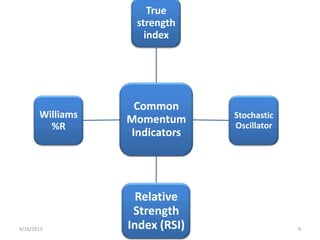
True
                   strength
                     index


                   Common
       Williams   Momentum      Stochastic
         %R                     Oscillator
                  Indicators


                    Relative
                   Strength
4/16/2013         Index (RSI)                4
True Strength Index
published in 1991 by William Blau
using moving averages of the underlying
 momentum of a financial instrument, TSI
 indicates both trend direction and overbought /
 oversold conditions.


4/16/2013                                      5
FORMULA


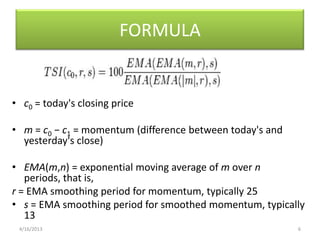
• c0 = today's closing price

• m = c0 − c1 = momentum (difference between today's and
  yesterday's close)

• EMA(m,n) = exponential moving average of m over n
   periods, that is,
r = EMA smoothing period for momentum, typically 25
• s = EMA smoothing period for smoothed momentum, typically
   13
 4/16/2013                                                 6
4/16/2013   7
INTERPRETATION
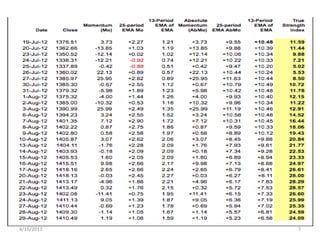
• While the TSI output is bound between +100 and
  −100, most values fall between +25 and −25.
• Blau suggests interpreting these values as
  overbought and oversold levels, respectively, at
  which point a trader may anticipate a market
  turn.
• Trend direction is indicated by the slope of the
  TSI; a rising TSI suggests an up-trend in the
  market, and a falling TSI suggests a down-trend
4/16/2013                                            8
Relative Strength Index - RSI
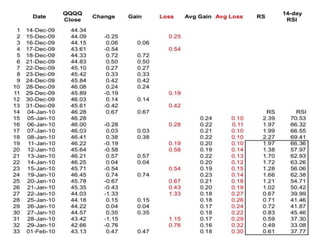
• The RSI is presented on a graph above or
  below the price chart. The indicator has an
  upper line, typically at 70, a lower line at
  30, and a dashed mid-line at 50. Wilder
  recommended a smoothing period of 14 (see
  EMA smoothing, i.e. α = 1/14 or N = 27).
• [edit]


4/16/2013                                        9
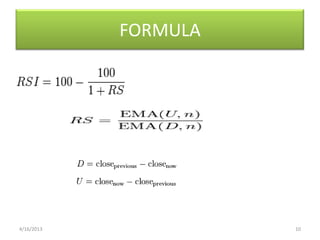
FORMULA


4/16/2013             10
4/16/2013   11
INTERPRETATION
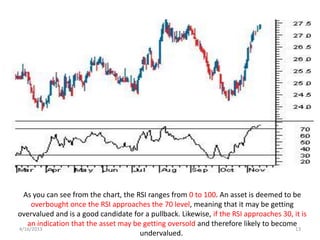
• the RSI ranges from 0 to 100. An asset is
  deemed to be overbought once the RSI
  approaches the 70 level, meaning that it may
  be getting overvalued and is a good candidate
  for a pullback. Likewise, if the RSI approaches
  30, it is an indication that the asset may be
  getting oversold and therefore likely to
  become undervalued.

4/16/2013                                       12
As you can see from the chart, the RSI ranges from 0 to 100. An asset is deemed to be
     overbought once the RSI approaches the 70 level, meaning that it may be getting
overvalued and is a good candidate for a pullback. Likewise, if the RSI approaches 30, it is
   an indication that the asset may be getting oversold and therefore likely to become
4/16/2013                                                                              13
                                      undervalued.
Stochastic osillator
• Developed by George C. Lane in the late
  1950s.

• the stochastic oscillator is a momentum
  indicator that uses support and resistance
  levels.


4/16/2013                                      14
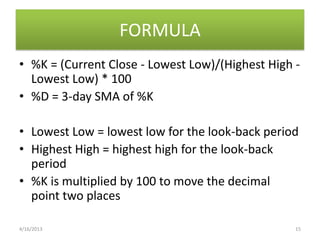
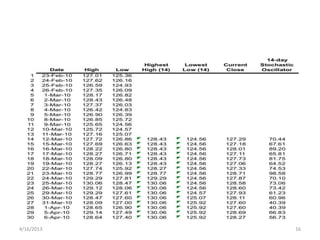
FORMULA
• %K = (Current Close - Lowest Low)/(Highest High -
  Lowest Low) * 100
• %D = 3-day SMA of %K

• Lowest Low = lowest low for the look-back period
• Highest High = highest high for the look-back
  period
• %K is multiplied by 100 to move the decimal
  point two places

4/16/2013                                         15
4/16/2013   16
INTERPRETATION
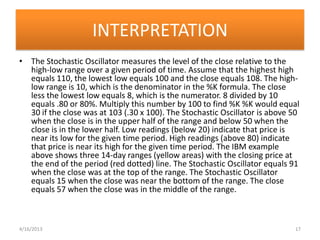
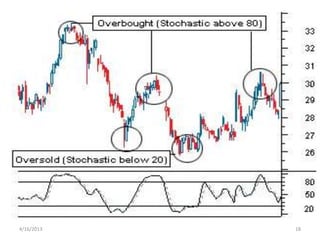
• The Stochastic Oscillator measures the level of the close relative to the
  high-low range over a given period of time. Assume that the highest high
  equals 110, the lowest low equals 100 and the close equals 108. The high-
  low range is 10, which is the denominator in the %K formula. The close
  less the lowest low equals 8, which is the numerator. 8 divided by 10
  equals .80 or 80%. Multiply this number by 100 to find %K %K would equal
  30 if the close was at 103 (.30 x 100). The Stochastic Oscillator is above 50
  when the close is in the upper half of the range and below 50 when the
  close is in the lower half. Low readings (below 20) indicate that price is
  near its low for the given time period. High readings (above 80) indicate
  that price is near its high for the given time period. The IBM example
  above shows three 14-day ranges (yellow areas) with the closing price at
  the end of the period (red dotted) line. The Stochastic Oscillator equals 91
  when the close was at the top of the range. The Stochastic Oscillator
  equals 15 when the close was near the bottom of the range. The close
  equals 57 when the close was in the middle of the range.


4/16/2013                                                                    17
4/16/2013   18
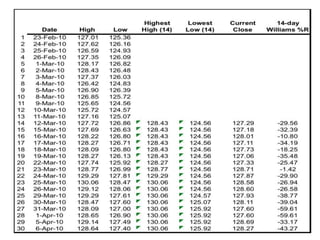
Williams %R
• It was developed by a publisher and promoter
  of trading materials, Larry Williams.
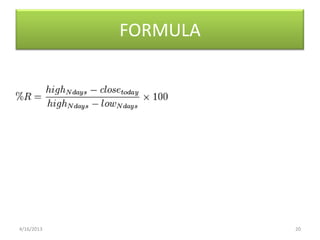
• Williams %R reflects the level of the close
  relative to the highest high for the look-back
  period.
• In contrast, the Stochastic Oscillator reflects
  the level of the close relative to the lowest
  low.

4/16/2013                                       19
FORMULA


4/16/2013             20
4/16/2013   21
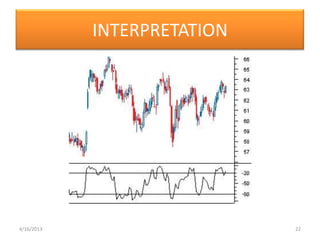
INTERPRETATION


4/16/2013                    22
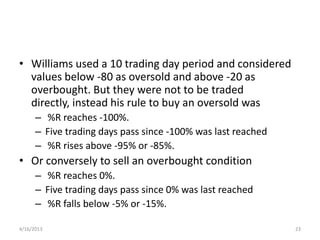
• Williams used a 10 trading day period and considered
  values below -80 as oversold and above -20 as
  overbought. But they were not to be traded
  directly, instead his rule to buy an oversold was
      – %R reaches -100%.
      – Five trading days pass since -100% was last reached
      – %R rises above -95% or -85%.
• Or conversely to sell an overbought condition
      – %R reaches 0%.
      – Five trading days pass since 0% was last reached
      – %R falls below -5% or -15%.

4/16/2013                                                     23
THANK YOU


4/16/2013               24

Momentum indicators in tech. analysis

  • 1.
    Technical Analysis -Momentum Indicators PUNEET ARORA(75141) SOUMYA ARORA(75158) BFIA 2B 4/16/2013 1
  • 2.
    WHAT IS MOMENTUM?? Momentum generally refers to the rate of change. This can be thought of as an increase or decrease in pressure. For instance, a stock may be rising at one dollar per month. The momentum is non-existent even though this stock is going up because there is no change in the rate at which it rises. If the stock is rising one dollar this month and none the next, the momentum would be dropping. As well, if the stock increased from one dollar price appreciation to two dollars of appreciation the next month, momentum would be rising. So when referring to momentum, we can usually refer to it as a 4/16/2013 rate of change. 2
  • 3.
    What Does MomentumTell Us? While there are many ways to trade momentum indicators, momentum is a good gauge of how emotions are swinging in the market place. If a sudden euphoria hits, the momentum indicator will reflect this. If panic takes over, the momentum will also show us how the mood has soured. They are commonly considered to be leading indicators. Generally speaking, momentum trading is a shorter window than trend trading and requires practice to properly analyse trading signals. 4/16/2013 3
  • 4.
    True strength index Common Williams Momentum Stochastic %R Oscillator Indicators Relative Strength 4/16/2013 Index (RSI) 4
  • 5.
    True Strength Index publishedin 1991 by William Blau using moving averages of the underlying momentum of a financial instrument, TSI indicates both trend direction and overbought / oversold conditions. 4/16/2013 5
  • 6.
    FORMULA • c0 =today's closing price • m = c0 − c1 = momentum (difference between today's and yesterday's close) • EMA(m,n) = exponential moving average of m over n periods, that is, r = EMA smoothing period for momentum, typically 25 • s = EMA smoothing period for smoothed momentum, typically 13 4/16/2013 6
  • 7.
  • 8.
    INTERPRETATION • While theTSI output is bound between +100 and −100, most values fall between +25 and −25. • Blau suggests interpreting these values as overbought and oversold levels, respectively, at which point a trader may anticipate a market turn. • Trend direction is indicated by the slope of the TSI; a rising TSI suggests an up-trend in the market, and a falling TSI suggests a down-trend 4/16/2013 8
  • 9.
    Relative Strength Index- RSI • The RSI is presented on a graph above or below the price chart. The indicator has an upper line, typically at 70, a lower line at 30, and a dashed mid-line at 50. Wilder recommended a smoothing period of 14 (see EMA smoothing, i.e. α = 1/14 or N = 27). • [edit] 4/16/2013 9
  • 10.
  • 11.
  • 12.
    INTERPRETATION • the RSIranges from 0 to 100. An asset is deemed to be overbought once the RSI approaches the 70 level, meaning that it may be getting overvalued and is a good candidate for a pullback. Likewise, if the RSI approaches 30, it is an indication that the asset may be getting oversold and therefore likely to become undervalued. 4/16/2013 12
  • 13.
    As you cansee from the chart, the RSI ranges from 0 to 100. An asset is deemed to be overbought once the RSI approaches the 70 level, meaning that it may be getting overvalued and is a good candidate for a pullback. Likewise, if the RSI approaches 30, it is an indication that the asset may be getting oversold and therefore likely to become 4/16/2013 13 undervalued.
  • 14.
    Stochastic osillator • Developedby George C. Lane in the late 1950s. • the stochastic oscillator is a momentum indicator that uses support and resistance levels. 4/16/2013 14
  • 15.
    FORMULA • %K =(Current Close - Lowest Low)/(Highest High - Lowest Low) * 100 • %D = 3-day SMA of %K • Lowest Low = lowest low for the look-back period • Highest High = highest high for the look-back period • %K is multiplied by 100 to move the decimal point two places 4/16/2013 15
  • 16.
  • 17.
    INTERPRETATION • The StochasticOscillator measures the level of the close relative to the high-low range over a given period of time. Assume that the highest high equals 110, the lowest low equals 100 and the close equals 108. The high- low range is 10, which is the denominator in the %K formula. The close less the lowest low equals 8, which is the numerator. 8 divided by 10 equals .80 or 80%. Multiply this number by 100 to find %K %K would equal 30 if the close was at 103 (.30 x 100). The Stochastic Oscillator is above 50 when the close is in the upper half of the range and below 50 when the close is in the lower half. Low readings (below 20) indicate that price is near its low for the given time period. High readings (above 80) indicate that price is near its high for the given time period. The IBM example above shows three 14-day ranges (yellow areas) with the closing price at the end of the period (red dotted) line. The Stochastic Oscillator equals 91 when the close was at the top of the range. The Stochastic Oscillator equals 15 when the close was near the bottom of the range. The close equals 57 when the close was in the middle of the range. 4/16/2013 17
  • 18.
  • 19.
    Williams %R • Itwas developed by a publisher and promoter of trading materials, Larry Williams. • Williams %R reflects the level of the close relative to the highest high for the look-back period. • In contrast, the Stochastic Oscillator reflects the level of the close relative to the lowest low. 4/16/2013 19
  • 20.
  • 21.
  • 22.
  • 23.
    • Williams useda 10 trading day period and considered values below -80 as oversold and above -20 as overbought. But they were not to be traded directly, instead his rule to buy an oversold was – %R reaches -100%. – Five trading days pass since -100% was last reached – %R rises above -95% or -85%. • Or conversely to sell an overbought condition – %R reaches 0%. – Five trading days pass since 0% was last reached – %R falls below -5% or -15%. 4/16/2013 23
  • 24.