Chapter 17
TECHNICAL ANALYSIS
   The Visual Clue
OUTLINE

• What Is Technical Analysis

• Charting Techniques

• Technical Indicators

• Testing Technical Trading Rules

• Evaluation of Technical Analysis
WHAT IS TECHNICAL ANALYSIS
IN HIS BOOK TECHNICAL ANALYSIS EXPLAINED,
MARTIN J. PRING EXPLAINS:
“THE TECHNICAL APPROACH TO INVESTING IS
ESSENTIALLY A REFLECTION OF THE IDEA THAT
PRICES MOVE IN TRENDS WHICH ARE DETERMINED
BY THECHANGING ATTITUDES OF INVESTORS
TOWARD A VARIETY OF ECONOMIC, MONETARY,
POLITICAL AND PYSHOLOGICAL FORCES. THE ART
OF TECHNICAL ANALYSIS - FOR IT IS AN ART - IS TO
IDENTIFY TREND CHANGES AT AN EARLY STAGE AND
TO MAINTAIN AN INVESTMENT POSTURE UNTIL THE
WEIGHT OF THE EVIDENCE INDICATES THAT THE
TREND HAS BEEN REVERSED.”
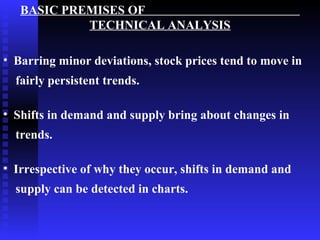
BASIC PREMISES OF
            TECHNICAL ANALYSIS

• Barring minor deviations, stock prices tend to move in
  fairly persistent trends.

• Shifts in demand and supply bring about changes in
  trends.

• Irrespective of why they occur, shifts in demand and
  supply can be detected in charts.
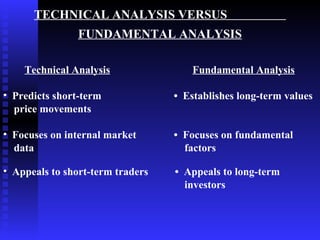
TECHNICAL ANALYSIS VERSUS
                FUNDAMENTAL ANALYSIS

    Technical Analysis                Fundamental Analysis

• Predicts short-term             • Establishes long-term values
  price movements

• Focuses on internal market      • Focuses on fundamental
  data                              factors

• Appeals to short-term traders   • Appeals to long-term
                                    investors
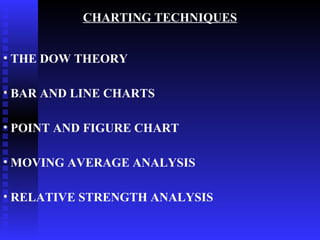
CHARTING TECHNIQUES


• THE DOW THEORY

• BAR AND LINE CHARTS

• POINT AND FIGURE CHART

• MOVING AVERAGE ANALYSIS

• RELATIVE STRENGTH ANALYSIS
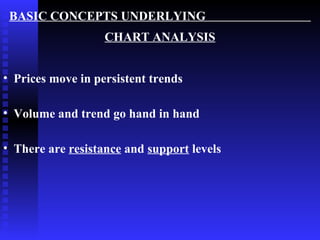
BASIC CONCEPTS UNDERLYING
                   CHART ANALYSIS


• Prices move in persistent trends

• Volume and trend go hand in hand

• There are resistance and support levels
THE DOW THEORY

The market has three movements, all going at the same
time:

• Daily fluctuations    : Random day-to-day wiggles

• Secondary movements : Corrections that last for a few
                        weeks or months

• Primary trends        : Representing bull and bear
                          phases of the market
BAR AND LINE CHARTS

• The bar chart depicts the daily price change along with
  the closing price.

• A line chart shows the line connecting successive closing
  prices.

• Technical analysts believe that certain formations or
  patterns observed on the bar chart or line chart have
  predictive value. For example, a head and shoulder
  pattern represents a bearish development.
POINT AND FIGURE CHART


More complex than a bear chart, a point and figure chart

(PFC) condenses the recording of price changes by

eliminating the time scale and small changes.
RELATIVE STRENGTH ANALYSIS

The relative strength analysis is based on the assumption

that prices of some securities rise rapidly during the bull

phase but fall slowly during the bear phase in relation to

the market as a whole.
THE ADVANCE-DECLINE LINE

The advance-decline line is also referred to as the breadth
of the market. Its measurement involves two steps:

1. Calculate the number of net advances/declines on a
   daily basis.

2. Obtain the breadth of the market by cumulating daily
   net advances/declines.
NEW HIGHS AND LOWS


Technical analysts consider the market as bullish when a

significant number of stocks hit the 52-week high each day.

On the other hand, if market indices rise but few stocks hit

new highs, technical analysts view this as a sign of trouble.
VOLUME


Volume analysis is an important part of technical analysis.

Other things being equal, a high trading volume is

considered   a   bullish   sign.   If   heavy   volumes   are

accompanied by rising prices, it is considered even more

bullish.
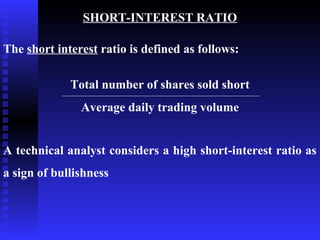
SHORT-INTEREST RATIO

The short interest ratio is defined as follows:

             Total number of shares sold short
               Average daily trading volume


A technical analyst considers a high short-interest ratio as
a sign of bullishness
MUTUAL FUND LIQUIDITY


Low mutual fund liquidity is considered a bearish factor


High mutual fund liquidity is considered as a bullish
indication
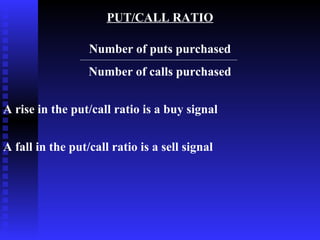
PUT/CALL RATIO

                  Number of puts purchased
                  Number of calls purchased


A rise in the put/call ratio is a buy signal


A fall in the put/call ratio is a sell signal
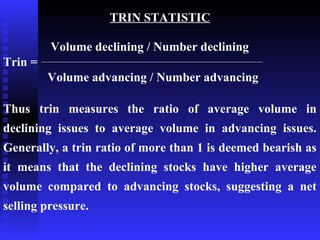
TRIN STATISTIC

         Volume declining / Number declining
Trin =
         Volume advancing / Number advancing

Thus trin measures the ratio of average volume in
declining issues to average volume in advancing issues.
Generally, a trin ratio of more than 1 is deemed bearish as
it means that the declining stocks have higher average
volume compared to advancing stocks, suggesting a net
selling pressure.
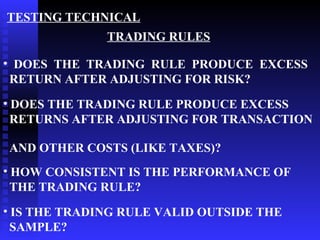
TESTING TECHNICAL
              TRADING RULES

• DOES THE TRADING RULE PRODUCE EXCESS
 RETURN AFTER ADJUSTING FOR RISK?
• DOES THE TRADING RULE PRODUCE EXCESS
  RETURNS AFTER ADJUSTING FOR TRANSACTION

AND OTHER COSTS (LIKE TAXES)?
• HOW CONSISTENT IS THE PERFORMANCE OF
  THE TRADING RULE?
• IS THE TRADING RULE VALID OUTSIDE THE
  SAMPLE?
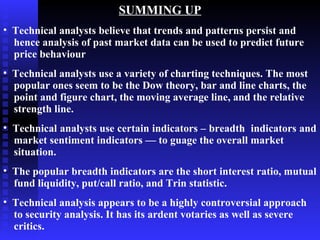
SUMMING UP
• Technical analysts believe that trends and patterns persist and
  hence analysis of past market data can be used to predict future
  price behaviour
• Technical analysts use a variety of charting techniques. The most
  popular ones seem to be the Dow theory, bar and line charts, the
  point and figure chart, the moving average line, and the relative
  strength line.
• Technical analysts use certain indicators – breadth indicators and
  market sentiment indicators — to guage the overall market
  situation.
• The popular breadth indicators are the short interest ratio, mutual
  fund liquidity, put/call ratio, and Trin statistic.
• Technical analysis appears to be a highly controversial approach
  to security analysis. It has its ardent votaries as well as severe
  critics.

Chapter 17 technical analysis

  • 1.
  • 2.
    OUTLINE • What IsTechnical Analysis • Charting Techniques • Technical Indicators • Testing Technical Trading Rules • Evaluation of Technical Analysis
  • 3.
    WHAT IS TECHNICALANALYSIS IN HIS BOOK TECHNICAL ANALYSIS EXPLAINED, MARTIN J. PRING EXPLAINS: “THE TECHNICAL APPROACH TO INVESTING IS ESSENTIALLY A REFLECTION OF THE IDEA THAT PRICES MOVE IN TRENDS WHICH ARE DETERMINED BY THECHANGING ATTITUDES OF INVESTORS TOWARD A VARIETY OF ECONOMIC, MONETARY, POLITICAL AND PYSHOLOGICAL FORCES. THE ART OF TECHNICAL ANALYSIS - FOR IT IS AN ART - IS TO IDENTIFY TREND CHANGES AT AN EARLY STAGE AND TO MAINTAIN AN INVESTMENT POSTURE UNTIL THE WEIGHT OF THE EVIDENCE INDICATES THAT THE TREND HAS BEEN REVERSED.”
  • 4.
    BASIC PREMISES OF TECHNICAL ANALYSIS • Barring minor deviations, stock prices tend to move in fairly persistent trends. • Shifts in demand and supply bring about changes in trends. • Irrespective of why they occur, shifts in demand and supply can be detected in charts.
  • 5.
    TECHNICAL ANALYSIS VERSUS FUNDAMENTAL ANALYSIS Technical Analysis Fundamental Analysis • Predicts short-term • Establishes long-term values price movements • Focuses on internal market • Focuses on fundamental data factors • Appeals to short-term traders • Appeals to long-term investors
  • 6.
    CHARTING TECHNIQUES • THEDOW THEORY • BAR AND LINE CHARTS • POINT AND FIGURE CHART • MOVING AVERAGE ANALYSIS • RELATIVE STRENGTH ANALYSIS
  • 7.
    BASIC CONCEPTS UNDERLYING CHART ANALYSIS • Prices move in persistent trends • Volume and trend go hand in hand • There are resistance and support levels
  • 8.
    THE DOW THEORY Themarket has three movements, all going at the same time: • Daily fluctuations : Random day-to-day wiggles • Secondary movements : Corrections that last for a few weeks or months • Primary trends : Representing bull and bear phases of the market
  • 9.
    BAR AND LINECHARTS • The bar chart depicts the daily price change along with the closing price. • A line chart shows the line connecting successive closing prices. • Technical analysts believe that certain formations or patterns observed on the bar chart or line chart have predictive value. For example, a head and shoulder pattern represents a bearish development.
  • 10.
    POINT AND FIGURECHART More complex than a bear chart, a point and figure chart (PFC) condenses the recording of price changes by eliminating the time scale and small changes.
  • 11.
    RELATIVE STRENGTH ANALYSIS Therelative strength analysis is based on the assumption that prices of some securities rise rapidly during the bull phase but fall slowly during the bear phase in relation to the market as a whole.
  • 12.
    THE ADVANCE-DECLINE LINE Theadvance-decline line is also referred to as the breadth of the market. Its measurement involves two steps: 1. Calculate the number of net advances/declines on a daily basis. 2. Obtain the breadth of the market by cumulating daily net advances/declines.
  • 13.
    NEW HIGHS ANDLOWS Technical analysts consider the market as bullish when a significant number of stocks hit the 52-week high each day. On the other hand, if market indices rise but few stocks hit new highs, technical analysts view this as a sign of trouble.
  • 14.
    VOLUME Volume analysis isan important part of technical analysis. Other things being equal, a high trading volume is considered a bullish sign. If heavy volumes are accompanied by rising prices, it is considered even more bullish.
  • 15.
    SHORT-INTEREST RATIO The shortinterest ratio is defined as follows: Total number of shares sold short Average daily trading volume A technical analyst considers a high short-interest ratio as a sign of bullishness
  • 16.
    MUTUAL FUND LIQUIDITY Lowmutual fund liquidity is considered a bearish factor High mutual fund liquidity is considered as a bullish indication
  • 17.
    PUT/CALL RATIO Number of puts purchased Number of calls purchased A rise in the put/call ratio is a buy signal A fall in the put/call ratio is a sell signal
  • 18.
    TRIN STATISTIC Volume declining / Number declining Trin = Volume advancing / Number advancing Thus trin measures the ratio of average volume in declining issues to average volume in advancing issues. Generally, a trin ratio of more than 1 is deemed bearish as it means that the declining stocks have higher average volume compared to advancing stocks, suggesting a net selling pressure.
  • 19.
    TESTING TECHNICAL TRADING RULES • DOES THE TRADING RULE PRODUCE EXCESS RETURN AFTER ADJUSTING FOR RISK? • DOES THE TRADING RULE PRODUCE EXCESS RETURNS AFTER ADJUSTING FOR TRANSACTION AND OTHER COSTS (LIKE TAXES)? • HOW CONSISTENT IS THE PERFORMANCE OF THE TRADING RULE? • IS THE TRADING RULE VALID OUTSIDE THE SAMPLE?
  • 20.
    SUMMING UP • Technicalanalysts believe that trends and patterns persist and hence analysis of past market data can be used to predict future price behaviour • Technical analysts use a variety of charting techniques. The most popular ones seem to be the Dow theory, bar and line charts, the point and figure chart, the moving average line, and the relative strength line. • Technical analysts use certain indicators – breadth indicators and market sentiment indicators — to guage the overall market situation. • The popular breadth indicators are the short interest ratio, mutual fund liquidity, put/call ratio, and Trin statistic. • Technical analysis appears to be a highly controversial approach to security analysis. It has its ardent votaries as well as severe critics.