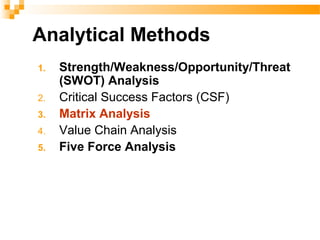



Analytical Methods
1. Strength/Weakness/Opportunity/Threat
(SWOT) Analysis
2. Critical Success Factors (CSF)
3. Matrix Analysis
4. Value Chain Analysis
5. Five Force Analysis
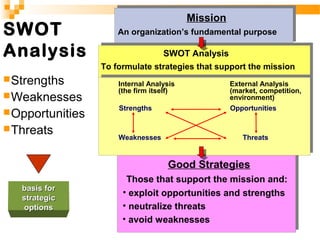
SWOT
Analysis
Strengths
Weaknesses
Opportunities
Threats
Mission
An organization’s fundamental purpose
Good Strategies
SWOT Analysis
To formulate strategies that support the mission
Those that support the mission and:
• exploit opportunities and strengths
• neutralize threats
• avoid weaknesses
Internal Analysis
(the firm itself)
Strengths
Weaknesses Threats
External Analysis
(market, competition,
environment)
Opportunities
basis forbasis for
strategicstrategic
optionsoptions
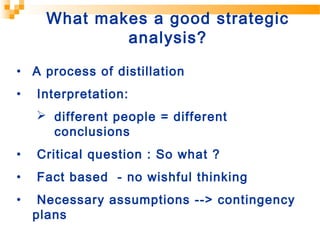
• A process of distillation
• Interpretation:
 different people = different
conclusions
• Critical question : So what ?
• Fact based - no wishful thinking
• Necessary assumptions --> contingency
plans
What makes a good strategic
analysis?
SWOT ANALYSIS
SWOT Analysis is an effective way of
identifying your Strengths and Weaknesses,
and of examining the Opportunities and
Threats you face.
You can also apply SWOT analysis to your
competitors.
Somi
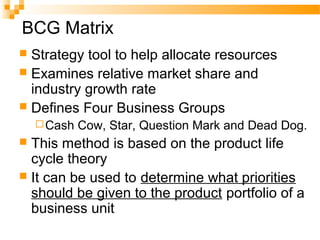
BCG Matrix
 Strategy tool to help allocate resources
 Examines relative market share and
industry growth rate
 Defines Four Business Groups
Cash Cow, Star, Question Mark and Dead Dog.
 This method is based on the product life
cycle theory
 It can be used to determine what priorities
should be given to the product portfolio of a
business unit
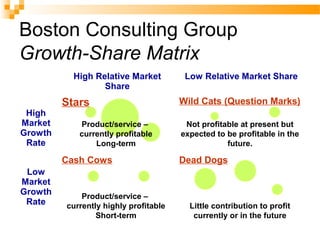
Boston Consulting Group
Growth-Share Matrix
High Relative Market
Share
Low Relative Market Share
High
Market
Growth
Rate
Stars Wild Cats (Question Marks)
Low
Market
Growth
Rate
Cash Cows Dead Dogs
Product/service –
currently profitable
Long-term
Product/service –
currently highly profitable
Short-term
Not profitable at present but
expected to be profitable in the
future.
Little contribution to profit
currently or in the future
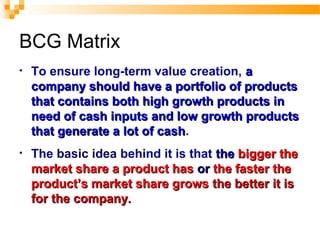
BCG Matrix
• To ensure long-term value creation, aa
company should have a portfolio of productscompany should have a portfolio of products
that contains both high growth products inthat contains both high growth products in
need of cash inputs and low growth productsneed of cash inputs and low growth products
that generate a lot of cashthat generate a lot of cash.
• The basic idea behind it is that thethe bigger thebigger the
market share a product hasmarket share a product has oror the faster thethe faster the
product’s market share growsproduct’s market share grows the better it isthe better it is
for the company.for the company.
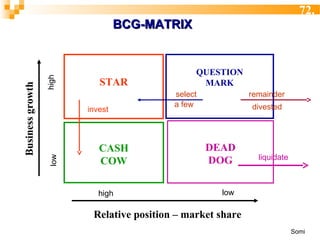
72.
QUESTION
MARKSTAR
CASH
COW
DEAD
DOG
Relative position – market share
high low
Businessgrowth
highlow
BCG-BCG-MATRIXMATRIX
select
a few
remainder
divestedinvest
liquidate
Somi
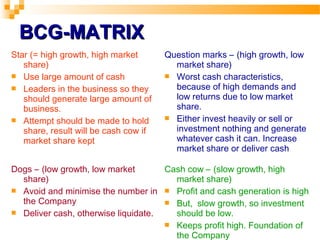
BCG-BCG-MATRIXMATRIX
Star (= high growth, high market
share)
 Use large amount of cash
 Leaders in the business so they
should generate large amount of
business.
 Attempt should be made to hold
share, result will be cash cow if
market share kept
Question marks – (high growth, low
market share)
 Worst cash characteristics,
because of high demands and
low returns due to low market
share.
 Either invest heavily or sell or
investment nothing and generate
whatever cash it can. Increase
market share or deliver cash
Dogs – (low growth, low market
share)
 Avoid and minimise the number in
the Company
 Deliver cash, otherwise liquidate.
Cash cow – (slow growth, high
market share)
 Profit and cash generation is high
 But, slow growth, so investment
should be low.
 Keeps profit high. Foundation of
the Company
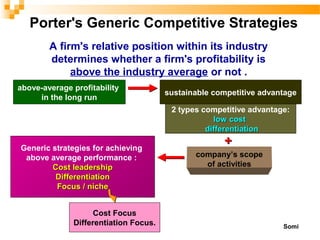
Porter's Generic Competitive Strategies
Somi
++
above-average profitability
in the long run
sustainable competitive advantage
2 types competitive advantage:
low costlow cost
differentiationdifferentiation
company’s scope
of activities
Generic strategies for achieving
above average performance :
Cost leadershipCost leadership
DifferentiationDifferentiation
Focus / nicheFocus / niche
Cost Focus
Differentiation Focus.
A firm's relative position within its industry
determines whether a firm's profitability is
above the industry average or not .
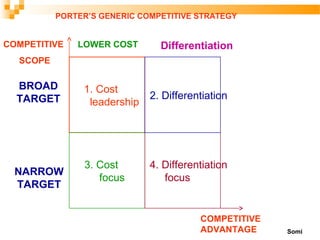
1. Cost
leadership
3. Cost
focus
4. Differentiation
focus
2. Differentiation
PORTER’S GENERIC COMPETITIVE STRATEGY
BROAD
TARGET
NARROW
TARGET
LOWER COST Differentiation
COMPETITIVE
ADVANTAGE
COMPETITIVE
SCOPE
Somi
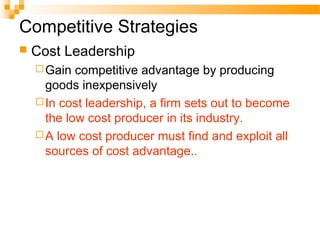
Competitive Strategies
 Cost Leadership
Gain competitive advantage by producing
goods inexpensively
In cost leadership, a firm sets out to become
the low cost producer in its industry.
A low cost producer must find and exploit all
sources of cost advantage..
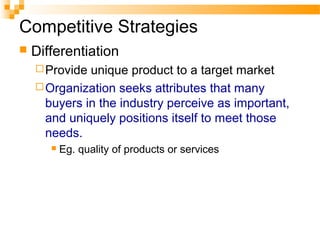
Competitive Strategies
 Differentiation
Provide unique product to a target market
Organization seeks attributes that many
buyers in the industry perceive as important,
and uniquely positions itself to meet those
needs.
 Eg. quality of products or services
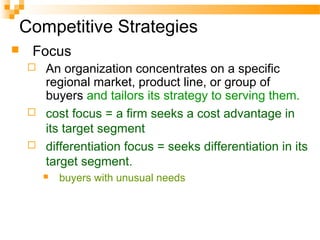
Competitive Strategies
 Focus
 An organization concentrates on a specific
regional market, product line, or group of
buyers and tailors its strategy to serving them.
 cost focus = a firm seeks a cost advantage in
its target segment
 differentiation focus = seeks differentiation in its
target segment.
 buyers with unusual needs
Additional Notes
Ansoff's Product/Market Matrix
Somi
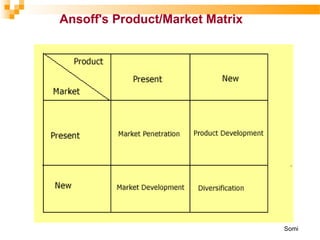
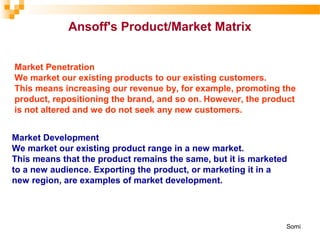
Market Penetration
We market our existing products to our existing customers.
This means increasing our revenue by, for example, promoting the
product, repositioning the brand, and so on. However, the product
is not altered and we do not seek any new customers.
Market Development
We market our existing product range in a new market.
This means that the product remains the same, but it is marketed
to a new audience. Exporting the product, or marketing it in a
new region, are examples of market development.
Ansoff's Product/Market Matrix
Somi
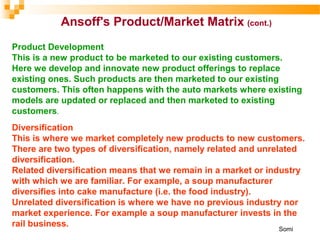
Product Development
This is a new product to be marketed to our existing customers.
Here we develop and innovate new product offerings to replace
existing ones. Such products are then marketed to our existing
customers. This often happens with the auto markets where existing
models are updated or replaced and then marketed to existing
customers.
Diversification
This is where we market completely new products to new customers.
There are two types of diversification, namely related and unrelated
diversification.
Related diversification means that we remain in a market or industry
with which we are familiar. For example, a soup manufacturer
diversifies into cake manufacture (i.e. the food industry).
Unrelated diversification is where we have no previous industry nor
market experience. For example a soup manufacturer invests in the
rail business.
Ansoff's Product/Market Matrix (cont.)
Somi
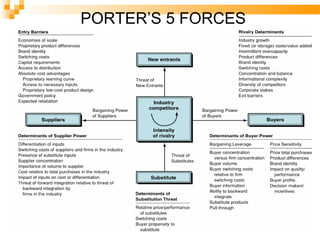
Five Force Analysis
 Model developed by Porter and Millar (1985)
 Depict the competitive world in which any
organization exist
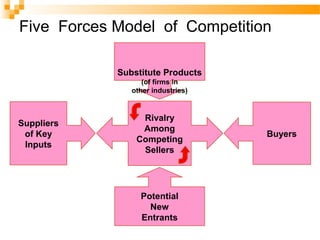
Five Forces Model of Competition
Substitute Products
(of firms in
other industries)
Suppliers
of Key
Inputs
Buyers
Potential
New
Entrants
Rivalry
Among
Competing
Sellers
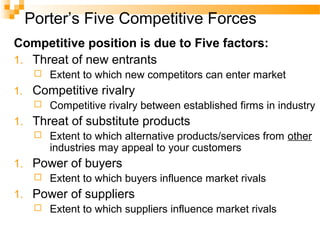
Porter’s Five Competitive Forces
Competitive position is due to Five factors:
1. Threat of new entrants
 Extent to which new competitors can enter market
1. Competitive rivalry
 Competitive rivalry between established firms in industry
1. Threat of substitute products
 Extent to which alternative products/services from other
industries may appeal to your customers
1. Power of buyers
 Extent to which buyers influence market rivals
1. Power of suppliers
 Extent to which suppliers influence market rivals
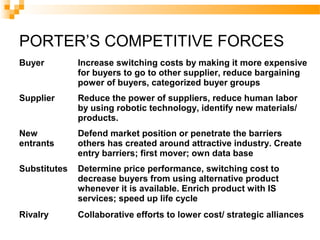
PORTER’S COMPETITIVE FORCES
Buyer Increase switching costs by making it more expensive
for buyers to go to other supplier, reduce bargaining
power of buyers, categorized buyer groups
Supplier Reduce the power of suppliers, reduce human labor
by using robotic technology, identify new materials/
products.
New
entrants
Defend market position or penetrate the barriers
others has created around attractive industry. Create
entry barriers; first mover; own data base
Substitutes Determine price performance, switching cost to
decrease buyers from using alternative product
whenever it is available. Enrich product with IS
services; speed up life cycle
Rivalry Collaborative efforts to lower cost/ strategic alliances
PORTER’S 5 FORCES

Strategic planning

  • 2.
    Analytical Methods 1. Strength/Weakness/Opportunity/Threat (SWOT)Analysis 2. Critical Success Factors (CSF) 3. Matrix Analysis 4. Value Chain Analysis 5. Five Force Analysis
  • 4.
    SWOT Analysis Strengths Weaknesses Opportunities Threats Mission An organization’s fundamentalpurpose Good Strategies SWOT Analysis To formulate strategies that support the mission Those that support the mission and: • exploit opportunities and strengths • neutralize threats • avoid weaknesses Internal Analysis (the firm itself) Strengths Weaknesses Threats External Analysis (market, competition, environment) Opportunities basis forbasis for strategicstrategic optionsoptions
  • 5.
    • A processof distillation • Interpretation:  different people = different conclusions • Critical question : So what ? • Fact based - no wishful thinking • Necessary assumptions --> contingency plans What makes a good strategic analysis?
  • 6.
    SWOT ANALYSIS SWOT Analysisis an effective way of identifying your Strengths and Weaknesses, and of examining the Opportunities and Threats you face. You can also apply SWOT analysis to your competitors. Somi
  • 8.
    BCG Matrix  Strategytool to help allocate resources  Examines relative market share and industry growth rate  Defines Four Business Groups Cash Cow, Star, Question Mark and Dead Dog.  This method is based on the product life cycle theory  It can be used to determine what priorities should be given to the product portfolio of a business unit
  • 9.
    Boston Consulting Group Growth-ShareMatrix High Relative Market Share Low Relative Market Share High Market Growth Rate Stars Wild Cats (Question Marks) Low Market Growth Rate Cash Cows Dead Dogs Product/service – currently profitable Long-term Product/service – currently highly profitable Short-term Not profitable at present but expected to be profitable in the future. Little contribution to profit currently or in the future
  • 10.
    BCG Matrix • Toensure long-term value creation, aa company should have a portfolio of productscompany should have a portfolio of products that contains both high growth products inthat contains both high growth products in need of cash inputs and low growth productsneed of cash inputs and low growth products that generate a lot of cashthat generate a lot of cash. • The basic idea behind it is that thethe bigger thebigger the market share a product hasmarket share a product has oror the faster thethe faster the product’s market share growsproduct’s market share grows the better it isthe better it is for the company.for the company.
  • 11.
    72. QUESTION MARKSTAR CASH COW DEAD DOG Relative position –market share high low Businessgrowth highlow BCG-BCG-MATRIXMATRIX select a few remainder divestedinvest liquidate Somi
  • 12.
    BCG-BCG-MATRIXMATRIX Star (= highgrowth, high market share)  Use large amount of cash  Leaders in the business so they should generate large amount of business.  Attempt should be made to hold share, result will be cash cow if market share kept Question marks – (high growth, low market share)  Worst cash characteristics, because of high demands and low returns due to low market share.  Either invest heavily or sell or investment nothing and generate whatever cash it can. Increase market share or deliver cash Dogs – (low growth, low market share)  Avoid and minimise the number in the Company  Deliver cash, otherwise liquidate. Cash cow – (slow growth, high market share)  Profit and cash generation is high  But, slow growth, so investment should be low.  Keeps profit high. Foundation of the Company
  • 14.
    Porter's Generic CompetitiveStrategies Somi ++ above-average profitability in the long run sustainable competitive advantage 2 types competitive advantage: low costlow cost differentiationdifferentiation company’s scope of activities Generic strategies for achieving above average performance : Cost leadershipCost leadership DifferentiationDifferentiation Focus / nicheFocus / niche Cost Focus Differentiation Focus. A firm's relative position within its industry determines whether a firm's profitability is above the industry average or not .
  • 15.
    1. Cost leadership 3. Cost focus 4.Differentiation focus 2. Differentiation PORTER’S GENERIC COMPETITIVE STRATEGY BROAD TARGET NARROW TARGET LOWER COST Differentiation COMPETITIVE ADVANTAGE COMPETITIVE SCOPE Somi
  • 16.
    Competitive Strategies  CostLeadership Gain competitive advantage by producing goods inexpensively In cost leadership, a firm sets out to become the low cost producer in its industry. A low cost producer must find and exploit all sources of cost advantage..
  • 17.
    Competitive Strategies  Differentiation Provideunique product to a target market Organization seeks attributes that many buyers in the industry perceive as important, and uniquely positions itself to meet those needs.  Eg. quality of products or services
  • 18.
    Competitive Strategies  Focus An organization concentrates on a specific regional market, product line, or group of buyers and tailors its strategy to serving them.  cost focus = a firm seeks a cost advantage in its target segment  differentiation focus = seeks differentiation in its target segment.  buyers with unusual needs
  • 19.
  • 20.
  • 21.
    Market Penetration We marketour existing products to our existing customers. This means increasing our revenue by, for example, promoting the product, repositioning the brand, and so on. However, the product is not altered and we do not seek any new customers. Market Development We market our existing product range in a new market. This means that the product remains the same, but it is marketed to a new audience. Exporting the product, or marketing it in a new region, are examples of market development. Ansoff's Product/Market Matrix Somi
  • 22.
    Product Development This isa new product to be marketed to our existing customers. Here we develop and innovate new product offerings to replace existing ones. Such products are then marketed to our existing customers. This often happens with the auto markets where existing models are updated or replaced and then marketed to existing customers. Diversification This is where we market completely new products to new customers. There are two types of diversification, namely related and unrelated diversification. Related diversification means that we remain in a market or industry with which we are familiar. For example, a soup manufacturer diversifies into cake manufacture (i.e. the food industry). Unrelated diversification is where we have no previous industry nor market experience. For example a soup manufacturer invests in the rail business. Ansoff's Product/Market Matrix (cont.) Somi
  • 24.
    Five Force Analysis Model developed by Porter and Millar (1985)  Depict the competitive world in which any organization exist
  • 25.
    Five Forces Modelof Competition Substitute Products (of firms in other industries) Suppliers of Key Inputs Buyers Potential New Entrants Rivalry Among Competing Sellers
  • 26.
    Porter’s Five CompetitiveForces Competitive position is due to Five factors: 1. Threat of new entrants  Extent to which new competitors can enter market 1. Competitive rivalry  Competitive rivalry between established firms in industry 1. Threat of substitute products  Extent to which alternative products/services from other industries may appeal to your customers 1. Power of buyers  Extent to which buyers influence market rivals 1. Power of suppliers  Extent to which suppliers influence market rivals
  • 27.
    PORTER’S COMPETITIVE FORCES BuyerIncrease switching costs by making it more expensive for buyers to go to other supplier, reduce bargaining power of buyers, categorized buyer groups Supplier Reduce the power of suppliers, reduce human labor by using robotic technology, identify new materials/ products. New entrants Defend market position or penetrate the barriers others has created around attractive industry. Create entry barriers; first mover; own data base Substitutes Determine price performance, switching cost to decrease buyers from using alternative product whenever it is available. Enrich product with IS services; speed up life cycle Rivalry Collaborative efforts to lower cost/ strategic alliances
  • 28.

Editor's Notes

  • #6 Description, refinement, interpretation
  • #25 Capital requirements, technological requirements, brand loyalty, economies of scale Growth rate, level of demand
  • #29 Pg 37. text book