TransformingLives. InventingtheFuture. www.iit.edu
I ELLINOIS T UINS TI T
OF TECHNOLOGY
ITM 578 1
RiskManagement I
Ray Trygstad
ITM 578 Section 071
Summer 2003
Master of Information Technology & Management Program
CenterforProfessional Development
Slides based on Whitman, M. and Mattord, H., Principles of InformationSecurity; Thomson Course Technology 2003
Transfo rm ing Live s. Inve nting the Future .
www.iit.edu
ITM 578 2
ILLINOIS INSTITUTE OF TECHNOLOGY
Learning Objectives:
Upon completion of this lesson
students should be able to:
– Define risk management and its role in
the SecSDLC
– Describe how risk is identified
– Assess risk based on the likelihood of
occurrence and impact on an organization
– Explain fundamental aspects of
documenting risk identification and
assessment
Transfo rm ing Live s. Inve nting the Future .
www.iit.edu
ITM 578 3
ILLINOIS INSTITUTE OF TECHNOLOGY
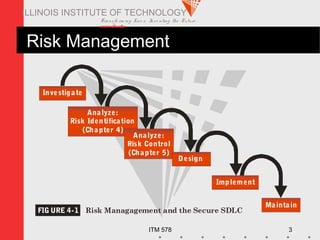
Risk Management
Investigate
Analyze:
Risk Identification
(Chapter 4)
Implement
Maintain
Analyze:
Risk Control
(Chapter 5)
Design
FIG URE 4-1 Risk Managagement and the Secure SDLC
Transfo rm ing Live s. Inve nting the Future .
www.iit.edu
ITM 578 4
ILLINOIS INSTITUTE OF TECHNOLOGY
Risk Management
“If you know the enemy and know
yourself, you need not fear the result of
a hundred battles.
If you know yourself but not the
enemy, for every victory gained you
will also suffer a defeat.
If you know neither the enemy nor
yourself, you will succumb in every
battle.” (Sun Tzu)
Transfo rm ing Live s. Inve nting the Future .
www.iit.edu
ITM 578 5
ILLINOIS INSTITUTE OF TECHNOLOGY
Know Ourselves
 First, identify, examine, and understand the
information, and systems, currently in place
 In order to protect our assets, defined here
as the information and the systems that use,
store, and transmit it, we must understand
everything about the information
 Once these aspects are examined, we can
then look at what we are already doing to
protect the information and systems from
the threats
Transfo rm ing Live s. Inve nting the Future .
www.iit.edu
ITM 578 6
ILLINOIS INSTITUTE OF TECHNOLOGY
Know the Enemy
For information security this means
identifying, examining, and
understanding the threats that most
directly affect our organization and the
security of our organization’s
information assets
We then can use our understanding of
these aspects to create a list of threats
prioritized by importance to the
organization
Transfo rm ing Live s. Inve nting the Future .
www.iit.edu
ITM 578 7
ILLINOIS INSTITUTE OF TECHNOLOGY
Accountability for Risk Management
 It is the responsibility of each community of
interest to manage risks; each community
has a role to play:
– Information Security - best understands the
threats and attacks that introduce risk into the
organization
– Management and Users – play a part in the early
detection and response process - they also insure
sufficient resources are allocated
– Information Technology – must assist in building
secure systems and operating them safely
Transfo rm ing Live s. Inve nting the Future .
www.iit.edu
ITM 578 8
ILLINOIS INSTITUTE OF TECHNOLOGY
Accountability for Risk Management
All three communities must also:
– Evaluate the risk controls
– Determine which control options are cost
effective
– Assist in acquiring or installing needed
controls
– Ensure that the controls remain effective
Transfo rm ing Live s. Inve nting the Future .
www.iit.edu
ITM 578 9
ILLINOIS INSTITUTE OF TECHNOLOGY
Risk Management Process
 Management reviews asset inventory
 The threats and vulnerabilities that have
been identified as dangerous to the asset
inventory must be reviewed and verified as
complete and current
 The potential controls and mitigation
strategies should be reviewed for
completeness
Transfo rm ing Live s. Inve nting the Future .
www.iit.edu
ITM 578 10
ILLINOIS INSTITUTE OF TECHNOLOGY
Risk Management Process
 The cost effectiveness of each control should
be reviewed as well, and the decisions about
deployment of controls revisited
 Further, managers of all levels are
accountable on a regular schedule for
ensuring the ongoing effectiveness of every
control deployed
Transfo rm ing Live s. Inve nting the Future .
www.iit.edu
ITM 578 11
ILLINOIS INSTITUTE OF TECHNOLOGY
Risk Identification
A risk management strategy calls on
us to “know ourselves” by identifying,
classifying, and prioritizing the
organization’s information assets
These assets are the targets of various
threats and threat agents and our goal
is to protect them from these threats
Transfo rm ing Live s. Inve nting the Future .
www.iit.edu
ITM 578 12
ILLINOIS INSTITUTE OF TECHNOLOGY
Threat Identification
Next comes threat identification:
– Assess the circumstances and setting of
each information asset
– Identify the vulnerabilities and begin
exploring the controls that might be
used to manage the risks
Transfo rm ing Live s. Inve nting the Future .
www.iit.edu
ITM 578 13
ILLINOIS INSTITUTE OF TECHNOLOGY
Asset Identification and Valuation
This iterative process begins with the
identification of assets, including all of
the elements of an organization’s
system: people, procedures, data and
information, software, hardware, and
networking elements
Then, we classify and categorize the
assets adding details as we dig deeper
into the analysis
Transfo rm ing Live s. Inve nting the Future .
www.iit.edu
ITM 578 14
ILLINOIS INSTITUTE OF TECHNOLOGY
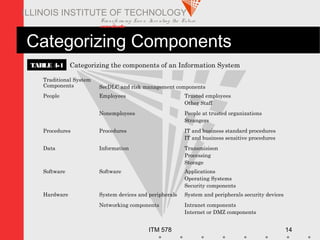
Categorizing Components
Traditional System
Components SecDLC and risk management components
People Employees Trusted employees
Other Staff
Nonemployees People at trusted organizations
Strangers
Procedures Procedures IT and business standard procedures
IT and business sensitive procedures
Data Information Transmisison
Processing
Storage
Software Software Applications
Operating Systems
Security components
Hardware System devices and peripherals System and peripherals security devices
Networking components Intranet components
Internet or DMZ components
TABLE 4-1 Categorizing the components of an Information System
Transfo rm ing Live s. Inve nting the Future .
www.iit.edu
ITM 578 15
ILLINOIS INSTITUTE OF TECHNOLOGY
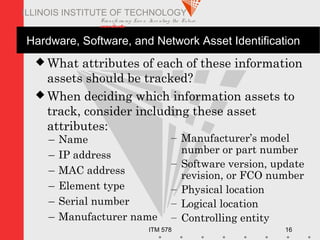
Hardware, Software, and Network Asset Identification
Automated tools can sometimes
uncover the system elements that
make up the hardware, software, and
network components
Once created, the inventory listing
must be kept current, often through
a tool that periodically refreshes the
data
Transfo rm ing Live s. Inve nting the Future .
www.iit.edu
ITM 578 16
ILLINOIS INSTITUTE OF TECHNOLOGY
Hardware, Software, and Network Asset Identification
 What attributes of each of these information
assets should be tracked?
 When deciding which information assets to
track, consider including these asset
attributes:
– Name
– IP address
– MAC address
– Element type
– Serial number
– Manufacturer name
– Manufacturer’s model
number or part number
– Software version, update
revision, or FCO number
– Physical location
– Logical location
– Controlling entity
Transfo rm ing Live s. Inve nting the Future .
www.iit.edu
ITM 578 17
ILLINOIS INSTITUTE OF TECHNOLOGY
People, Procedures, and Data Asset Identification
 Unlike the tangible hardware and
software elements already described, the
human resources, documentation, and
data information assets are not as readily
discovered and documented
 These assets should be identified,
described, and evaluated by people using
knowledge, experience, and judgment
 As these elements are identified, they
should also be recorded into some reliable
data handling process
Transfo rm ing Live s. Inve nting the Future .
www.iit.edu
ITM 578 18
ILLINOIS INSTITUTE OF TECHNOLOGY
Asset Information for People
For People:
– Position name/number/ID – try to avoid
names and stick to identifying positions,
roles, or functions
– Supervisor
– Security clearance level
– Special skills
Transfo rm ing Live s. Inve nting the Future .
www.iit.edu
ITM 578 19
ILLINOIS INSTITUTE OF TECHNOLOGY
Asset Information for Procedures
For Procedures:
– Description
– Intended purpose
– What elements is it tied to
– Where is it stored for reference
– Where is it stored for update purposes
Transfo rm ing Live s. Inve nting the Future .
www.iit.edu
ITM 578 20
ILLINOIS INSTITUTE OF TECHNOLOGY
Asset Information for Data
For Data:
– Classification
– Owner/creator/manager
– Size of data structure
– Data structure used – sequential,
relational
– Online or offline
– Where located
– Backup procedures employed
Transfo rm ing Live s. Inve nting the Future .
www.iit.edu
ITM 578 21
ILLINOIS INSTITUTE OF TECHNOLOGY
Information Asset Classification
 Many organizations already have a
classification scheme
 Examples of these kinds of classifications:
– confidential data
– internal data
– public data
 Informal organizations may have to organize
themselves to create a useable data
classification model
 Other side of the data classification scheme
is the personnel security clearance structure
Transfo rm ing Live s. Inve nting the Future .
www.iit.edu
ITM 578 22
ILLINOIS INSTITUTE OF TECHNOLOGY
Information Asset Valuation
Each asset is categorized
Questions to assist in developing
criteria to be used for asset valuation:
– Which information asset is the most
critical to the success of the organization?
– Which information asset generates the
most revenue?
– Which information asset generates the
most profitability?
Transfo rm ing Live s. Inve nting the Future .
www.iit.edu
ITM 578 23
ILLINOIS INSTITUTE OF TECHNOLOGY
Information Asset Valuation
More questions to assist in developing
criteria to be used for asset valuation:
– Which information asset would be the
most expensive to replace?
– Which information asset would be the
most expensive to protect?
– Which information asset would be the
most embarrassing or cause the greatest
liability if revealed?
Transfo rm ing Live s. Inve nting the Future .
www.iit.edu
ITM 578 24
ILLINOIS INSTITUTE OF TECHNOLOGY
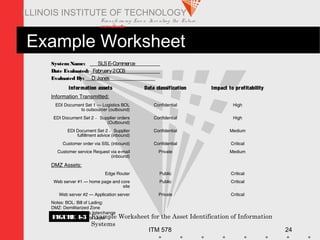
Example Worksheet
SystemName: SLSE-Commerce .
Date Evaluated: February2OO3 .
Evaluated By: D.Jones .
Information assets Data classification Impact to profitability
Information Transmitted:
EDI Document Set 1 — Logistics BOL
to outsourcer (outbound)
Confidential High
EDI Document Set 2 — Supplier orders
(Outbound)
Confidential High
EDI Document Set 2 — Supplier
fulfillment advice (inbound)
Confidential Medium
Customer order via SSL (inbound) Confidential Critical
Customer service Request via e-mail
(inbound)
Private Medium
DMZ Assets:
Edge Router Public Critical
Web server #1 — home page and core
site
Public Critical
Web server #2 — Application server Private Critical
Notes: BOL: Bill of Lading:
DMZ: Demilitarized Zone
EDI: Electronic Data Interchange
SSL: Secure Sockets LayerFIGURE 4-3 Example Worksheet for the Asset Identification of Information
Systems
Transfo rm ing Live s. Inve nting the Future .
www.iit.edu
ITM 578 25
ILLINOIS INSTITUTE OF TECHNOLOGY
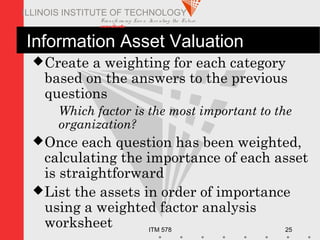
Information Asset Valuation
Create a weighting for each category
based on the answers to the previous
questions
Which factor is the most important to the
organization?
Once each question has been weighted,
calculating the importance of each asset
is straightforward
List the assets in order of importance
using a weighted factor analysis
worksheet
Transfo rm ing Live s. Inve nting the Future .
www.iit.edu
ITM 578 26
ILLINOIS INSTITUTE OF TECHNOLOGY
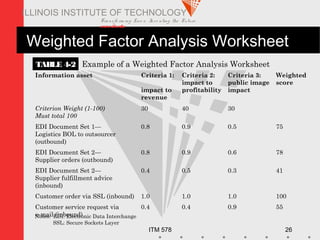
Weighted Factor Analysis Worksheet
Information asset Criteria 1:
impact to
revenue
Criteria 2:
impact to
profitability
Criteria 3:
public image
impact
Weighted
score
Criterion Weight (1-100)
Must total 100
30 40 30
EDI Document Set 1—
Logistics BOL to outsourcer
(outbound)
0.8 0.9 0.5 75
EDI Document Set 2—
Supplier orders (outbound)
0.8 0.9 0.6 78
EDI Document Set 2—
Supplier fulfillment advice
(inbound)
0.4 0.5 0.3 41
Customer order via SSL (inbound) 1.0 1.0 1.0 100
Customer service request via
e-mail (inbound)
0.4 0.4 0.9 55
Example of a Weighted Factor Analysis WorksheetTABLE 4-2
Notes: EDI: Electronic Data Interchange
SSL: Secure Sockets Layer
Transfo rm ing Live s. Inve nting the Future .
www.iit.edu
ITM 578 27
ILLINOIS INSTITUTE OF TECHNOLOGY
Data Classification and Management
 A variety of classification schemes are used
by corporate and military organizations
 Information owners are responsible for
classifying the information assets for which
they are responsible
 Information owners must review information
classifications periodically
 The military uses a five-level classification
scheme but most organizations do not need
the detailed level of classification used by the
military or federal agencies
Transfo rm ing Live s. Inve nting the Future .
www.iit.edu
ITM 578 28
ILLINOIS INSTITUTE OF TECHNOLOGY
Data Classification and Management
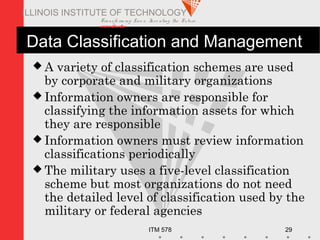
DOD/Federal Classification Scheme
– UNCLASSIFIED
– FOR OFFICIAL USE ONLY (FOUO)
(includes Formerly Restricted Data)
– CONFIDENTIAL
– SECRET
– TOP SECRET
Transfo rm ing Live s. Inve nting the Future .
www.iit.edu
ITM 578 29
ILLINOIS INSTITUTE OF TECHNOLOGY
Data Classification and Management
 A variety of classification schemes are used
by corporate and military organizations
 Information owners are responsible for
classifying the information assets for which
they are responsible
 Information owners must review information
classifications periodically
 The military uses a five-level classification
scheme but most organizations do not need
the detailed level of classification used by the
military or federal agencies
Transfo rm ing Live s. Inve nting the Future .
www.iit.edu
ITM 578 30
ILLINOIS INSTITUTE OF TECHNOLOGY
Security Clearances
 The other side of the data classification
scheme is the personnel security clearance
structure
 Each user of data in the organization is
assigned a single level of authorization
indicating the level of classification
 Before an individual is allowed access to a
specific set of data, he or she must meet the
need-to-know requirement
 This extra level of protection ensures that
the confidentiality of information is properly
maintained
Transfo rm ing Live s. Inve nting the Future .
www.iit.edu
ITM 578 31
ILLINOIS INSTITUTE OF TECHNOLOGY
Management of Classified Data
 Includes the storage, distribution, portability, and
destruction of classified information
– Must be clearly marked as such
– When stored, it must be unavailable to unauthorized
individuals
– When carried should be inconspicuous, as in a locked
briefcase or portfolio
 Clean desk policies require all information to be
stored in its appropriate storage container at the end
of each day
 Proper care should be taken to destroy any unneeded
copies
 Dumpster diving can prove embarrassing to the
organization
Transfo rm ing Live s. Inve nting the Future .
www.iit.edu
ITM 578 32
ILLINOIS INSTITUTE OF TECHNOLOGY
Threat Identification
 Each of the threats identified so far has the
potential to attack any of the assets protected
 This will quickly become more complex and
overwhelm the ability to plan
 To make this part of the process manageable,
each step in the threat identification and
vulnerability identification process is
managed separately, and then coordinated at
the end of the process
Transfo rm ing Live s. Inve nting the Future .
www.iit.edu
ITM 578 33
ILLINOIS INSTITUTE OF TECHNOLOGY
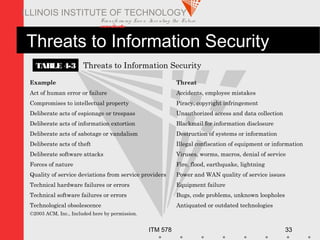
Threats to Information Security
Example Threat
Act of human error or failure Accidents, employee mistakes
Compromises to intellectual property Piracy, copyright infringement
Deliberate acts of espionage or trespass Unauthorized access and data collection
Deliberate acts of information extortion Blackmail for information disclosure
Deliberate acts of sabotage or vandalism Destruction of systems or information
Deliberate acts of theft Illegal confiscation of equipment or information
Deliberate software attacks Viruses, worms, macros, denial of service
Forces of nature Fire, flood, earthquake, lightning
Quality of service deviations from service providers Power and WAN quality of service issues
Technical hardware failures or errors Equipment failure
Technical software failures or errors Bugs, code problems, unknown loopholes
Technological obsolescence Antiquated or outdated technologies
©2003 ACM, Inc., Included here by permission.
TABLE 4-3 Threats to Information Security
Transfo rm ing Live s. Inve nting the Future .
www.iit.edu
ITM 578 34
ILLINOIS INSTITUTE OF TECHNOLOGY
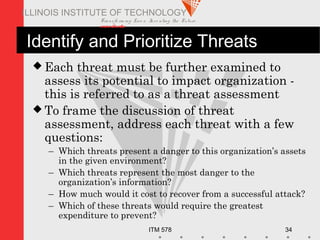
Identify and Prioritize Threats
 Each threat must be further examined to
assess its potential to impact organization -
this is referred to as a threat assessment
 To frame the discussion of threat
assessment, address each threat with a few
questions:
– Which threats present a danger to this organization’s assets
in the given environment?
– Which threats represent the most danger to the
organization’s information?
– How much would it cost to recover from a successful attack?
– Which of these threats would require the greatest
expenditure to prevent?
Transfo rm ing Live s. Inve nting the Future .
www.iit.edu
ITM 578 35
ILLINOIS INSTITUTE OF TECHNOLOGY
Vulnerability Identification
We now face the challenge of reviewing
each information asset for each threat
it faces and creating a list of the
vulnerabilities that remain viable
risks to the organization
Vulnerabilities are specific avenues
that threat agents can exploit to attack
an information asset
Transfo rm ing Live s. Inve nting the Future .
www.iit.edu
ITM 578 36
ILLINOIS INSTITUTE OF TECHNOLOGY
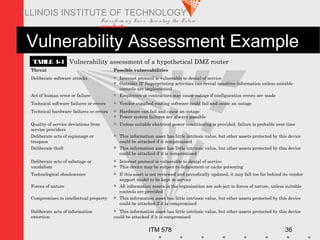
Vulnerability Assessment Example
Vulnerability assessment of a hypothetical DMZ router
Threat Possible vulnerabilities
Deliberate software attacks  Internet protocol is vulnerable to denial of service
 Outsider IP fingerprinting activities can reveal sensitive information unless suitable
controls are implemented
Act of human error or failure  Employees or contractors may cause outage if configuration errors are made
Technical software failures or errors  Vendor-supplied routing software could fail and cause an outage
Technical hardware failures or errors  Hardware can fail and cause an outage
 Power system failures are always possible
Quality of service deviations from
service providers
 Unless suitable electrical power conditioning is provided, failure is probable over time
Deliberate acts of espionage or
trespass
 This information asset has little intrinsic value, but other assets protected by this device
could be attacked if it compromised
Deliberate theft  This information asset has little intrinsic value, but other assets protected by this device
could be attacked if it is compromised
Deliberate acts of sabotage or
vandalism
 Internet protocol is vulnerable to denial of service
 This device may be subject to defacement or cache poisoning
Technological obsolescence  If this asset is not reviewed and periodically updated, it may fall too far behind its vendor
support model to be kept in service
Forces of nature  All information assets in the organization are sub-ject to forces of nature, unless suitable
controls are provided
Compromises to intellectual property  This information asset has little intrinsic value, but other assets protected by this device
could be attacked if it is compromised
Deliberate acts of information
extortion
 This information asset has little intrinsic value, but other assets protected by this device
could be attacked if it is compromised
TABLE 4-4
Transfo rm ing Live s. Inve nting the Future .
www.iit.edu
ITM 578 37
ILLINOIS INSTITUTE OF TECHNOLOGY
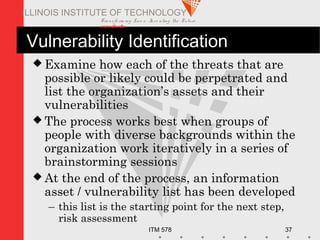
Vulnerability Identification
 Examine how each of the threats that are
possible or likely could be perpetrated and
list the organization’s assets and their
vulnerabilities
 The process works best when groups of
people with diverse backgrounds within the
organization work iteratively in a series of
brainstorming sessions
 At the end of the process, an information
asset / vulnerability list has been developed
– this list is the starting point for the next step,
risk assessment
Transfo rm ing Live s. Inve nting the Future .
www.iit.edu
ITM 578 38
ILLINOIS INSTITUTE OF TECHNOLOGY
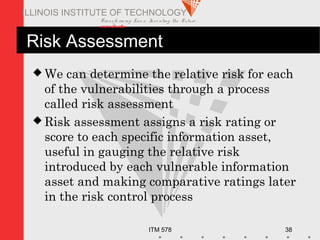
Risk Assessment
 We can determine the relative risk for each
of the vulnerabilities through a process
called risk assessment
 Risk assessment assigns a risk rating or
score to each specific information asset,
useful in gauging the relative risk
introduced by each vulnerable information
asset and making comparative ratings later
in the risk control process
Transfo rm ing Live s. Inve nting the Future .
www.iit.edu
ITM 578 39
ILLINOIS INSTITUTE OF TECHNOLOGY
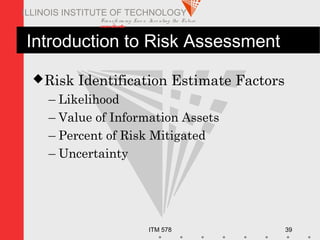
Introduction to Risk Assessment
Risk Identification Estimate Factors
– Likelihood
– Value of Information Assets
– Percent of Risk Mitigated
– Uncertainty
Transfo rm ing Live s. Inve nting the Future .
www.iit.edu
ITM 578 40
ILLINOIS INSTITUTE OF TECHNOLOGY
Risk Determination
For the purpose of relative risk assessment:
Risk= likelihood of vulnerability
occurrence
multiplied by
value of the information asset (or
impact)
minus
percentage risk already controlled
plus
Transfo rm ing Live s. Inve nting the Future .
www.iit.edu
ITM 578 41
ILLINOIS INSTITUTE OF TECHNOLOGY
Identify Possible Controls
For each threat and its associated
vulnerabilities that have any residual
risk, create a preliminary list of
control ideas
Residual risk is the risk that remains
to the information asset even after the
existing control has been applied
Transfo rm ing Live s. Inve nting the Future .
www.iit.edu
ITM 578 42
ILLINOIS INSTITUTE OF TECHNOLOGY
Access Controls
 One particular application of controls is in
the area of access controls
 Access controls are those controls that
specifically address admission of a user into
a trusted area of the organization
 There are a number of approaches to
controlling access
 Access controls can be
– discretionary
– mandatory
– nondiscretionary
Transfo rm ing Live s. Inve nting the Future .
www.iit.edu
ITM 578 43
ILLINOIS INSTITUTE OF TECHNOLOGY
Types of Access Controls
Discretionary Access Controls
(DAC) are implemented at the
discretion or option of the data user
Mandatory Access Controls
(MACs) are structured and
coordinated with a data classification
scheme, and are required
Transfo rm ing Live s. Inve nting the Future .
www.iit.edu
ITM 578 44
ILLINOIS INSTITUTE OF TECHNOLOGY
Types of Access Controls
Nondiscretionary Controls are
those determined by a central
authority in the organization and can
be based on that individual’s role
(Role-Based Controls) or a specified
set of duties or tasks the individual is
assigned (Task-Based Controls) or can
be based on specified lists maintained
on subjects or objects
Transfo rm ing Live s. Inve nting the Future .
www.iit.edu
ITM 578 45
ILLINOIS INSTITUTE OF TECHNOLOGY
Lattice-based Control
Another type of nondiscretionary
access is lattice-based control, where a
lattice structure (or matrix) is created
containing subjects and objects, and
the boundaries associated with each
pair is contained
This specifies the level of access each
subject has to each object
Transfo rm ing Live s. Inve nting the Future .
www.iit.edu
ITM 578 46
ILLINOIS INSTITUTE OF TECHNOLOGY
Lattice-based Control
In a lattice-based control the column
of attributes associated with a
particular object are referred to as an
access control list or ACL
The row of attributes associated with
a particular subject (such as a user) is
referred to as a capabilities table
Transfo rm ing Live s. Inve nting the Future .
www.iit.edu
ITM 578 47
ILLINOIS INSTITUTE OF TECHNOLOGY
Documenting Results of Risk Assessment
 Goal of this process: identify the
information assets of the organization that
have specific vulnerabilities and create a
list of them, ranked for focus on those most
needing protection first
 In preparing this list we have collected and
preserved factual information about the
assets, the threats they face, and the
vulnerabilities they experience
 We should also have collected some
information about the controls that are
already in place
Transfo rm ing Live s. Inve nting the Future .
www.iit.edu
ITM 578 48
ILLINOIS INSTITUTE OF TECHNOLOGY
Introduction to Risk Assessment
 The process you develop for risk
identification should include designating
what function the reports will serve, who is
responsible for preparing the reports, and
who reviews them
 We do know that the ranked vulnerability
risk worksheet is the initial working
document for the next step in the risk
management process: assessing and
controlling risk
Transfo rm ing Live s. Inve nting the Future .
www.iit.edu
ITM 578 49
ILLINOIS INSTITUTE OF TECHNOLOGY
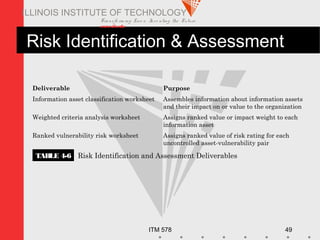
Risk Identification & Assessment
Deliverable Purpose
Information asset classification worksheet Assembles information about information assets
and their impact on or value to the organization
Weighted criteria analysis worksheet Assigns ranked value or impact weight to each
information asset
Ranked vulnerability risk worksheet Assigns ranked value of risk rating for each
uncontrolled asset-vulnerability pair
Risk Identification and Assessment DeliverablesTABLE 4-6
Transfo rm ing Live s. Inve nting the Future .
www.iit.edu
ITM 578 50
ILLINOIS INSTITUTE OF TECHNOLOGY
The End…
Questions!

Risk management i

  • 1.
    TransformingLives. InventingtheFuture. www.iit.edu IELLINOIS T UINS TI T OF TECHNOLOGY ITM 578 1 RiskManagement I Ray Trygstad ITM 578 Section 071 Summer 2003 Master of Information Technology & Management Program CenterforProfessional Development Slides based on Whitman, M. and Mattord, H., Principles of InformationSecurity; Thomson Course Technology 2003
  • 2.
    Transfo rm ingLive s. Inve nting the Future . www.iit.edu ITM 578 2 ILLINOIS INSTITUTE OF TECHNOLOGY Learning Objectives: Upon completion of this lesson students should be able to: – Define risk management and its role in the SecSDLC – Describe how risk is identified – Assess risk based on the likelihood of occurrence and impact on an organization – Explain fundamental aspects of documenting risk identification and assessment
  • 3.
    Transfo rm ingLive s. Inve nting the Future . www.iit.edu ITM 578 3 ILLINOIS INSTITUTE OF TECHNOLOGY Risk Management Investigate Analyze: Risk Identification (Chapter 4) Implement Maintain Analyze: Risk Control (Chapter 5) Design FIG URE 4-1 Risk Managagement and the Secure SDLC
  • 4.
    Transfo rm ingLive s. Inve nting the Future . www.iit.edu ITM 578 4 ILLINOIS INSTITUTE OF TECHNOLOGY Risk Management “If you know the enemy and know yourself, you need not fear the result of a hundred battles. If you know yourself but not the enemy, for every victory gained you will also suffer a defeat. If you know neither the enemy nor yourself, you will succumb in every battle.” (Sun Tzu)
  • 5.
    Transfo rm ingLive s. Inve nting the Future . www.iit.edu ITM 578 5 ILLINOIS INSTITUTE OF TECHNOLOGY Know Ourselves  First, identify, examine, and understand the information, and systems, currently in place  In order to protect our assets, defined here as the information and the systems that use, store, and transmit it, we must understand everything about the information  Once these aspects are examined, we can then look at what we are already doing to protect the information and systems from the threats
  • 6.
    Transfo rm ingLive s. Inve nting the Future . www.iit.edu ITM 578 6 ILLINOIS INSTITUTE OF TECHNOLOGY Know the Enemy For information security this means identifying, examining, and understanding the threats that most directly affect our organization and the security of our organization’s information assets We then can use our understanding of these aspects to create a list of threats prioritized by importance to the organization
  • 7.
    Transfo rm ingLive s. Inve nting the Future . www.iit.edu ITM 578 7 ILLINOIS INSTITUTE OF TECHNOLOGY Accountability for Risk Management  It is the responsibility of each community of interest to manage risks; each community has a role to play: – Information Security - best understands the threats and attacks that introduce risk into the organization – Management and Users – play a part in the early detection and response process - they also insure sufficient resources are allocated – Information Technology – must assist in building secure systems and operating them safely
  • 8.
    Transfo rm ingLive s. Inve nting the Future . www.iit.edu ITM 578 8 ILLINOIS INSTITUTE OF TECHNOLOGY Accountability for Risk Management All three communities must also: – Evaluate the risk controls – Determine which control options are cost effective – Assist in acquiring or installing needed controls – Ensure that the controls remain effective
  • 9.
    Transfo rm ingLive s. Inve nting the Future . www.iit.edu ITM 578 9 ILLINOIS INSTITUTE OF TECHNOLOGY Risk Management Process  Management reviews asset inventory  The threats and vulnerabilities that have been identified as dangerous to the asset inventory must be reviewed and verified as complete and current  The potential controls and mitigation strategies should be reviewed for completeness
  • 10.
    Transfo rm ingLive s. Inve nting the Future . www.iit.edu ITM 578 10 ILLINOIS INSTITUTE OF TECHNOLOGY Risk Management Process  The cost effectiveness of each control should be reviewed as well, and the decisions about deployment of controls revisited  Further, managers of all levels are accountable on a regular schedule for ensuring the ongoing effectiveness of every control deployed
  • 11.
    Transfo rm ingLive s. Inve nting the Future . www.iit.edu ITM 578 11 ILLINOIS INSTITUTE OF TECHNOLOGY Risk Identification A risk management strategy calls on us to “know ourselves” by identifying, classifying, and prioritizing the organization’s information assets These assets are the targets of various threats and threat agents and our goal is to protect them from these threats
  • 12.
    Transfo rm ingLive s. Inve nting the Future . www.iit.edu ITM 578 12 ILLINOIS INSTITUTE OF TECHNOLOGY Threat Identification Next comes threat identification: – Assess the circumstances and setting of each information asset – Identify the vulnerabilities and begin exploring the controls that might be used to manage the risks
  • 13.
    Transfo rm ingLive s. Inve nting the Future . www.iit.edu ITM 578 13 ILLINOIS INSTITUTE OF TECHNOLOGY Asset Identification and Valuation This iterative process begins with the identification of assets, including all of the elements of an organization’s system: people, procedures, data and information, software, hardware, and networking elements Then, we classify and categorize the assets adding details as we dig deeper into the analysis
  • 14.
    Transfo rm ingLive s. Inve nting the Future . www.iit.edu ITM 578 14 ILLINOIS INSTITUTE OF TECHNOLOGY Categorizing Components Traditional System Components SecDLC and risk management components People Employees Trusted employees Other Staff Nonemployees People at trusted organizations Strangers Procedures Procedures IT and business standard procedures IT and business sensitive procedures Data Information Transmisison Processing Storage Software Software Applications Operating Systems Security components Hardware System devices and peripherals System and peripherals security devices Networking components Intranet components Internet or DMZ components TABLE 4-1 Categorizing the components of an Information System
  • 15.
    Transfo rm ingLive s. Inve nting the Future . www.iit.edu ITM 578 15 ILLINOIS INSTITUTE OF TECHNOLOGY Hardware, Software, and Network Asset Identification Automated tools can sometimes uncover the system elements that make up the hardware, software, and network components Once created, the inventory listing must be kept current, often through a tool that periodically refreshes the data
  • 16.
    Transfo rm ingLive s. Inve nting the Future . www.iit.edu ITM 578 16 ILLINOIS INSTITUTE OF TECHNOLOGY Hardware, Software, and Network Asset Identification  What attributes of each of these information assets should be tracked?  When deciding which information assets to track, consider including these asset attributes: – Name – IP address – MAC address – Element type – Serial number – Manufacturer name – Manufacturer’s model number or part number – Software version, update revision, or FCO number – Physical location – Logical location – Controlling entity
  • 17.
    Transfo rm ingLive s. Inve nting the Future . www.iit.edu ITM 578 17 ILLINOIS INSTITUTE OF TECHNOLOGY People, Procedures, and Data Asset Identification  Unlike the tangible hardware and software elements already described, the human resources, documentation, and data information assets are not as readily discovered and documented  These assets should be identified, described, and evaluated by people using knowledge, experience, and judgment  As these elements are identified, they should also be recorded into some reliable data handling process
  • 18.
    Transfo rm ingLive s. Inve nting the Future . www.iit.edu ITM 578 18 ILLINOIS INSTITUTE OF TECHNOLOGY Asset Information for People For People: – Position name/number/ID – try to avoid names and stick to identifying positions, roles, or functions – Supervisor – Security clearance level – Special skills
  • 19.
    Transfo rm ingLive s. Inve nting the Future . www.iit.edu ITM 578 19 ILLINOIS INSTITUTE OF TECHNOLOGY Asset Information for Procedures For Procedures: – Description – Intended purpose – What elements is it tied to – Where is it stored for reference – Where is it stored for update purposes
  • 20.
    Transfo rm ingLive s. Inve nting the Future . www.iit.edu ITM 578 20 ILLINOIS INSTITUTE OF TECHNOLOGY Asset Information for Data For Data: – Classification – Owner/creator/manager – Size of data structure – Data structure used – sequential, relational – Online or offline – Where located – Backup procedures employed
  • 21.
    Transfo rm ingLive s. Inve nting the Future . www.iit.edu ITM 578 21 ILLINOIS INSTITUTE OF TECHNOLOGY Information Asset Classification  Many organizations already have a classification scheme  Examples of these kinds of classifications: – confidential data – internal data – public data  Informal organizations may have to organize themselves to create a useable data classification model  Other side of the data classification scheme is the personnel security clearance structure
  • 22.
    Transfo rm ingLive s. Inve nting the Future . www.iit.edu ITM 578 22 ILLINOIS INSTITUTE OF TECHNOLOGY Information Asset Valuation Each asset is categorized Questions to assist in developing criteria to be used for asset valuation: – Which information asset is the most critical to the success of the organization? – Which information asset generates the most revenue? – Which information asset generates the most profitability?
  • 23.
    Transfo rm ingLive s. Inve nting the Future . www.iit.edu ITM 578 23 ILLINOIS INSTITUTE OF TECHNOLOGY Information Asset Valuation More questions to assist in developing criteria to be used for asset valuation: – Which information asset would be the most expensive to replace? – Which information asset would be the most expensive to protect? – Which information asset would be the most embarrassing or cause the greatest liability if revealed?
  • 24.
    Transfo rm ingLive s. Inve nting the Future . www.iit.edu ITM 578 24 ILLINOIS INSTITUTE OF TECHNOLOGY Example Worksheet SystemName: SLSE-Commerce . Date Evaluated: February2OO3 . Evaluated By: D.Jones . Information assets Data classification Impact to profitability Information Transmitted: EDI Document Set 1 — Logistics BOL to outsourcer (outbound) Confidential High EDI Document Set 2 — Supplier orders (Outbound) Confidential High EDI Document Set 2 — Supplier fulfillment advice (inbound) Confidential Medium Customer order via SSL (inbound) Confidential Critical Customer service Request via e-mail (inbound) Private Medium DMZ Assets: Edge Router Public Critical Web server #1 — home page and core site Public Critical Web server #2 — Application server Private Critical Notes: BOL: Bill of Lading: DMZ: Demilitarized Zone EDI: Electronic Data Interchange SSL: Secure Sockets LayerFIGURE 4-3 Example Worksheet for the Asset Identification of Information Systems
  • 25.
    Transfo rm ingLive s. Inve nting the Future . www.iit.edu ITM 578 25 ILLINOIS INSTITUTE OF TECHNOLOGY Information Asset Valuation Create a weighting for each category based on the answers to the previous questions Which factor is the most important to the organization? Once each question has been weighted, calculating the importance of each asset is straightforward List the assets in order of importance using a weighted factor analysis worksheet
  • 26.
    Transfo rm ingLive s. Inve nting the Future . www.iit.edu ITM 578 26 ILLINOIS INSTITUTE OF TECHNOLOGY Weighted Factor Analysis Worksheet Information asset Criteria 1: impact to revenue Criteria 2: impact to profitability Criteria 3: public image impact Weighted score Criterion Weight (1-100) Must total 100 30 40 30 EDI Document Set 1— Logistics BOL to outsourcer (outbound) 0.8 0.9 0.5 75 EDI Document Set 2— Supplier orders (outbound) 0.8 0.9 0.6 78 EDI Document Set 2— Supplier fulfillment advice (inbound) 0.4 0.5 0.3 41 Customer order via SSL (inbound) 1.0 1.0 1.0 100 Customer service request via e-mail (inbound) 0.4 0.4 0.9 55 Example of a Weighted Factor Analysis WorksheetTABLE 4-2 Notes: EDI: Electronic Data Interchange SSL: Secure Sockets Layer
  • 27.
    Transfo rm ingLive s. Inve nting the Future . www.iit.edu ITM 578 27 ILLINOIS INSTITUTE OF TECHNOLOGY Data Classification and Management  A variety of classification schemes are used by corporate and military organizations  Information owners are responsible for classifying the information assets for which they are responsible  Information owners must review information classifications periodically  The military uses a five-level classification scheme but most organizations do not need the detailed level of classification used by the military or federal agencies
  • 28.
    Transfo rm ingLive s. Inve nting the Future . www.iit.edu ITM 578 28 ILLINOIS INSTITUTE OF TECHNOLOGY Data Classification and Management DOD/Federal Classification Scheme – UNCLASSIFIED – FOR OFFICIAL USE ONLY (FOUO) (includes Formerly Restricted Data) – CONFIDENTIAL – SECRET – TOP SECRET
  • 29.
    Transfo rm ingLive s. Inve nting the Future . www.iit.edu ITM 578 29 ILLINOIS INSTITUTE OF TECHNOLOGY Data Classification and Management  A variety of classification schemes are used by corporate and military organizations  Information owners are responsible for classifying the information assets for which they are responsible  Information owners must review information classifications periodically  The military uses a five-level classification scheme but most organizations do not need the detailed level of classification used by the military or federal agencies
  • 30.
    Transfo rm ingLive s. Inve nting the Future . www.iit.edu ITM 578 30 ILLINOIS INSTITUTE OF TECHNOLOGY Security Clearances  The other side of the data classification scheme is the personnel security clearance structure  Each user of data in the organization is assigned a single level of authorization indicating the level of classification  Before an individual is allowed access to a specific set of data, he or she must meet the need-to-know requirement  This extra level of protection ensures that the confidentiality of information is properly maintained
  • 31.
    Transfo rm ingLive s. Inve nting the Future . www.iit.edu ITM 578 31 ILLINOIS INSTITUTE OF TECHNOLOGY Management of Classified Data  Includes the storage, distribution, portability, and destruction of classified information – Must be clearly marked as such – When stored, it must be unavailable to unauthorized individuals – When carried should be inconspicuous, as in a locked briefcase or portfolio  Clean desk policies require all information to be stored in its appropriate storage container at the end of each day  Proper care should be taken to destroy any unneeded copies  Dumpster diving can prove embarrassing to the organization
  • 32.
    Transfo rm ingLive s. Inve nting the Future . www.iit.edu ITM 578 32 ILLINOIS INSTITUTE OF TECHNOLOGY Threat Identification  Each of the threats identified so far has the potential to attack any of the assets protected  This will quickly become more complex and overwhelm the ability to plan  To make this part of the process manageable, each step in the threat identification and vulnerability identification process is managed separately, and then coordinated at the end of the process
  • 33.
    Transfo rm ingLive s. Inve nting the Future . www.iit.edu ITM 578 33 ILLINOIS INSTITUTE OF TECHNOLOGY Threats to Information Security Example Threat Act of human error or failure Accidents, employee mistakes Compromises to intellectual property Piracy, copyright infringement Deliberate acts of espionage or trespass Unauthorized access and data collection Deliberate acts of information extortion Blackmail for information disclosure Deliberate acts of sabotage or vandalism Destruction of systems or information Deliberate acts of theft Illegal confiscation of equipment or information Deliberate software attacks Viruses, worms, macros, denial of service Forces of nature Fire, flood, earthquake, lightning Quality of service deviations from service providers Power and WAN quality of service issues Technical hardware failures or errors Equipment failure Technical software failures or errors Bugs, code problems, unknown loopholes Technological obsolescence Antiquated or outdated technologies ©2003 ACM, Inc., Included here by permission. TABLE 4-3 Threats to Information Security
  • 34.
    Transfo rm ingLive s. Inve nting the Future . www.iit.edu ITM 578 34 ILLINOIS INSTITUTE OF TECHNOLOGY Identify and Prioritize Threats  Each threat must be further examined to assess its potential to impact organization - this is referred to as a threat assessment  To frame the discussion of threat assessment, address each threat with a few questions: – Which threats present a danger to this organization’s assets in the given environment? – Which threats represent the most danger to the organization’s information? – How much would it cost to recover from a successful attack? – Which of these threats would require the greatest expenditure to prevent?
  • 35.
    Transfo rm ingLive s. Inve nting the Future . www.iit.edu ITM 578 35 ILLINOIS INSTITUTE OF TECHNOLOGY Vulnerability Identification We now face the challenge of reviewing each information asset for each threat it faces and creating a list of the vulnerabilities that remain viable risks to the organization Vulnerabilities are specific avenues that threat agents can exploit to attack an information asset
  • 36.
    Transfo rm ingLive s. Inve nting the Future . www.iit.edu ITM 578 36 ILLINOIS INSTITUTE OF TECHNOLOGY Vulnerability Assessment Example Vulnerability assessment of a hypothetical DMZ router Threat Possible vulnerabilities Deliberate software attacks  Internet protocol is vulnerable to denial of service  Outsider IP fingerprinting activities can reveal sensitive information unless suitable controls are implemented Act of human error or failure  Employees or contractors may cause outage if configuration errors are made Technical software failures or errors  Vendor-supplied routing software could fail and cause an outage Technical hardware failures or errors  Hardware can fail and cause an outage  Power system failures are always possible Quality of service deviations from service providers  Unless suitable electrical power conditioning is provided, failure is probable over time Deliberate acts of espionage or trespass  This information asset has little intrinsic value, but other assets protected by this device could be attacked if it compromised Deliberate theft  This information asset has little intrinsic value, but other assets protected by this device could be attacked if it is compromised Deliberate acts of sabotage or vandalism  Internet protocol is vulnerable to denial of service  This device may be subject to defacement or cache poisoning Technological obsolescence  If this asset is not reviewed and periodically updated, it may fall too far behind its vendor support model to be kept in service Forces of nature  All information assets in the organization are sub-ject to forces of nature, unless suitable controls are provided Compromises to intellectual property  This information asset has little intrinsic value, but other assets protected by this device could be attacked if it is compromised Deliberate acts of information extortion  This information asset has little intrinsic value, but other assets protected by this device could be attacked if it is compromised TABLE 4-4
  • 37.
    Transfo rm ingLive s. Inve nting the Future . www.iit.edu ITM 578 37 ILLINOIS INSTITUTE OF TECHNOLOGY Vulnerability Identification  Examine how each of the threats that are possible or likely could be perpetrated and list the organization’s assets and their vulnerabilities  The process works best when groups of people with diverse backgrounds within the organization work iteratively in a series of brainstorming sessions  At the end of the process, an information asset / vulnerability list has been developed – this list is the starting point for the next step, risk assessment
  • 38.
    Transfo rm ingLive s. Inve nting the Future . www.iit.edu ITM 578 38 ILLINOIS INSTITUTE OF TECHNOLOGY Risk Assessment  We can determine the relative risk for each of the vulnerabilities through a process called risk assessment  Risk assessment assigns a risk rating or score to each specific information asset, useful in gauging the relative risk introduced by each vulnerable information asset and making comparative ratings later in the risk control process
  • 39.
    Transfo rm ingLive s. Inve nting the Future . www.iit.edu ITM 578 39 ILLINOIS INSTITUTE OF TECHNOLOGY Introduction to Risk Assessment Risk Identification Estimate Factors – Likelihood – Value of Information Assets – Percent of Risk Mitigated – Uncertainty
  • 40.
    Transfo rm ingLive s. Inve nting the Future . www.iit.edu ITM 578 40 ILLINOIS INSTITUTE OF TECHNOLOGY Risk Determination For the purpose of relative risk assessment: Risk= likelihood of vulnerability occurrence multiplied by value of the information asset (or impact) minus percentage risk already controlled plus
  • 41.
    Transfo rm ingLive s. Inve nting the Future . www.iit.edu ITM 578 41 ILLINOIS INSTITUTE OF TECHNOLOGY Identify Possible Controls For each threat and its associated vulnerabilities that have any residual risk, create a preliminary list of control ideas Residual risk is the risk that remains to the information asset even after the existing control has been applied
  • 42.
    Transfo rm ingLive s. Inve nting the Future . www.iit.edu ITM 578 42 ILLINOIS INSTITUTE OF TECHNOLOGY Access Controls  One particular application of controls is in the area of access controls  Access controls are those controls that specifically address admission of a user into a trusted area of the organization  There are a number of approaches to controlling access  Access controls can be – discretionary – mandatory – nondiscretionary
  • 43.
    Transfo rm ingLive s. Inve nting the Future . www.iit.edu ITM 578 43 ILLINOIS INSTITUTE OF TECHNOLOGY Types of Access Controls Discretionary Access Controls (DAC) are implemented at the discretion or option of the data user Mandatory Access Controls (MACs) are structured and coordinated with a data classification scheme, and are required
  • 44.
    Transfo rm ingLive s. Inve nting the Future . www.iit.edu ITM 578 44 ILLINOIS INSTITUTE OF TECHNOLOGY Types of Access Controls Nondiscretionary Controls are those determined by a central authority in the organization and can be based on that individual’s role (Role-Based Controls) or a specified set of duties or tasks the individual is assigned (Task-Based Controls) or can be based on specified lists maintained on subjects or objects
  • 45.
    Transfo rm ingLive s. Inve nting the Future . www.iit.edu ITM 578 45 ILLINOIS INSTITUTE OF TECHNOLOGY Lattice-based Control Another type of nondiscretionary access is lattice-based control, where a lattice structure (or matrix) is created containing subjects and objects, and the boundaries associated with each pair is contained This specifies the level of access each subject has to each object
  • 46.
    Transfo rm ingLive s. Inve nting the Future . www.iit.edu ITM 578 46 ILLINOIS INSTITUTE OF TECHNOLOGY Lattice-based Control In a lattice-based control the column of attributes associated with a particular object are referred to as an access control list or ACL The row of attributes associated with a particular subject (such as a user) is referred to as a capabilities table
  • 47.
    Transfo rm ingLive s. Inve nting the Future . www.iit.edu ITM 578 47 ILLINOIS INSTITUTE OF TECHNOLOGY Documenting Results of Risk Assessment  Goal of this process: identify the information assets of the organization that have specific vulnerabilities and create a list of them, ranked for focus on those most needing protection first  In preparing this list we have collected and preserved factual information about the assets, the threats they face, and the vulnerabilities they experience  We should also have collected some information about the controls that are already in place
  • 48.
    Transfo rm ingLive s. Inve nting the Future . www.iit.edu ITM 578 48 ILLINOIS INSTITUTE OF TECHNOLOGY Introduction to Risk Assessment  The process you develop for risk identification should include designating what function the reports will serve, who is responsible for preparing the reports, and who reviews them  We do know that the ranked vulnerability risk worksheet is the initial working document for the next step in the risk management process: assessing and controlling risk
  • 49.
    Transfo rm ingLive s. Inve nting the Future . www.iit.edu ITM 578 49 ILLINOIS INSTITUTE OF TECHNOLOGY Risk Identification & Assessment Deliverable Purpose Information asset classification worksheet Assembles information about information assets and their impact on or value to the organization Weighted criteria analysis worksheet Assigns ranked value or impact weight to each information asset Ranked vulnerability risk worksheet Assigns ranked value of risk rating for each uncontrolled asset-vulnerability pair Risk Identification and Assessment DeliverablesTABLE 4-6
  • 50.
    Transfo rm ingLive s. Inve nting the Future . www.iit.edu ITM 578 50 ILLINOIS INSTITUTE OF TECHNOLOGY The End… Questions!

Editor's Notes

  • #3 Learning Objectives: Upon completion of this chapter you should be able to: Define risk management and its role in the SecSDLC Understand how risk is identified Assess risk based on the likelihood of occurrence and impact on an organization Grasp the fundamental aspects of documenting risk identification and assessment
  • #4 Introduction The Security Systems Development Life Cycle (or SecSDLC) is a process framework or methodology that can be used in a flexible fashion to assist organizations in deploying information security initiatives. Risk identification is the formal process of examining and documenting the current information technology security situation. Risk identification is conducted within the larger process of identifying and justifying risk controls, known as risk management.
  • #5 RISK MANAGEMENT “If you know the enemy and know yourself, you need not fear the result of a hundred battles. If you know yourself but not the enemy, for every victory gained you will also suffer a defeat. If you know neither the enemy nor yourself, you will succumb in every battle.” (Sun Tzu)
  • #6 KNOW OURSELVES First, we must identify, examine, and understand the information, and systems, currently in place. In order to protect our assets, defined here as the information and the systems that use, store, and transmit it, we have to understand everything about the information. Once we have examined these aspects, we can then look at what we are already doing to protect the information and systems from the threats.
  • #7 KNOW THE ENEMY Informed of our own nature, and aware of our own weaknesses, we must then know the enemy. For information security this means identifying, examining, and understanding the threats that most directly affect our organization and the security of our organization’s information assets. We then can use our understanding of these aspects to create a list of threats prioritized by importance to the organization.
  • #8 Accountability for Risk Management It is the responsibility of each of the organization’s communities of interest to manage the risks the organization encounters. Each community of interest has a role to play. Information Security - best understand the threats and attacks that introduce risk into the organization. Management and Users – play a part in the early detection and response process. They also insure sufficient resources) are allocated Information Technology – must assist in building secure systems and operating them safely. General management, IT management, and information security management are accountable for identifying and classifying risk. All three communities of interest are also responsible for: Evaluating the risk controls Determining which control options are cost effective for the organization Acquiring or installing the needed controls Overseeing that the controls remain effective in controlling risk
  • #9 Accountability for Risk Management It is the responsibility of each of the organization’s communities of interest to manage the risks the organization encounters. Each community of interest has a role to play. Information Security - best understand the threats and attacks that introduce risk into the organization. Management and Users – play a part in the early detection and response process. They also insure sufficient resources) are allocated Information Technology – must assist in building secure systems and operating them safely. General management, IT management, and information security management are accountable for identifying and classifying risk. All three communities of interest are also responsible for: Evaluating the risk controls Determining which control options are cost effective for the organization Acquiring or installing the needed controls Overseeing that the controls remain effective in controlling risk
  • #10 Risk management process 1)The first focus of management review is asset inventory. 2)Next the threats and vulnerabilities that have been identified as dangerous to the asset inventory must be reviewed and verified as complete and current, and the potential controls and mitigation strategies should be reviewed for completeness.
  • #11 3)The cost effectiveness of each control should be reviewed as well, and the decisions about deployment of controls revisited. 4)Further, managers of all levels are accountable on a regular schedule for insuring the ongoing effectiveness of every control deployed.
  • #12 Risk Identification A risk management strategy calls on us to “know ourselves” by identifying, classifying, and prioritizing the organization’s information assets. These assets are the targets of various threats and threat agents and our goal is to protect them from these threats.
  • #13 Once we have gone through the process of self-examination, we then move into threat identification. We must assess the circumstances and setting of each information asset. To begin managing the risk from the vulnerabilities, we must identify those vulnerabilities and begin exploring the controls that might be used to manage the risks. We begin the process by identifying and assessing the value of our information assets.
  • #14 Asset Identification and Valuation This iterative process begins with the identification of assets, including all of the elements of an organization’s system: people, procedures, data and information, software, hardware and networking elements. Then, we classify and categorize the assets adding details as we dig deeper into the analysis.
  • #16 Hardware, Software, and Network Asset Identification Automated tools can sometimes uncover the system elements that make up the hardware, software, and network components. Once created and stored, the inventory listing must be kept current, often through a tool that periodically refreshes the data.
  • #17 Hardware, Software, and Network Asset Identification What attributes of each of these information assets should be tracked? When deciding which information assets to track, consider including these asset attributes: Name IP address MAC address Element Type DeviceClass = S (server) DeviceOS = W2K (windows 2000) DeviceCapacity = AS (Advanced Server) Hardware, Software, and Network Asset Identification Serial number Manufacturer Name Manufacturer’s Model Number or Part Number Software Version, Update Revision, or FCO number Physical Location Logical location Controlling Entity
  • #18 People, Procedures, and Data Asset Identification Unlike the tangible hardware and software elements already described, the human resources, documentation, and data information assets are not as readily discovered and documented. These assets should be identified, described, and evaluated by people using knowledge, experience, and judgment. As these elements are identified, they should also be recorded into some reliable data handling process.
  • #19 People, Procedures, and Data Asset Identification For People: Position name/number/ID – try to stay aware from names and stick to identifying positions, roles or functions Supervisor Security clearance level Special skills
  • #20 People, Procedures, and Data Asset Identification For Procedures: Description Intended purpose What elements is it tied to Where is it stored for reference Where is it stored for update purposes
  • #21 People, Procedures, and Data Asset Identification For Data: Classification Owner/creator/manager Size of data structure Data structure used – sequential, relational Online or offline Where located Backup procedures employed
  • #22 Information Asset Classification Many organizations already have a classification scheme. Examples of these kinds of classifications are confidential data, internal data, and public data. Informal organizations may have to organize themselves to create a useable data classification model. The other side of the data classification scheme is the personnel security clearance structure, identifying the level of information each individual is authorized to view, based on his need-to-know.
  • #23 Information Asset Valuation As each asset of the organization is assigned to its category, these questions will assist in developing the criteria to be used for asset valuation : Which information asset is the most critical to the success of the organization? Which information asset generates the most revenue? Which information asset generates the most profitability?
  • #24 Which information asset would be the most expensive to replace? Which information asset would be the most expensive to protect? Which information asset would be the most embarrassing or cause the greatest liability if revealed?
  • #26 Information Asset Valuation In order to finalize this step of the information asset identification process, each organization should create a weighting for each category based on the answers to the previous questions. Which Factor is the most important to the organization? Once each question has been weighted, calculating the importance of each asset is straightforward. The final step is to list the assets in order of importance. This can be achieved by using a weighted factor analysis worksheet.
  • #28 Data Classification and Management A variety of classification schemes are used by corporate and military organizations. Information owners are responsible for classifying the information assets for which they are responsible. At least once a year, information owners must review information classifications to ensure the information is still classified correctly and the appropriate access controls are in place. The U.S. Military Classification Scheme has a more complex categorization system than required by most corporations. For most information, the military uses a five-level classification scheme: Unclassified, Sensitive But Unclassified (i.e., For Official Use Only), Confidential, Secret, and Top Secret. Most organizations do not need the detailed level of classification used by the military or federal agencies. A simple scheme will allow the organization to protect its sensitive information like: Public, For official use only, Sensitive, Classified
  • #29 Data Classification and Management A variety of classification schemes are used by corporate and military organizations. Information owners are responsible for classifying the information assets for which they are responsible. At least once a year, information owners must review information classifications to ensure the information is still classified correctly and the appropriate access controls are in place. The U.S. Military Classification Scheme has a more complex categorization system than required by most corporations. For most information, the military uses a five-level classification scheme: Unclassified, Sensitive But Unclassified (i.e., For Official Use Only), Confidential, Secret, and Top Secret. Most organizations do not need the detailed level of classification used by the military or federal agencies. A simple scheme will allow the organization to protect its sensitive information like: Public, For official use only, Sensitive, Classified
  • #30 Data Classification and Management A variety of classification schemes are used by corporate and military organizations. Information owners are responsible for classifying the information assets for which they are responsible. At least once a year, information owners must review information classifications to ensure the information is still classified correctly and the appropriate access controls are in place. The U.S. Military Classification Scheme has a more complex categorization system than required by most corporations. For most information, the military uses a five-level classification scheme: Unclassified, Sensitive But Unclassified (i.e., For Official Use Only), Confidential, Secret, and Top Secret. Most organizations do not need the detailed level of classification used by the military or federal agencies. A simple scheme will allow the organization to protect its sensitive information like: Public, For official use only, Sensitive, Classified
  • #31 Security Clearances The other side of the data classification scheme is the personnel security clearance structure. For each user of data in the organization, a single level of authorization must be assigned, indicating the level of classification he is authorized to view. Before an individual is allowed access to a specific set of data, he must meet the need-to-know requirement. This extra level of protection ensures that the confidentiality of information is properly maintained.
  • #32 Management of Classified Data Requirements for the management of information include the storage, distribution, portability, and destruction of classified information. Information that has a classification designation other than unclassified or public must be clearly marked as such. When classified data is stored, it must be unavailable to unauthorized individuals. When an individual carries classified information, it should be inconspicuous, as in a locked briefcase or portfolio. The clean desk policy, which requires each employee to secure any and all information in its appropriate storage container at the end of each day. When classified information is no longer valuable or excessive copies exist, proper care should be taken to destroy any unneeded copies, through shredding, burning or transfer to an authorized document destruction service. There are those individuals who would not hesitate to engage in dumpster diving to retrieve information that could prove embarrassing or compromise the security of information in the organization.
  • #33 Threat Identification Each of these threats identified has the potential to attack any of the assets protected. If we assume every threat can and will attack every information asset, this will quickly become more complex and overwhelm the ability to plan. To make this part of the process manageable, each step in the threat identification and vulnerability identification process is managed separately, and then coordinated at the end of the process.
  • #35 Identify And Prioritize Threats and Threat Agents Before threats can be used in the process, each threat must be further examined to assess its potential to impact the specific targeted organization. This is referred to as a threat assessment. To frame the discussion of threat assessment, address each threat with a few questions: Which threats present a danger to this organization’s assets in the given environment? Which threats represent the most danger to the organization’s information? How much would it cost to recover from a successful attack? Which of these threats would require the greatest expenditure to prevent?
  • #36 Vulnerability Identification We now face the challenge of reviewing each information asset for each threat it faces and creating a list of the vulnerabilities that remain viable risks to the organizations. Vulnerabilities are specific avenues that threat agents can exploit to attack an information asset.
  • #38 Vulnerability Identification Now, we examine how each of the threats that are possible or likely, could be perpetrated and list the organization’s assets and their vulnerabilities. The process works best when groups of people with diverse backgrounds within the organization work iteratively in a series of brainstorming sessions. At the end of the process, an information asset / vulnerability list has been developed. This list is the starting point for the next step, risk assessment.
  • #39 Risk Assessment We can determine the relative risk for each of the vulnerabilities through a process called risk assessment. Risk assessment assigns a risk rating or score to each specific information asset, useful in gauging the relative risk introduced by each vulnerable information asset and making comparative ratings later in the risk control process.
  • #40 Introduction to Risk Assessment Risk Identification Estimate Factors Likelihood Value of Information Assets Percent of Risk Mitigated Uncertainty Factors in Risk Estimation Likelihood is the overall rating of the probability of occurrence that a potential vulnerability may be exercised within the organization’s threat environment. (i.e. between 0.1 for low and 1.0 for high) Valuation of Information Assets. We can assign weighted scores for the value of each information asset to the organization. (i.e. a scale of 1 to 100, with 100 reserved for the utmost mission critical assets) Percentage of Risk Mitigated by Current Controls. If a vulnerability is fully managed by an existing control, it no longer needs to be considered for additional controls and can be set aside. If it is partially controlled, estimate what percentage of the vulnerability has been controlled. Uncertainty. It is not possible to know everything about each vulnerability and how likely it is to occur and how much impact it will have. We must apply judgment to add a factor into the equation to allow for an estimation of the uncertainty of the information
  • #41 Risk Determination For the purpose of relative risk assessment: risk = likelihood of vulnerability occurrence times value (or impact) minus percentage risk already controlled plus an element of uncertainty
  • #42 Identify Possible Controls For each threat and its associated vulnerabilities that have any residual risk, create a preliminary list of control ideas. Residual risk is the risk that remains to the information asset even after the existing control has been applied.
  • #43 Access Controls One particular application of controls is in the area of access controls. Access controls are those controls that specifically address admission of a user into a trusted area of the organization. There are a number of approaches to controlling access. Access controls can be discretionary, mandatory, or non-discretionary.
  • #44 Types of Access Controls Discretionary Access Controls (DAC) are implemented at the discretion or option of the data user. Mandatory Access Controls (MACs) - are structured and coordinated with a data classification scheme, and are required.
  • #45 Non-discretionary Controls are those determined by a central authority in the organization and can be based on that individual’s role (Role-Based Controls) or a specified set of duties or tasks the individual is assigned (Task-Based Controls) or can be based on specified lists maintained on subjects or objects.
  • #46 Lattice-based Control Yet another type of non-discretionary access is lattice-based control, where a lattice structure (or matrix) is created containing subjects and objects, and the boundaries associate with each pair is contained. This specified the level of access each subject has to each object, if any.
  • #47 Lattice-based Control In a lattice-based control the column of attributes associated with a particular object (such as a printer) are referred to as an access control list or ACL. The row of attributes associated with a particular subject (such as a user) is referred to as a capabilities table.
  • #48 Documenting Results of Risk Assessment The goal of this process has been to identify the information assets of the organization that have specific vulnerabilities and create a list of them, ranked for focus on those most needing protection first. In preparing this list we have collected and preserved a wealth of factual information about the assets, the threats they face, and the vulnerabilities they experience. We should also have collected some information about the controls that are already in place.
  • #49 Introduction to Risk Assessment The process you develop for risk identification should include designating what function the reports will serve, who is responsible for preparing the reports, and who reviews them. We do know that the ranked vulnerability risk worksheet is the initial working document for the next step in the risk management process: assessing and controlling risk.