
Chapter 2
Sources in Islam
1
IMR 660
ISLAMIC INFORMATION
MANAGEMENT
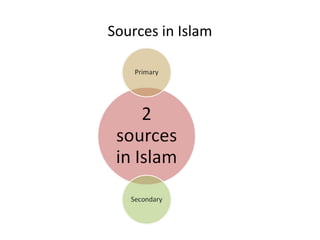
Sources in Islam
Primary Sources
• Definition
Primary source according to information
professional refer to original source which is
not translated, interpreted or published by
anyone else for examples, research,
biography, patent, thesis and etc.
Cont…
• According to Islam refer to knowledge that is
revealed by God to the prophet.
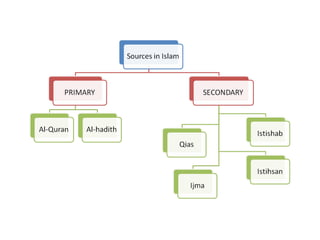
• So, primary sources in Islam are Quran and
Hadith.
Types of Primary Sources
1. Quran
• Definition
It is the Arabic speech of Allah which He revealed
to prophet Muhammad in wording and meaning
and which has been preserved in the Mushaf and
has reached us mutawatir transmission (several
chains of narration) and is a challenge to mankind
to produce something similar to it.
Cont…
• The Holy Quran is the book of Allah sent through the
last prophet, Muhammad.
• It contains the knowledge conveyed by Allah and the
guidance for men who are righteous (honorable) for
all time to come.
• The Quran provides a code of conduct for every
believer and is the commandment (order) and a
warrant for him.
Cont…
2. Hadiths
• Definition
– It includes everything, other than the Quran,
which has been transmitted from the prophet;
what he said, did and agreed to.
– The word stands for what was transmitted on
the authority of the prophet, his deed, sayings,
tacit approval or description of his features
meaning his physical appearance.
Characteristics of Primary Sources
• It is revealed by God to the prophet directly
or indirectly.
• The information cannot be changed.
• It is considered as the ultimate (final)
source.
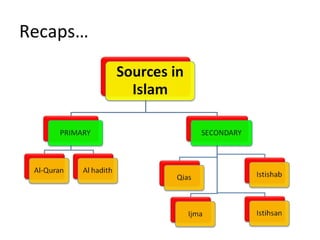
Secondary Sources (alternative source)
• Definition
–It refers to sources which are not directly
revealed by God.
–It is gained by mankind through certain
processes like observation,
experimentation and research.
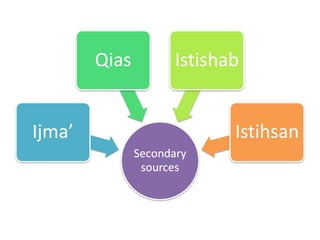
Types of Secondary Sources
1. Ijma (consensus)
– It refers to the consensus of the
companions of the prophet and the
agreement reached on the decision taken
by the learned Muftis on various Islamic
matters.
– The consensus of the jurists of a certain
period over a religious matter. Eg.
Collection of Quranic mushaf.
Cont…
2. Qias
– Literally it means analogy.
– It actually refers to the legal principle
introduced in order to derive at a logical
conclusion of a certain law on a certain
issue that has to do with the welfare of
the Muslim.
– It still must be based on the primary
sources. eg. Prohibition of drug.
Cont…
3. Istishab (The companions practice)
– It refers to the legal principle introduced
based on the companions' opinion and
practice. Eg. Azan for twice before Friday
speech.
Cont…
4. Istihsan/ Istihlah
– The legal principle introduced based on
public interest.
– Preference based on judgment of what is
more relevant, suitable or important and
what is more conducive to the public
interest, welfare and development. Eg.
Amount of mihar
Recaps…
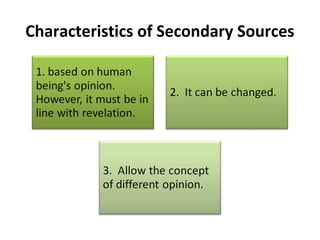
Characteristics of Secondary Sources
Theory of knowledge from Islamic perspective
a) Islam and knowledge
b) Views from Islamic scholars regarding Islam
and knowledge
c) How knowledge is acquired
d) Hierarchy of knowledge receivers
e) Classification of knowledge in Islam.
a) Islam and knowledge
• Islam emphasizes on knowledge and there is
nothing equivalent to it in this world.
• Muslims are encouraged to seek knowledge
and it is compulsory to them.
• The prophet said, if we want the world, seek
knowledge. If we want the hereafter, seek
knowledge. If we want both, seek
knowledge.
b) Views from Islamic scholars regarding Islam
and knowledge
• Yusof al-Razi
–Knowledge will help to do the correct
action. It also will raise the level of
intellectualism.
Cont…
• Abu Hatim al-Razi
–A smart person is a person who put his
knowledge into practice.
c) How knowledge is acquired
• According to Islam, knowledge can be
acquired through various methods. They are:
1. Revelation
2. Mind
3. Sensors
4. Acquired ideas
Cont…
1. Revelation
– It is the main source of Islamic knowledge.
– It is revealed from God to mankind through the prophets
as the source of knowledge.
– Revelations include Quran and Hadiths.
– It is considered as the highest source of Islamic
knowledge.
2. Mind
– Healthy mind can help human beings to acquire
knowledge.
– They can use their healthy mind to think and conduct
research.
– These activities will help them to produce new
knowledge.
Cont…
3. Sensors
– The five sensors help human beings to acquire
knowledge.
– They are fully function when mankind receive or seek
knowledge.
– Information is brought to mind through these sensors for
interpretation.
4. Acquired ideas
– Islam also accepts acquired ideas as a method to gain
knowledge.
– Acquired ideas include the dream of a pious person.
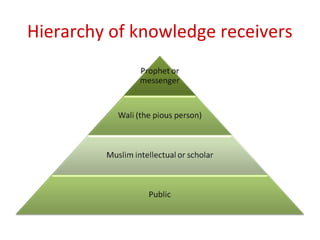
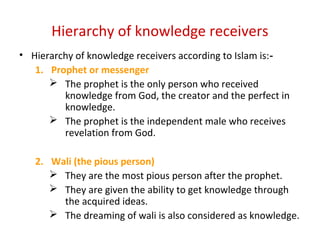
Hierarchy of knowledge receivers
• Hierarchy of knowledge receivers according to Islam is:‑
1. Prophet or messenger
 The prophet is the only person who received
knowledge from God, the creator and the perfect in
knowledge.
 The prophet is the independent male who receives
revelation from God.
2. Wali (the pious person)
 They are the most pious person after the prophet.
 They are given the ability to get knowledge through
the acquired ideas.
 The dreaming of wali is also considered as knowledge.
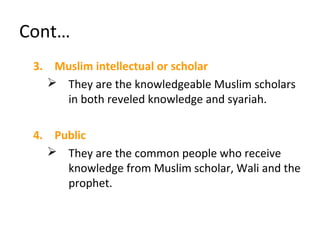
Cont…
3. Muslim intellectual or scholar
 They are the knowledgeable Muslim scholars
in both reveled knowledge and syariah.
4. Public
 They are the common people who receive
knowledge from Muslim scholar, Wali and the
prophet.
Classification of knowledge in Islam.
Classification of knowledge from 4th
century to
20th century (western & Islam)
Cont…
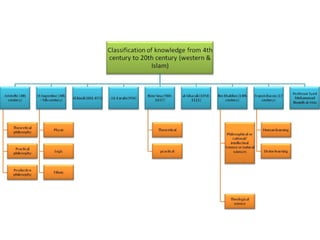
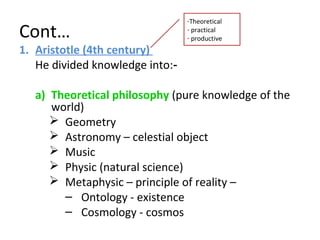
1. Aristotle (4th century)
He divided knowledge into:‑
a) Theoretical philosophy (pure knowledge of the
world)
 Geometry
 Astronomy – celestial object
 Music
 Physic (natural science)
 Metaphysic – principle of reality –
– Ontology - existence
– Cosmology - cosmos
-Theoretical
- practical
- productive
Cont…
b. Practical philosophy (Study of the social
science)
–Moral
–Economy
–Politic
Cont…
c. Productive philosophy (study of creative
activity)
–Poetry
–Rhetoric (speech) –public speaking
–Dialectical
Cont…
2. St Augustine (4th – 5th century)
He divided knowledge into:
–Physic
–Logic
–Ethic
Cont…
3. Al-kindi (801-873)
He divided knowledge into
–theoretical (Philosophical aspect)
–practical
Cont…
4.A1-Farabi (950)
He explained the classification of knowledge
in his book "Enumeration of science", which is
known to the west from the Latin translation
by Gerald Cremona as De Sciendis. Hossein
Nasr has summarized al-Farabi's scheme as
follows:-
Cont…
• Science of Language: syntax, grammar,
pronunciation and speech, poetry.
• Logic- study on syllogism.
• The propaedutic science: Arithmetic, Geometry,
Optics, Science of heavens (Astronomy), Music,
Science of weights, Science of tool making
(Engineering)
• Science of nature: Physic and metaphysic
• Science of society: political science, sociology,
Jurisprudence, etc
Cont…
5. Ibnu Sina (980-1037)
He divided knowledge into
–permanent (Revealed knowledge/ Syariah)
–temporary (Acquired knowledge/
Philosophical knowledge)
Cont…
6. Al-Ghazali (1058-1111)
He divided knowledge into:-
–Theoretical science
–Practical science
Cont…
2. This division is divided into two part:‑
a. Religion (Syariyya Sciences)
– The Holy Quran
– The sunnah and hadith
– Jurisprudence
– Theology (Tawhid)
– Islamic Metaphysic
(Tasawwuf)
– Linguistic science
Cont…
b. Rational philosophy (non-syariyya sciences)
- Human sciences
- Natural sciences
- Applied sciences
- Technological sciences
Cont…
3. Individually requisite knowledge (Fardhu ain)
and Socially-requisite knowledge (Fardhu
Kifayah)
Cont…
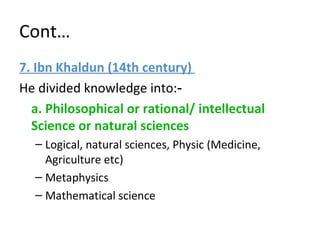
7. Ibn Khaldun (14th century)
He divided knowledge into:‑
a. Philosophical or rational/ intellectual
Science or natural sciences
– Logical, natural sciences, Physic (Medicine,
Agriculture etc)
– Metaphysics
– Mathematical science
Cont…
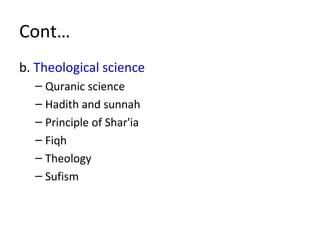
b. Theological science
– Quranic science
– Hadith and sunnah
– Principle of Shar'ia
– Fiqh
– Theology
– Sufism
Cont…
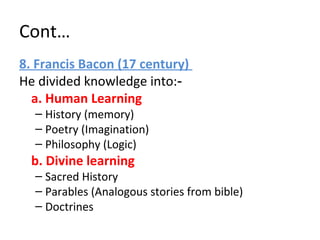
8. Francis Bacon (17 century)
He divided knowledge into:‑
a. Human Learning
– History (memory)
– Poetry (Imagination)
– Philosophy (Logic)
b. Divine learning
– Sacred History
– Parables (Analogous stories from bible)
– Doctrines
Cont…
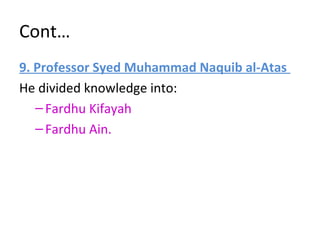
9. Professor Syed Muhammad Naquib al-Atas
He divided knowledge into:
–Fardhu Kifayah
–Fardhu Ain.
Revealed knowledge
• Revealed knowledge refer to knowledge which is
revealed from God to mankind through the prophet.
• It includes knowledge on Quran, Hadiths and syariah
• This knowledge is compulsory to be learnt by all
Muslim.
• It is also known as religious knowledge.
Acquired knowledge
• Acquired knowledge refer to knowledge which
is acquired by mankind through the
interpretation, analysis, observation and
experimentation.
• It is also called worldly knowledge.
Fardhu Kifayah/ Social Obligation
• According to Professor Syed Muhammad
Naquib al-Atas, it is obligation towards
society.
• According to Prof Dr. Osman Bakar, it refers to
what is divinely binding for the Muslim
community as a whole but it is not necessarily
binding for each member of the community.
Fardhu Ain / Individual Obligation
• According to Professor Syed Muhammad
Naquib al-Atas, it is obligation towards the
self.
• According to Prof Dr. Osman Bakar, it refers to
a religious obligation that is binding on every
Muslim
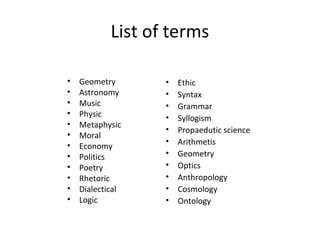
List of terms
• Geometry
• Astronomy
• Music
• Physic
• Metaphysic
• Moral
• Economy
• Politics
• Poetry
• Rhetoric
• Dialectical
• Logic
• Ethic
• Syntax
• Grammar
• Syllogism
• Propaedutic science
• Arithmetis
• Geometry
• Optics
• Anthropology
• Cosmology
• Ontology
THANK YOU…THAT ALL FOR TODAY.
SEE U IN NEXT CLASS !!!

Islamic information management sources in islam

  • 1.
    Chapter 2 Sources inIslam 1 IMR 660 ISLAMIC INFORMATION MANAGEMENT
  • 3.
  • 4.
    Primary Sources • Definition Primarysource according to information professional refer to original source which is not translated, interpreted or published by anyone else for examples, research, biography, patent, thesis and etc.
  • 5.
    Cont… • According toIslam refer to knowledge that is revealed by God to the prophet. • So, primary sources in Islam are Quran and Hadith.
  • 6.
    Types of PrimarySources 1. Quran • Definition It is the Arabic speech of Allah which He revealed to prophet Muhammad in wording and meaning and which has been preserved in the Mushaf and has reached us mutawatir transmission (several chains of narration) and is a challenge to mankind to produce something similar to it.
  • 7.
    Cont… • The HolyQuran is the book of Allah sent through the last prophet, Muhammad. • It contains the knowledge conveyed by Allah and the guidance for men who are righteous (honorable) for all time to come. • The Quran provides a code of conduct for every believer and is the commandment (order) and a warrant for him.
  • 8.
    Cont… 2. Hadiths • Definition –It includes everything, other than the Quran, which has been transmitted from the prophet; what he said, did and agreed to. – The word stands for what was transmitted on the authority of the prophet, his deed, sayings, tacit approval or description of his features meaning his physical appearance.
  • 9.
    Characteristics of PrimarySources • It is revealed by God to the prophet directly or indirectly. • The information cannot be changed. • It is considered as the ultimate (final) source.
  • 10.
    Secondary Sources (alternativesource) • Definition –It refers to sources which are not directly revealed by God. –It is gained by mankind through certain processes like observation, experimentation and research.
  • 12.
    Types of SecondarySources 1. Ijma (consensus) – It refers to the consensus of the companions of the prophet and the agreement reached on the decision taken by the learned Muftis on various Islamic matters. – The consensus of the jurists of a certain period over a religious matter. Eg. Collection of Quranic mushaf.
  • 13.
    Cont… 2. Qias – Literallyit means analogy. – It actually refers to the legal principle introduced in order to derive at a logical conclusion of a certain law on a certain issue that has to do with the welfare of the Muslim. – It still must be based on the primary sources. eg. Prohibition of drug.
  • 14.
    Cont… 3. Istishab (Thecompanions practice) – It refers to the legal principle introduced based on the companions' opinion and practice. Eg. Azan for twice before Friday speech.
  • 15.
    Cont… 4. Istihsan/ Istihlah –The legal principle introduced based on public interest. – Preference based on judgment of what is more relevant, suitable or important and what is more conducive to the public interest, welfare and development. Eg. Amount of mihar
  • 16.
  • 17.
  • 18.
    Theory of knowledgefrom Islamic perspective a) Islam and knowledge b) Views from Islamic scholars regarding Islam and knowledge c) How knowledge is acquired d) Hierarchy of knowledge receivers e) Classification of knowledge in Islam.
  • 19.
    a) Islam andknowledge • Islam emphasizes on knowledge and there is nothing equivalent to it in this world. • Muslims are encouraged to seek knowledge and it is compulsory to them. • The prophet said, if we want the world, seek knowledge. If we want the hereafter, seek knowledge. If we want both, seek knowledge.
  • 20.
    b) Views fromIslamic scholars regarding Islam and knowledge • Yusof al-Razi –Knowledge will help to do the correct action. It also will raise the level of intellectualism.
  • 21.
    Cont… • Abu Hatimal-Razi –A smart person is a person who put his knowledge into practice.
  • 22.
    c) How knowledgeis acquired • According to Islam, knowledge can be acquired through various methods. They are: 1. Revelation 2. Mind 3. Sensors 4. Acquired ideas
  • 23.
    Cont… 1. Revelation – Itis the main source of Islamic knowledge. – It is revealed from God to mankind through the prophets as the source of knowledge. – Revelations include Quran and Hadiths. – It is considered as the highest source of Islamic knowledge. 2. Mind – Healthy mind can help human beings to acquire knowledge. – They can use their healthy mind to think and conduct research. – These activities will help them to produce new knowledge.
  • 24.
    Cont… 3. Sensors – Thefive sensors help human beings to acquire knowledge. – They are fully function when mankind receive or seek knowledge. – Information is brought to mind through these sensors for interpretation. 4. Acquired ideas – Islam also accepts acquired ideas as a method to gain knowledge. – Acquired ideas include the dream of a pious person.
  • 25.
  • 26.
    Hierarchy of knowledgereceivers • Hierarchy of knowledge receivers according to Islam is:‑ 1. Prophet or messenger  The prophet is the only person who received knowledge from God, the creator and the perfect in knowledge.  The prophet is the independent male who receives revelation from God. 2. Wali (the pious person)  They are the most pious person after the prophet.  They are given the ability to get knowledge through the acquired ideas.  The dreaming of wali is also considered as knowledge.
  • 27.
    Cont… 3. Muslim intellectualor scholar  They are the knowledgeable Muslim scholars in both reveled knowledge and syariah. 4. Public  They are the common people who receive knowledge from Muslim scholar, Wali and the prophet.
  • 28.
    Classification of knowledgein Islam. Classification of knowledge from 4th century to 20th century (western & Islam)
  • 30.
    Cont… 1. Aristotle (4thcentury) He divided knowledge into:‑ a) Theoretical philosophy (pure knowledge of the world)  Geometry  Astronomy – celestial object  Music  Physic (natural science)  Metaphysic – principle of reality – – Ontology - existence – Cosmology - cosmos -Theoretical - practical - productive
  • 31.
    Cont… b. Practical philosophy(Study of the social science) –Moral –Economy –Politic
  • 32.
    Cont… c. Productive philosophy(study of creative activity) –Poetry –Rhetoric (speech) –public speaking –Dialectical
  • 33.
    Cont… 2. St Augustine(4th – 5th century) He divided knowledge into: –Physic –Logic –Ethic
  • 34.
    Cont… 3. Al-kindi (801-873) Hedivided knowledge into –theoretical (Philosophical aspect) –practical
  • 35.
    Cont… 4.A1-Farabi (950) He explainedthe classification of knowledge in his book "Enumeration of science", which is known to the west from the Latin translation by Gerald Cremona as De Sciendis. Hossein Nasr has summarized al-Farabi's scheme as follows:-
  • 36.
    Cont… • Science ofLanguage: syntax, grammar, pronunciation and speech, poetry. • Logic- study on syllogism. • The propaedutic science: Arithmetic, Geometry, Optics, Science of heavens (Astronomy), Music, Science of weights, Science of tool making (Engineering) • Science of nature: Physic and metaphysic • Science of society: political science, sociology, Jurisprudence, etc
  • 37.
    Cont… 5. Ibnu Sina(980-1037) He divided knowledge into –permanent (Revealed knowledge/ Syariah) –temporary (Acquired knowledge/ Philosophical knowledge)
  • 38.
    Cont… 6. Al-Ghazali (1058-1111) Hedivided knowledge into:- –Theoretical science –Practical science
  • 39.
    Cont… 2. This divisionis divided into two part:‑ a. Religion (Syariyya Sciences) – The Holy Quran – The sunnah and hadith – Jurisprudence – Theology (Tawhid) – Islamic Metaphysic (Tasawwuf) – Linguistic science
  • 40.
    Cont… b. Rational philosophy(non-syariyya sciences) - Human sciences - Natural sciences - Applied sciences - Technological sciences
  • 41.
    Cont… 3. Individually requisiteknowledge (Fardhu ain) and Socially-requisite knowledge (Fardhu Kifayah)
  • 42.
    Cont… 7. Ibn Khaldun(14th century) He divided knowledge into:‑ a. Philosophical or rational/ intellectual Science or natural sciences – Logical, natural sciences, Physic (Medicine, Agriculture etc) – Metaphysics – Mathematical science
  • 43.
    Cont… b. Theological science –Quranic science – Hadith and sunnah – Principle of Shar'ia – Fiqh – Theology – Sufism
  • 44.
    Cont… 8. Francis Bacon(17 century) He divided knowledge into:‑ a. Human Learning – History (memory) – Poetry (Imagination) – Philosophy (Logic) b. Divine learning – Sacred History – Parables (Analogous stories from bible) – Doctrines
  • 45.
    Cont… 9. Professor SyedMuhammad Naquib al-Atas He divided knowledge into: –Fardhu Kifayah –Fardhu Ain.
  • 46.
    Revealed knowledge • Revealedknowledge refer to knowledge which is revealed from God to mankind through the prophet. • It includes knowledge on Quran, Hadiths and syariah • This knowledge is compulsory to be learnt by all Muslim. • It is also known as religious knowledge.
  • 47.
    Acquired knowledge • Acquiredknowledge refer to knowledge which is acquired by mankind through the interpretation, analysis, observation and experimentation. • It is also called worldly knowledge.
  • 48.
    Fardhu Kifayah/ SocialObligation • According to Professor Syed Muhammad Naquib al-Atas, it is obligation towards society. • According to Prof Dr. Osman Bakar, it refers to what is divinely binding for the Muslim community as a whole but it is not necessarily binding for each member of the community.
  • 49.
    Fardhu Ain /Individual Obligation • According to Professor Syed Muhammad Naquib al-Atas, it is obligation towards the self. • According to Prof Dr. Osman Bakar, it refers to a religious obligation that is binding on every Muslim
  • 50.
    List of terms •Geometry • Astronomy • Music • Physic • Metaphysic • Moral • Economy • Politics • Poetry • Rhetoric • Dialectical • Logic • Ethic • Syntax • Grammar • Syllogism • Propaedutic science • Arithmetis • Geometry • Optics • Anthropology • Cosmology • Ontology
  • 51.
    THANK YOU…THAT ALLFOR TODAY. SEE U IN NEXT CLASS !!!