Chapter 13

Systems Analysis and Design in a Changing World, 6t
1
Making the System
Operational

Chapter 13
Systems Analysis and Design
in a Changing World 6th Ed
Satzinger, Jackson & Burd
Chapter 13 Outline
 Testing
 Deployment

Activities
 Planning and Managing Implementation,
Testing, and Deployment
 Putting It All Together—RMO Revisited

Systems Analysis and Design in a Changing World, 6t
3
Learning Objectives









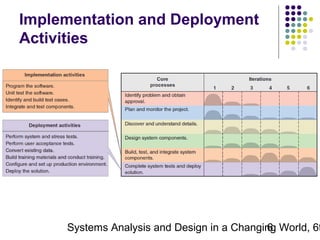
Describe implementation and deployment activities
Describe various types of software tests and explain
how and why each is used
Explain the importance of configuration management,
change management, and source code control to the
implementation, testing, and deployment of a system
List various approaches to data conversion and system
deployment and describe the advantages and
disadvantages of each
Describe training and user support requirements for new
and operational systems

Systems Analysis and Design in a Changing World, 6t
4
Overview
Up to this point, the text has covered the first
four of the core development processes in the
SDLC
 This chapter covers the last 2 processes—
Implementation activities and Deployment
activities
 Implementation includes programming and
testing activities. Deployment includes system
tests, converting data, training, setting up the
production environment, and deploying the
solution


Systems Analysis and Design in a Changing World, 6t
5
Implementation and Deployment
Activities

Systems Analysis and Design in a Changing World, 6t
6
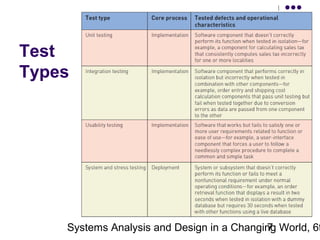
Test
Types

Systems Analysis and Design in a Changing World, 6t
7
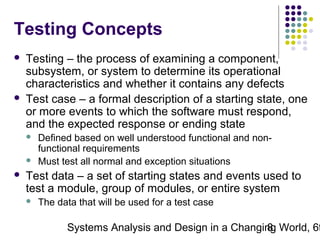
Testing Concepts




Testing – the process of examining a component,
subsystem, or system to determine its operational
characteristics and whether it contains any defects
Test case – a formal description of a starting state, one
or more events to which the software must respond,
and the expected response or ending state





Defined based on well understood functional and nonfunctional requirements
Must test all normal and exception situations

Test data – a set of starting states and events used to
test a module, group of modules, or entire system


The data that will be used for a test case

Systems Analysis and Design in a Changing World, 6t
8
Unit Testing
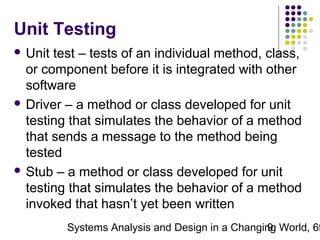
 Unit

test – tests of an individual method, class,
or component before it is integrated with other
software
 Driver – a method or class developed for unit
testing that simulates the behavior of a method
that sends a message to the method being
tested
 Stub – a method or class developed for unit
testing that simulates the behavior of a method
invoked that hasn’t yet been written

Systems Analysis and Design in a Changing World, 6t
9
Unit Testing
Driver to test createCartItem method

Systems Analysis and Design in a Changing World, 6t
10
Unit Testing
Some stub modules used by createCartItem

Systems Analysis and Design in a Changing World, 6t
11
Integration Testing


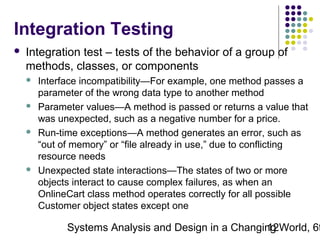
Integration test – tests of the behavior of a group of
methods, classes, or components








Interface incompatibility—For example, one method passes a
parameter of the wrong data type to another method
Parameter values—A method is passed or returns a value that
was unexpected, such as a negative number for a price.
Run-time exceptions—A method generates an error, such as
“out of memory” or “file already in use,” due to conflicting
resource needs
Unexpected state interactions—The states of two or more
objects interact to cause complex failures, as when an
OnlineCart class method operates correctly for all possible
Customer object states except one

Systems Analysis and Design in a Changing World, 6t
12
Integration Testing


Integration testing of object-oriented software is very
complex because an object-oriented program consists
of a set of interacting objects







Methods can be (and usually are) called by many other
methods, and the calling methods may be distributed across
many classes.
Classes may inherit methods and state variables from other
classes.
The specific method to be called is dynamically determined at
run time based on the number and type of message
parameters.
Objects can retain internal variable values (i.e., the object
state) between calls. The response to two identical calls may
be different due to state changes that result from the first call
or occur between calls.

Systems Analysis and Design in a Changing World, 6t
13
Usability Testing






Usability test – a test to determine whether a method,
class, subsystem, or system meets user requirements
Many usability tests are required because they involve
functional and non-functional requirements
Most common type evaluates functional requirements,
use case by use case






Can be completed in each iteration as use cases are
implemented
Can test ease of learning and ease of use
Can test whether results match actual requirements
Key type of feedback from users throughout project

Systems Analysis and Design in a Changing World, 6t
14
System, Performance, and Stress
Testing


System test – an integration test of an entire
system or independent subsystem




Can be performed at the end of each iteration
Can be performed more frequently
Build and smoke test – a system test that is performed
daily or several times a week
 The system is completely compiled and linked (built), and
a battery of tests is executed to see whether anything
malfunctions in an obvious way (“smokes”)
 Automated testing tools are used. Catches any problems
that may have come up since the last system test

Systems Analysis and Design in a Changing World, 6t
15
System, Performance, and Stress
Testing


Performance test or stress test – an integration
and usability test that determines whether a
system or subsystem can meet time-based
performance criteria




Response time – the desired or maximum allowable time
limit for software response to a query or update
Throughput – the desired or minimum number of queries
and transactions that must be processed per minute or
hour

Systems Analysis and Design in a Changing World, 6t
16
User Acceptance Testing
User acceptance test – a system test performed
to determine whether the system fulfills user
requirements
 May be performed near the end of the project (or
at end of later project iterations)
 A very formal activity in most development
projects. Payments tied to passing tests
 Details of acceptance tests are sometimes
included in the request for proposal (RFP) and
procurement contract


Systems Analysis and Design in a Changing World, 6t
17
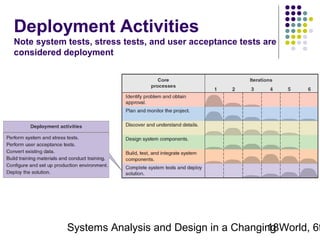
Deployment Activities
Note system tests, stress tests, and user acceptance tests are
considered deployment

Systems Analysis and Design in a Changing World, 6t
18
Converting and Initializing Data
An operational system requires a fully populated
database to support ongoing processing
 Data needed at system startup can be obtained
from these sources:








Files or databases of a system being replaced
Manual records
Files or databases from other systems in the
organization
User feedback during normal system operation

Systems Analysis and Design in a Changing World, 6t
19
Converting and Initializing Data
Complex data conversion example

Systems Analysis and Design in a Changing World, 6t
20
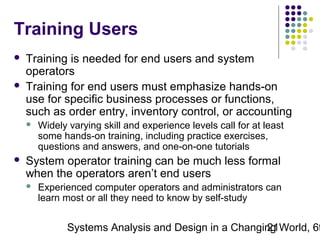
Training Users



Training is needed for end users and system
operators
Training for end users must emphasize hands-on
use for specific business processes or functions,
such as order entry, inventory control, or accounting




Widely varying skill and experience levels call for at least
some hands-on training, including practice exercises,
questions and answers, and one-on-one tutorials

System operator training can be much less formal
when the operators aren’t end users


Experienced computer operators and administrators can
learn most or all they need to know by self-study

Systems Analysis and Design in a Changing World, 6t
21
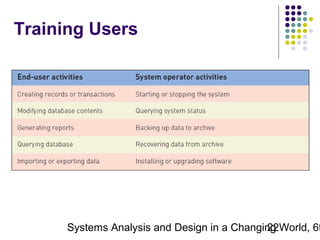
Training Users

Systems Analysis and Design in a Changing World, 6t
22
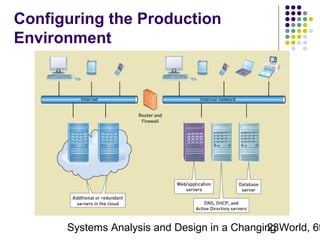
Configuring the Production
Environment

Systems Analysis and Design in a Changing World, 6t
23
Planning and Managing
Implementation, Testing and Deployment
 Development




Input, process, output (IPO) – a development
order that implements input modules first, process
modules next, and output modules last
Top-down development – a development order
that implements top-level modules first




Order

Use stubs for testing

Bottom-up development – a development order
that implements low-level detailed modules first


Use drivers for testing

Systems Analysis and Design in a Changing World, 6t
24
Planning and Managing
Implementation, Testing and Deployment
 Source


code control

An automated tool for tracking source code files
and controlling changes to those files






A programmer checks out a file in read-only mode
when he or she wants to examine the code without
making changes (e.g., to examine a module’s
interfaces to other modules)
When a programmer needs to make changes to a file,
he or she checks out the file in read/write mode
The SCCS allows only one programmer at a time to
check out a file in read/write mode.

Systems Analysis and Design in a Changing World, 6t
25
Source Code Control System (SCCS)

Systems Analysis and Design in a Changing World, 6t
26
Planning and Managing
Implementation, Testing and Deployment


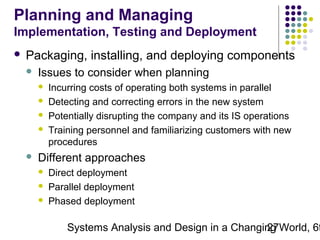
Packaging, installing, and deploying components


Issues to consider when planning







Incurring costs of operating both systems in parallel
Detecting and correcting errors in the new system
Potentially disrupting the company and its IS operations
Training personnel and familiarizing customers with new
procedures

Different approaches




Direct deployment
Parallel deployment
Phased deployment

Systems Analysis and Design in a Changing World, 6t
27
Planning and Managing
Implementation, Testing and Deployment


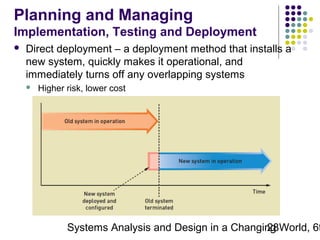
Direct deployment – a deployment method that installs a
new system, quickly makes it operational, and
immediately turns off any overlapping systems


Higher risk, lower cost

Systems Analysis and Design in a Changing World, 6t
28
Planning and Managing
Implementation, Testing and Deployment


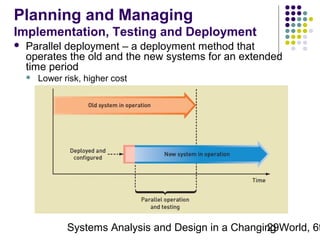
Parallel deployment – a deployment method that
operates the old and the new systems for an extended
time period


Lower risk, higher cost

Systems Analysis and Design in a Changing World, 6t
29
Planning and Managing
Implementation, Testing and Deployment


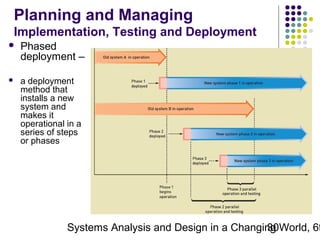
Phased
deployment –



a deployment
method that
installs a new
system and
makes it
operational in a
series of steps
or phases

Systems Analysis and Design in a Changing World, 6t
30
Planning and Managing
Implementation, Testing and Deployment


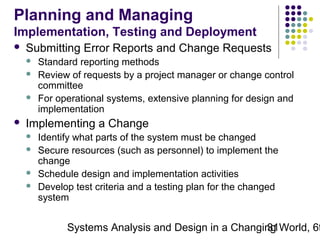
Submitting Error Reports and Change Requests






Standard reporting methods
Review of requests by a project manager or change control
committee
For operational systems, extensive planning for design and
implementation

Implementing a Change





Identify what parts of the system must be changed
Secure resources (such as personnel) to implement the
change
Schedule design and implementation activities
Develop test criteria and a testing plan for the changed
system

Systems Analysis and Design in a Changing World, 6t
31
Planning and Managing
Implementation, Testing and Deployment


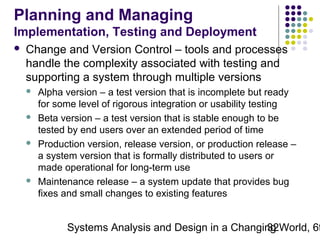
Change and Version Control – tools and processes
handle the complexity associated with testing and
supporting a system through multiple versions








Alpha version – a test version that is incomplete but ready
for some level of rigorous integration or usability testing
Beta version – a test version that is stable enough to be
tested by end users over an extended period of time
Production version, release version, or production release –
a system version that is formally distributed to users or
made operational for long-term use
Maintenance release – a system update that provides bug
fixes and small changes to existing features

Systems Analysis and Design in a Changing World, 6t
32
RMO CSMS System Revisited
 Upgrade






or Replace?

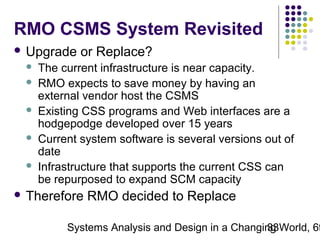
The current infrastructure is near capacity.
RMO expects to save money by having an
external vendor host the CSMS
Existing CSS programs and Web interfaces are a
hodgepodge developed over 15 years
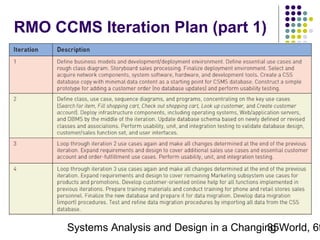
Current system software is several versions out of
date
Infrastructure that supports the current CSS can
be repurposed to expand SCM capacity

 Therefore

RMO decided to Replace

Systems Analysis and Design in a Changing World, 6t
33
RMO CSMS System Revisited


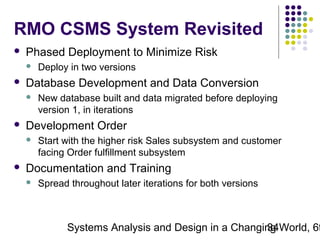
Phased Deployment to Minimize Risk




Database Development and Data Conversion




New database built and data migrated before deploying
version 1, in iterations

Development Order




Deploy in two versions

Start with the higher risk Sales subsystem and customer
facing Order fulfillment subsystem

Documentation and Training


Spread throughout later iterations for both versions

Systems Analysis and Design in a Changing World, 6t
34
RMO CCMS Iteration Plan (part 1)

Systems Analysis and Design in a Changing World, 6t
35
RMO CCMS Iteration Plan (part 2)

Systems Analysis and Design in a Changing World, 6t
36
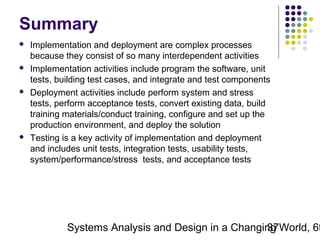
Summary








Implementation and deployment are complex processes
because they consist of so many interdependent activities
Implementation activities include program the software, unit
tests, building test cases, and integrate and test components
Deployment activities include perform system and stress
tests, perform acceptance tests, convert existing data, build
training materials/conduct training, configure and set up the
production environment, and deploy the solution
Testing is a key activity of implementation and deployment
and includes unit tests, integration tests, usability tests,
system/performance/stress tests, and acceptance tests

Systems Analysis and Design in a Changing World, 6t
37
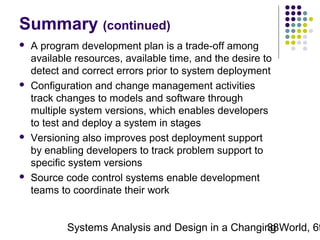
Summary (continued)








A program development plan is a trade-off among
available resources, available time, and the desire to
detect and correct errors prior to system deployment
Configuration and change management activities
track changes to models and software through
multiple system versions, which enables developers
to test and deploy a system in stages
Versioning also improves post deployment support
by enabling developers to track problem support to
specific system versions
Source code control systems enable development
teams to coordinate their work

Systems Analysis and Design in a Changing World, 6t
38
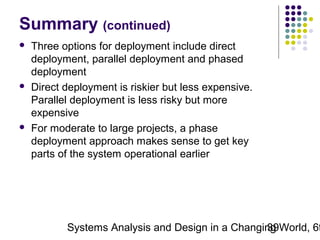
Summary (continued)






Three options for deployment include direct
deployment, parallel deployment and phased
deployment
Direct deployment is riskier but less expensive.
Parallel deployment is less risky but more
expensive
For moderate to large projects, a phase
deployment approach makes sense to get key
parts of the system operational earlier

Systems Analysis and Design in a Changing World, 6t
39

System Analysis and Design

  • 1.
    Chapter 13 Systems Analysisand Design in a Changing World, 6t 1
  • 2.
    Making the System Operational Chapter13 Systems Analysis and Design in a Changing World 6th Ed Satzinger, Jackson & Burd
  • 3.
    Chapter 13 Outline Testing  Deployment Activities  Planning and Managing Implementation, Testing, and Deployment  Putting It All Together—RMO Revisited Systems Analysis and Design in a Changing World, 6t 3
  • 4.
    Learning Objectives      Describe implementationand deployment activities Describe various types of software tests and explain how and why each is used Explain the importance of configuration management, change management, and source code control to the implementation, testing, and deployment of a system List various approaches to data conversion and system deployment and describe the advantages and disadvantages of each Describe training and user support requirements for new and operational systems Systems Analysis and Design in a Changing World, 6t 4
  • 5.
    Overview Up to thispoint, the text has covered the first four of the core development processes in the SDLC  This chapter covers the last 2 processes— Implementation activities and Deployment activities  Implementation includes programming and testing activities. Deployment includes system tests, converting data, training, setting up the production environment, and deploying the solution  Systems Analysis and Design in a Changing World, 6t 5
  • 6.
    Implementation and Deployment Activities SystemsAnalysis and Design in a Changing World, 6t 6
  • 7.
    Test Types Systems Analysis andDesign in a Changing World, 6t 7
  • 8.
    Testing Concepts   Testing –the process of examining a component, subsystem, or system to determine its operational characteristics and whether it contains any defects Test case – a formal description of a starting state, one or more events to which the software must respond, and the expected response or ending state    Defined based on well understood functional and nonfunctional requirements Must test all normal and exception situations Test data – a set of starting states and events used to test a module, group of modules, or entire system  The data that will be used for a test case Systems Analysis and Design in a Changing World, 6t 8
  • 9.
    Unit Testing  Unit test– tests of an individual method, class, or component before it is integrated with other software  Driver – a method or class developed for unit testing that simulates the behavior of a method that sends a message to the method being tested  Stub – a method or class developed for unit testing that simulates the behavior of a method invoked that hasn’t yet been written Systems Analysis and Design in a Changing World, 6t 9
  • 10.
    Unit Testing Driver totest createCartItem method Systems Analysis and Design in a Changing World, 6t 10
  • 11.
    Unit Testing Some stubmodules used by createCartItem Systems Analysis and Design in a Changing World, 6t 11
  • 12.
    Integration Testing  Integration test– tests of the behavior of a group of methods, classes, or components     Interface incompatibility—For example, one method passes a parameter of the wrong data type to another method Parameter values—A method is passed or returns a value that was unexpected, such as a negative number for a price. Run-time exceptions—A method generates an error, such as “out of memory” or “file already in use,” due to conflicting resource needs Unexpected state interactions—The states of two or more objects interact to cause complex failures, as when an OnlineCart class method operates correctly for all possible Customer object states except one Systems Analysis and Design in a Changing World, 6t 12
  • 13.
    Integration Testing  Integration testingof object-oriented software is very complex because an object-oriented program consists of a set of interacting objects     Methods can be (and usually are) called by many other methods, and the calling methods may be distributed across many classes. Classes may inherit methods and state variables from other classes. The specific method to be called is dynamically determined at run time based on the number and type of message parameters. Objects can retain internal variable values (i.e., the object state) between calls. The response to two identical calls may be different due to state changes that result from the first call or occur between calls. Systems Analysis and Design in a Changing World, 6t 13
  • 14.
    Usability Testing    Usability test– a test to determine whether a method, class, subsystem, or system meets user requirements Many usability tests are required because they involve functional and non-functional requirements Most common type evaluates functional requirements, use case by use case     Can be completed in each iteration as use cases are implemented Can test ease of learning and ease of use Can test whether results match actual requirements Key type of feedback from users throughout project Systems Analysis and Design in a Changing World, 6t 14
  • 15.
    System, Performance, andStress Testing  System test – an integration test of an entire system or independent subsystem    Can be performed at the end of each iteration Can be performed more frequently Build and smoke test – a system test that is performed daily or several times a week  The system is completely compiled and linked (built), and a battery of tests is executed to see whether anything malfunctions in an obvious way (“smokes”)  Automated testing tools are used. Catches any problems that may have come up since the last system test Systems Analysis and Design in a Changing World, 6t 15
  • 16.
    System, Performance, andStress Testing  Performance test or stress test – an integration and usability test that determines whether a system or subsystem can meet time-based performance criteria   Response time – the desired or maximum allowable time limit for software response to a query or update Throughput – the desired or minimum number of queries and transactions that must be processed per minute or hour Systems Analysis and Design in a Changing World, 6t 16
  • 17.
    User Acceptance Testing Useracceptance test – a system test performed to determine whether the system fulfills user requirements  May be performed near the end of the project (or at end of later project iterations)  A very formal activity in most development projects. Payments tied to passing tests  Details of acceptance tests are sometimes included in the request for proposal (RFP) and procurement contract  Systems Analysis and Design in a Changing World, 6t 17
  • 18.
    Deployment Activities Note systemtests, stress tests, and user acceptance tests are considered deployment Systems Analysis and Design in a Changing World, 6t 18
  • 19.
    Converting and InitializingData An operational system requires a fully populated database to support ongoing processing  Data needed at system startup can be obtained from these sources:      Files or databases of a system being replaced Manual records Files or databases from other systems in the organization User feedback during normal system operation Systems Analysis and Design in a Changing World, 6t 19
  • 20.
    Converting and InitializingData Complex data conversion example Systems Analysis and Design in a Changing World, 6t 20
  • 21.
    Training Users   Training isneeded for end users and system operators Training for end users must emphasize hands-on use for specific business processes or functions, such as order entry, inventory control, or accounting   Widely varying skill and experience levels call for at least some hands-on training, including practice exercises, questions and answers, and one-on-one tutorials System operator training can be much less formal when the operators aren’t end users  Experienced computer operators and administrators can learn most or all they need to know by self-study Systems Analysis and Design in a Changing World, 6t 21
  • 22.
    Training Users Systems Analysisand Design in a Changing World, 6t 22
  • 23.
    Configuring the Production Environment SystemsAnalysis and Design in a Changing World, 6t 23
  • 24.
    Planning and Managing Implementation,Testing and Deployment  Development   Input, process, output (IPO) – a development order that implements input modules first, process modules next, and output modules last Top-down development – a development order that implements top-level modules first   Order Use stubs for testing Bottom-up development – a development order that implements low-level detailed modules first  Use drivers for testing Systems Analysis and Design in a Changing World, 6t 24
  • 25.
    Planning and Managing Implementation,Testing and Deployment  Source  code control An automated tool for tracking source code files and controlling changes to those files    A programmer checks out a file in read-only mode when he or she wants to examine the code without making changes (e.g., to examine a module’s interfaces to other modules) When a programmer needs to make changes to a file, he or she checks out the file in read/write mode The SCCS allows only one programmer at a time to check out a file in read/write mode. Systems Analysis and Design in a Changing World, 6t 25
  • 26.
    Source Code ControlSystem (SCCS) Systems Analysis and Design in a Changing World, 6t 26
  • 27.
    Planning and Managing Implementation,Testing and Deployment  Packaging, installing, and deploying components  Issues to consider when planning      Incurring costs of operating both systems in parallel Detecting and correcting errors in the new system Potentially disrupting the company and its IS operations Training personnel and familiarizing customers with new procedures Different approaches    Direct deployment Parallel deployment Phased deployment Systems Analysis and Design in a Changing World, 6t 27
  • 28.
    Planning and Managing Implementation,Testing and Deployment  Direct deployment – a deployment method that installs a new system, quickly makes it operational, and immediately turns off any overlapping systems  Higher risk, lower cost Systems Analysis and Design in a Changing World, 6t 28
  • 29.
    Planning and Managing Implementation,Testing and Deployment  Parallel deployment – a deployment method that operates the old and the new systems for an extended time period  Lower risk, higher cost Systems Analysis and Design in a Changing World, 6t 29
  • 30.
    Planning and Managing Implementation,Testing and Deployment  Phased deployment –  a deployment method that installs a new system and makes it operational in a series of steps or phases Systems Analysis and Design in a Changing World, 6t 30
  • 31.
    Planning and Managing Implementation,Testing and Deployment  Submitting Error Reports and Change Requests     Standard reporting methods Review of requests by a project manager or change control committee For operational systems, extensive planning for design and implementation Implementing a Change     Identify what parts of the system must be changed Secure resources (such as personnel) to implement the change Schedule design and implementation activities Develop test criteria and a testing plan for the changed system Systems Analysis and Design in a Changing World, 6t 31
  • 32.
    Planning and Managing Implementation,Testing and Deployment  Change and Version Control – tools and processes handle the complexity associated with testing and supporting a system through multiple versions     Alpha version – a test version that is incomplete but ready for some level of rigorous integration or usability testing Beta version – a test version that is stable enough to be tested by end users over an extended period of time Production version, release version, or production release – a system version that is formally distributed to users or made operational for long-term use Maintenance release – a system update that provides bug fixes and small changes to existing features Systems Analysis and Design in a Changing World, 6t 32
  • 33.
    RMO CSMS SystemRevisited  Upgrade      or Replace? The current infrastructure is near capacity. RMO expects to save money by having an external vendor host the CSMS Existing CSS programs and Web interfaces are a hodgepodge developed over 15 years Current system software is several versions out of date Infrastructure that supports the current CSS can be repurposed to expand SCM capacity  Therefore RMO decided to Replace Systems Analysis and Design in a Changing World, 6t 33
  • 34.
    RMO CSMS SystemRevisited  Phased Deployment to Minimize Risk   Database Development and Data Conversion   New database built and data migrated before deploying version 1, in iterations Development Order   Deploy in two versions Start with the higher risk Sales subsystem and customer facing Order fulfillment subsystem Documentation and Training  Spread throughout later iterations for both versions Systems Analysis and Design in a Changing World, 6t 34
  • 35.
    RMO CCMS IterationPlan (part 1) Systems Analysis and Design in a Changing World, 6t 35
  • 36.
    RMO CCMS IterationPlan (part 2) Systems Analysis and Design in a Changing World, 6t 36
  • 37.
    Summary     Implementation and deploymentare complex processes because they consist of so many interdependent activities Implementation activities include program the software, unit tests, building test cases, and integrate and test components Deployment activities include perform system and stress tests, perform acceptance tests, convert existing data, build training materials/conduct training, configure and set up the production environment, and deploy the solution Testing is a key activity of implementation and deployment and includes unit tests, integration tests, usability tests, system/performance/stress tests, and acceptance tests Systems Analysis and Design in a Changing World, 6t 37
  • 38.
    Summary (continued)     A programdevelopment plan is a trade-off among available resources, available time, and the desire to detect and correct errors prior to system deployment Configuration and change management activities track changes to models and software through multiple system versions, which enables developers to test and deploy a system in stages Versioning also improves post deployment support by enabling developers to track problem support to specific system versions Source code control systems enable development teams to coordinate their work Systems Analysis and Design in a Changing World, 6t 38
  • 39.
    Summary (continued)    Three optionsfor deployment include direct deployment, parallel deployment and phased deployment Direct deployment is riskier but less expensive. Parallel deployment is less risky but more expensive For moderate to large projects, a phase deployment approach makes sense to get key parts of the system operational earlier Systems Analysis and Design in a Changing World, 6t 39