Chapter 1. Bacterial isolation, identification and 
storage. 
Title Chapter 1. Bacterial isolation, identification and storage. 
Author(s) Ruangpan, Lila; Tendencia, Eleonor A. 
Citation Ruangpan, L., & Tendencia, E. A. (2004). Chapter 1. Bacterial 
isolation, identification and storage. In Laboratory manual of 
standardized methods for antimicrobial sensitivity tests for 
bacteria isolated from aquatic animals and environment (pp. 
3–11). Tigbauan, Iloilo, Philippines: Southeast Asian Fisheries 
Development Center, Aquaculture Department. 
Issue Date 2004 
URL http://hdl.handle.net/10862/1616 
Downloaded on September 29, 2014 from http://repository.seafdec.org.ph at 7:11 PM CST 
SEAFDEC/AQD Institutional Repository (SAIR)
3 
CHAPTER I 
Bacterial Isolation, Identification, 
and Storage 
Lila Ruangpan 
Chanthaburi Coastal Fisheries Research and Development Center 
Department of Fisheries 
Ministry of Agriculture and Cooperatives 
Thailand 
and 
Eleonor A. Tendencia 
Aquaculture Department 
Southeast Asian Fisheries Development Center 
Philippines 
Laboratory Manual of Standardized Methods for Antimicrobial Sensitivity Tests for Bacteria Isolated from Aquatic Animals and Environment 
Downloaded from http://repository.seafdec.org.ph on September 29, 2014
4 CHAPTER 1. Bacterial Isolation, Identification, and Storage PRINCIPLE 
Bacterial isolation, purification and identification are the first steps to 
bacteriological studies. Isolation is done to obtain pure bacterial cultures. Bacteria are 
usually isolated from fish kidney and spleen; and from the hepatopancreas, lymphoid 
organ and muscles of shrimp. These tissues are monitor organs that usually harbor 
the disease-causing bacteria during infection. 
To obtain a pure bacterial culture is the first step to bacterial identification. 
Pure culture is essential in the study of the morphology, physiology, biochemical 
characteristics, and susceptibility to antimicrobial agents of a particular bacterial 
strain. 
Pure cultures are best obtained by using solid media, by streak plate or pour plate 
method. Streak plate, if properly done, is the most practical method. In the streak 
plate method, a loopful of the inoculum is placed near the periphery of the plate with 
agar medium and spread or streaked on the upper portion of the plate with parallel 
overlapping strokes. The inoculum is streaked over other portions of the plate so that 
isolated colonies could be observed in the last streaked area. 
The identification of a bacterial pathogen is important in fish diagnosis. Treatment 
could be implemented only after the causative agent or the bacterium has been 
identified. Bacterial species differ in morphological, physiological and biochemical 
characteristics and those can be used when coding or labelling them (Appendix 
1.1). Therefore, identification is accomplished by performing several morphological, 
physiological and biochemical tests. Results of these tests are compared to established 
taxa or identification schemes (Appendix 1.2). 
Bacterial cultures should be preserved for future study. Storing in appropriate 
medium preserves bacterial cultures. The simplest method is by sub-culturing or by 
transferring the organism to fresh solid medium that has a minimal nutrient content 
to prevent bacterial overgrowth. The bacteria are allowed to grow before storing in 
the refrigerator or are covered with paraffin oil and stored at room temperature in the 
dark. Another simple method is by deep-freezing of the bacterial culture, stocked in a 
broth medium with glycerol. Glycerol is added to prevent the dessication of bacterial 
cells. Bacterial cultures may also be preserved by freeze-drying or lyophilization. In 
this method, water is removed from the frozen bacterial suspension by sublimation 
under vacuum. 
Bacterial cultures should be properly labeled or coded before storage. It is 
important to label the tube or vial for storing bacterial cultures with an indelible 
ink. The label or code should include the reference number and other pertinent 
information such as source of sample (host animal, location), date of isolation, 
special properties, identification, name of the person who isolated the organism and 
the date of preparation of the stock culture. 
Laboratory Manual of Standardized Methods for Antimicrobial Sensitivity Tests for Bacteria Isolated from Aquatic Animals and Environment 
Downloaded from http://repository.seafdec.org.ph on September 29, 2014
5 
ISOLATION 
Me d i a 
Bacterial isolation can be done using a general medium, wherein various bacteria 
can grow, and selective media that allows growth of specific genera. Examples of 
general media are nutrient agar (NA), tryptic soy agar (TSA), and brain heart infusion 
agar (BHIA). Examples of selective media are thiosulfate citrate bile sucrose agar 
(TCBS) for vibrios, and glutamate starch phenol red agar (GSP) for aeromonads and 
peudomonads. Media are supplemented with 1-2% sodium chloride (NaCl) if to be 
used for marine species. Adjust the pH of the culture media to 7.2-7.4 by adding 0.1 
N NaOH. 
S t r e a k i n g 
1 Using inoculating loop, get samples of shrimp (such as the hepatopancreas 
and muscle) and fish (kidney, spleen) tissues and streak onto the upper one-fourth 
portion of an agar plate with parallel overlapping strokes. Use one agar 
plate for each animal sample. The plate can be divided into half and streaked 
with two different tissues from the same sample. Be sure to label the plate. 
2 Flame the loop and allow it to cool. Turn the plate at right angle. Overlap the 
previous streak once or twice and repeat the streaking process on one-half of 
the remaining area. 
3 Repeat procedure 2. 
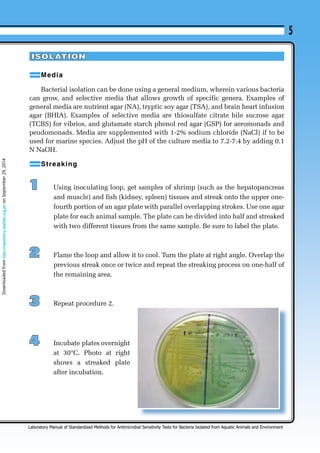
4 Incubate plates overnight 
at 30°C. Photo at right 
shows a streaked plate 
after incubation. 
Laboratory Manual of Standardized Methods for Antimicrobial Sensitivity Tests for Bacteria Isolated from Aquatic Animals and Environment 
Downloaded from http://repository.seafdec.org.ph on September 29, 2014
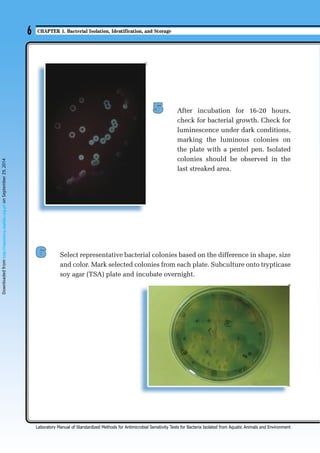
6 CHAPTER 1. Bacterial Isolation, Identification, and Storage 6 5 After incubation for 16-20 hours, 
check for bacterial growth. Check for 
luminescence under dark conditions, 
marking the luminous colonies on 
the plate with a pentel pen. Isolated 
colonies should be observed in the 
last streaked area. 
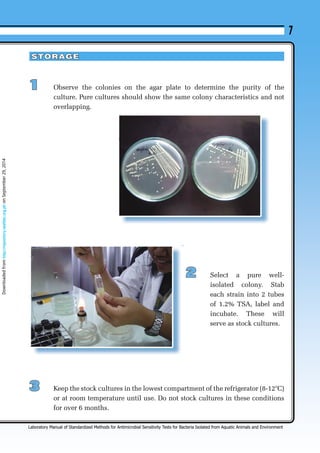
Select representative bacterial colonies based on the difference in shape, size 
and color. Mark selected colonies from each plate. Subculture onto trypticase 
soy agar (TSA) plate and incubate overnight. 
Laboratory Manual of Standardized Methods for Antimicrobial Sensitivity Tests for Bacteria Isolated from Aquatic Animals and Environment 
Downloaded from http://repository.seafdec.org.ph on September 29, 2014
7 
STORAGE 
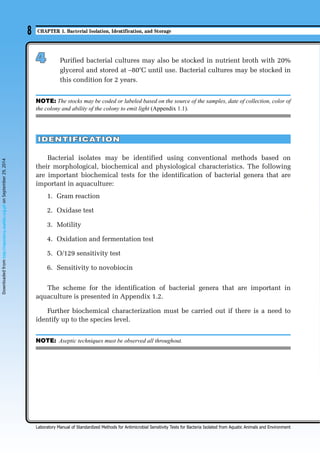
1 Observe the colonies on the agar plate to determine the purity of the 
culture. Pure cultures should show the same colony characteristics and not 
overlapping. 
2 Select a pure well-isolated 
colony. Stab 
each strain into 2 tubes 
of 1.2% TSA, label and 
incubate. These will 
serve as stock cultures. 
3 Keep the stock cultures in the lowest compartment of the refrigerator (8-12°C) 
or at room temperature until use. Do not stock cultures in these conditions 
for over 6 months. 
Laboratory Manual of Standardized Methods for Antimicrobial Sensitivity Tests for Bacteria Isolated from Aquatic Animals and Environment 
Downloaded from http://repository.seafdec.org.ph on September 29, 2014
8 CHAPTER 1. Bacterial Isolation, Identification, and Storage 4 Purified bacterial cultures may also be stocked in nutrient broth with 20% 
glycerol and stored at –80°C until use. Bacterial cultures may be stocked in 
this condition for 2 years. 
NOTE: The stocks may be coded or labeled based on the source of the samples, date of collection, color of 
the colony and ability of the colony to emit light (Appendix 1.1). 
IDENTIFICATION 
Bacterial isolates may be identified using conventional methods based on 
their morphological, biochemical and physiological characteristics. The following 
are important biochemical tests for the identification of bacterial genera that are 
important in aquaculture: 
1. Gram reaction 
2. Oxidase test 
3. Motility 
4. Oxidation and fermentation test 
5. O/129 sensitivity test 
6. Sensitivity to novobiocin 
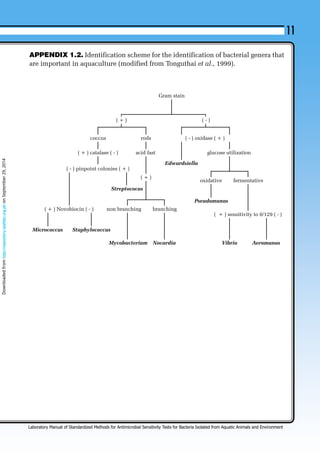
The scheme for the identification of bacterial genera that are important in 
aquaculture is presented in Appendix 1.2. 
Further biochemical characterization must be carried out if there is a need to 
identify up to the species level. 
NOTE: Aseptic techniques must be observed all throughout. 
Laboratory Manual of Standardized Methods for Antimicrobial Sensitivity Tests for Bacteria Isolated from Aquatic Animals and Environment 
Downloaded from http://repository.seafdec.org.ph on September 29, 2014
9 
REFERENCES 
Bailey, W.R. and E.G. Scott. 1966. Diagnostic Microbiology, Second Edition. Toppan 
Company Ltd., Japan, 342 pp. 
Tonguthai, K., S. Chinabut, T. Somsiri, P. Chanratchakol and S. Kanchanakhan. 1999. 
Diagnostic Procedures for Finfish Diseases. Aquatic Animal Health Research 
Institute, Bangkok, Thailand. 
Laboratory Manual of Standardized Methods for Antimicrobial Sensitivity Tests for Bacteria Isolated from Aquatic Animals and Environment 
Downloaded from http://repository.seafdec.org.ph on September 29, 2014
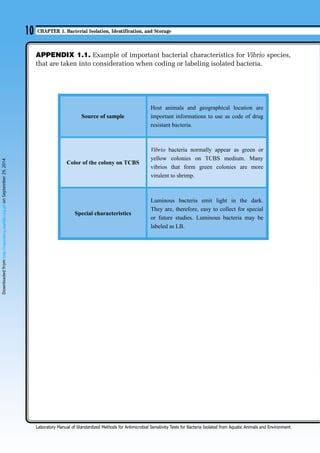
10 CHAPTER 1. Bacterial Isolation, Identification, and Storage APPENDIX 1.1. Example of important bacterial characteristics for Vibrio species, 
that are taken into consideration when coding or labeling isolated bacteria. 
Source of sample 
Host animals and geographical location are 
important informations to use as code of drug 
resistant bacteria. 
Color of the colony on TCBS 
Vibrio bacteria normally appear as green or 
yellow colonies on TCBS medium. Many 
vibrios that form green colonies are more 
virulent to shrimp. 
Special characteristics 
Luminous bacteria emit light in the dark. 
They are, therefore, easy to collect for special 
or future studies. Luminous bacteria may be 
labeled as LB. 
Laboratory Manual of Standardized Methods for Antimicrobial Sensitivity Tests for Bacteria Isolated from Aquatic Animals and Environment 
Downloaded from http://repository.seafdec.org.ph on September 29, 2014
11 
APPENDIX 1.2. Identification scheme for the identification of bacterial genera that 
are important in aquaculture (modified from Tonguthai et al., 1999). 
Gram stain 
( + ) ( - ) 
coccus rods 
( + ) catalase ( - ) 
( - ) pinpoint colonies ( + ) 
acid fast 
( + ) 
Streptococus 
Edwardsiella 
( + ) Novobiocin ( - ) non branching branching 
Micrococcus Staphylococcus 
Mycobacterium Nocardia 
( - ) oxidase ( + ) 
glucose utilization 
oxidative fermentative 
Pseudomanas 
( + ) sensitivity to 0/129 ( - ) 
Vibrio Aeromanas 
Laboratory Manual of Standardized Methods for Antimicrobial Sensitivity Tests for Bacteria Isolated from Aquatic Animals and Environment 
Downloaded from http://repository.seafdec.org.ph on September 29, 2014

Chapter1 bacterial-isolation-identification-and-storage

  • 1.
    Chapter 1. Bacterialisolation, identification and storage. Title Chapter 1. Bacterial isolation, identification and storage. Author(s) Ruangpan, Lila; Tendencia, Eleonor A. Citation Ruangpan, L., & Tendencia, E. A. (2004). Chapter 1. Bacterial isolation, identification and storage. In Laboratory manual of standardized methods for antimicrobial sensitivity tests for bacteria isolated from aquatic animals and environment (pp. 3–11). Tigbauan, Iloilo, Philippines: Southeast Asian Fisheries Development Center, Aquaculture Department. Issue Date 2004 URL http://hdl.handle.net/10862/1616 Downloaded on September 29, 2014 from http://repository.seafdec.org.ph at 7:11 PM CST SEAFDEC/AQD Institutional Repository (SAIR)
  • 2.
    3 CHAPTER I Bacterial Isolation, Identification, and Storage Lila Ruangpan Chanthaburi Coastal Fisheries Research and Development Center Department of Fisheries Ministry of Agriculture and Cooperatives Thailand and Eleonor A. Tendencia Aquaculture Department Southeast Asian Fisheries Development Center Philippines Laboratory Manual of Standardized Methods for Antimicrobial Sensitivity Tests for Bacteria Isolated from Aquatic Animals and Environment Downloaded from http://repository.seafdec.org.ph on September 29, 2014
  • 3.
    4 CHAPTER 1.Bacterial Isolation, Identification, and Storage PRINCIPLE Bacterial isolation, purification and identification are the first steps to bacteriological studies. Isolation is done to obtain pure bacterial cultures. Bacteria are usually isolated from fish kidney and spleen; and from the hepatopancreas, lymphoid organ and muscles of shrimp. These tissues are monitor organs that usually harbor the disease-causing bacteria during infection. To obtain a pure bacterial culture is the first step to bacterial identification. Pure culture is essential in the study of the morphology, physiology, biochemical characteristics, and susceptibility to antimicrobial agents of a particular bacterial strain. Pure cultures are best obtained by using solid media, by streak plate or pour plate method. Streak plate, if properly done, is the most practical method. In the streak plate method, a loopful of the inoculum is placed near the periphery of the plate with agar medium and spread or streaked on the upper portion of the plate with parallel overlapping strokes. The inoculum is streaked over other portions of the plate so that isolated colonies could be observed in the last streaked area. The identification of a bacterial pathogen is important in fish diagnosis. Treatment could be implemented only after the causative agent or the bacterium has been identified. Bacterial species differ in morphological, physiological and biochemical characteristics and those can be used when coding or labelling them (Appendix 1.1). Therefore, identification is accomplished by performing several morphological, physiological and biochemical tests. Results of these tests are compared to established taxa or identification schemes (Appendix 1.2). Bacterial cultures should be preserved for future study. Storing in appropriate medium preserves bacterial cultures. The simplest method is by sub-culturing or by transferring the organism to fresh solid medium that has a minimal nutrient content to prevent bacterial overgrowth. The bacteria are allowed to grow before storing in the refrigerator or are covered with paraffin oil and stored at room temperature in the dark. Another simple method is by deep-freezing of the bacterial culture, stocked in a broth medium with glycerol. Glycerol is added to prevent the dessication of bacterial cells. Bacterial cultures may also be preserved by freeze-drying or lyophilization. In this method, water is removed from the frozen bacterial suspension by sublimation under vacuum. Bacterial cultures should be properly labeled or coded before storage. It is important to label the tube or vial for storing bacterial cultures with an indelible ink. The label or code should include the reference number and other pertinent information such as source of sample (host animal, location), date of isolation, special properties, identification, name of the person who isolated the organism and the date of preparation of the stock culture. Laboratory Manual of Standardized Methods for Antimicrobial Sensitivity Tests for Bacteria Isolated from Aquatic Animals and Environment Downloaded from http://repository.seafdec.org.ph on September 29, 2014
  • 4.
    5 ISOLATION Med i a Bacterial isolation can be done using a general medium, wherein various bacteria can grow, and selective media that allows growth of specific genera. Examples of general media are nutrient agar (NA), tryptic soy agar (TSA), and brain heart infusion agar (BHIA). Examples of selective media are thiosulfate citrate bile sucrose agar (TCBS) for vibrios, and glutamate starch phenol red agar (GSP) for aeromonads and peudomonads. Media are supplemented with 1-2% sodium chloride (NaCl) if to be used for marine species. Adjust the pH of the culture media to 7.2-7.4 by adding 0.1 N NaOH. S t r e a k i n g 1 Using inoculating loop, get samples of shrimp (such as the hepatopancreas and muscle) and fish (kidney, spleen) tissues and streak onto the upper one-fourth portion of an agar plate with parallel overlapping strokes. Use one agar plate for each animal sample. The plate can be divided into half and streaked with two different tissues from the same sample. Be sure to label the plate. 2 Flame the loop and allow it to cool. Turn the plate at right angle. Overlap the previous streak once or twice and repeat the streaking process on one-half of the remaining area. 3 Repeat procedure 2. 4 Incubate plates overnight at 30°C. Photo at right shows a streaked plate after incubation. Laboratory Manual of Standardized Methods for Antimicrobial Sensitivity Tests for Bacteria Isolated from Aquatic Animals and Environment Downloaded from http://repository.seafdec.org.ph on September 29, 2014
  • 5.
    6 CHAPTER 1.Bacterial Isolation, Identification, and Storage 6 5 After incubation for 16-20 hours, check for bacterial growth. Check for luminescence under dark conditions, marking the luminous colonies on the plate with a pentel pen. Isolated colonies should be observed in the last streaked area. Select representative bacterial colonies based on the difference in shape, size and color. Mark selected colonies from each plate. Subculture onto trypticase soy agar (TSA) plate and incubate overnight. Laboratory Manual of Standardized Methods for Antimicrobial Sensitivity Tests for Bacteria Isolated from Aquatic Animals and Environment Downloaded from http://repository.seafdec.org.ph on September 29, 2014
  • 6.
    7 STORAGE 1Observe the colonies on the agar plate to determine the purity of the culture. Pure cultures should show the same colony characteristics and not overlapping. 2 Select a pure well-isolated colony. Stab each strain into 2 tubes of 1.2% TSA, label and incubate. These will serve as stock cultures. 3 Keep the stock cultures in the lowest compartment of the refrigerator (8-12°C) or at room temperature until use. Do not stock cultures in these conditions for over 6 months. Laboratory Manual of Standardized Methods for Antimicrobial Sensitivity Tests for Bacteria Isolated from Aquatic Animals and Environment Downloaded from http://repository.seafdec.org.ph on September 29, 2014
  • 7.
    8 CHAPTER 1.Bacterial Isolation, Identification, and Storage 4 Purified bacterial cultures may also be stocked in nutrient broth with 20% glycerol and stored at –80°C until use. Bacterial cultures may be stocked in this condition for 2 years. NOTE: The stocks may be coded or labeled based on the source of the samples, date of collection, color of the colony and ability of the colony to emit light (Appendix 1.1). IDENTIFICATION Bacterial isolates may be identified using conventional methods based on their morphological, biochemical and physiological characteristics. The following are important biochemical tests for the identification of bacterial genera that are important in aquaculture: 1. Gram reaction 2. Oxidase test 3. Motility 4. Oxidation and fermentation test 5. O/129 sensitivity test 6. Sensitivity to novobiocin The scheme for the identification of bacterial genera that are important in aquaculture is presented in Appendix 1.2. Further biochemical characterization must be carried out if there is a need to identify up to the species level. NOTE: Aseptic techniques must be observed all throughout. Laboratory Manual of Standardized Methods for Antimicrobial Sensitivity Tests for Bacteria Isolated from Aquatic Animals and Environment Downloaded from http://repository.seafdec.org.ph on September 29, 2014
  • 8.
    9 REFERENCES Bailey,W.R. and E.G. Scott. 1966. Diagnostic Microbiology, Second Edition. Toppan Company Ltd., Japan, 342 pp. Tonguthai, K., S. Chinabut, T. Somsiri, P. Chanratchakol and S. Kanchanakhan. 1999. Diagnostic Procedures for Finfish Diseases. Aquatic Animal Health Research Institute, Bangkok, Thailand. Laboratory Manual of Standardized Methods for Antimicrobial Sensitivity Tests for Bacteria Isolated from Aquatic Animals and Environment Downloaded from http://repository.seafdec.org.ph on September 29, 2014
  • 9.
    10 CHAPTER 1.Bacterial Isolation, Identification, and Storage APPENDIX 1.1. Example of important bacterial characteristics for Vibrio species, that are taken into consideration when coding or labeling isolated bacteria. Source of sample Host animals and geographical location are important informations to use as code of drug resistant bacteria. Color of the colony on TCBS Vibrio bacteria normally appear as green or yellow colonies on TCBS medium. Many vibrios that form green colonies are more virulent to shrimp. Special characteristics Luminous bacteria emit light in the dark. They are, therefore, easy to collect for special or future studies. Luminous bacteria may be labeled as LB. Laboratory Manual of Standardized Methods for Antimicrobial Sensitivity Tests for Bacteria Isolated from Aquatic Animals and Environment Downloaded from http://repository.seafdec.org.ph on September 29, 2014
  • 10.
    11 APPENDIX 1.2.Identification scheme for the identification of bacterial genera that are important in aquaculture (modified from Tonguthai et al., 1999). Gram stain ( + ) ( - ) coccus rods ( + ) catalase ( - ) ( - ) pinpoint colonies ( + ) acid fast ( + ) Streptococus Edwardsiella ( + ) Novobiocin ( - ) non branching branching Micrococcus Staphylococcus Mycobacterium Nocardia ( - ) oxidase ( + ) glucose utilization oxidative fermentative Pseudomanas ( + ) sensitivity to 0/129 ( - ) Vibrio Aeromanas Laboratory Manual of Standardized Methods for Antimicrobial Sensitivity Tests for Bacteria Isolated from Aquatic Animals and Environment Downloaded from http://repository.seafdec.org.ph on September 29, 2014