Conventional methods and
sampling of food
Introduction
• Food is the basic need of the human
• Commercialization of food
• Spoilage and outbreaks
• Emergence of food safety and bio-security
• Microbial analysis and food analysis
Methods used
• Microbial evaluation of food and food ingredients and environments
• Broadly grouped into Quantitative and Qualitative methods
• Quantitative methods – growth condition
• Qualitative methods – for identification
Standard and Recommended methods
• Various regulatory agencies approved different methods- standard
and recommended method
• Some of the publications in the United States that are approved by
the regulatory agencies are Standard Methods for the Examination of Dairy
Products, Standard Methods for the Examination of Water and Waste Water, Standard
Methods for the Examination of Seawater and Shellfish, Compendium of Methods for the
Microbiological Examination of Food (all four are published by the American Public Health
Association, Washington, D.C.)
• Bacteriological Analytical Manual of Food and Drug Administration (prepared by the FDA
and published by the Association of Official Analytical Chemists, Arlington, VA)
Sampling for microbial analysis
• Sample
• Microbiological quality of a batch or a lot of a food
• Type of food and sample size
• True representative
• Sampling plans
• Single attribute plan: Sample is collected once and tested for bacteria
of interest. The results are used for acceptance or rejection of batch,
where n is sample size or number of sample, which dependents on
the batch or lot size (N). Defective unit(s) (C) of n is dependent on the
microbial type
• Multiple attributes plan: Initially based on the N the number of
samples (n1) are tested. If the C1 is above the standard level, a second
sampling is taken (n2) analyzed for C2 for decision
• Three- class attribute plan: Microbial levels are divided into three
groups: ≤ m is acceptable;
• > m but ≤ M is marginal;
• and > M is unacceptable. Number of units (C1) allowed between > m
and ≤ M among a number of samples tested (n) is defined for a
microbial type
• Plan for low level of contamination: This is important for some highly
potent pathogens.
• Units, depending upon the lot size, are tested to determine the
presence or absence of a pathogen in the unit to make a decision for
acceptance or rejection of a lot.
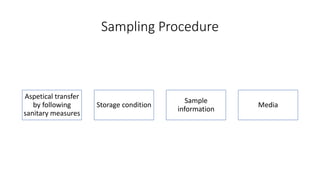
Sampling Procedure
Aspetical transfer
by following
sanitary measures
Storage condition
Sample
information
Media
Quantitative methods for Microbial
Enumeration in Foods
• Direct Enumeration
• Microscopic counts: Stained cells under bright field or live cells under
a phase contrast microbes can be enumerated using appropriate
microscopic factor, these counts- per gm or ml.
• Viable and non-viable cells
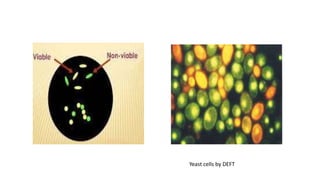
• Direct Epifluorescent filter technique (DEFT) is prefer for viable and
non viable
• Uses Acridine orange dye
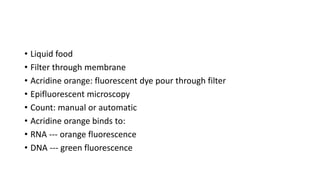
• Liquid food
• Filter through membrane
• Acridine orange: fluorescent dye pour through filter
• Epifluorescent microscopy
• Count: manual or automatic
• Acridine orange binds to:
• RNA --- orange fluorescence
• DNA --- green fluorescence
Yeast cells by DEFT
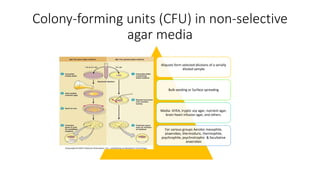
Colony-forming units (CFU) in non-selective
agar media
Aliquots form selected dilutions of a serially
diluted sample
Bulk seeding or Surface spreading
Media- GYEA, tryptic soy agar, nutrient agar,
brain-heart infusion agar, and others.
For various groups Aerobic mesophile,
anaerobes, thermoduric, thermophile,
psychrophile, psychrotrophic & facultative
anaerobes
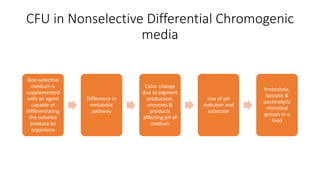
CFU in Nonselective Differential Chromogenic
media
Non-selective
medium is
supplemented
with an agent
capable of
differentiating
the colonies
produce by
organisms
Difference in
metabolic
pathway
Color change
due to pigment
production,
enzymes &
products
affecting pH of
medium
Use of pH
indicator and
substrate
Proteolytic,
lipolytic &
pectinolytic
microbial
groups in a
food
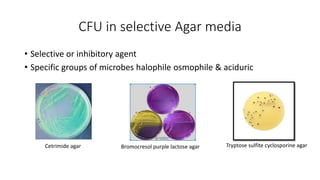
CFU in selective Agar media
• Selective or inhibitory agent
• Specific groups of microbes halophile osmophile & aciduric
Cetrimide agar Bromocresol purple lactose agar Tryptose sulfite cyclosporine agar
CFU in Selective-Differential Chromogenic
Agar Media
Media supplemented with
one or more selective
agents to allow selective
growth of specific resistant
microbes
Example; MacConkey agar,
Baired-Parker agar or V-J
agar, KF azide agar, & XLD
agar
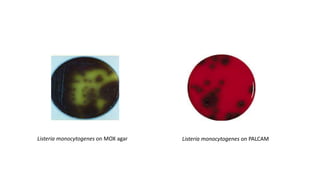
Listeria monocytogenes on PALCAM
Listeria monocytogenes on MOX agar
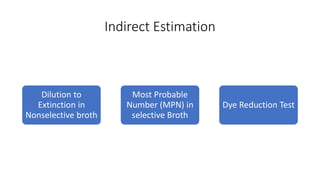
Indirect Estimation
Dilution to
Extinction in
Nonselective broth
Most Probable
Number (MPN) in
selective Broth
Dye Reduction Test
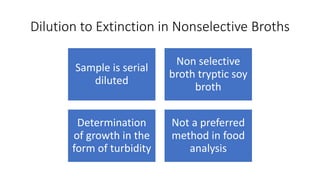
Dilution to Extinction in Nonselective Broths
Sample is serial
diluted
Non selective
broth tryptic soy
broth
Determination
of growth in the
form of turbidity
Not a preferred
method in food
analysis
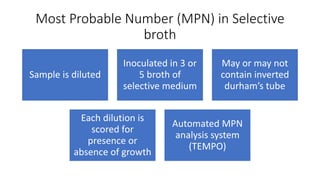
Most Probable Number (MPN) in Selective
broth
Sample is diluted
Inoculated in 3 or
5 broth of
selective medium
May or may not
contain inverted
durham’s tube
Each dilution is
scored for
presence or
absence of growth
Automated MPN
analysis system
(TEMPO)
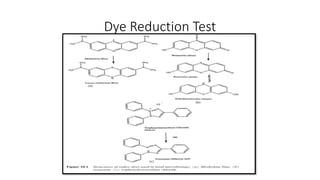
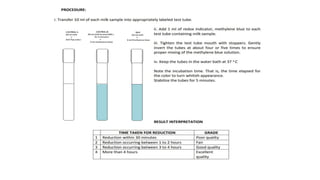
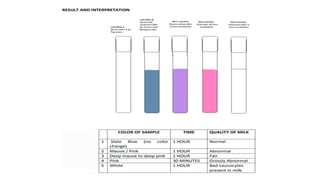
Dye Reduction Test
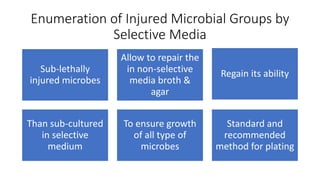
Enumeration of Injured Microbial Groups by
Selective Media
Sub-lethally
injured microbes
Allow to repair the
in non-selective
media broth &
agar
Regain its ability
Than sub-cultured
in selective
medium
To ensure growth
of all type of
microbes
Standard and
recommended
method for plating
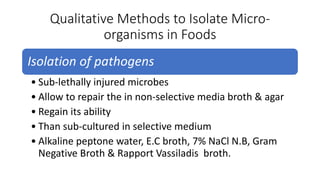
Qualitative Methods to Isolate Micro-
organisms in Foods
Isolation of pathogens
• Sub-lethally injured microbes
• Allow to repair the in non-selective media broth & agar
• Regain its ability
• Than sub-cultured in selective medium
• Alkaline peptone water, E.C broth, 7% NaCl N.B, Gram
Negative Broth & Rapport Vassiladis broth.
Test for Bacterial Toxins in Foods
• Bacteria and fungi such as Vibrio parahemolyticus, Staphylococcus
aureus, Clostridium botulinum, Bacillus cereus & molds produces
toxins
• In order to determine toxin concentration of toxin
• Detection is done by microslide precipitation method
• Radioimmunoassay (RIA), ELISA, & reverse passive latex agglutination
assay.
• Animal models
Rapid methods and automation
• Rapid
• Specific
• Sensitive and relatively accurate
• Less labor intensive
Metabolic Fingerprinting
• Each species of bacterium, mold, or yeast has unique C or N re

Conventional methods and sampling of food.pptx

  • 1.
  • 2.
    Introduction • Food isthe basic need of the human • Commercialization of food • Spoilage and outbreaks • Emergence of food safety and bio-security • Microbial analysis and food analysis
  • 3.
    Methods used • Microbialevaluation of food and food ingredients and environments • Broadly grouped into Quantitative and Qualitative methods • Quantitative methods – growth condition • Qualitative methods – for identification
  • 4.
    Standard and Recommendedmethods • Various regulatory agencies approved different methods- standard and recommended method • Some of the publications in the United States that are approved by the regulatory agencies are Standard Methods for the Examination of Dairy Products, Standard Methods for the Examination of Water and Waste Water, Standard Methods for the Examination of Seawater and Shellfish, Compendium of Methods for the Microbiological Examination of Food (all four are published by the American Public Health Association, Washington, D.C.) • Bacteriological Analytical Manual of Food and Drug Administration (prepared by the FDA and published by the Association of Official Analytical Chemists, Arlington, VA)
  • 5.
    Sampling for microbialanalysis • Sample • Microbiological quality of a batch or a lot of a food • Type of food and sample size • True representative • Sampling plans • Single attribute plan: Sample is collected once and tested for bacteria of interest. The results are used for acceptance or rejection of batch, where n is sample size or number of sample, which dependents on the batch or lot size (N). Defective unit(s) (C) of n is dependent on the microbial type
  • 6.
    • Multiple attributesplan: Initially based on the N the number of samples (n1) are tested. If the C1 is above the standard level, a second sampling is taken (n2) analyzed for C2 for decision • Three- class attribute plan: Microbial levels are divided into three groups: ≤ m is acceptable; • > m but ≤ M is marginal; • and > M is unacceptable. Number of units (C1) allowed between > m and ≤ M among a number of samples tested (n) is defined for a microbial type
  • 7.
    • Plan forlow level of contamination: This is important for some highly potent pathogens. • Units, depending upon the lot size, are tested to determine the presence or absence of a pathogen in the unit to make a decision for acceptance or rejection of a lot.
  • 8.
    Sampling Procedure Aspetical transfer byfollowing sanitary measures Storage condition Sample information Media
  • 9.
    Quantitative methods forMicrobial Enumeration in Foods • Direct Enumeration • Microscopic counts: Stained cells under bright field or live cells under a phase contrast microbes can be enumerated using appropriate microscopic factor, these counts- per gm or ml. • Viable and non-viable cells • Direct Epifluorescent filter technique (DEFT) is prefer for viable and non viable • Uses Acridine orange dye
  • 10.
    • Liquid food •Filter through membrane • Acridine orange: fluorescent dye pour through filter • Epifluorescent microscopy • Count: manual or automatic • Acridine orange binds to: • RNA --- orange fluorescence • DNA --- green fluorescence
  • 11.
  • 12.
    Colony-forming units (CFU)in non-selective agar media Aliquots form selected dilutions of a serially diluted sample Bulk seeding or Surface spreading Media- GYEA, tryptic soy agar, nutrient agar, brain-heart infusion agar, and others. For various groups Aerobic mesophile, anaerobes, thermoduric, thermophile, psychrophile, psychrotrophic & facultative anaerobes
  • 13.
    CFU in NonselectiveDifferential Chromogenic media Non-selective medium is supplemented with an agent capable of differentiating the colonies produce by organisms Difference in metabolic pathway Color change due to pigment production, enzymes & products affecting pH of medium Use of pH indicator and substrate Proteolytic, lipolytic & pectinolytic microbial groups in a food
  • 14.
    CFU in selectiveAgar media • Selective or inhibitory agent • Specific groups of microbes halophile osmophile & aciduric Cetrimide agar Bromocresol purple lactose agar Tryptose sulfite cyclosporine agar
  • 15.
    CFU in Selective-DifferentialChromogenic Agar Media Media supplemented with one or more selective agents to allow selective growth of specific resistant microbes Example; MacConkey agar, Baired-Parker agar or V-J agar, KF azide agar, & XLD agar
  • 17.
    Listeria monocytogenes onPALCAM Listeria monocytogenes on MOX agar
  • 18.
    Indirect Estimation Dilution to Extinctionin Nonselective broth Most Probable Number (MPN) in selective Broth Dye Reduction Test
  • 19.
    Dilution to Extinctionin Nonselective Broths Sample is serial diluted Non selective broth tryptic soy broth Determination of growth in the form of turbidity Not a preferred method in food analysis
  • 20.
    Most Probable Number(MPN) in Selective broth Sample is diluted Inoculated in 3 or 5 broth of selective medium May or may not contain inverted durham’s tube Each dilution is scored for presence or absence of growth Automated MPN analysis system (TEMPO)
  • 21.
  • 24.
    Enumeration of InjuredMicrobial Groups by Selective Media Sub-lethally injured microbes Allow to repair the in non-selective media broth & agar Regain its ability Than sub-cultured in selective medium To ensure growth of all type of microbes Standard and recommended method for plating
  • 25.
    Qualitative Methods toIsolate Micro- organisms in Foods Isolation of pathogens • Sub-lethally injured microbes • Allow to repair the in non-selective media broth & agar • Regain its ability • Than sub-cultured in selective medium • Alkaline peptone water, E.C broth, 7% NaCl N.B, Gram Negative Broth & Rapport Vassiladis broth.
  • 26.
    Test for BacterialToxins in Foods • Bacteria and fungi such as Vibrio parahemolyticus, Staphylococcus aureus, Clostridium botulinum, Bacillus cereus & molds produces toxins • In order to determine toxin concentration of toxin • Detection is done by microslide precipitation method • Radioimmunoassay (RIA), ELISA, & reverse passive latex agglutination assay. • Animal models
  • 27.
    Rapid methods andautomation • Rapid • Specific • Sensitive and relatively accurate • Less labor intensive
  • 28.
    Metabolic Fingerprinting • Eachspecies of bacterium, mold, or yeast has unique C or N re