DOUBLE IMMUNODIFFUSION
TECHNIQUE
PRACHEE RAJPUT
SYNOPSIS
 Introduction
 Historical Background
 Types of Immunodiffusion
 Principle
 Ouchterlony Double Diffusion
 Required Material
 Methodology
 Interpretation
 Zonal reaction
 Application
 Example the test
 Recent research
 References
INTRODUCTION
.
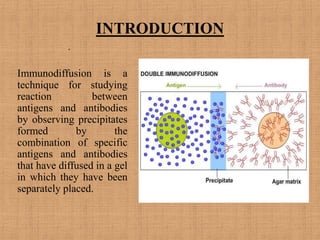
Immunodiffusion is a
technique for studying
reaction between
antigens and antibodies
by observing precipitates
formed by the
combination of specific
antigens and antibodies
that have diffused in a gel
in which they have been
separately placed.
HISTORICAL BACKGROUND
 It was firstly developed by Dr MORRIS GOODMAN.
 In 1948, Ouchterlony double diffusion technique was
firstly developed by Dr ORJAN OUCHTERLONY.
TYPES OF IMMUNODIFFUSION
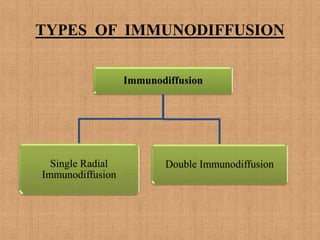
Immunodiffusion
Single Radial
Immunodiffusion
Double Immunodiffusion
OUCHTERLONY DOUBLE
DIFFUSION TECNIQUE
 It is used extensively to check anti-sera for the presence and
specificity of antibodies for a particular antigen.
 Antibodies and Ag form lattice structures that will develop into
visible precipitate.
 Formation of Ab-Ag lattice depends on,
• Ab must be bivalent.
• Ag must be bivalent or polyvalent.
PRINCIPLE
 In ouchterlony double diffusion, both antigen and antibody
allowed to diffuse in to the gel. This assay is frequently used
for comparing different antigen preparations. the method is
called double since the antigen and antibody are allowed to
migrate towards each other in a gel and a line of precipitation
is formed where the two reactants are meet. This precipitation
is highly specific and is used by people working with
diagnosis and protein detection technique.
Cont…
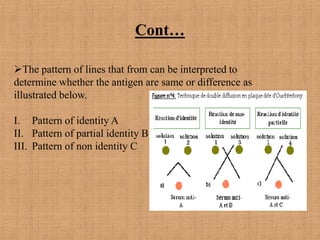
The pattern of lines that from can be interpreted to
determine whether the antigen are same or difference as
illustrated below.
I. Pattern of identity A
II. Pattern of partial identity B
III. Pattern of non identity C
REQUIRED MATERIAL
 Chemicals :- Agarose, Assay Buffer(PBS) ,anti-serum, test
antigens, (ph 7.2),0.05% Sodium azide.
 Equipments:- incubator (37°C), micro pipette, tips, weighing
balance, Gel punch with syringe.
 Glassware's:- Glass plate, Template, conical flask measuring
cylinder.
 Reagents :- alcohol, distill water.
METHODOLOGY
Prepare 25 ml of 1.2 % agarose (0.3g/25ml) in assay buffer by
boiling to dissolve the agarose completely.
Cool the solution 55 to 60°C pour 4ml/plate on to 5 grase free
glass plates placed on a horizontal surface, allow get to set for
30 minutes.
Punch wells by keeping the glass plate on the template.
Fill the lower well 10 micro liter of anti-serum and the upper
Two wells with 10 ml of each antigen.
Keep the glass plate in a moist chamber over night at 37°C.
After incubation, observe for opaque precipitin lines between the
Antigen and anti-sera wells.
INTERPRETATION
 If a pattern A or pattern of identity is observed between the
antigen and the anti-serum it indicates the antigens are
immunologically identical.
 If a pattern B, it indicates that the antigen are partially similar
or cross reaction.
 If a pattern C, it indicates that there is no cross reaction
between the antigen i.e. the two antigen are immunological
unrelated.
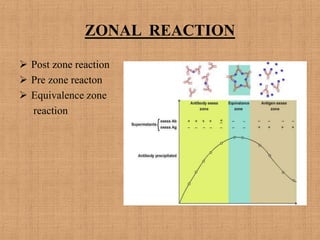
ZONAL REACTION
 Post zone reaction
 Pre zone reacton
 Equivalence zone
reaction
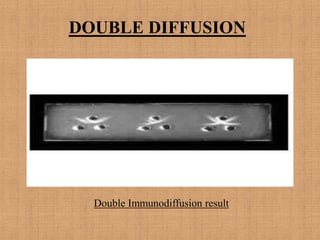
DOUBLE DIFFUSION
Double Immunodiffusion result
EXAMPLES
 Home Pregnancy Test
 It is a modification of an agglutination experiment.
 It is called agglutination inhibition.
 It is good because, it is sensitive to small amounts of Ag.
APPLICATIONS
 Identification of Fungal antigen. Example- coccidiomycosis,
Histoplasma.
 It is used for measuring hormones serum proteins, drugs.
 This test is commonly used in the clinical laboratory for the
determination of Immunoglobulin levels in patient sample.
RECENT RESEARCH
 Gomes S.F., Silva-Da-Marques H.S.
 19 March 2012.
Effect of Pretreating serum samples on the Performance of a
Latex agglutination test for Serodiognosis of
Paracoccidioidomycosis.
Institute of Science Biologic and Evandro Chagas, Federal
University of Para, Belem, Brazil.
REFERENCES
 Baveja .C.P.,2007,Antigen-Antibody Reaction :In Text Book of
Microbiology,2nd Edition Arya Publishing Company, pp:44-46.
Chirikjan.G.J., 1995,Anttibody Interactions With Antigens: In Plant
Biotechnology Animal Cell Culture Immunology, Vol.1 Jones and
Baraet Publishers,pp: 80-95.
Hay,C.F, Westwood, M.R,2002,Precipitation Reactions: In Practical
Immunology, Black Well Publishing Compony,pp:92-95.
,
Wilson, K, Walker, M.J, 1994,Electrophoresis Technique: In
Principle and Technique of Biochemistry,7th Edition, Cambridge
University Press, pp:390-395.
CONT....
http://www.nhc.ed.ac.uk.(12/10/2012)
http://www.btprotocolsmaulikblogspot.com.(10/10/2012)
http://www.amrita.vlab.com.in(10/10/2012)
 http://www.sbs.utexas.edu/sanders/Bio347/Lectures/htm.(8/10/2012)
http://www.ncbi.nlm.nih.gov.(12/10/2012)
Double immunodiffusion technique

Double immunodiffusion technique

  • 1.
  • 2.
    SYNOPSIS  Introduction  HistoricalBackground  Types of Immunodiffusion  Principle  Ouchterlony Double Diffusion  Required Material  Methodology  Interpretation  Zonal reaction  Application  Example the test  Recent research  References
  • 3.
    INTRODUCTION . Immunodiffusion is a techniquefor studying reaction between antigens and antibodies by observing precipitates formed by the combination of specific antigens and antibodies that have diffused in a gel in which they have been separately placed.
  • 4.
    HISTORICAL BACKGROUND  Itwas firstly developed by Dr MORRIS GOODMAN.  In 1948, Ouchterlony double diffusion technique was firstly developed by Dr ORJAN OUCHTERLONY.
  • 5.
    TYPES OF IMMUNODIFFUSION Immunodiffusion SingleRadial Immunodiffusion Double Immunodiffusion
  • 6.
    OUCHTERLONY DOUBLE DIFFUSION TECNIQUE It is used extensively to check anti-sera for the presence and specificity of antibodies for a particular antigen.  Antibodies and Ag form lattice structures that will develop into visible precipitate.  Formation of Ab-Ag lattice depends on, • Ab must be bivalent. • Ag must be bivalent or polyvalent.
  • 7.
    PRINCIPLE  In ouchterlonydouble diffusion, both antigen and antibody allowed to diffuse in to the gel. This assay is frequently used for comparing different antigen preparations. the method is called double since the antigen and antibody are allowed to migrate towards each other in a gel and a line of precipitation is formed where the two reactants are meet. This precipitation is highly specific and is used by people working with diagnosis and protein detection technique.
  • 8.
    Cont… The pattern oflines that from can be interpreted to determine whether the antigen are same or difference as illustrated below. I. Pattern of identity A II. Pattern of partial identity B III. Pattern of non identity C
  • 9.
    REQUIRED MATERIAL  Chemicals:- Agarose, Assay Buffer(PBS) ,anti-serum, test antigens, (ph 7.2),0.05% Sodium azide.  Equipments:- incubator (37°C), micro pipette, tips, weighing balance, Gel punch with syringe.  Glassware's:- Glass plate, Template, conical flask measuring cylinder.  Reagents :- alcohol, distill water.
  • 10.
    METHODOLOGY Prepare 25 mlof 1.2 % agarose (0.3g/25ml) in assay buffer by boiling to dissolve the agarose completely. Cool the solution 55 to 60°C pour 4ml/plate on to 5 grase free glass plates placed on a horizontal surface, allow get to set for 30 minutes. Punch wells by keeping the glass plate on the template.
  • 11.
    Fill the lowerwell 10 micro liter of anti-serum and the upper Two wells with 10 ml of each antigen. Keep the glass plate in a moist chamber over night at 37°C. After incubation, observe for opaque precipitin lines between the Antigen and anti-sera wells.
  • 12.
    INTERPRETATION  If apattern A or pattern of identity is observed between the antigen and the anti-serum it indicates the antigens are immunologically identical.  If a pattern B, it indicates that the antigen are partially similar or cross reaction.  If a pattern C, it indicates that there is no cross reaction between the antigen i.e. the two antigen are immunological unrelated.
  • 13.
    ZONAL REACTION  Postzone reaction  Pre zone reacton  Equivalence zone reaction
  • 14.
  • 15.
    EXAMPLES  Home PregnancyTest  It is a modification of an agglutination experiment.  It is called agglutination inhibition.  It is good because, it is sensitive to small amounts of Ag.
  • 17.
    APPLICATIONS  Identification ofFungal antigen. Example- coccidiomycosis, Histoplasma.  It is used for measuring hormones serum proteins, drugs.  This test is commonly used in the clinical laboratory for the determination of Immunoglobulin levels in patient sample.
  • 18.
    RECENT RESEARCH  GomesS.F., Silva-Da-Marques H.S.  19 March 2012. Effect of Pretreating serum samples on the Performance of a Latex agglutination test for Serodiognosis of Paracoccidioidomycosis. Institute of Science Biologic and Evandro Chagas, Federal University of Para, Belem, Brazil.
  • 19.
    REFERENCES  Baveja .C.P.,2007,Antigen-AntibodyReaction :In Text Book of Microbiology,2nd Edition Arya Publishing Company, pp:44-46. Chirikjan.G.J., 1995,Anttibody Interactions With Antigens: In Plant Biotechnology Animal Cell Culture Immunology, Vol.1 Jones and Baraet Publishers,pp: 80-95. Hay,C.F, Westwood, M.R,2002,Precipitation Reactions: In Practical Immunology, Black Well Publishing Compony,pp:92-95. , Wilson, K, Walker, M.J, 1994,Electrophoresis Technique: In Principle and Technique of Biochemistry,7th Edition, Cambridge University Press, pp:390-395.
  • 20.