Submitted By :-
Ayush Vikram Singh
SL/14/4413
Ujjwal Singh
SL/14/4414
GFT
A microbiological culture, or microbial culture, is a method of
multiplying microbial organisms by letting them reproduce in
predetermined culture media under controlled laboratory conditions.
Microbial cultures are used to determine the type of organism, its
abundance in the sample being tested, or both. It is one of the
primary diagnostic methods of microbiology and used as a tool to
determine the cause of infectious disease by letting the agent multiply in a
predetermined medium.
Microbial cultures are foundational and basic diagnostic methods used
extensively as a research tool in molecular biology. It is often essential to
isolate a pure culture of microorganisms. A pure (or axenic) culture is a
population of cells or multicellular organisms growing in the absence of
other species or types. A pure culture may originate from a single cell or
single organism, in which case the cells are genetic clones of one another.
Introduce bacteria into a growth medium using “aseptic technique” to
prevent contamination. Tools: Bunsen burner, loop. Needle, etc.
In working with microorganisms, we must have a method of transferring
growing organisms from a pure culture to a sterile medium without introducing
any unwanted outside contaminants.
 This method of preventing unwanted microorganisms from gaining access is
termed aseptic technique.
For the most part, bacterial physiology only can be studied in pure cultures.
The best way to obtain a pure culture is to start with a single bacterial cell.
This cell then divides quickly, and may produce millions of cells within 24 hours.
A single unwanted contaminant cell can do the same thing in an otherwise pure
culture, making the culture useless.
 The most commonly used device for moving bacteria is the inoculating loop.
This is simply a piece of nichrome (an alloy of nickel and chromium) or platinum
wire with a loop at one end and a handle at the other.
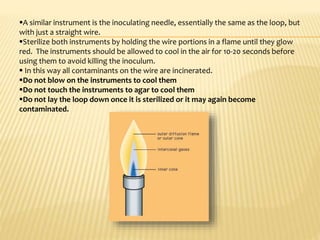
A similar instrument is the inoculating needle, essentially the same as the loop, but
with just a straight wire.
Sterilize both instruments by holding the wire portions in a flame until they glow
red. The instruments should be allowed to cool in the air for 10-20 seconds before
using them to avoid killing the inoculum.
 In this way all contaminants on the wire are incinerated.
Do not blow on the instruments to cool them
Do not touch the instruments to agar to cool them
Do not lay the loop down once it is sterilized or it may again become
contaminated.
1. Flame the loop.
2. Without setting the loop down, open the first culture
tube and flame the mouth. Do not set the cap on the
bench. The cap should be held in the same hand as the
loop.
3. Insert the loop into the culture medium, then withdraw it.
4. Flame the mouth of the first culture tube again, and
replace the cap.
Attempts to identify bacteria in a clinical sample cannot be done unless
isolated colonies are used.
To obtain well-isolated colonies, it is essential to disperse the inoculum
(sample) on the surface of an enriched agar plate so that individual bacteria
are well separated from each other.
Contaminants = other microorganisms present in the sample
Isolated colois= a population of millions of cells that are identical and are
descendent from a single founder cell
Stock Culture = a culture that already contains cells.
 It is used a source of cells from which to inoculate new cultures.
culture medium: rich/selective
growth inhibitors
liquid/solid
 temperature
source of energy
sources of carbon, nitrogen, ...
Aseptic technique:
 sterilization of medium and equipment
 proper handling
Indications for culture -
Isolate bacteria in pure cultures.
Demonstrate their properties.
Obtain sufficient growth for preparation of
antigens & for other tests.
Typing bacterial isolates.
Antibiotic sensitivity.
Estimate viable counts.
Maintain stock cultures.
STREAK PLATE TECHNIQUE
POUR PLATE TECHNIQUE
SPREAD PLATE TECHNIQUE
1. With the loop, spread the inoculum back and forth across the
upper 1/4 of the plate, keeping the lines of inoculation very close
together (area 1 in figure).
2. Isolated colonies are not expected in this area. Do not use strong
pressure, which will break the surface of the agar. Use the end of
the loop, not its side when streaking. Dispose of the loop in the
biohazard bucket on the bench.
3. Turn plate approximately 900. Streak the plate as indicated in the
figure (area 2) across about 1/4 of the plate. Dispose of the loop.
4. Repeat step 2 one or two times more.
5. In area 3 and/or 4 single colonies should appear.
6. Label plates on the bottom and incubate inverted at 370C
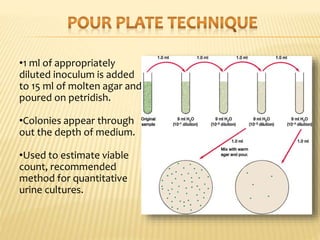
•1 ml of appropriately
diluted inoculum is added
to 15 ml of molten agar and
poured on petridish.
•Colonies appear through
out the depth of medium.
•Used to estimate viable
count, recommended
method for quantitative
urine cultures.
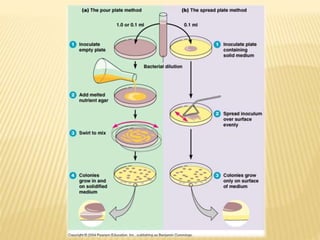
•Prepare LAF bench with required material.
•Dilute the sample and shake gently to suspend organisms.
•Insert the loop into the test tube and remove loop full of
broth with bacterial culture using aseptic techniques.
•Put the loop full of culture on the sterile agar plate.
•Spread the culture with L- shaped glass on the surface of
agar by rotating the Petri-Plate and L-shaped glass both.
•Keep the lid over the plate as much as possible.
•Incubate to develop the culture.
Pure culture techniques

Pure culture techniques

  • 1.
    Submitted By :- AyushVikram Singh SL/14/4413 Ujjwal Singh SL/14/4414 GFT
  • 3.
    A microbiological culture,or microbial culture, is a method of multiplying microbial organisms by letting them reproduce in predetermined culture media under controlled laboratory conditions. Microbial cultures are used to determine the type of organism, its abundance in the sample being tested, or both. It is one of the primary diagnostic methods of microbiology and used as a tool to determine the cause of infectious disease by letting the agent multiply in a predetermined medium. Microbial cultures are foundational and basic diagnostic methods used extensively as a research tool in molecular biology. It is often essential to isolate a pure culture of microorganisms. A pure (or axenic) culture is a population of cells or multicellular organisms growing in the absence of other species or types. A pure culture may originate from a single cell or single organism, in which case the cells are genetic clones of one another.
  • 4.
    Introduce bacteria intoa growth medium using “aseptic technique” to prevent contamination. Tools: Bunsen burner, loop. Needle, etc.
  • 6.
    In working withmicroorganisms, we must have a method of transferring growing organisms from a pure culture to a sterile medium without introducing any unwanted outside contaminants.  This method of preventing unwanted microorganisms from gaining access is termed aseptic technique. For the most part, bacterial physiology only can be studied in pure cultures. The best way to obtain a pure culture is to start with a single bacterial cell. This cell then divides quickly, and may produce millions of cells within 24 hours. A single unwanted contaminant cell can do the same thing in an otherwise pure culture, making the culture useless.  The most commonly used device for moving bacteria is the inoculating loop. This is simply a piece of nichrome (an alloy of nickel and chromium) or platinum wire with a loop at one end and a handle at the other.
  • 7.
    A similar instrumentis the inoculating needle, essentially the same as the loop, but with just a straight wire. Sterilize both instruments by holding the wire portions in a flame until they glow red. The instruments should be allowed to cool in the air for 10-20 seconds before using them to avoid killing the inoculum.  In this way all contaminants on the wire are incinerated. Do not blow on the instruments to cool them Do not touch the instruments to agar to cool them Do not lay the loop down once it is sterilized or it may again become contaminated.
  • 8.
    1. Flame theloop. 2. Without setting the loop down, open the first culture tube and flame the mouth. Do not set the cap on the bench. The cap should be held in the same hand as the loop. 3. Insert the loop into the culture medium, then withdraw it. 4. Flame the mouth of the first culture tube again, and replace the cap.
  • 9.
    Attempts to identifybacteria in a clinical sample cannot be done unless isolated colonies are used. To obtain well-isolated colonies, it is essential to disperse the inoculum (sample) on the surface of an enriched agar plate so that individual bacteria are well separated from each other. Contaminants = other microorganisms present in the sample Isolated colois= a population of millions of cells that are identical and are descendent from a single founder cell Stock Culture = a culture that already contains cells.  It is used a source of cells from which to inoculate new cultures. culture medium: rich/selective growth inhibitors liquid/solid  temperature source of energy sources of carbon, nitrogen, ... Aseptic technique:  sterilization of medium and equipment  proper handling
  • 10.
    Indications for culture- Isolate bacteria in pure cultures. Demonstrate their properties. Obtain sufficient growth for preparation of antigens & for other tests. Typing bacterial isolates. Antibiotic sensitivity. Estimate viable counts. Maintain stock cultures.
  • 11.
    STREAK PLATE TECHNIQUE POURPLATE TECHNIQUE SPREAD PLATE TECHNIQUE
  • 12.
    1. With theloop, spread the inoculum back and forth across the upper 1/4 of the plate, keeping the lines of inoculation very close together (area 1 in figure). 2. Isolated colonies are not expected in this area. Do not use strong pressure, which will break the surface of the agar. Use the end of the loop, not its side when streaking. Dispose of the loop in the biohazard bucket on the bench. 3. Turn plate approximately 900. Streak the plate as indicated in the figure (area 2) across about 1/4 of the plate. Dispose of the loop. 4. Repeat step 2 one or two times more. 5. In area 3 and/or 4 single colonies should appear. 6. Label plates on the bottom and incubate inverted at 370C
  • 14.
    •1 ml ofappropriately diluted inoculum is added to 15 ml of molten agar and poured on petridish. •Colonies appear through out the depth of medium. •Used to estimate viable count, recommended method for quantitative urine cultures.
  • 15.
    •Prepare LAF benchwith required material. •Dilute the sample and shake gently to suspend organisms. •Insert the loop into the test tube and remove loop full of broth with bacterial culture using aseptic techniques. •Put the loop full of culture on the sterile agar plate. •Spread the culture with L- shaped glass on the surface of agar by rotating the Petri-Plate and L-shaped glass both. •Keep the lid over the plate as much as possible. •Incubate to develop the culture.