Chapter 1Chapter 1
IntroductionIntroduction
Dr. Naimhapter 1, Slide 2
Learning ObjectivesLearning Objectives
 Why process signals digitally?Why process signals digitally?
 Definition of a real-time application.Definition of a real-time application.
 Why useWhy use DDigitaligital SSignalignal PProcessingrocessing
processors?processors?
 What are the typicalWhat are the typical DSPDSP algorithms?algorithms?
 Parameters to consider when choosing aParameters to consider when choosing a
DSP processor.DSP processor.
 Programmable vs ASIC DSP.Programmable vs ASIC DSP.
 Texas Instruments’ TMS320 family.Texas Instruments’ TMS320 family.
Dr. Naimhapter 1, Slide 3
Why go digital?Why go digital?
 Digital signal processing techniques areDigital signal processing techniques are
now so powerful that sometimes it isnow so powerful that sometimes it is
extremely difficult, if not impossible, forextremely difficult, if not impossible, for
analogue signal processing to achieveanalogue signal processing to achieve
similar performance.similar performance.
 Examples:Examples:
 FIR filter with linear phase.FIR filter with linear phase.
 Adaptive filters.Adaptive filters.
Dr. Naimhapter 1, Slide 4
Why go digital?Why go digital?
 Analogue signal processing is achievedAnalogue signal processing is achieved
by using analogue components such as:by using analogue components such as:
 Resistors.Resistors.
 Capacitors.Capacitors.
 Inductors.Inductors.
 The inherent tolerances associated withThe inherent tolerances associated with
these components, temperature, voltagethese components, temperature, voltage
changes and mechanical vibrations canchanges and mechanical vibrations can
dramatically affect the effectiveness ofdramatically affect the effectiveness of
the analogue circuitry.the analogue circuitry.
Dr. Naimhapter 1, Slide 5
Why go digital?Why go digital?
 With DSP it is easy to:With DSP it is easy to:
 Change applications.Change applications.
 Correct applications.Correct applications.
 Update applications.Update applications.
 Additionally DSP reduces:Additionally DSP reduces:
 Noise susceptibility.Noise susceptibility.
 Chip count.Chip count.
 Development time.Development time.
 Cost.Cost.
 Power consumption.Power consumption.
Dr. Naimhapter 1, Slide 6
Why NOT go digital?Why NOT go digital?
 High frequency signals cannot beHigh frequency signals cannot be
processed digitally because of twoprocessed digitally because of two
reasons:reasons:
 AAnalog tonalog to DDigitaligital CConverters,onverters, ADCADC cannotcannot
work fast enough.work fast enough.
 The application can be too complex to beThe application can be too complex to be
performed inperformed in real-time.
Dr. Naimhapter 1, Slide 7
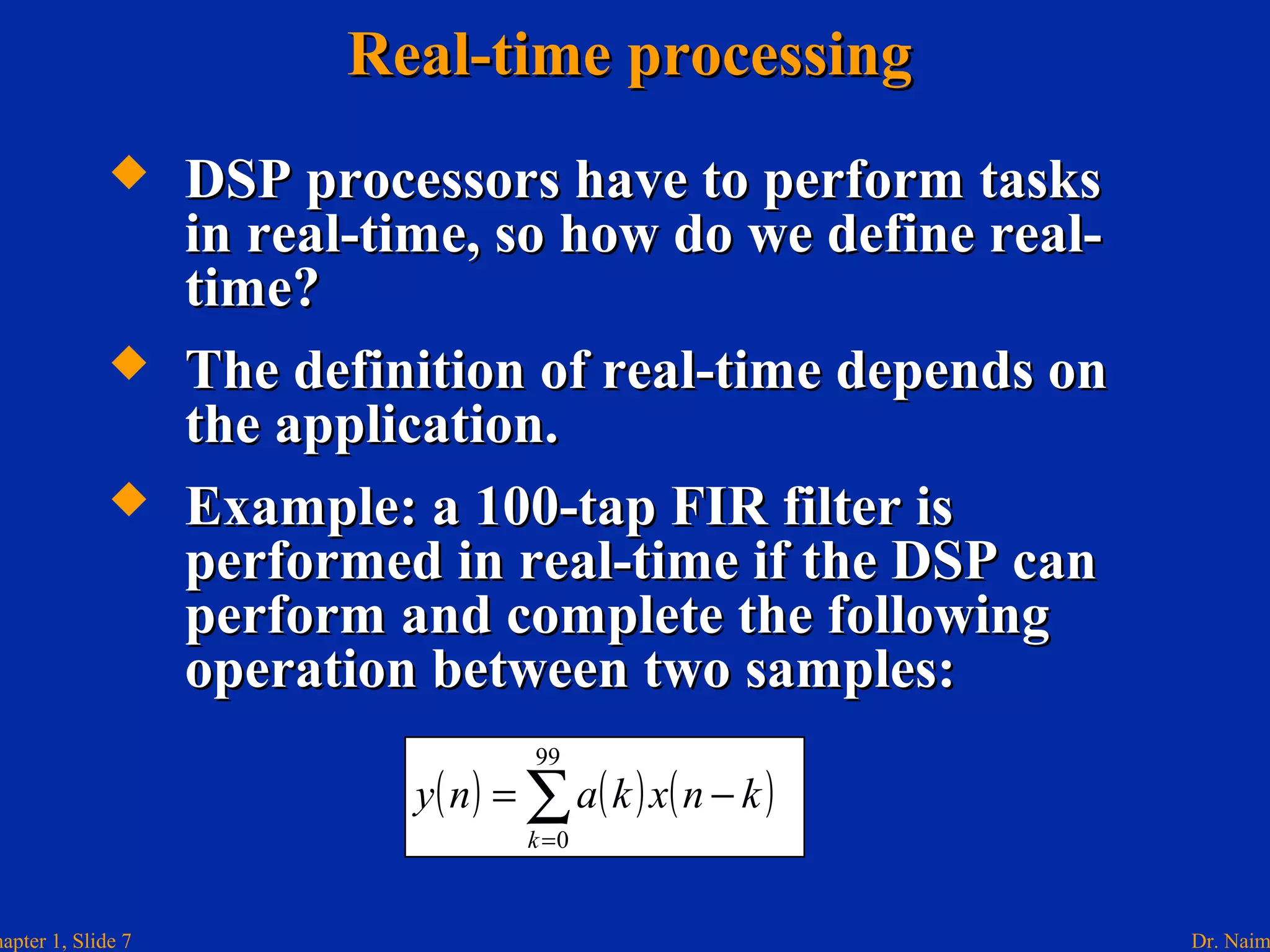
 DSP processors have to perform tasksDSP processors have to perform tasks
in real-time, so how do we define real-in real-time, so how do we define real-
time?time?
 The definition of real-time depends onThe definition of real-time depends on
the application.the application.
 Example: a 100-tap FIR filter isExample: a 100-tap FIR filter is
performed in real-time if the DSP canperformed in real-time if the DSP can
perform and complete the followingperform and complete the following
operation between two samples:operation between two samples:
Real-time processingReal-time processing
( ) ( ) ( )∑=
−=
99
0k
knxkany
Dr. Naimhapter 1, Slide 8
 We can say that we have a real-timeWe can say that we have a real-time
application if:application if:
 Waiting TimeWaiting Time ≥≥ 00
Real-time processingReal-time processing
Processing TimeProcessing Time
WaitingWaiting
TimeTime
Sample TimeSample Time
nn n+1n+1
Dr. Naimhapter 1, Slide 9
 Why not use a General PurposeWhy not use a General Purpose
Processor (GPP) such as a PentiumProcessor (GPP) such as a Pentium
instead of a DSP processor?instead of a DSP processor?
 What is theWhat is the power consumptionpower consumption of aof a
Pentium and a DSP processor?Pentium and a DSP processor?
 What is theWhat is the costcost of a Pentium and a DSPof a Pentium and a DSP
processor?processor?
Why do we need DSP processors?Why do we need DSP processors?
Dr. Naimhapter 1, Slide 10
 Use a DSP processor when the followingUse a DSP processor when the following
are required:are required:
 Cost saving.Cost saving.
 Smaller size.Smaller size.
 Low power consumption.Low power consumption.
 Processing of many “high” frequencyProcessing of many “high” frequency
signals in real-time.signals in real-time.
 Use a GPP processor when the followingUse a GPP processor when the following
are required:are required:
 Large memory.Large memory.
 Advanced operating systems.Advanced operating systems.
Why do we need DSP processors?Why do we need DSP processors?
Dr. Naimhapter 1, Slide 11
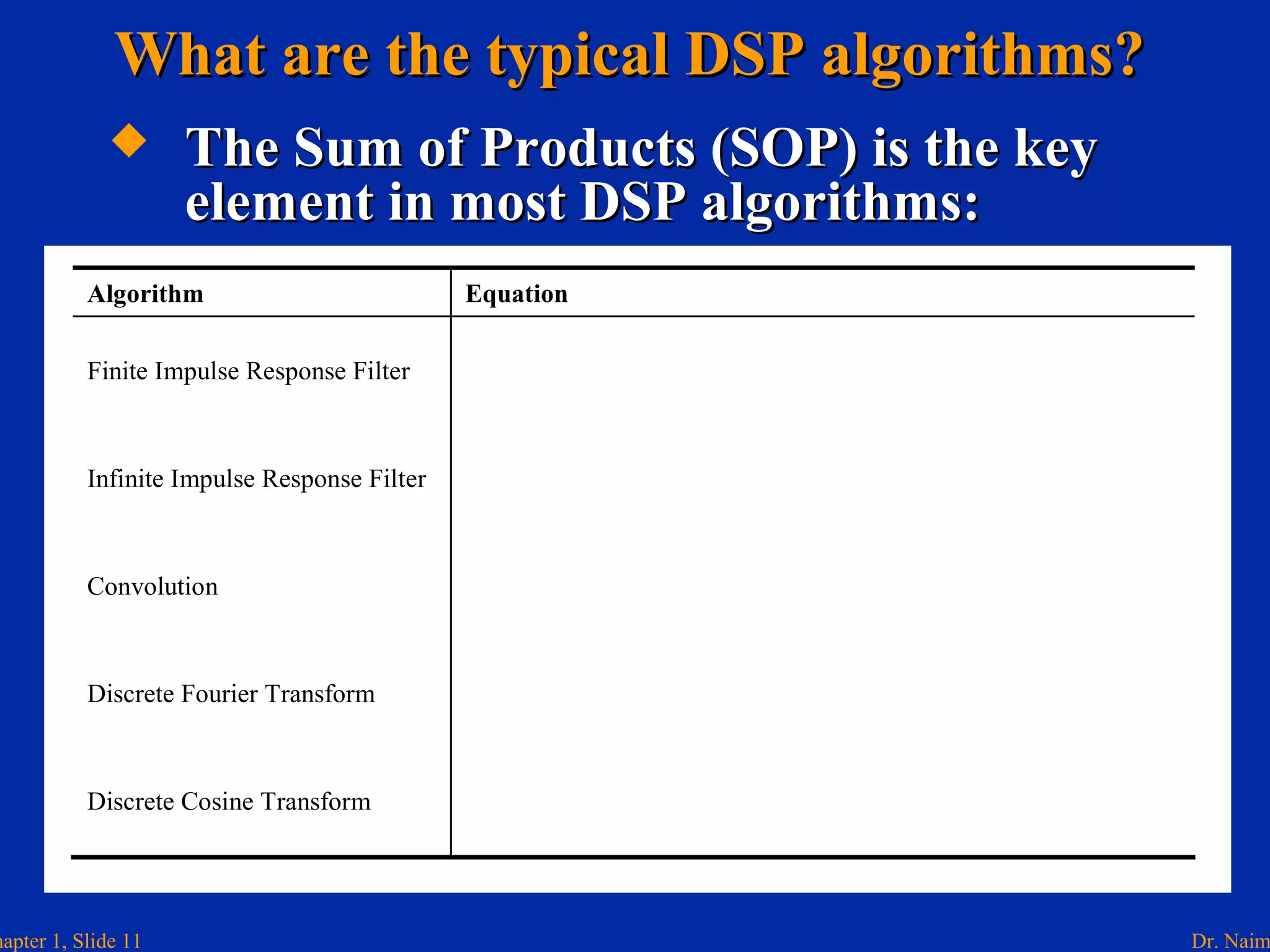
What are the typical DSP algorithms?What are the typical DSP algorithms?
Algorithm Equation
Finite Impulse Response Filter
Infinite Impulse Response Filter
Convolution
Discrete Fourier Transform
Discrete Cosine Transform
 The Sum of Products (SOP) is the keyThe Sum of Products (SOP) is the key
element in most DSP algorithms:element in most DSP algorithms:
Dr. Naimhapter 1, Slide 12
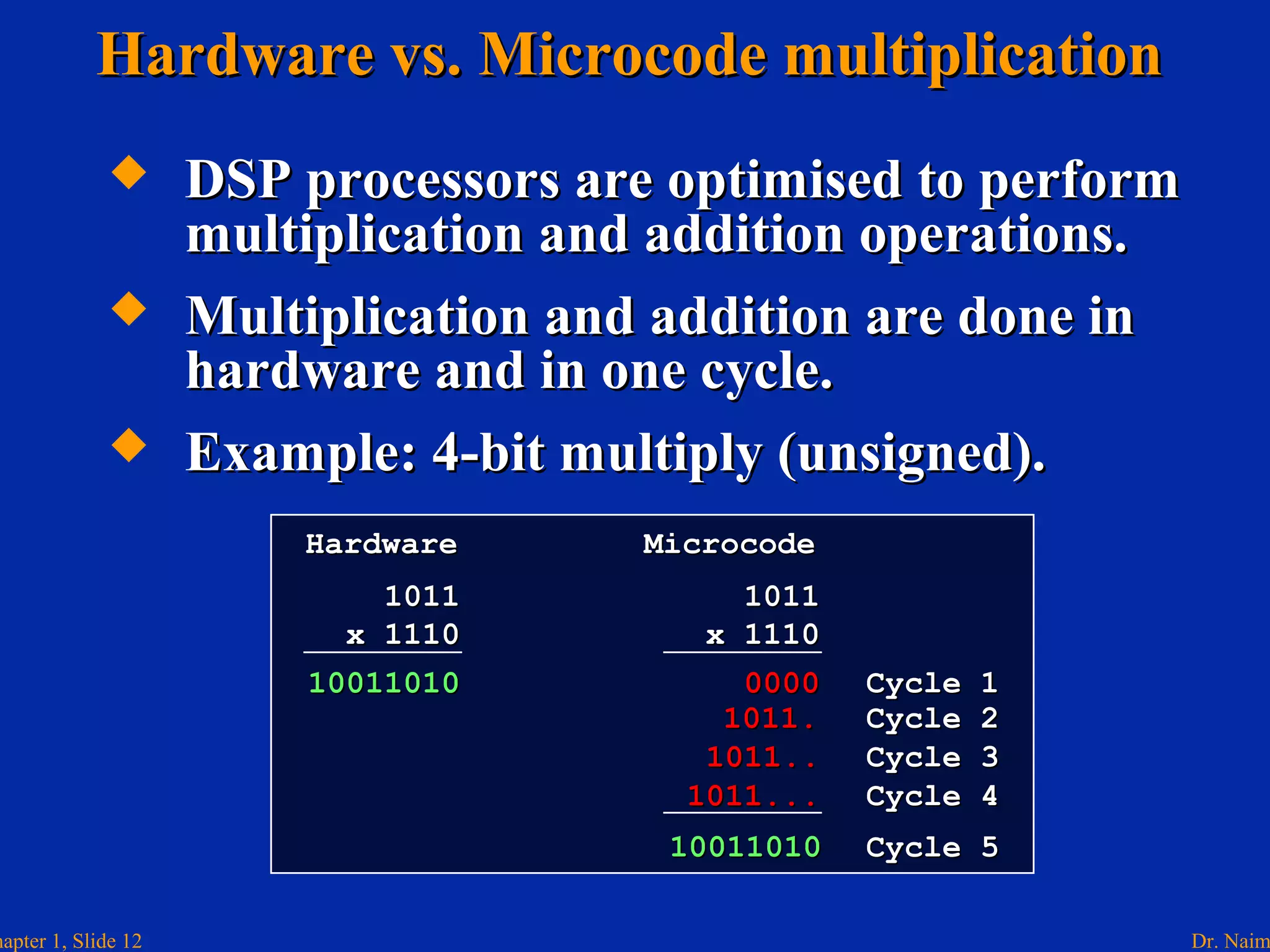
Hardware vs. Microcode multiplicationHardware vs. Microcode multiplication
 DSP processors are optimised to performDSP processors are optimised to perform
multiplication and addition operations.multiplication and addition operations.
 Multiplication and addition are done inMultiplication and addition are done in
hardware and in one cycle.hardware and in one cycle.
 Example: 4-bit multiply (unsigned).Example: 4-bit multiply (unsigned).
10111011
x 1110x 1110
10111011
x 1110x 1110
HardwareHardware MicrocodeMicrocode
1001101010011010 00000000
1011.1011.
1011..1011..
1011...1011...
1001101010011010
Cycle 1Cycle 1
Cycle 2Cycle 2
Cycle 3Cycle 3
Cycle 4Cycle 4
Cycle 5Cycle 5
Dr. Naimhapter 1, Slide 13
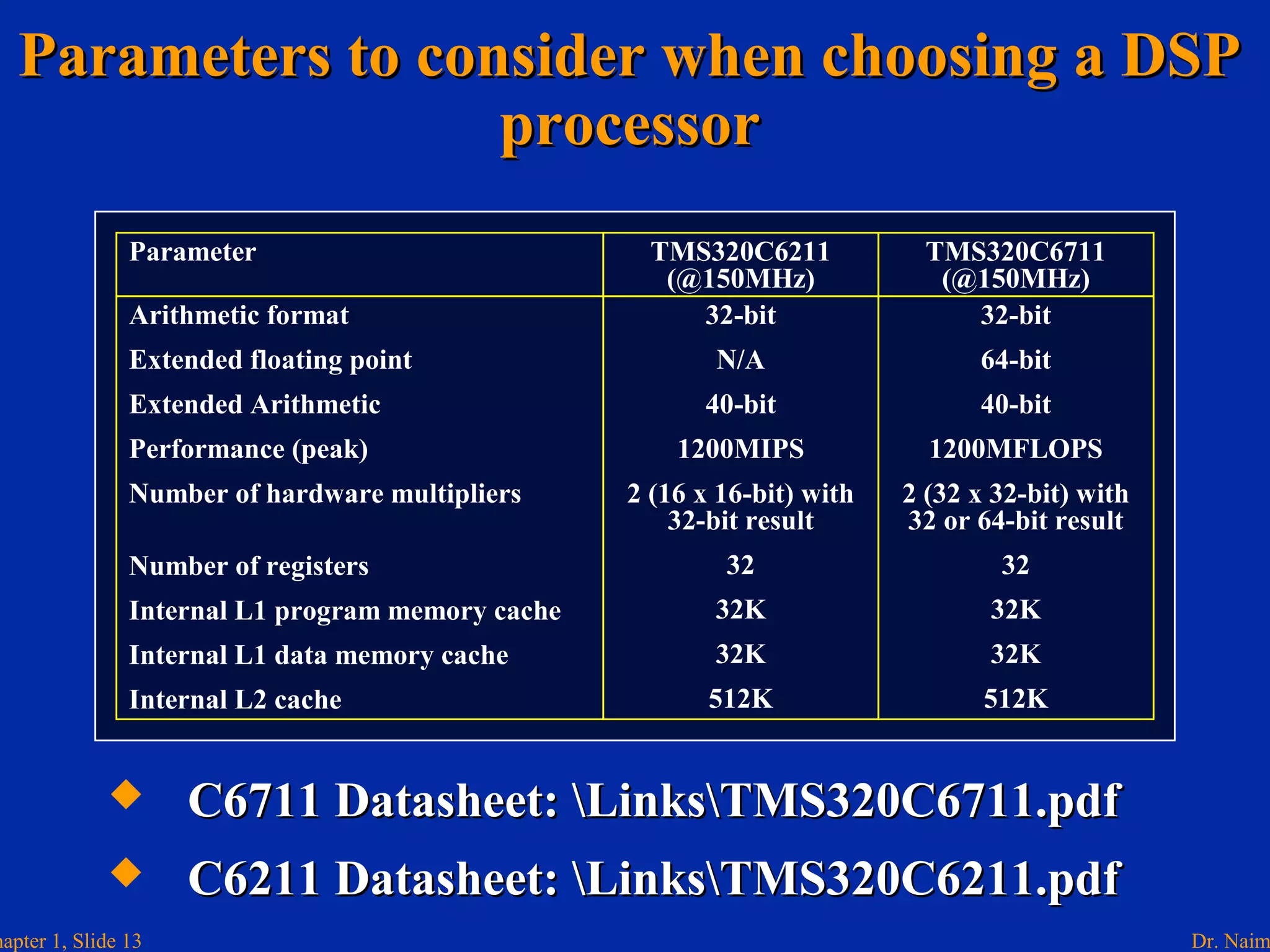
Parameters to consider when choosing a DSPParameters to consider when choosing a DSP
processorprocessor
Parameter
Arithmetic format
Extended floating point
Extended Arithmetic
Performance (peak)
Number of hardware multipliers
Number of registers
Internal L1 program memory cache
Internal L1 data memory cache
Internal L2 cache
32-bit
N/A
40-bit
1200MIPS
2 (16 x 16-bit) with
32-bit result
32
32K
32K
512K
32-bit
64-bit
40-bit
1200MFLOPS
2 (32 x 32-bit) with
32 or 64-bit result
32
32K
32K
512K
TMS320C6211
(@150MHz)
TMS320C6711
(@150MHz)
 C6711 Datasheet:C6711 Datasheet: LinksTMS320C6711.pdfLinksTMS320C6711.pdf
 C6211 Datasheet:C6211 Datasheet: LinksTMS320C6211.pdfLinksTMS320C6211.pdf
Dr. Naimhapter 1, Slide 14
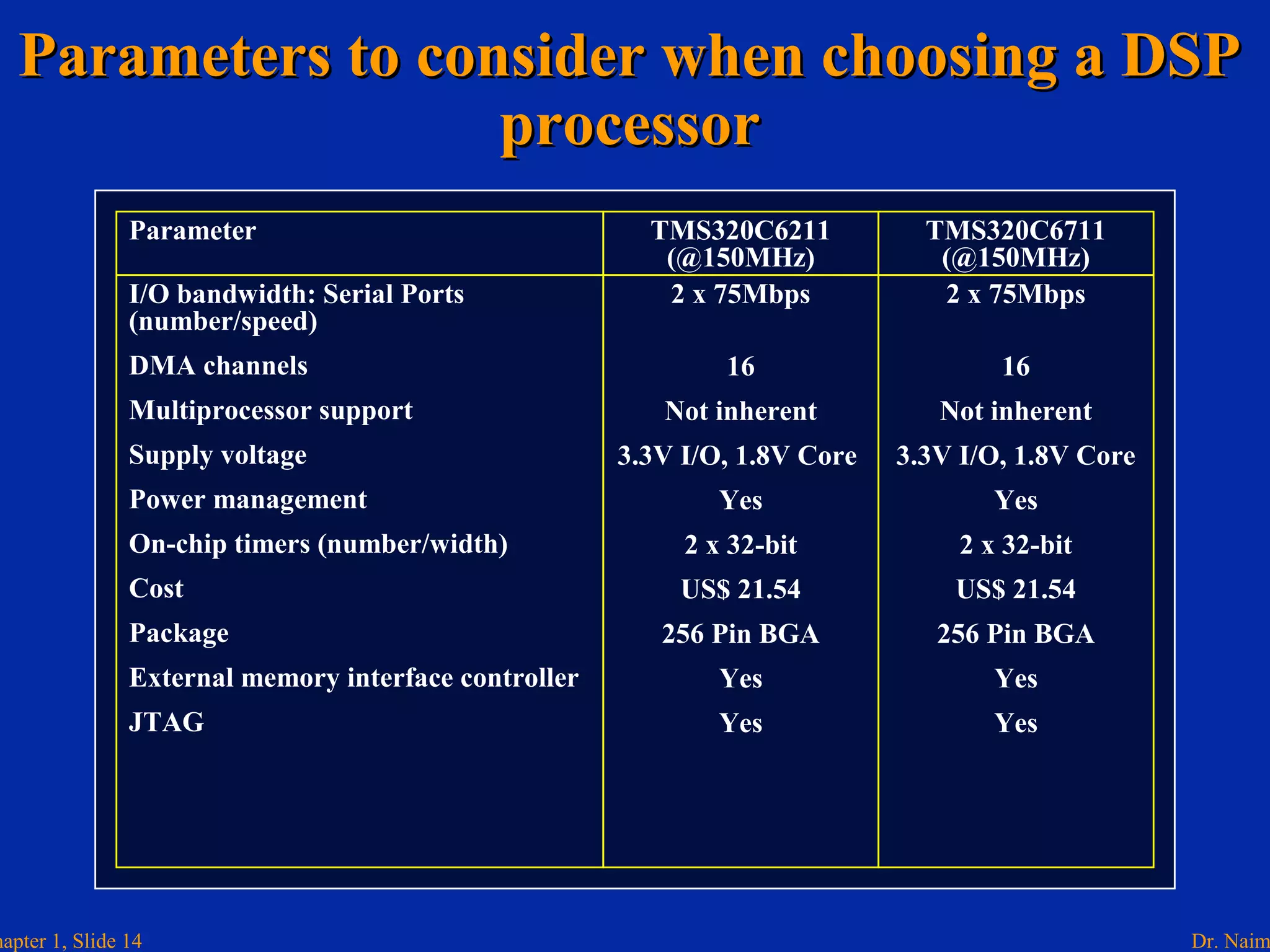
Parameters to consider when choosing a DSPParameters to consider when choosing a DSP
processorprocessor
Parameter
I/O bandwidth: Serial Ports
(number/speed)
DMA channels
Multiprocessor support
Supply voltage
Power management
On-chip timers (number/width)
Cost
Package
External memory interface controller
JTAG
2 x 75Mbps
16
Not inherent
3.3V I/O, 1.8V Core
Yes
2 x 32-bit
US$ 21.54
256 Pin BGA
Yes
Yes
2 x 75Mbps
16
Not inherent
3.3V I/O, 1.8V Core
Yes
2 x 32-bit
US$ 21.54
256 Pin BGA
Yes
Yes
TMS320C6211
(@150MHz)
TMS320C6711
(@150MHz)
Dr. Naimhapter 1, Slide 15
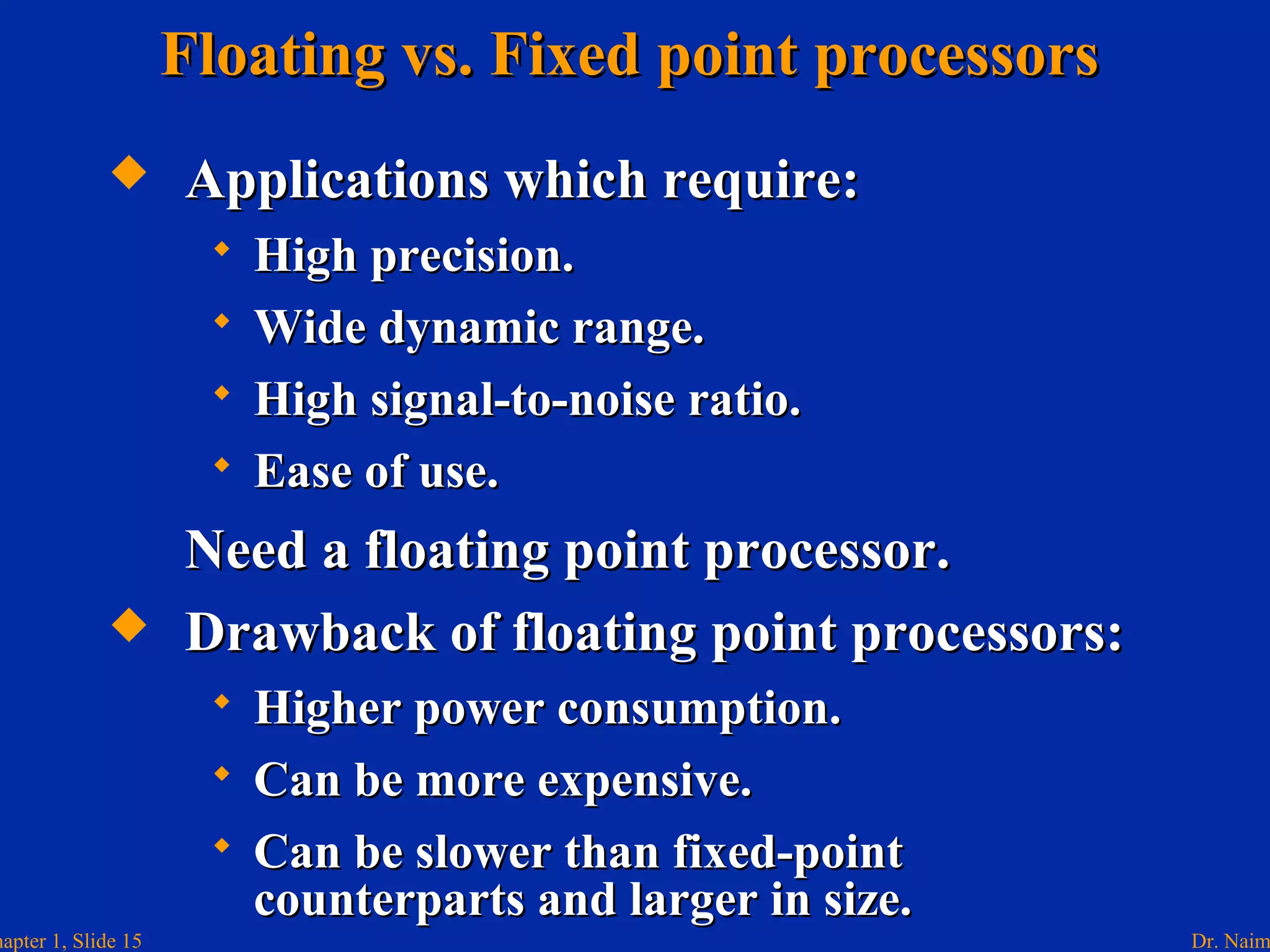
Floating vs. Fixed point processorsFloating vs. Fixed point processors
 Applications which require:Applications which require:
 High precision.High precision.
 Wide dynamic range.Wide dynamic range.
 High signal-to-noise ratio.High signal-to-noise ratio.
 Ease of use.Ease of use.
Need a floating point processor.Need a floating point processor.
 Drawback of floating point processors:Drawback of floating point processors:
 Higher power consumption.Higher power consumption.
 Can be more expensive.Can be more expensive.
 Can be slower than fixed-pointCan be slower than fixed-point
counterparts and larger in size.counterparts and larger in size.
Dr. Naimhapter 1, Slide 16
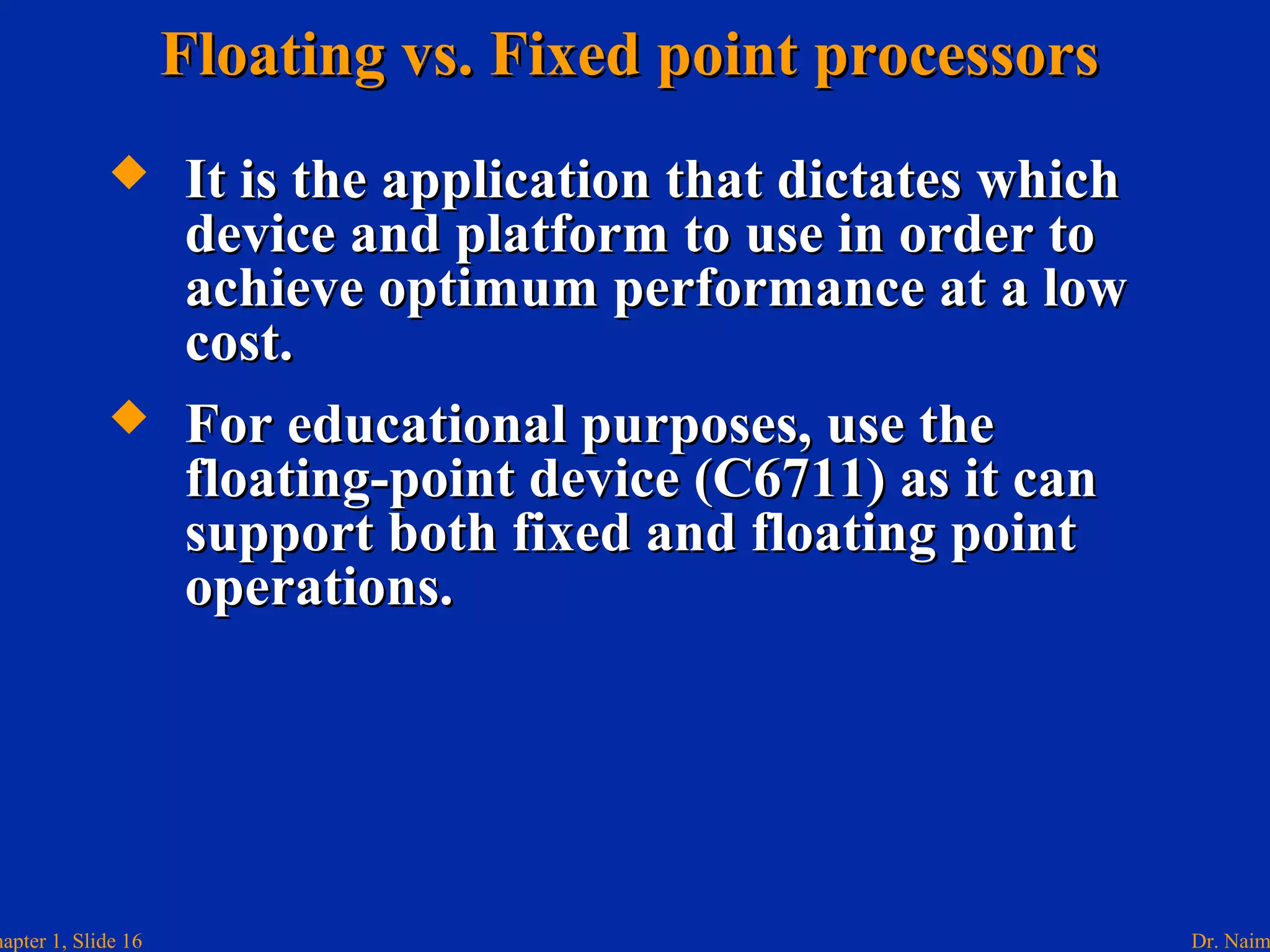
Floating vs. Fixed point processorsFloating vs. Fixed point processors
 It is the application that dictates whichIt is the application that dictates which
device and platform to use in order todevice and platform to use in order to
achieve optimum performance at a lowachieve optimum performance at a low
cost.cost.
 For educational purposes, use theFor educational purposes, use the
floating-point device (C6711) as it canfloating-point device (C6711) as it can
support both fixed and floating pointsupport both fixed and floating point
operations.operations.
Dr. Naimhapter 1, Slide 17
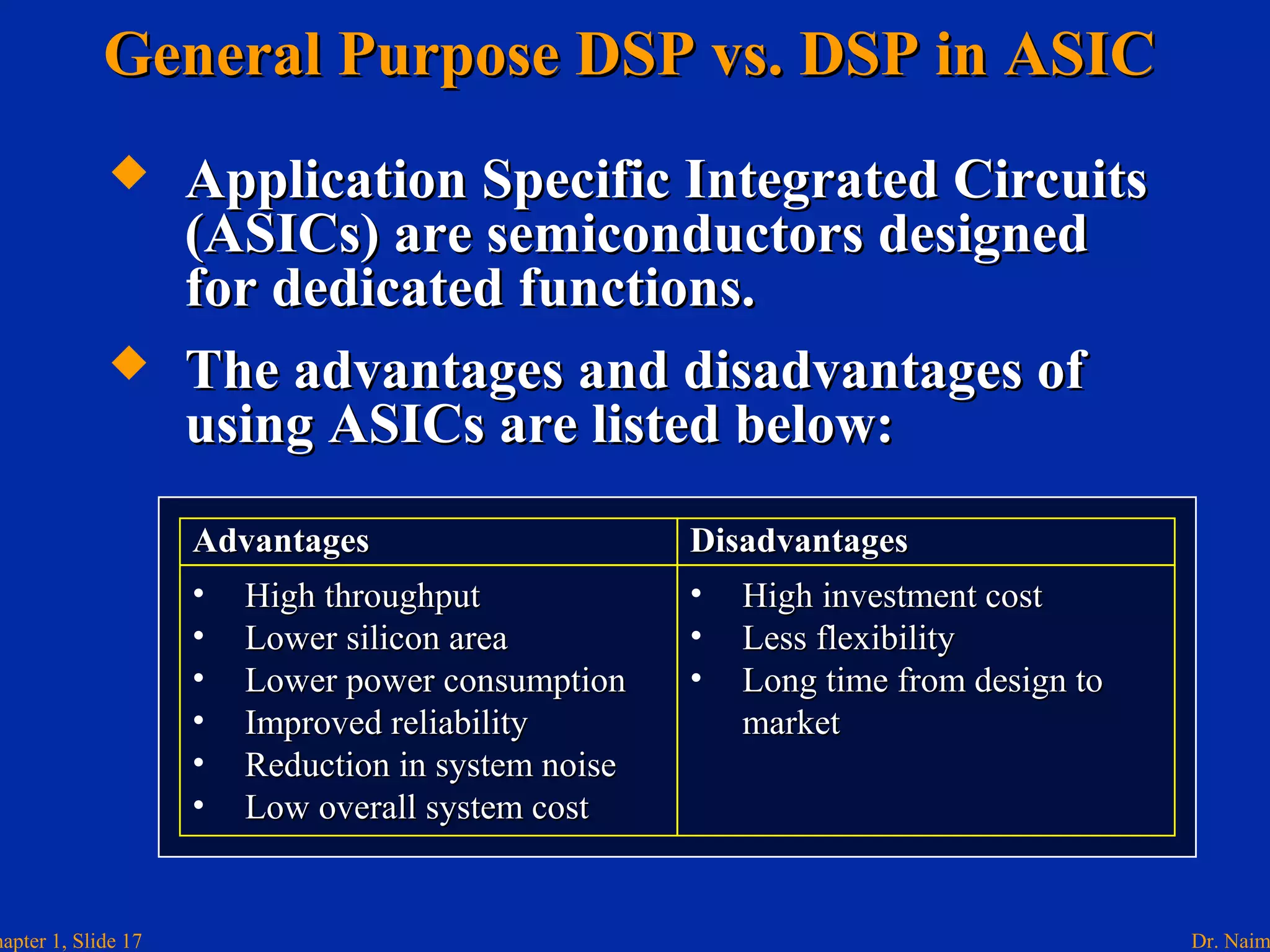
General Purpose DSP vs. DSP in ASICGeneral Purpose DSP vs. DSP in ASIC
 Application Specific Integrated CircuitsApplication Specific Integrated Circuits
(ASICs) are semiconductors designed(ASICs) are semiconductors designed
for dedicated functions.for dedicated functions.
 The advantages and disadvantages ofThe advantages and disadvantages of
using ASICs are listed below:using ASICs are listed below:
AdvantagesAdvantages
• High throughputHigh throughput
• Lower silicon areaLower silicon area
• Lower power consumptionLower power consumption
• Improved reliabilityImproved reliability
• Reduction in system noiseReduction in system noise
• Low overall system costLow overall system cost
DisadvantagesDisadvantages
• High investment costHigh investment cost
• Less flexibilityLess flexibility
• Long time from design toLong time from design to
marketmarket
Dr. Naimhapter 1, Slide 18
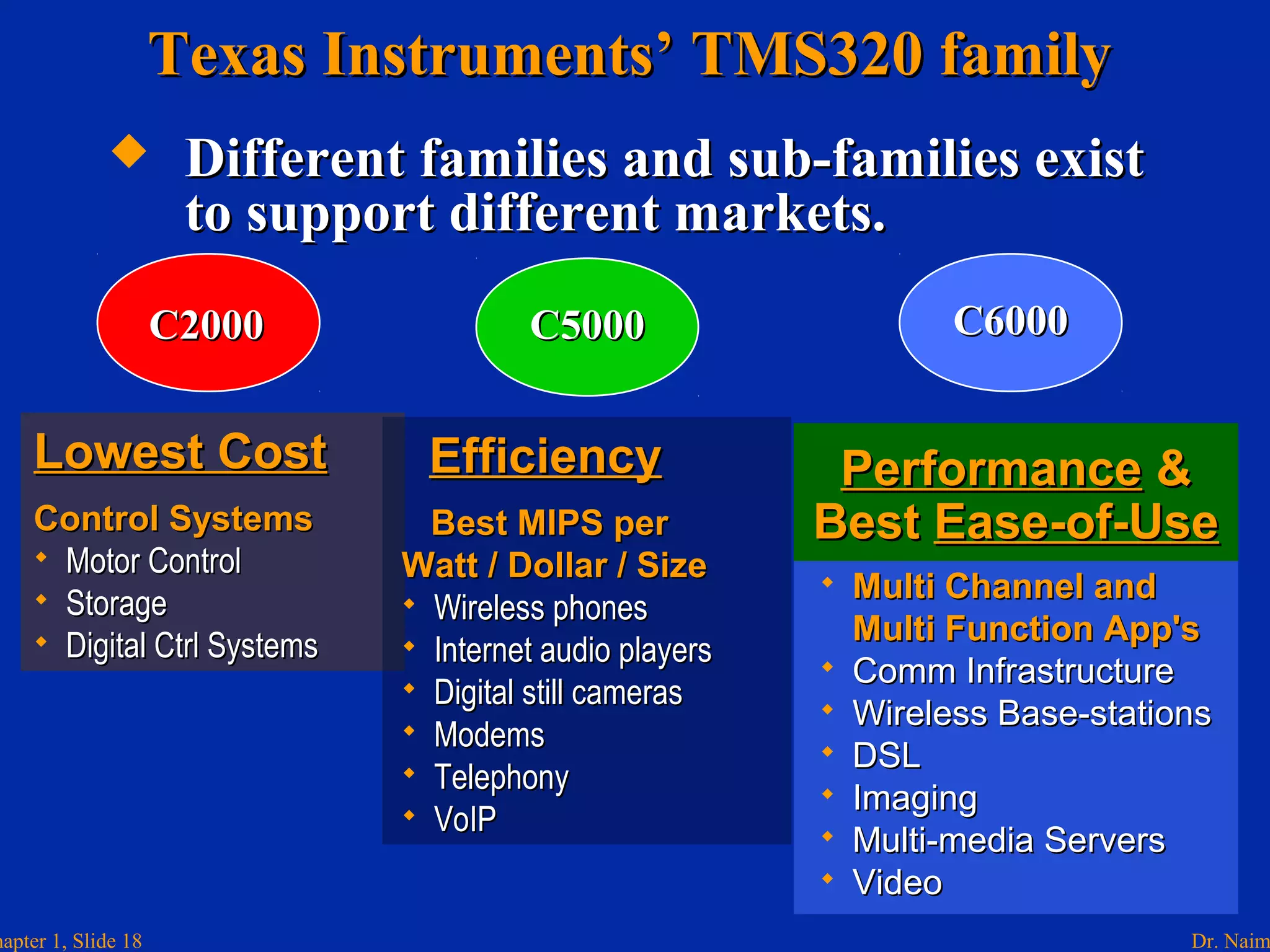
Texas Instruments’ TMS320 familyTexas Instruments’ TMS320 family
 Different families and sub-families existDifferent families and sub-families exist
to support different markets.to support different markets.
Lowest CostLowest Cost
Control SystemsControl Systems
 Motor ControlMotor Control
 StorageStorage
 Digital Ctrl SystemsDigital Ctrl Systems
C2000C2000 C5000C5000
EfficiencyEfficiency
Best MIPS perBest MIPS per
Watt / Dollar / SizeWatt / Dollar / Size
 Wireless phonesWireless phones
 Internet audio playersInternet audio players
 Digital still camerasDigital still cameras
 ModemsModems
 TelephonyTelephony
 VoIPVoIP
C6000C6000
 Multi Channel andMulti Channel and
Multi Function App'sMulti Function App's
 Comm InfrastructureComm Infrastructure
 Wireless Base-stationsWireless Base-stations
 DSLDSL
 ImagingImaging
 Multi-media ServersMulti-media Servers
 VideoVideo
PerformancePerformance &&
BestBest Ease-of-UseEase-of-Use
Dr. Naimhapter 1, Slide 19
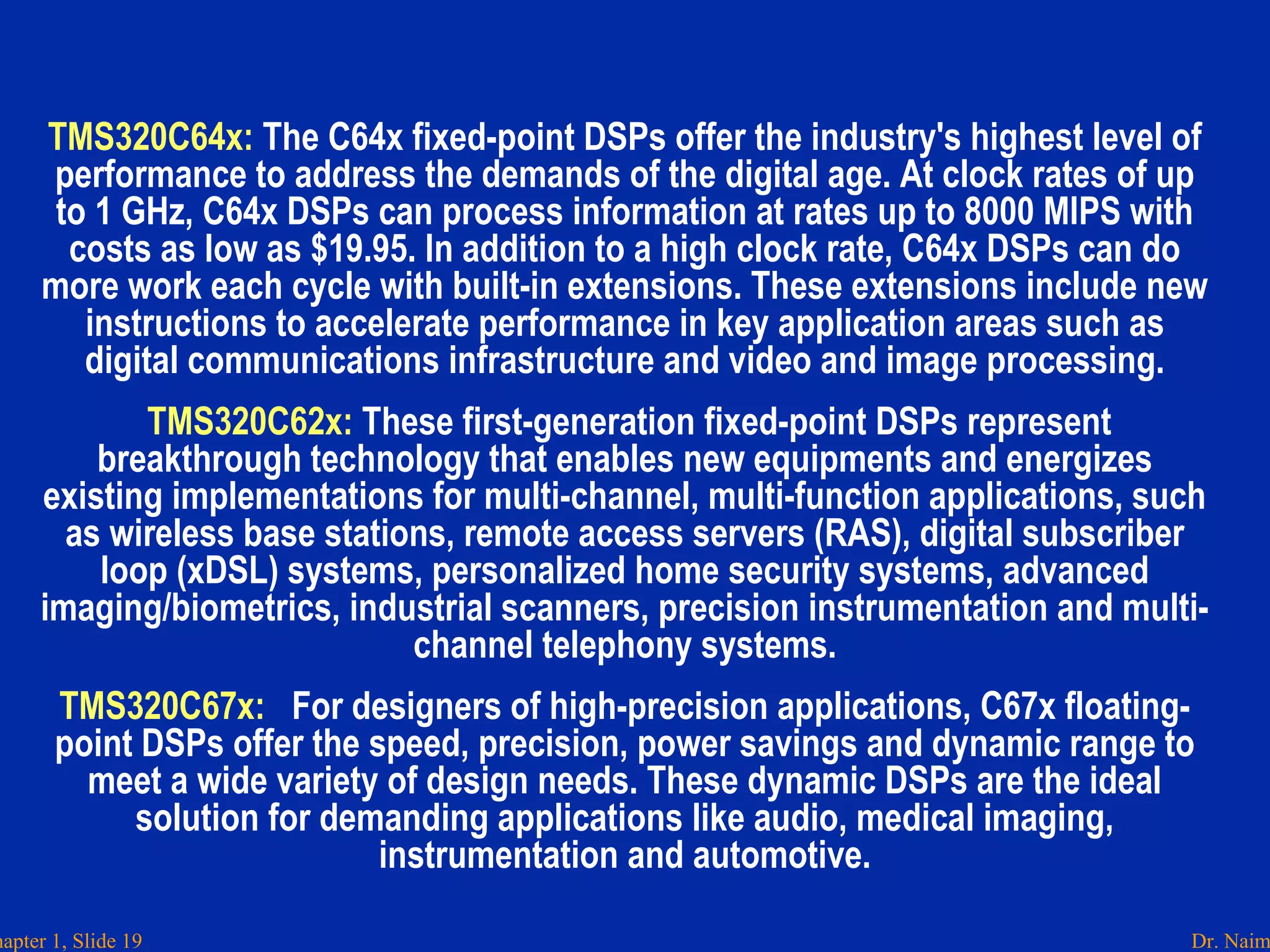
TMS320C64x: The C64x fixed-point DSPs offer the industry's highest level of
performance to address the demands of the digital age. At clock rates of up
to 1 GHz, C64x DSPs can process information at rates up to 8000 MIPS with
costs as low as $19.95. In addition to a high clock rate, C64x DSPs can do
more work each cycle with built-in extensions. These extensions include new
instructions to accelerate performance in key application areas such as
digital communications infrastructure and video and image processing.
TMS320C62x: These first-generation fixed-point DSPs represent
breakthrough technology that enables new equipments and energizes
existing implementations for multi-channel, multi-function applications, such
as wireless base stations, remote access servers (RAS), digital subscriber
loop (xDSL) systems, personalized home security systems, advanced
imaging/biometrics, industrial scanners, precision instrumentation and multi-
channel telephony systems.
TMS320C67x:  For designers of high-precision applications, C67x floating-
point DSPs offer the speed, precision, power savings and dynamic range to
meet a wide variety of design needs. These dynamic DSPs are the ideal
solution for demanding applications like audio, medical imaging,
instrumentation and automotive.
Dr. Naimhapter 1, Slide 20
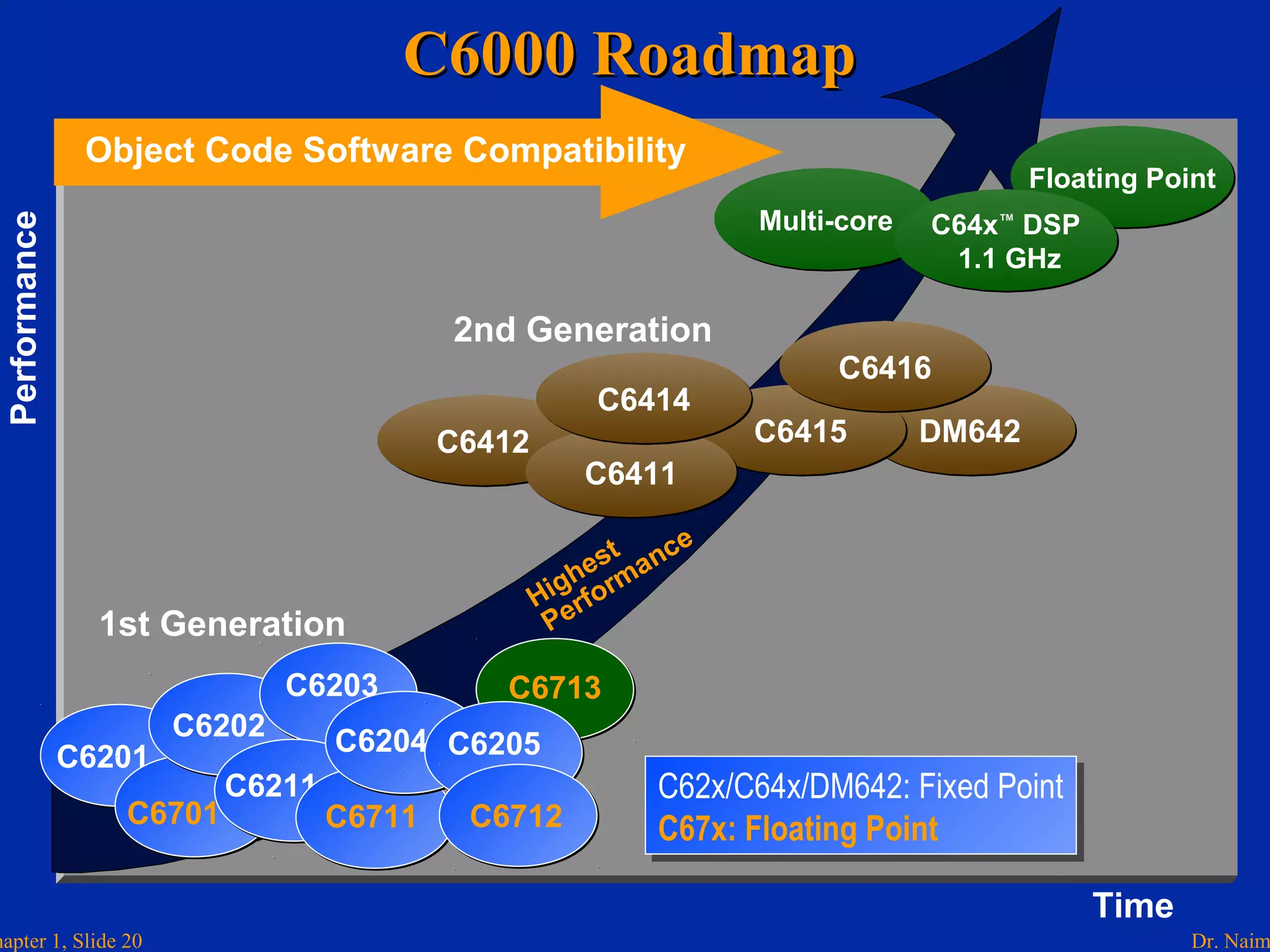
C6000 RoadmapC6000 Roadmap
Performance
Time
C62x/C64x/DM642: Fixed Point
C67x: Floating Point
C62x/C64x/DM642: Fixed Point
C67x: Floating Point
Highest
Performance
Object Code Software Compatibility
Floating PointFloating Point
Multi-coreMulti-core C64x™
DSP
1.1 GHz
C64x™
DSP
1.1 GHz
C6201
C6701
C6202
C6203
C6211
C6711
C6204
1st Generation
C6713C6713
C6205
C6712
C6412C6412 DM642DM642
2nd Generation
C6415C6415
C6416C6416
C6411C6411
C6414C6414
Dr. Naimhapter 1, Slide 21
Useful LinksUseful Links
 Selection Guide:Selection Guide:
 LinksDSP SelectionLinksDSP Selection Guide.pdfGuide.pdf
LinksDSP Selection Guide.pdf (3Q 2004)LinksDSP Selection Guide.pdf (3Q 2004)
LinksDSP Selection Guide.pdf (4Q 2004)LinksDSP Selection Guide.pdf (4Q 2004)
Chapter 1Chapter 1
IntroductionIntroduction
- End -- End -

Chapter1

  • 1.
  • 2.
    Dr. Naimhapter 1,Slide 2 Learning ObjectivesLearning Objectives  Why process signals digitally?Why process signals digitally?  Definition of a real-time application.Definition of a real-time application.  Why useWhy use DDigitaligital SSignalignal PProcessingrocessing processors?processors?  What are the typicalWhat are the typical DSPDSP algorithms?algorithms?  Parameters to consider when choosing aParameters to consider when choosing a DSP processor.DSP processor.  Programmable vs ASIC DSP.Programmable vs ASIC DSP.  Texas Instruments’ TMS320 family.Texas Instruments’ TMS320 family.
  • 3.
    Dr. Naimhapter 1,Slide 3 Why go digital?Why go digital?  Digital signal processing techniques areDigital signal processing techniques are now so powerful that sometimes it isnow so powerful that sometimes it is extremely difficult, if not impossible, forextremely difficult, if not impossible, for analogue signal processing to achieveanalogue signal processing to achieve similar performance.similar performance.  Examples:Examples:  FIR filter with linear phase.FIR filter with linear phase.  Adaptive filters.Adaptive filters.
  • 4.
    Dr. Naimhapter 1,Slide 4 Why go digital?Why go digital?  Analogue signal processing is achievedAnalogue signal processing is achieved by using analogue components such as:by using analogue components such as:  Resistors.Resistors.  Capacitors.Capacitors.  Inductors.Inductors.  The inherent tolerances associated withThe inherent tolerances associated with these components, temperature, voltagethese components, temperature, voltage changes and mechanical vibrations canchanges and mechanical vibrations can dramatically affect the effectiveness ofdramatically affect the effectiveness of the analogue circuitry.the analogue circuitry.
  • 5.
    Dr. Naimhapter 1,Slide 5 Why go digital?Why go digital?  With DSP it is easy to:With DSP it is easy to:  Change applications.Change applications.  Correct applications.Correct applications.  Update applications.Update applications.  Additionally DSP reduces:Additionally DSP reduces:  Noise susceptibility.Noise susceptibility.  Chip count.Chip count.  Development time.Development time.  Cost.Cost.  Power consumption.Power consumption.
  • 6.
    Dr. Naimhapter 1,Slide 6 Why NOT go digital?Why NOT go digital?  High frequency signals cannot beHigh frequency signals cannot be processed digitally because of twoprocessed digitally because of two reasons:reasons:  AAnalog tonalog to DDigitaligital CConverters,onverters, ADCADC cannotcannot work fast enough.work fast enough.  The application can be too complex to beThe application can be too complex to be performed inperformed in real-time.
  • 7.
    Dr. Naimhapter 1,Slide 7  DSP processors have to perform tasksDSP processors have to perform tasks in real-time, so how do we define real-in real-time, so how do we define real- time?time?  The definition of real-time depends onThe definition of real-time depends on the application.the application.  Example: a 100-tap FIR filter isExample: a 100-tap FIR filter is performed in real-time if the DSP canperformed in real-time if the DSP can perform and complete the followingperform and complete the following operation between two samples:operation between two samples: Real-time processingReal-time processing ( ) ( ) ( )∑= −= 99 0k knxkany
  • 8.
    Dr. Naimhapter 1,Slide 8  We can say that we have a real-timeWe can say that we have a real-time application if:application if:  Waiting TimeWaiting Time ≥≥ 00 Real-time processingReal-time processing Processing TimeProcessing Time WaitingWaiting TimeTime Sample TimeSample Time nn n+1n+1
  • 9.
    Dr. Naimhapter 1,Slide 9  Why not use a General PurposeWhy not use a General Purpose Processor (GPP) such as a PentiumProcessor (GPP) such as a Pentium instead of a DSP processor?instead of a DSP processor?  What is theWhat is the power consumptionpower consumption of aof a Pentium and a DSP processor?Pentium and a DSP processor?  What is theWhat is the costcost of a Pentium and a DSPof a Pentium and a DSP processor?processor? Why do we need DSP processors?Why do we need DSP processors?
  • 10.
    Dr. Naimhapter 1,Slide 10  Use a DSP processor when the followingUse a DSP processor when the following are required:are required:  Cost saving.Cost saving.  Smaller size.Smaller size.  Low power consumption.Low power consumption.  Processing of many “high” frequencyProcessing of many “high” frequency signals in real-time.signals in real-time.  Use a GPP processor when the followingUse a GPP processor when the following are required:are required:  Large memory.Large memory.  Advanced operating systems.Advanced operating systems. Why do we need DSP processors?Why do we need DSP processors?
  • 11.
    Dr. Naimhapter 1,Slide 11 What are the typical DSP algorithms?What are the typical DSP algorithms? Algorithm Equation Finite Impulse Response Filter Infinite Impulse Response Filter Convolution Discrete Fourier Transform Discrete Cosine Transform  The Sum of Products (SOP) is the keyThe Sum of Products (SOP) is the key element in most DSP algorithms:element in most DSP algorithms:
  • 12.
    Dr. Naimhapter 1,Slide 12 Hardware vs. Microcode multiplicationHardware vs. Microcode multiplication  DSP processors are optimised to performDSP processors are optimised to perform multiplication and addition operations.multiplication and addition operations.  Multiplication and addition are done inMultiplication and addition are done in hardware and in one cycle.hardware and in one cycle.  Example: 4-bit multiply (unsigned).Example: 4-bit multiply (unsigned). 10111011 x 1110x 1110 10111011 x 1110x 1110 HardwareHardware MicrocodeMicrocode 1001101010011010 00000000 1011.1011. 1011..1011.. 1011...1011... 1001101010011010 Cycle 1Cycle 1 Cycle 2Cycle 2 Cycle 3Cycle 3 Cycle 4Cycle 4 Cycle 5Cycle 5
  • 13.
    Dr. Naimhapter 1,Slide 13 Parameters to consider when choosing a DSPParameters to consider when choosing a DSP processorprocessor Parameter Arithmetic format Extended floating point Extended Arithmetic Performance (peak) Number of hardware multipliers Number of registers Internal L1 program memory cache Internal L1 data memory cache Internal L2 cache 32-bit N/A 40-bit 1200MIPS 2 (16 x 16-bit) with 32-bit result 32 32K 32K 512K 32-bit 64-bit 40-bit 1200MFLOPS 2 (32 x 32-bit) with 32 or 64-bit result 32 32K 32K 512K TMS320C6211 (@150MHz) TMS320C6711 (@150MHz)  C6711 Datasheet:C6711 Datasheet: LinksTMS320C6711.pdfLinksTMS320C6711.pdf  C6211 Datasheet:C6211 Datasheet: LinksTMS320C6211.pdfLinksTMS320C6211.pdf
  • 14.
    Dr. Naimhapter 1,Slide 14 Parameters to consider when choosing a DSPParameters to consider when choosing a DSP processorprocessor Parameter I/O bandwidth: Serial Ports (number/speed) DMA channels Multiprocessor support Supply voltage Power management On-chip timers (number/width) Cost Package External memory interface controller JTAG 2 x 75Mbps 16 Not inherent 3.3V I/O, 1.8V Core Yes 2 x 32-bit US$ 21.54 256 Pin BGA Yes Yes 2 x 75Mbps 16 Not inherent 3.3V I/O, 1.8V Core Yes 2 x 32-bit US$ 21.54 256 Pin BGA Yes Yes TMS320C6211 (@150MHz) TMS320C6711 (@150MHz)
  • 15.
    Dr. Naimhapter 1,Slide 15 Floating vs. Fixed point processorsFloating vs. Fixed point processors  Applications which require:Applications which require:  High precision.High precision.  Wide dynamic range.Wide dynamic range.  High signal-to-noise ratio.High signal-to-noise ratio.  Ease of use.Ease of use. Need a floating point processor.Need a floating point processor.  Drawback of floating point processors:Drawback of floating point processors:  Higher power consumption.Higher power consumption.  Can be more expensive.Can be more expensive.  Can be slower than fixed-pointCan be slower than fixed-point counterparts and larger in size.counterparts and larger in size.
  • 16.
    Dr. Naimhapter 1,Slide 16 Floating vs. Fixed point processorsFloating vs. Fixed point processors  It is the application that dictates whichIt is the application that dictates which device and platform to use in order todevice and platform to use in order to achieve optimum performance at a lowachieve optimum performance at a low cost.cost.  For educational purposes, use theFor educational purposes, use the floating-point device (C6711) as it canfloating-point device (C6711) as it can support both fixed and floating pointsupport both fixed and floating point operations.operations.
  • 17.
    Dr. Naimhapter 1,Slide 17 General Purpose DSP vs. DSP in ASICGeneral Purpose DSP vs. DSP in ASIC  Application Specific Integrated CircuitsApplication Specific Integrated Circuits (ASICs) are semiconductors designed(ASICs) are semiconductors designed for dedicated functions.for dedicated functions.  The advantages and disadvantages ofThe advantages and disadvantages of using ASICs are listed below:using ASICs are listed below: AdvantagesAdvantages • High throughputHigh throughput • Lower silicon areaLower silicon area • Lower power consumptionLower power consumption • Improved reliabilityImproved reliability • Reduction in system noiseReduction in system noise • Low overall system costLow overall system cost DisadvantagesDisadvantages • High investment costHigh investment cost • Less flexibilityLess flexibility • Long time from design toLong time from design to marketmarket
  • 18.
    Dr. Naimhapter 1,Slide 18 Texas Instruments’ TMS320 familyTexas Instruments’ TMS320 family  Different families and sub-families existDifferent families and sub-families exist to support different markets.to support different markets. Lowest CostLowest Cost Control SystemsControl Systems  Motor ControlMotor Control  StorageStorage  Digital Ctrl SystemsDigital Ctrl Systems C2000C2000 C5000C5000 EfficiencyEfficiency Best MIPS perBest MIPS per Watt / Dollar / SizeWatt / Dollar / Size  Wireless phonesWireless phones  Internet audio playersInternet audio players  Digital still camerasDigital still cameras  ModemsModems  TelephonyTelephony  VoIPVoIP C6000C6000  Multi Channel andMulti Channel and Multi Function App'sMulti Function App's  Comm InfrastructureComm Infrastructure  Wireless Base-stationsWireless Base-stations  DSLDSL  ImagingImaging  Multi-media ServersMulti-media Servers  VideoVideo PerformancePerformance && BestBest Ease-of-UseEase-of-Use
  • 19.
    Dr. Naimhapter 1,Slide 19 TMS320C64x: The C64x fixed-point DSPs offer the industry's highest level of performance to address the demands of the digital age. At clock rates of up to 1 GHz, C64x DSPs can process information at rates up to 8000 MIPS with costs as low as $19.95. In addition to a high clock rate, C64x DSPs can do more work each cycle with built-in extensions. These extensions include new instructions to accelerate performance in key application areas such as digital communications infrastructure and video and image processing. TMS320C62x: These first-generation fixed-point DSPs represent breakthrough technology that enables new equipments and energizes existing implementations for multi-channel, multi-function applications, such as wireless base stations, remote access servers (RAS), digital subscriber loop (xDSL) systems, personalized home security systems, advanced imaging/biometrics, industrial scanners, precision instrumentation and multi- channel telephony systems. TMS320C67x:  For designers of high-precision applications, C67x floating- point DSPs offer the speed, precision, power savings and dynamic range to meet a wide variety of design needs. These dynamic DSPs are the ideal solution for demanding applications like audio, medical imaging, instrumentation and automotive.
  • 20.
    Dr. Naimhapter 1,Slide 20 C6000 RoadmapC6000 Roadmap Performance Time C62x/C64x/DM642: Fixed Point C67x: Floating Point C62x/C64x/DM642: Fixed Point C67x: Floating Point Highest Performance Object Code Software Compatibility Floating PointFloating Point Multi-coreMulti-core C64x™ DSP 1.1 GHz C64x™ DSP 1.1 GHz C6201 C6701 C6202 C6203 C6211 C6711 C6204 1st Generation C6713C6713 C6205 C6712 C6412C6412 DM642DM642 2nd Generation C6415C6415 C6416C6416 C6411C6411 C6414C6414
  • 21.
    Dr. Naimhapter 1,Slide 21 Useful LinksUseful Links  Selection Guide:Selection Guide:  LinksDSP SelectionLinksDSP Selection Guide.pdfGuide.pdf LinksDSP Selection Guide.pdf (3Q 2004)LinksDSP Selection Guide.pdf (3Q 2004) LinksDSP Selection Guide.pdf (4Q 2004)LinksDSP Selection Guide.pdf (4Q 2004)
  • 22.