Classification of Embedded Systems
Three Types of Embedded Systems are :
(1) Small Scale
(2) Medium Scale
(3) Sophisticated
Small Scale Embedded Systems
 Designed with a single 8 or 16 bit µC.
 Little Hardware & Software
complexities.
 Involves Board level design.
 May be Battery Operated.
 Programming Tools Needed:
Editor, Assembler, Cross Assembler
specific to µC or µP used.
Medium Scale Embedded Systems
 Designed with Single or a few 16-32
Bit µC or DSP or RISC Computer,
 Hardware & Software Complexities
 Programming Tools: RTOS, Source
Code Engg. Tools, Simulator,
Debugger, IDE.
 May employ readily available ASSP
and IP for various functions*
Sophisticated Embedded Systems
 Have enormous H/W and S/W complexities, may need
scalable or configurable processors and PLA
 Used for cutting edge application that needs H/W &
S/W Co-design and integration in final system
 Constrained by processing speed available in their
Hardware
 Certain S/W functions implemented in H/W* to obtain
additional speed by saving execution time.
 Development Tools for such systems may not be
readily available at a reasonable cost or may not be
available at all
Processor Types Used in New
Embedded Designs
0.0%
10.0%
20.0%
30.0%
40.0%
50.0%
60.0%
4-bit 8-bit 16-bit 32-bit 64-bit Special
1998-1999
1999-2000
Selection of a Processor
 Instruction Set, Pipelining, Super Scalar
Execution.
 Data Bus Width (8-16-32 Bits) for Arithmetic.
 Floating Point Coprocessor, Cache Memory
 On-chip peripheral devices, Clock Frequency,
 Availability of Retarget-able Compiler and
Hardware Software Co-design Tools
 Power Saving Modes available
 Cost [Components, Development tools, NRE]
Types of Processors used in Emb.
Systems
 General Purpose Processor (GPP):
 Microprocessor
 Micro-controller
 Digital Signal Processor
 Embedded Processor
 Application Specific System Processor
(ASSP)
 Multiprocessor Systems using GPP
 Application Specific Instruction Processor
(ASIP)
Microprocessor (µP):
 Single VLSI Chip having CPU and (may have)
Cache memory, Floating point Arithmetic
Coprocessor, Pipelining Architecture to
process instructions faster.
 CPU Instruction Set supports ALU operations,
Data Transfer and Stack operations, Input
and Output, Program Control, Sequencing
and Supervisory operations
 Software located in external memory Chips
Examples- Microprocessors
Intel 8085
Intel 8086/ 88
8 Bit
16 bit
Simple control
Applications
Intel 80386
Intel 80486
32 bit Graphics Accelerator,
Network Interface
card
Pentium 64 bit Encryption Engine
with 0.464 Gbps data
rate
PowerPC
MPC 823
32 Bit Floating Pt
Coprocessor, USB,
IrDA,
Microcontrollers
 Contains ROM, RAM Memories on
Chip
 Enhanced Input Output capabilities
 Limited Computational Abilities
 More Functional Units on Chip:
Timers, Watchdog Timer, Interrupt
Controller, UART, Parallel I/O Ports,
A/D Converter and
PWM Circuit for D/A converters
Functional Circuits in a Chip or Core of Microcontroller
Processor ROM/ EPROM I/O Ports
Controls and
Interfaces
Data
and
Stack
RAM
Timers
External Memory
Interface
Serial UART
A/D Converter
Interrupt
Controller
PWM for D/A
Watchdog
Timer
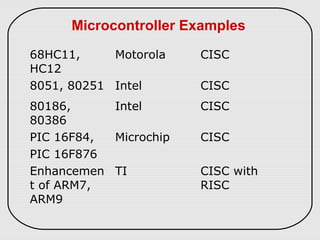
Microcontroller Examples
68HC11,
HC12
Motorola CISC
8051, 80251 Intel CISC
80186,
80386
Intel CISC
PIC 16F84,
PIC 16F876
Microchip CISC
Enhancemen
t of ARM7,
ARM9
TI CISC with
RISC
Embedded Processor
Specially designed µC / µP with:
(1) Fast Context Switching and thus lower latencies
of the task in complex real time applications
(2) Atomic ALU Operations and thus no shared data
problem
(3) RISC Core for fast, more precise and intensive
calculations by embedded software
 Needed in Real time Image
processing and Aerodynamics
Applications
Examples- Embedded Processors
ARM 7 and
ARM 9
Image Processing
Intel i960 4 Channel DMA
Controller
Digital Signal Processor
 Computational capabilities of a µP
 Has Multiply – Accumulate (MAC) Units
 Very Large Instruction Word
 Processes Single Instruction Multiple
Data(SIMD)
 Fast processing of Discrete Cosine
Transforms and Inverse (IDCT) algorithms
in Image Processing, Multimedia, Audio,
Video, HDTV, DSP Modems and Telecom
Processing Systems
Examples - DSP
TMS 320C6211 Texas Instruments
SHARC Analog Devices
5600xx Motorola
Application Specific System
Processor (ASSP)
 Dedicated to perform specific tasks in H/W
Like
 Provides Faster Solution using a single Chip
 Configured & Interfaced with the rest of ES.
Target Application Examples:
 Video Compression & Decompression (MPEG)
 Encryption and Decryption Implementations
 Serial to Ethernet Converter Application
Compression & Decompression
Application
 in MPEG2 or MPEG4 Standards
 Compression of Video signal is done before
storing or transmitting. Decompression is
done before retrieving or receiving these
signals
 If embedded Software is run on GPP,
separate DSP(s) are required to achieve
real time processing. A single dedicated
ASSP processor provides a faster solution.
Encryption & Decryption Applications
 When 2 Systems needs data communications
on a common bus and protocol, Embedded
Software (with some RTOS feature) may take
longer time than a hardware based approach
 ASSP Processor (W3100) from i2Chip has, for
example TCP, UDP, IP, ARP, Ethernet 10/100
Media Access Control (MAC)
 Provides RTOS less, Internet Connectivity in
H/W 5 times faster than a GPP based software
solution
Serial to Ethernet Converter Application
 IIM 7100 processes data in Real Time
by hardware protocol stack
 Requires no change in Application
Firmware
 Provides economical and smallest
RTOS solution.
Multiple Processor System using GPP
 Multiple GPP are used in Mobile
Phone. Tasks performed are:
 Speech signal compression and coding
 Dialing
 Modulating & transmitting
 Demodulating and Receiving
 Signal decoding and Decompression
 interface to LCD display and Keypad
 SMS protocol based messaging and
displays
Multiple Processors in Video
Conferencing
 Image Pixels are just 144 x 176 as against
525 x 625 pixel in video picture on TV.
 30 Samples of Images have to be taken in a
second
 144 x 176 x 30 = 760320 Pixels per second
are to be processed by Compression before
transmission
 A single DSP does not suffice. Multiple DSP(s)
are needed to process images during Video
Conferencing in real time.
Application Specific Instruction
Processor-ASIP
 For many Applications, the GPP cores
may not suffice. For examples:
 Security Applications, Smart Cards,
 Video games, Palmtop
computers,
 Cell phones, Mobile
Internet,
 Satellite Missile Systems
 Gbps Transceivers and Gbps LAN
systems
Application Specific Instruction
Processor-ASIP
 ‘Special Processing Units’ needed in a VLSI
designed Circuit to function as a Processor,
called Application Specific Instruction
Processors (ASIP)
 Both the Configurable processor (FPGA cum
ASIP) and Non-configurable processors (DSP,
µP or µC) might be needed on a chip.
 Examples: (1) Cell phone
(2) ASIP for HDTV to process an image with
1920 x 1020 pixels on TV screen.

39245196 intro-es-iii

  • 1.
    Classification of EmbeddedSystems Three Types of Embedded Systems are : (1) Small Scale (2) Medium Scale (3) Sophisticated
  • 2.
    Small Scale EmbeddedSystems  Designed with a single 8 or 16 bit µC.  Little Hardware & Software complexities.  Involves Board level design.  May be Battery Operated.  Programming Tools Needed: Editor, Assembler, Cross Assembler specific to µC or µP used.
  • 3.
    Medium Scale EmbeddedSystems  Designed with Single or a few 16-32 Bit µC or DSP or RISC Computer,  Hardware & Software Complexities  Programming Tools: RTOS, Source Code Engg. Tools, Simulator, Debugger, IDE.  May employ readily available ASSP and IP for various functions*
  • 4.
    Sophisticated Embedded Systems Have enormous H/W and S/W complexities, may need scalable or configurable processors and PLA  Used for cutting edge application that needs H/W & S/W Co-design and integration in final system  Constrained by processing speed available in their Hardware  Certain S/W functions implemented in H/W* to obtain additional speed by saving execution time.  Development Tools for such systems may not be readily available at a reasonable cost or may not be available at all
  • 5.
    Processor Types Usedin New Embedded Designs 0.0% 10.0% 20.0% 30.0% 40.0% 50.0% 60.0% 4-bit 8-bit 16-bit 32-bit 64-bit Special 1998-1999 1999-2000
  • 6.
    Selection of aProcessor  Instruction Set, Pipelining, Super Scalar Execution.  Data Bus Width (8-16-32 Bits) for Arithmetic.  Floating Point Coprocessor, Cache Memory  On-chip peripheral devices, Clock Frequency,  Availability of Retarget-able Compiler and Hardware Software Co-design Tools  Power Saving Modes available  Cost [Components, Development tools, NRE]
  • 7.
    Types of Processorsused in Emb. Systems  General Purpose Processor (GPP):  Microprocessor  Micro-controller  Digital Signal Processor  Embedded Processor  Application Specific System Processor (ASSP)  Multiprocessor Systems using GPP  Application Specific Instruction Processor (ASIP)
  • 8.
    Microprocessor (µP):  SingleVLSI Chip having CPU and (may have) Cache memory, Floating point Arithmetic Coprocessor, Pipelining Architecture to process instructions faster.  CPU Instruction Set supports ALU operations, Data Transfer and Stack operations, Input and Output, Program Control, Sequencing and Supervisory operations  Software located in external memory Chips
  • 9.
    Examples- Microprocessors Intel 8085 Intel8086/ 88 8 Bit 16 bit Simple control Applications Intel 80386 Intel 80486 32 bit Graphics Accelerator, Network Interface card Pentium 64 bit Encryption Engine with 0.464 Gbps data rate PowerPC MPC 823 32 Bit Floating Pt Coprocessor, USB, IrDA,
  • 10.
    Microcontrollers  Contains ROM,RAM Memories on Chip  Enhanced Input Output capabilities  Limited Computational Abilities  More Functional Units on Chip: Timers, Watchdog Timer, Interrupt Controller, UART, Parallel I/O Ports, A/D Converter and PWM Circuit for D/A converters
  • 11.
    Functional Circuits ina Chip or Core of Microcontroller Processor ROM/ EPROM I/O Ports Controls and Interfaces Data and Stack RAM Timers External Memory Interface Serial UART A/D Converter Interrupt Controller PWM for D/A Watchdog Timer
  • 12.
    Microcontroller Examples 68HC11, HC12 Motorola CISC 8051,80251 Intel CISC 80186, 80386 Intel CISC PIC 16F84, PIC 16F876 Microchip CISC Enhancemen t of ARM7, ARM9 TI CISC with RISC
  • 13.
    Embedded Processor Specially designedµC / µP with: (1) Fast Context Switching and thus lower latencies of the task in complex real time applications (2) Atomic ALU Operations and thus no shared data problem (3) RISC Core for fast, more precise and intensive calculations by embedded software  Needed in Real time Image processing and Aerodynamics Applications
  • 14.
    Examples- Embedded Processors ARM7 and ARM 9 Image Processing Intel i960 4 Channel DMA Controller
  • 15.
    Digital Signal Processor Computational capabilities of a µP  Has Multiply – Accumulate (MAC) Units  Very Large Instruction Word  Processes Single Instruction Multiple Data(SIMD)  Fast processing of Discrete Cosine Transforms and Inverse (IDCT) algorithms in Image Processing, Multimedia, Audio, Video, HDTV, DSP Modems and Telecom Processing Systems
  • 16.
    Examples - DSP TMS320C6211 Texas Instruments SHARC Analog Devices 5600xx Motorola
  • 17.
    Application Specific System Processor(ASSP)  Dedicated to perform specific tasks in H/W Like  Provides Faster Solution using a single Chip  Configured & Interfaced with the rest of ES. Target Application Examples:  Video Compression & Decompression (MPEG)  Encryption and Decryption Implementations  Serial to Ethernet Converter Application
  • 18.
    Compression & Decompression Application in MPEG2 or MPEG4 Standards  Compression of Video signal is done before storing or transmitting. Decompression is done before retrieving or receiving these signals  If embedded Software is run on GPP, separate DSP(s) are required to achieve real time processing. A single dedicated ASSP processor provides a faster solution.
  • 19.
    Encryption & DecryptionApplications  When 2 Systems needs data communications on a common bus and protocol, Embedded Software (with some RTOS feature) may take longer time than a hardware based approach  ASSP Processor (W3100) from i2Chip has, for example TCP, UDP, IP, ARP, Ethernet 10/100 Media Access Control (MAC)  Provides RTOS less, Internet Connectivity in H/W 5 times faster than a GPP based software solution
  • 20.
    Serial to EthernetConverter Application  IIM 7100 processes data in Real Time by hardware protocol stack  Requires no change in Application Firmware  Provides economical and smallest RTOS solution.
  • 21.
    Multiple Processor Systemusing GPP  Multiple GPP are used in Mobile Phone. Tasks performed are:  Speech signal compression and coding  Dialing  Modulating & transmitting  Demodulating and Receiving  Signal decoding and Decompression  interface to LCD display and Keypad  SMS protocol based messaging and displays
  • 22.
    Multiple Processors inVideo Conferencing  Image Pixels are just 144 x 176 as against 525 x 625 pixel in video picture on TV.  30 Samples of Images have to be taken in a second  144 x 176 x 30 = 760320 Pixels per second are to be processed by Compression before transmission  A single DSP does not suffice. Multiple DSP(s) are needed to process images during Video Conferencing in real time.
  • 23.
    Application Specific Instruction Processor-ASIP For many Applications, the GPP cores may not suffice. For examples:  Security Applications, Smart Cards,  Video games, Palmtop computers,  Cell phones, Mobile Internet,  Satellite Missile Systems  Gbps Transceivers and Gbps LAN systems
  • 24.
    Application Specific Instruction Processor-ASIP ‘Special Processing Units’ needed in a VLSI designed Circuit to function as a Processor, called Application Specific Instruction Processors (ASIP)  Both the Configurable processor (FPGA cum ASIP) and Non-configurable processors (DSP, µP or µC) might be needed on a chip.  Examples: (1) Cell phone (2) ASIP for HDTV to process an image with 1920 x 1020 pixels on TV screen.

Editor's Notes

  • #12 Block Diagram of a Microcontroller
  • #13 Other popular Microcontrollers are Hitachi H8, Super Hitachi SH7xxx, Mitsubishi 740, 7700; NS COP8, Toshiba TLCS 900S, TI MSP 430.
  • #19 Used in Digital Television, HDTV Decoders, Set-top Boxes, DVD Players, Web Phones and Video Conferencing.