Mr. Kevin A. Boudreaux
Angelo State University
CHEM 2353 Fundamentals of Organic Chemistry
Organic and Biochemistry for Today (Seager & Slabaugh)
www.angelo.edu/faculty/kboudrea
Chapter Objectives:
• Learn how to classify carbohydrates.
• Learn how to recognize molecules with chiral centers and draw Fischer projections.
• Learn how to classify the monosaccharides, and learn their chemical and physical
properties.
• Learn about the disaccharides and oligosaccharides.
• Learn the major types of polysaccharides and their structural and biological features.
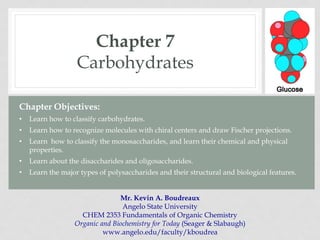
Chapter 7
Carbohydrates
Biochemistry
• Biochemistry is the study of the chemistry of
biomolecules and living organisms.
• In organic chemistry, we organized our study of
carbon-containing molecules by functional group
(alcohol, alkene, ketone, carboxylic acid, etc.).
• In the first five chapters, we will take a look at
several groups of important biological molecules,
many of which have more than one functional
group: carbohydrates (Ch. 7), lipids (Ch. 8),
proteins and enzymes (Ch. 9 and 10), and nucleic
acids (Ch. 11).
• We will also examine the synthesis of proteins (Ch.
11), nutrition (Ch. 12) and metabolism (Ch. 13, 14),
and important body fluids (Ch. 15).
2
3
Classification of
Carbohydrates
4
Carbohydrates and Biochemistry
• Carbohydrates are compounds of tremendous
biological importance:
– they provide energy through oxidation
– they supply carbon for the synthesis of cell
components
– they serve as a form of stored chemical energy
– they form part of the structures of some cells and
tissues
• Carbohydrates, along with lipids, proteins, nucleic
acids, and other compounds are known as
biomolecules because they are closely associated
with living organisms.
5
Carbohydrates
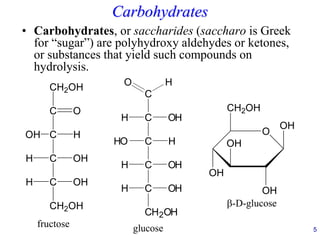
• Carbohydrates, or saccharides (saccharo is Greek
for “sugar”) are polyhydroxy aldehydes or ketones,
or substances that yield such compounds on
hydrolysis.
C
C
O H
H OH
C
HO H
C
C
OH
H
CH2OH
OH
H
glucose
C
OH H
C
C
C
OH
H
CH2OH
OH
H
O
CH2OH
fructose
O
CH2OH
OH
OH
OH
OH
-D-glucose
Carbohydrates
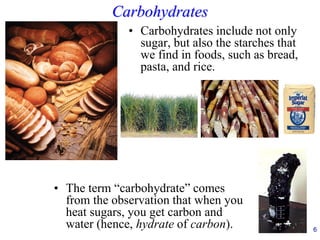
• Carbohydrates include not only
sugar, but also the starches that
we find in foods, such as bread,
pasta, and rice.
6
• The term “carbohydrate” comes
from the observation that when you
heat sugars, you get carbon and
water (hence, hydrate of carbon).
7
Classes of Carbohydrates
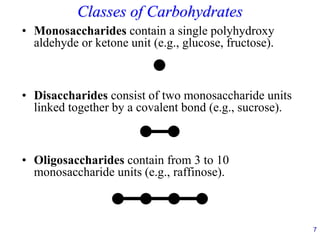
• Monosaccharides contain a single polyhydroxy
aldehyde or ketone unit (e.g., glucose, fructose).
• Disaccharides consist of two monosaccharide units
linked together by a covalent bond (e.g., sucrose).
• Oligosaccharides contain from 3 to 10
monosaccharide units (e.g., raffinose).
8
Classes of Carbohydrates
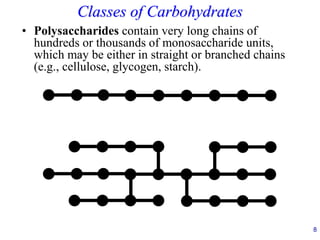
• Polysaccharides contain very long chains of
hundreds or thousands of monosaccharide units,
which may be either in straight or branched chains
(e.g., cellulose, glycogen, starch).
9
The Stereochemistry
of Carbohydrates
10
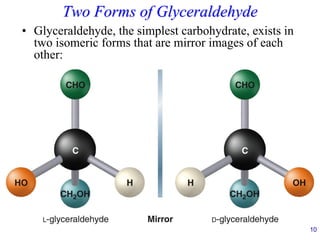
Two Forms of Glyceraldehyde
• Glyceraldehyde, the simplest carbohydrate, exists in
two isomeric forms that are mirror images of each
other:
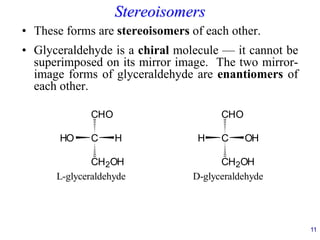
Stereoisomers
• These forms are stereoisomers of each other.
• Glyceraldehyde is a chiral molecule — it cannot be
superimposed on its mirror image. The two mirror-
image forms of glyceraldehyde are enantiomers of
each other.
11
C
CHO
CH2OH
H
HO C
H OH
CH2OH
CHO
L-glyceraldehyde D-glyceraldehyde
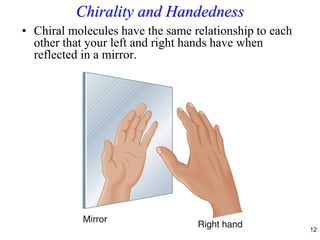
Chirality and Handedness
• Chiral molecules have the same relationship to each
other that your left and right hands have when
reflected in a mirror.
12
13
Chiral Carbons
• Chiral objects cannot be superimposed on their
mirror images — e.g., hands, gloves, and shoes.
• Achiral objects can be superimposed on the mirror
images — e.g., drinking glasses, spheres, and cubes.
• Any carbon atom which is connected to four
different groups will be chiral, and will have two
nonsuperimposable mirror images; it is a chiral
carbon or a center of chirality.
– If any of the two groups on the carbon are the
same, the carbon atom cannot be chiral.
• Many organic compounds, including carbohydrates,
contain more than one chiral carbon.
14
Examples: Chiral Carbon Atoms
• Identify the chiral carbon atoms (if any) in each of
the following molecules:
C
CH3 CH3
OH
H
C
CH3 CH2CH3
OH
H
C
CH3 CH2CH3
O
O
HO
C
CH3 CH2Cl
OH
H
HO
C
H H
H
H
C
H H
Cl
Cl
C
H Cl
Cl
Cl
C
H Cl
Br
F
15
Examples: Chiral Carbons in Carbohydrates
• Identify the chiral carbons (if any) in the following
carbohydrates:
erythrose
CH
CHO
CH OH
CH2OH
OH
C
C
O H
H OH
C
HO H
C
C
OH
H
CH2OH
OH
H
glucose
O
CH2OH
OH
OH
OH
OH
C
CH2OH
O
C
H OH
C
CH2OH
OH
H
2n Rule
• When a molecule has more than one chiral carbon,
each carbon can possibly be arranged in either the
right-hand or left-hand form, thus if there are n
chiral carbons, there are 2n possible stereoisomers.
Maximum number of possible stereoisomers = 2n
C
H Cl
Br
F
16
21 = 2 possible stereoisomers
C
CH3 C
OH
H
CH2OH
H
OH
22 = 4 possible stereoisomers
17
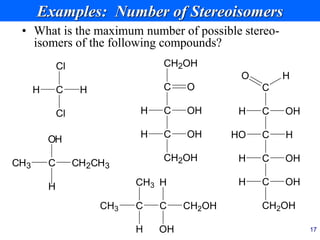
Examples: Number of Stereoisomers
• What is the maximum number of possible stereo-
isomers of the following compounds?
C
C
O H
H OH
C
HO H
C
C
OH
H
CH2OH
OH
H
C
CH2OH
O
C
H OH
C
CH2OH
OH
H
C
CH3 CH2CH3
OH
H
C
H H
Cl
Cl
C
CH3 C
CH3
H
CH2OH
OH
H
18
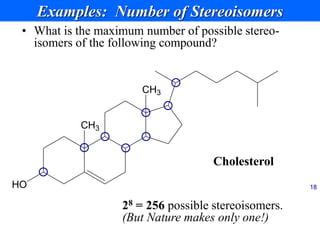
Examples: Number of Stereoisomers
• What is the maximum number of possible stereo-
isomers of the following compound?
CH3
CH3
HO 18
28 = 256 possible stereoisomers.
(But Nature makes only one!)
Cholesterol
19
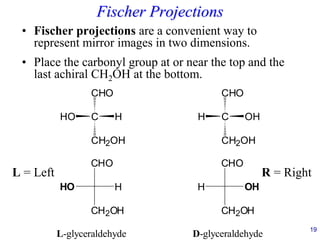
Fischer Projections
• Fischer projections are a convenient way to
represent mirror images in two dimensions.
• Place the carbonyl group at or near the top and the
last achiral CH2OH at the bottom.
C
CHO
CH2OH
H
HO C
H OH
CH2OH
CHO
CHO
CH2OH
H
HO H OH
CH2OH
CHO
L-glyceraldehyde D-glyceraldehyde
L = Left R = Right
20
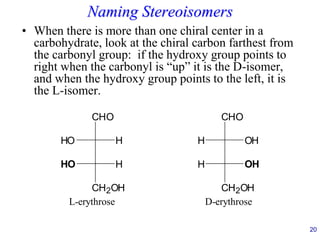
Naming Stereoisomers
• When there is more than one chiral center in a
carbohydrate, look at the chiral carbon farthest from
the carbonyl group: if the hydroxy group points to
right when the carbonyl is “up” it is the D-isomer,
and when the hydroxy group points to the left, it is
the L-isomer.
CHO
H
HO H OH
CHO
CH2OH
HO H
CH2OH
OH
H
D-erythrose
L-erythrose
21
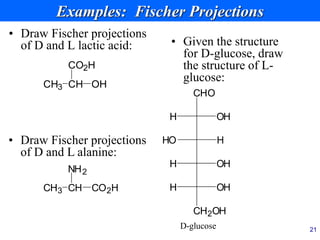
Examples: Fischer Projections
• Draw Fischer projections
of D and L lactic acid:
CH
CO2H
CH3 OH
• Draw Fischer projections
of D and L alanine:
CH
NH2
CH3 CO2H
• Given the structure
for D-glucose, draw
the structure of L-
glucose:
CHO
OH
H
H
HO
OH
H
CH2OH
OH
H
D-glucose
22
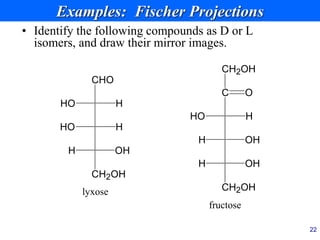
Examples: Fischer Projections
• Identify the following compounds as D or L
isomers, and draw their mirror images.
HO H
C
OH
H
CH2OH
OH
H
O
CH2OH
fructose
HO H
CH2OH
OH
H
H
CHO
lyxose
HO
23
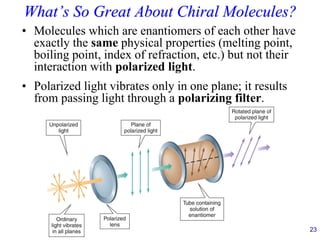
What’s So Great About Chiral Molecules?
• Molecules which are enantiomers of each other have
exactly the same physical properties (melting point,
boiling point, index of refraction, etc.) but not their
interaction with polarized light.
• Polarized light vibrates only in one plane; it results
from passing light through a polarizing filter.
24
Optical Activity
• A levorotatory (–) substance rotates polarized light
to the left [e.g., l-glucose; (-)-glucose].
• A dextrorotatory (+) substance rotates polarized
light to the right [e.g., d-glucose; (+)-glucose].
• Molecules which rotate the plane of polarized light
are optically active.
• Many biologically important molecules are chiral
and optically active. Often, living systems contain
only one of the possible stereochemical forms of a
compound, or they are found in separate systems.
– L-lactic acid is found in living muscles; D-lactic acid is present in sour milk.
– In some cases, one form of a molecule is beneficial, and the enantiomer is a
poison (e.g., thalidomide).
– Humans can metabolize D-monosaccharides but not L-isomers; only L-amino
acids are used in protein synthesis
25
Monosaccharides
26
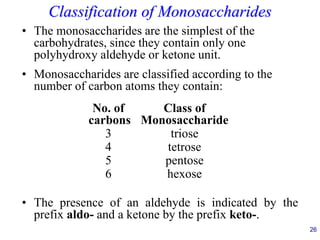
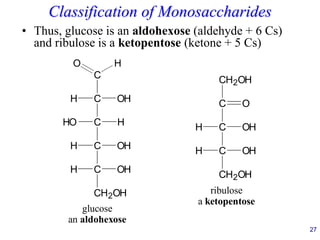
Classification of Monosaccharides
• The monosaccharides are the simplest of the
carbohydrates, since they contain only one
polyhydroxy aldehyde or ketone unit.
• Monosaccharides are classified according to the
number of carbon atoms they contain:
• The presence of an aldehyde is indicated by the
prefix aldo- and a ketone by the prefix keto-.
No. of Class of
carbons Monosaccharide
3 triose
4 tetrose
5 pentose
6 hexose
27
Classification of Monosaccharides
• Thus, glucose is an aldohexose (aldehyde + 6 Cs)
and ribulose is a ketopentose (ketone + 5 Cs)
C
C
O H
H OH
C
HO H
C
C
OH
H
CH2OH
OH
H
glucose
an aldohexose
C
CH2OH
O
C
H OH
C
CH2OH
OH
H
ribulose
a ketopentose
28
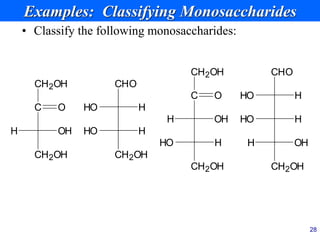
Examples: Classifying Monosaccharides
• Classify the following monosaccharides:
C
CH2OH
CH2OH
OH
H
O
CHO
CH2OH
H
HO
H
HO
C
CH2OH
OH
H
O
CH2OH
H
HO
CHO
H
HO
H
HO
CH2OH
OH
H
29
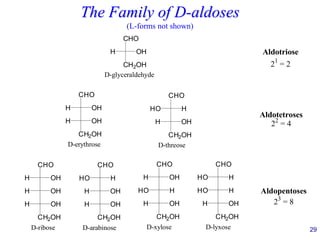
The Family of D-aldoses
(L-forms not shown)
H OH
CH2OH
CHO
Aldotriose
21
= 2
D-glyceraldehyde
H OH
CHO
CH2OH
OH
H
HO H
CHO
CH2OH
OH
H
D-threose
D-erythrose
Aldotetroses
22
= 4
CHO
H OH
H OH
CH2OH
OH
H
CHO
HO H
H OH
CH2OH
OH
H
CHO
H OH
HO H
CH2OH
OH
H
CHO
HO H
HO H
CH2OH
OH
H
D-xylose
D-arabinose D-lyxose
D-ribose
Aldopentoses
23
= 8
30
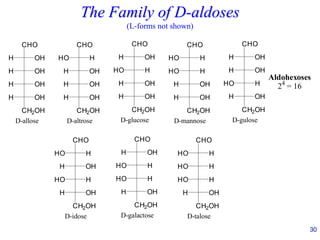
The Family of D-aldoses
(L-forms not shown)
CHO
H OH
HO H
OH
H
CH2OH
OH
H
CHO
H OH
H OH
OH
H
CH2OH
OH
H
CHO
HO H
H OH
OH
H
CH2OH
OH
H
CHO
HO H
HO H
OH
H
CH2OH
OH
H
CHO
H OH
H OH
H
HO
CH2OH
OH
H
CHO
HO H
H OH
H
HO
CH2OH
OH
H
CHO
H OH
HO H
H
HO
CH2OH
OH
H
D-glucose
CHO
HO H
HO H
H
HO
CH2OH
OH
H
D-talose
D-gulose
D-idose D-galactose
D-mannose
D-allose D-altrose
Aldohexoses
24
= 16
31
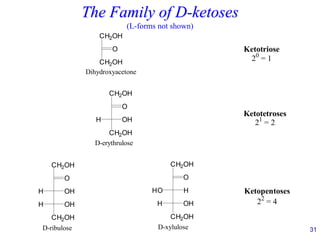
The Family of D-ketoses
(L-forms not shown)
O
CH2OH
CH2OH
Ketotriose
20
= 1
Dihydroxyacetone
O
CH2OH
CH2OH
OH
H
D-erythrulose
Ketotetroses
21
= 2
CH2OH
O
H OH
CH2OH
OH
H
CH2OH
O
HO H
CH2OH
OH
H
D-xylulose
D-ribulose
Ketopentoses
22
= 4
32
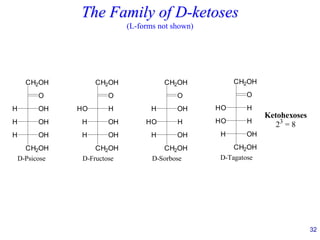
The Family of D-ketoses
(L-forms not shown)
CH2OH
O
H OH
H
HO
CH2OH
OH
H
CH2OH
O
H OH
OH
H
CH2OH
OH
H
CH2OH
O
HO H
OH
H
CH2OH
OH
H
CH2OH
O
HO H
H
HO
CH2OH
OH
H
D-Sorbose D-Tagatose
D-Psicose D-Fructose
Ketohexoses
23
= 8
33
Physical Properties of Monosaccharides
• Most monosaccharides have a sweet taste (fructose
is sweetest; 73% sweeter than sucrose).
• They are solids at room temperature.
• They are extremely soluble in water:
– Despite their high molecular weights, the
presence of large numbers of OH groups make
the monosaccharides much more water soluble
than most molecules of similar MW.
– Glucose can dissolve in minute amounts of water
to make a syrup (1 g / 1 ml H2O).
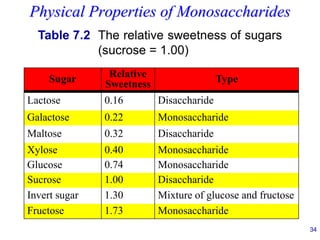
34
Sugar Relative
Sweetness Type
Lactose 0.16 Disaccharide
Galactose 0.22 Monosaccharide
Maltose 0.32 Disaccharide
Xylose 0.40 Monosaccharide
Glucose 0.74 Monosaccharide
Sucrose 1.00 Disaccharide
Invert sugar 1.30 Mixture of glucose and fructose
Fructose 1.73 Monosaccharide
Table 7.2 The relative sweetness of sugars
(sucrose = 1.00)
Physical Properties of Monosaccharides
35
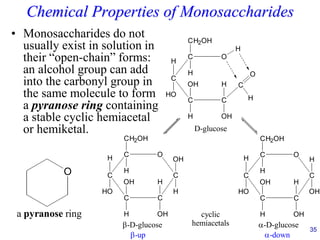
Chemical Properties of Monosaccharides
• Monosaccharides do not
usually exist in solution in
their “open-chain” forms:
an alcohol group can add
into the carbonyl group in
the same molecule to form
a pyranose ring containing
a stable cyclic hemiacetal
or hemiketal.
O
C
C
C C
C
CH2OH
H
H
HO
H OH
O
H
H
H
OH
O
C
C
C C
C
CH2OH
H
H
HO
H OH
H
OH
OH
H
O
C
C
C C
C
CH2OH
H
H
HO
H OH
H
OH
H
OH
-D-glucose -D-glucose
D-glucose
cyclic
hemiacetals
-up -down
O
a pyranose ring
36
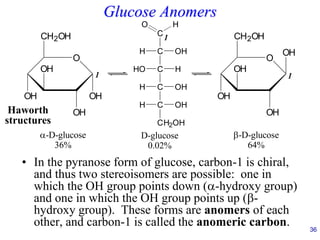
Glucose Anomers
• In the pyranose form of glucose, carbon-1 is chiral,
and thus two stereoisomers are possible: one in
which the OH group points down (-hydroxy group)
and one in which the OH group points up (-
hydroxy group). These forms are anomers of each
other, and carbon-1 is called the anomeric carbon.
O
CH2OH
OH
OH
OH
OH
C
C
O H
H OH
C
HO H
C
C
OH
H
CH2OH
OH
H
O
CH2OH
OH
OH
OH
OH
-D-glucose
64%
-D-glucose
36%
D-glucose
0.02%
1
1
1
Haworth
structures
37
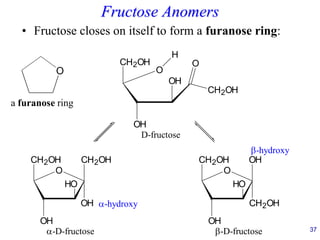
Fructose Anomers
• Fructose closes on itself to form a furanose ring:
O
a furanose ring
O
H
CH2OH
O
CH2OH
OH
OH
O
CH2OH
OH
HO
CH2OH
OH
O
CH2OH
OH
HO
OH
CH2OH
D-fructose
-D-fructose
-D-fructose
-hydroxy
-hydroxy
38
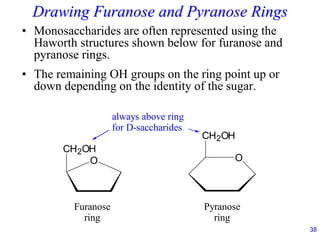
Drawing Furanose and Pyranose Rings
• Monosaccharides are often represented using the
Haworth structures shown below for furanose and
pyranose rings.
• The remaining OH groups on the ring point up or
down depending on the identity of the sugar.
O
CH2OH
O
CH2OH
Furanose
ring
Pyranose
ring
always above ring
for D-saccharides
39
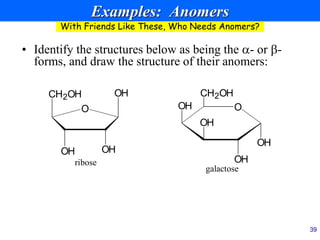
Examples: Anomers
• Identify the structures below as being the - or -
forms, and draw the structure of their anomers:
OH
CH2OH
OH OH
O
ribose
O
OH
OH
OH
OH
CH2OH
galactose
With Friends Like These, Who Needs Anomers?
40
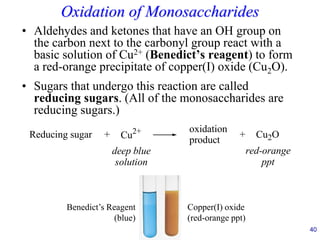
Oxidation of Monosaccharides
• Aldehydes and ketones that have an OH group on
the carbon next to the carbonyl group react with a
basic solution of Cu2+ (Benedict’s reagent) to form
a red-orange precipitate of copper(I) oxide (Cu2O).
• Sugars that undergo this reaction are called
reducing sugars. (All of the monosaccharides are
reducing sugars.)
Reducing sugar + Cu2+ oxidation
product
+ Cu2O
deep blue
solution
red-orange
ppt
Benedict’s Reagent
(blue)
Copper(I) oxide
(red-orange ppt)
41
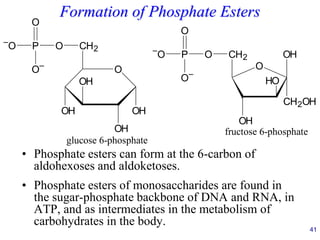
Formation of Phosphate Esters
• Phosphate esters can form at the 6-carbon of
aldohexoses and aldoketoses.
• Phosphate esters of monosaccharides are found in
the sugar-phosphate backbone of DNA and RNA, in
ATP, and as intermediates in the metabolism of
carbohydrates in the body.
O
CH2
OH
OH
OH
OH
O
P
O
O–
–
O
glucose 6-phosphate
O
CH2
OH
HO
OH
CH2OH
O
P
–
O
O–
O
fructose 6-phosphate
42
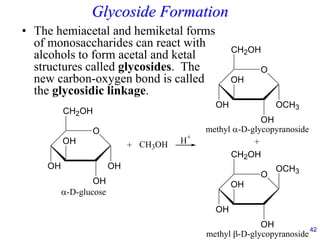
Glycoside Formation
• The hemiacetal and hemiketal forms
of monosaccharides can react with
alcohols to form acetal and ketal
structures called glycosides. The
new carbon-oxygen bond is called
the glycosidic linkage.
O
CH2OH
OH
OH
OH
OH
O
CH2OH
OH
OH
OH
OCH3
O
CH2OH
OH
OH
OH
+
OCH3
methyl -D-glycopyranoside
-D-glucose
methyl -D-glycopyranoside
+
CH3OH H+
43
Glycoside Formation
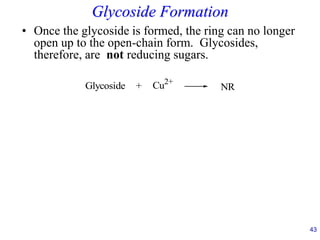
• Once the glycoside is formed, the ring can no longer
open up to the open-chain form. Glycosides,
therefore, are not reducing sugars.
Glycoside + Cu2+
NR
44
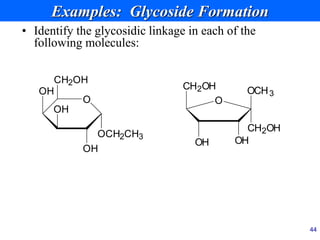
Examples: Glycoside Formation
• Identify the glycosidic linkage in each of the
following molecules:
O
CH2OH
OH
OH
OCH2CH3
OH
CH2OH
OH OH
O
CH2OH
OCH3
45
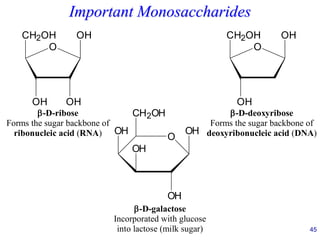
Important Monosaccharides
O
CH2OH
OH
OH
OH
-D-ribose
Forms the sugar backbone of
ribonucleic acid (RNA)
O
CH2OH
OH
OH
-D-deoxyribose
Forms the sugar backbone of
deoxyribonucleic acid (DNA)
O
CH2OH
OH
OH
OH
-D-galactose
Incorporated with glucose
into lactose (milk sugar)
OH
46
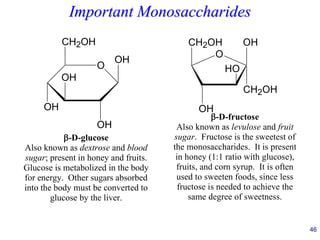
Important Monosaccharides
O
CH2OH
OH
OH
OH
OH
-D-glucose
Also known as dextrose and blood
sugar; present in honey and fruits.
Glucose is metabolized in the body
for energy. Other sugars absorbed
into the body must be converted to
glucose by the liver.
O
CH2OH
OH
HO
OH
CH2OH
-D-fructose
Also known as levulose and fruit
sugar. Fructose is the sweetest of
the monosaccharides. It is present
in honey (1:1 ratio with glucose),
fruits, and corn syrup. It is often
used to sweeten foods, since less
fructose is needed to achieve the
same degree of sweetness.
47
Disaccharides and
Oligosaccharides
48
Disaccharides
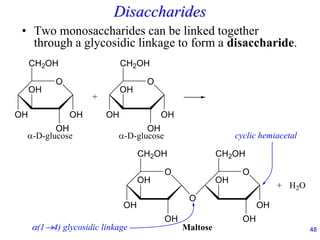
• Two monosaccharides can be linked together
through a glycosidic linkage to form a disaccharide.
O
CH2OH
OH
OH
OH
OH
O
CH2OH
OH
OH
OH
OH
O
CH2OH
O
OH
OH
OH
O
CH2OH
OH
OH
OH
Maltose
+
-D-glucose -D-glucose
+
(1→4) glycosidic linkage
cyclic hemiacetal
H2O
Disaccharides
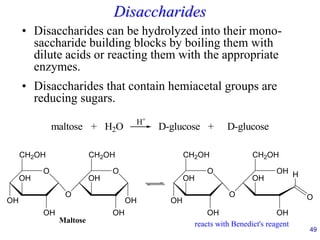
• Disaccharides can be hydrolyzed into their mono-
saccharide building blocks by boiling them with
dilute acids or reacting them with the appropriate
enzymes.
• Disaccharides that contain hemiacetal groups are
reducing sugars.
49
O
CH2OH
O
OH
OH
OH
O
CH2OH
OH
OH
OH
Maltose
O
CH2OH
O
OH
OH
OH
OH
CH2OH
O
OH
OH H
reacts with Benedict's reagent
maltose + H2O D-glucose + D-glucose
H+
50
Important Disaccharides
O
CH2OH
O
OH
OH
OH
O
CH2OH
OH
OH
OH
-D-glucose -D-glucose
Maltose
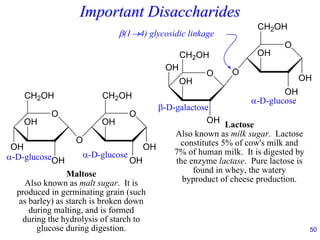
Also known as malt sugar. It is
produced in germinating grain (such
as barley) as starch is broken down
during malting, and is formed
during the hydrolysis of starch to
glucose during digestion.
O
CH2OH
OH
OH
OH
O
O
CH2OH
OH
OH
OH
(1→4) glycosidic linkage
-D-galactose
-D-glucose
Lactose
Also known as milk sugar. Lactose
constitutes 5% of cow's milk and
7% of human milk. It is digested by
the enzyme lactase. Pure lactose is
found in whey, the watery
byproduct of cheese production.
51
Important Disaccharides
O
C H 2 O H
O
C H 2 O H
O H
O H
O H
O
C H 2 O H
H O
O H
 - D - g l u c o s e
 - D - f r u c t o s e
 −  →  − 
g l y c o s i d i c
l i n k a g e
HO
O
HO
OH
OH
OH
O
OH
O
OH
OH
Sucrose
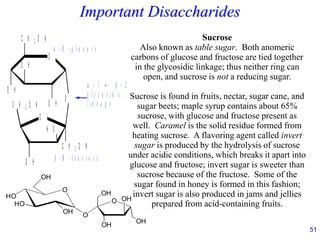
Also known as table sugar. Both anomeric
carbons of glucose and fructose are tied together
in the glycosidic linkage; thus neither ring can
open, and sucrose is not a reducing sugar.
Sucrose is found in fruits, nectar, sugar cane, and
sugar beets; maple syrup contains about 65%
sucrose, with glucose and fructose present as
well. Caramel is the solid residue formed from
heating sucrose. A flavoring agent called invert
sugar is produced by the hydrolysis of sucrose
under acidic conditions, which breaks it apart into
glucose and fructose; invert sugar is sweeter than
sucrose because of the fructose. Some of the
sugar found in honey is formed in this fashion;
invert sugar is also produced in jams and jellies
prepared from acid-containing fruits.
52
Oligosaccharides
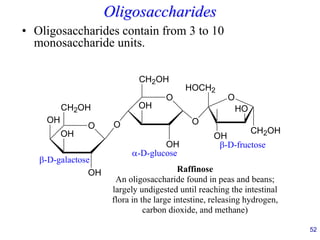
• Oligosaccharides contain from 3 to 10
monosaccharide units.
O
CH2OH
OH
OH
OH
O
O
CH2OH
OH
OH
-D-galactose
-D-glucose
Raffinose
An oligosaccharide found in peas and beans;
largely undigested until reaching the intestinal
flora in the large intestine, releasing hydrogen,
carbon dioxide, and methane)
O
HOCH2
O
OH
HO
CH2OH
-D-fructose
53
Polysaccharides
54
Polysaccharides
• Polysaccharides contain hundreds or thousands of
carbohydrate units.
• Polysaccharides are not reducing sugars, since the
anomeric carbons are connected through glycosidic
linkages.
• We will consider three kinds of polysaccharides, all
of which are polymers of glucose: starch, glycogen,
and cellulose.
55
Starch
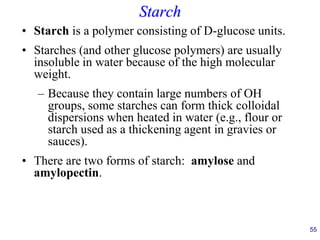
• Starch is a polymer consisting of D-glucose units.
• Starches (and other glucose polymers) are usually
insoluble in water because of the high molecular
weight.
– Because they contain large numbers of OH
groups, some starches can form thick colloidal
dispersions when heated in water (e.g., flour or
starch used as a thickening agent in gravies or
sauces).
• There are two forms of starch: amylose and
amylopectin.
Starch — Amylose
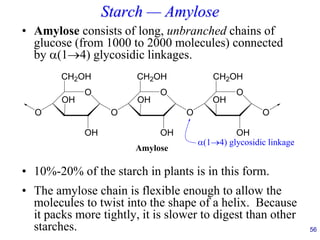
• Amylose consists of long, unbranched chains of
glucose (from 1000 to 2000 molecules) connected
by (1→4) glycosidic linkages.
• 10%-20% of the starch in plants is in this form.
• The amylose chain is flexible enough to allow the
molecules to twist into the shape of a helix. Because
it packs more tightly, it is slower to digest than other
starches. 56
O
CH2OH
OH
OH
O
O
O
CH2OH
OH
OH
O
O
CH2OH
OH
OH
O
(1→4) glycosidic linkage
Amylose
Starch — Amylose
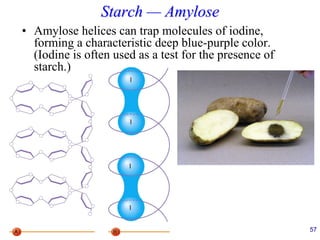
• Amylose helices can trap molecules of iodine,
forming a characteristic deep blue-purple color.
(Iodine is often used as a test for the presence of
starch.)
57
58
Starch — Amylopectin
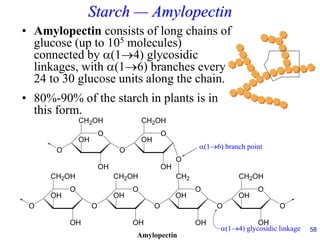
• Amylopectin consists of long chains of
glucose (up to 105 molecules)
connected by (1→4) glycosidic
linkages, with (1→6) branches every
24 to 30 glucose units along the chain.
• 80%-90% of the starch in plants is in
this form.
O
CH2OH
OH
OH
O
O
CH2
OH
OH
O
O
CH2OH
OH
OH
O
O
CH2OH
OH
OH
O
(1→4) glycosidic linkage
(1→6) branch point
O
CH2OH
OH
OH
O
O
O
CH2OH
OH
OH
O
O
Amylopectin
59
Glycogen
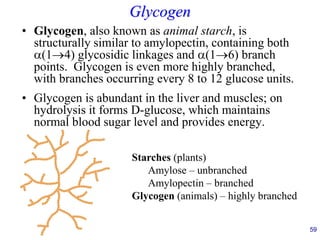
• Glycogen, also known as animal starch, is
structurally similar to amylopectin, containing both
(1→4) glycosidic linkages and (1→6) branch
points. Glycogen is even more highly branched,
with branches occurring every 8 to 12 glucose units.
• Glycogen is abundant in the liver and muscles; on
hydrolysis it forms D-glucose, which maintains
normal blood sugar level and provides energy.
Starches (plants)
Amylose – unbranched
Amylopectin – branched
Glycogen (animals) – highly branched
60
Cellulose
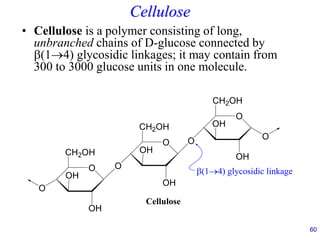
• Cellulose is a polymer consisting of long,
unbranched chains of D-glucose connected by
(1→4) glycosidic linkages; it may contain from
300 to 3000 glucose units in one molecule.
O
CH2OH
OH
OH
O
O
O
CH2OH
OH
OH
O
O
CH2OH
OH
OH
O
(1→4) glycosidic linkage
Cellulose
61
Cellulose
• Because of the -linkages, cellulose has a different
overall shape from amylose, forming extended
straight chains which hydrogen bond to each other,
resulting in a very rigid structure.
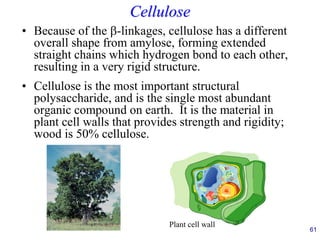
• Cellulose is the most important structural
polysaccharide, and is the single most abundant
organic compound on earth. It is the material in
plant cell walls that provides strength and rigidity;
wood is 50% cellulose.
Plant cell wall
62
Cellulose
• Most animals lack the enzymes needed to digest
cellulose, but it does provide roughage (dietary
fiber) to stimulate contraction of the intestines and
help pass food through the digestive system.
– Some animals, such as cows, sheep, and goats
(ruminants), process cellulose using colonies of bacteria
in the digestive system which are capable of breaking
down cellulose, and a series of stomachs to give cellulose
a longer time to digest.
– Some other animals have a longer intestinal tract (e.g.,
horses), and others reprocess digested food (e.g., rabbits)
to allow more time for the breakdown of cellulose to
occur.
• Cellulose is important industrially, from its presence
in wood, paper, cotton, cellophane, rayon, linen,
nitrocellulose (guncotton), photographic films
(cellulose acetate), etc.
63
Nitrocellulose, Celluloid, and Rayon
• Guncotton (German, schiessbaumwolle) is cotton which has been treated
with a mixture of nitric and sulfuric acids. It was discovered by Christian
Friedrich Schönbein in 1845, when he used his wife’s cotton apron to
wipe up a mixture of nitric and sulfuric acids in his kitchen, which
vanished in a flash of flame when it dried out over a fire. Schönbein
attempted to market it as a smokeless powder, but it combusted so readily
it was dangerous to handle. Eventually its use was replaced by cordite
(James Dewar and Frederick Abel, 1891), a mixture of nitrocellulose,
nitroglycerine, and petroleum jelly, which could be extruded into cords.
• Celluloid (John Hyatt, 1869) was the first synthetic plastic, made by
combining partially nitrated cellulose with alcohol and ether and adding
camphor to make it softer and more malleable. It was used in
manufacturing synthetic billiard balls (as a replacement for ivory),
photographic film, etc.; it was eventually replaced by less flammable
plastics.
• Rayon (Louis Marie Chardonnet, 1884) consists of partially nitrated
cellulose mixed with solvents and extruded through small holes, allowing
the solvent to evaporate; rayon was a sensation when introduced since it
was a good substitute for silk, but it was still highly flammable.
Dietary Fiber
• Dietary fiber consists of complex carbohydrates,
such as cellulose, and other substances that make up
the cell walls and structural parts of plants.
• Good sources of dietary fiber include cereal grains,
oatmeal, fresh fruits and vegetables, and grain
products.
• Soluble fiber, such as pectin, has a lower molecular
weight, and is more water soluble. Soluble fiber
traps carbohydrates and slows their digestion and
absorption, thereby leveling out blood sugar levels
during the day. Soluble fiber also helps to lower
cholesterol levels by binding dietary cholesterol.
• Insoluble fiber, such as cellulose, provides bulk to
the stool, which helps the body to eliminate solid
wastes.
64
Chitin
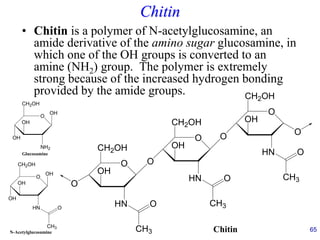
• Chitin is a polymer of N-acetylglucosamine, an
amide derivative of the amino sugar glucosamine, in
which one of the OH groups is converted to an
amine (NH2) group. The polymer is extremely
strong because of the increased hydrogen bonding
provided by the amide groups.
65
O
CH2OH
OH
OH
NH2
OH
Glucosamine
O
CH2OH
OH
OH
HN
OH
N-Acetylglucosamine
CH3
O
O
CH2OH
OH
HN
O
O
O
CH2OH
OH
HN
O
O
CH2OH
OH
HN
O
Chitin
CH3
O CH3
O CH3
O
Chitin
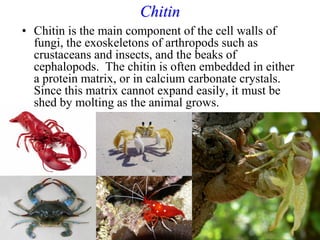
• Chitin is the main component of the cell walls of
fungi, the exoskeletons of arthropods such as
crustaceans and insects, and the beaks of
cephalopods. The chitin is often embedded in either
a protein matrix, or in calcium carbonate crystals.
Since this matrix cannot expand easily, it must be
shed by molting as the animal grows.
66
67
How Sweet It Is!
Sugar Substitutes
68
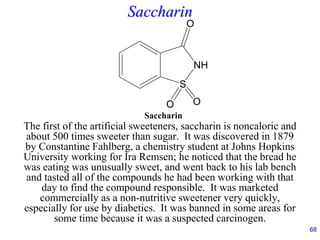
Saccharin
The first of the artificial sweeteners, saccharin is noncaloric and
about 500 times sweeter than sugar. It was discovered in 1879
by Constantine Fahlberg, a chemistry student at Johns Hopkins
University working for Ira Remsen; he noticed that the bread he
was eating was unusually sweet, and went back to his lab bench
and tasted all of the compounds he had been working with that
day to find the compound responsible. It was marketed
commercially as a non-nutritive sweetener very quickly,
especially for use by diabetics. It was banned in some areas for
some time because it was a suspected carcinogen.
S
NH
O
O
O
Saccharin
69
Aspartame (NutraSweet)
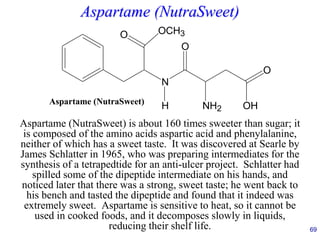
Aspartame (NutraSweet) is about 160 times sweeter than sugar; it
is composed of the amino acids aspartic acid and phenylalanine,
neither of which has a sweet taste. It was discovered at Searle by
James Schlatter in 1965, who was preparing intermediates for the
synthesis of a tetrapedtide for an anti-ulcer project. Schlatter had
spilled some of the dipeptide intermediate on his hands, and
noticed later that there was a strong, sweet taste; he went back to
his bench and tasted the dipeptide and found that it indeed was
extremely sweet. Aspartame is sensitive to heat, so it cannot be
used in cooked foods, and it decomposes slowly in liquids,
reducing their shelf life.
OCH3
O
N
O
NH2
O
OH
H
Aspartame (NutraSweet)
70
N
S
H
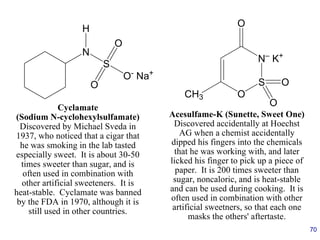
Cyclamate
(Sodium N-cyclohexylsulfamate)
Discovered by Michael Sveda in
1937, who noticed that a cigar that
he was smoking in the lab tasted
especially sweet. It is about 30-50
times sweeter than sugar, and is
often used in combination with
other artificial sweeteners. It is
heat-stable. Cyclamate was banned
by the FDA in 1970, although it is
still used in other countries.
O-
Na+
O
O
O
S
N–
K+
O
CH3
O
O
Acesulfame-K (Sunette, Sweet One)
Discovered accidentally at Hoechst
AG when a chemist accidentally
dipped his fingers into the chemicals
that he was working with, and later
licked his finger to pick up a piece of
paper. It is 200 times sweeter than
sugar, noncaloric, and is heat-stable
and can be used during cooking. It is
often used in combination with other
artificial sweetners, so that each one
masks the others' aftertaste.
71
O
CH2OH
Cl
OH
OH
"galactose"
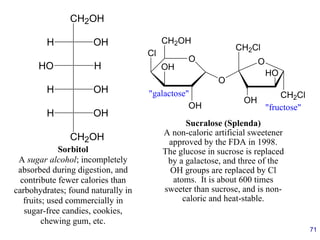
Sucralose (Splenda)
A non-caloric artificial sweetener
approved by the FDA in 1998.
The glucose in sucrose is replaced
by a galactose, and three of the
OH groups are replaced by Cl
atoms. It is about 600 times
sweeter than sucrose, and is non-
caloric and heat-stable.
O
CH2Cl
O
OH
HO
CH2Cl
"fructose"
CH2OH
H OH
HO H
H OH
H OH
CH2OH
Sorbitol
A sugar alcohol; incompletely
absorbed during digestion, and
contribute fewer calories than
carbohydrates; found naturally in
fruits; used commercially in
sugar-free candies, cookies,
chewing gum, etc.
72
Stevia
OH
O
HO Steviol
O
O
O
O
O
O
O
OH
HO
HO
OH
OH
OH
OH
HO
OH
HO
OH
Stevioside
(a steviol glycoside)
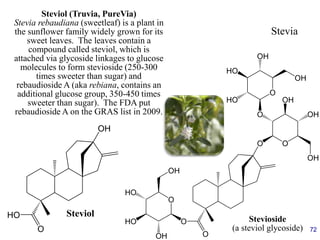
Steviol (Truvia, PureVia)
Stevia rebaudiana (sweetleaf) is a plant in
the sunflower family widely grown for its
sweet leaves. The leaves contain a
compound called steviol, which is
attached via glycoside linkages to glucose
molecules to form stevioside (250-300
times sweeter than sugar) and
rebaudioside A (aka rebiana, contains an
additional glucose group, 350-450 times
sweeter than sugar). The FDA put
rebaudioside A on the GRAS list in 2009.
73
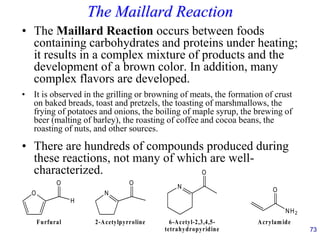
The Maillard Reaction
• The Maillard Reaction occurs between foods
containing carbohydrates and proteins under heating;
it results in a complex mixture of products and the
development of a brown color. In addition, many
complex flavors are developed.
• It is observed in the grilling or browning of meats, the formation of crust
on baked breads, toast and pretzels, the toasting of marshmallows, the
frying of potatoes and onions, the boiling of maple syrup, the brewing of
beer (malting of barley), the roasting of coffee and cocoa beans, the
roasting of nuts, and other sources.
• There are hundreds of compounds produced during
these reactions, not many of which are well-
characterized.
O
H
O
Furfural
N
N
O
O
2-Acetylpyrroline 6-Acetyl-2,3,4,5-
tetrahydropyridine
NH2
O
Acrylamide
74
The End

Chapter_07.pdf

  • 1.
    Mr. Kevin A.Boudreaux Angelo State University CHEM 2353 Fundamentals of Organic Chemistry Organic and Biochemistry for Today (Seager & Slabaugh) www.angelo.edu/faculty/kboudrea Chapter Objectives: • Learn how to classify carbohydrates. • Learn how to recognize molecules with chiral centers and draw Fischer projections. • Learn how to classify the monosaccharides, and learn their chemical and physical properties. • Learn about the disaccharides and oligosaccharides. • Learn the major types of polysaccharides and their structural and biological features. Chapter 7 Carbohydrates
  • 2.
    Biochemistry • Biochemistry isthe study of the chemistry of biomolecules and living organisms. • In organic chemistry, we organized our study of carbon-containing molecules by functional group (alcohol, alkene, ketone, carboxylic acid, etc.). • In the first five chapters, we will take a look at several groups of important biological molecules, many of which have more than one functional group: carbohydrates (Ch. 7), lipids (Ch. 8), proteins and enzymes (Ch. 9 and 10), and nucleic acids (Ch. 11). • We will also examine the synthesis of proteins (Ch. 11), nutrition (Ch. 12) and metabolism (Ch. 13, 14), and important body fluids (Ch. 15). 2
  • 3.
  • 4.
    4 Carbohydrates and Biochemistry •Carbohydrates are compounds of tremendous biological importance: – they provide energy through oxidation – they supply carbon for the synthesis of cell components – they serve as a form of stored chemical energy – they form part of the structures of some cells and tissues • Carbohydrates, along with lipids, proteins, nucleic acids, and other compounds are known as biomolecules because they are closely associated with living organisms.
  • 5.
    5 Carbohydrates • Carbohydrates, orsaccharides (saccharo is Greek for “sugar”) are polyhydroxy aldehydes or ketones, or substances that yield such compounds on hydrolysis. C C O H H OH C HO H C C OH H CH2OH OH H glucose C OH H C C C OH H CH2OH OH H O CH2OH fructose O CH2OH OH OH OH OH -D-glucose
  • 6.
    Carbohydrates • Carbohydrates includenot only sugar, but also the starches that we find in foods, such as bread, pasta, and rice. 6 • The term “carbohydrate” comes from the observation that when you heat sugars, you get carbon and water (hence, hydrate of carbon).
  • 7.
    7 Classes of Carbohydrates •Monosaccharides contain a single polyhydroxy aldehyde or ketone unit (e.g., glucose, fructose). • Disaccharides consist of two monosaccharide units linked together by a covalent bond (e.g., sucrose). • Oligosaccharides contain from 3 to 10 monosaccharide units (e.g., raffinose).
  • 8.
    8 Classes of Carbohydrates •Polysaccharides contain very long chains of hundreds or thousands of monosaccharide units, which may be either in straight or branched chains (e.g., cellulose, glycogen, starch).
  • 9.
  • 10.
    10 Two Forms ofGlyceraldehyde • Glyceraldehyde, the simplest carbohydrate, exists in two isomeric forms that are mirror images of each other:
  • 11.
    Stereoisomers • These formsare stereoisomers of each other. • Glyceraldehyde is a chiral molecule — it cannot be superimposed on its mirror image. The two mirror- image forms of glyceraldehyde are enantiomers of each other. 11 C CHO CH2OH H HO C H OH CH2OH CHO L-glyceraldehyde D-glyceraldehyde
  • 12.
    Chirality and Handedness •Chiral molecules have the same relationship to each other that your left and right hands have when reflected in a mirror. 12
  • 13.
    13 Chiral Carbons • Chiralobjects cannot be superimposed on their mirror images — e.g., hands, gloves, and shoes. • Achiral objects can be superimposed on the mirror images — e.g., drinking glasses, spheres, and cubes. • Any carbon atom which is connected to four different groups will be chiral, and will have two nonsuperimposable mirror images; it is a chiral carbon or a center of chirality. – If any of the two groups on the carbon are the same, the carbon atom cannot be chiral. • Many organic compounds, including carbohydrates, contain more than one chiral carbon.
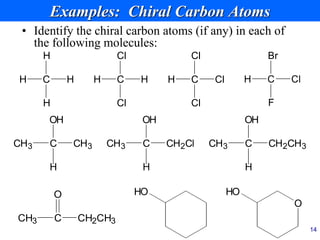
  • 14.
    14 Examples: Chiral CarbonAtoms • Identify the chiral carbon atoms (if any) in each of the following molecules: C CH3 CH3 OH H C CH3 CH2CH3 OH H C CH3 CH2CH3 O O HO C CH3 CH2Cl OH H HO C H H H H C H H Cl Cl C H Cl Cl Cl C H Cl Br F
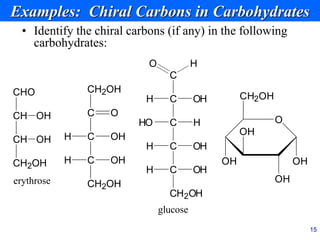
  • 15.
    15 Examples: Chiral Carbonsin Carbohydrates • Identify the chiral carbons (if any) in the following carbohydrates: erythrose CH CHO CH OH CH2OH OH C C O H H OH C HO H C C OH H CH2OH OH H glucose O CH2OH OH OH OH OH C CH2OH O C H OH C CH2OH OH H
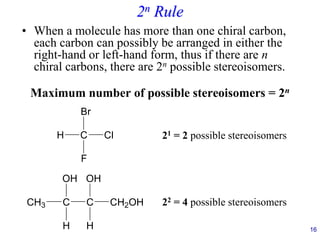
  • 16.
    2n Rule • Whena molecule has more than one chiral carbon, each carbon can possibly be arranged in either the right-hand or left-hand form, thus if there are n chiral carbons, there are 2n possible stereoisomers. Maximum number of possible stereoisomers = 2n C H Cl Br F 16 21 = 2 possible stereoisomers C CH3 C OH H CH2OH H OH 22 = 4 possible stereoisomers
  • 17.
    17 Examples: Number ofStereoisomers • What is the maximum number of possible stereo- isomers of the following compounds? C C O H H OH C HO H C C OH H CH2OH OH H C CH2OH O C H OH C CH2OH OH H C CH3 CH2CH3 OH H C H H Cl Cl C CH3 C CH3 H CH2OH OH H
  • 18.
    18 Examples: Number ofStereoisomers • What is the maximum number of possible stereo- isomers of the following compound? CH3 CH3 HO 18 28 = 256 possible stereoisomers. (But Nature makes only one!) Cholesterol
  • 19.
    19 Fischer Projections • Fischerprojections are a convenient way to represent mirror images in two dimensions. • Place the carbonyl group at or near the top and the last achiral CH2OH at the bottom. C CHO CH2OH H HO C H OH CH2OH CHO CHO CH2OH H HO H OH CH2OH CHO L-glyceraldehyde D-glyceraldehyde L = Left R = Right
  • 20.
    20 Naming Stereoisomers • Whenthere is more than one chiral center in a carbohydrate, look at the chiral carbon farthest from the carbonyl group: if the hydroxy group points to right when the carbonyl is “up” it is the D-isomer, and when the hydroxy group points to the left, it is the L-isomer. CHO H HO H OH CHO CH2OH HO H CH2OH OH H D-erythrose L-erythrose
  • 21.
    21 Examples: Fischer Projections •Draw Fischer projections of D and L lactic acid: CH CO2H CH3 OH • Draw Fischer projections of D and L alanine: CH NH2 CH3 CO2H • Given the structure for D-glucose, draw the structure of L- glucose: CHO OH H H HO OH H CH2OH OH H D-glucose
  • 22.
    22 Examples: Fischer Projections •Identify the following compounds as D or L isomers, and draw their mirror images. HO H C OH H CH2OH OH H O CH2OH fructose HO H CH2OH OH H H CHO lyxose HO
  • 23.
    23 What’s So GreatAbout Chiral Molecules? • Molecules which are enantiomers of each other have exactly the same physical properties (melting point, boiling point, index of refraction, etc.) but not their interaction with polarized light. • Polarized light vibrates only in one plane; it results from passing light through a polarizing filter.
  • 24.
    24 Optical Activity • Alevorotatory (–) substance rotates polarized light to the left [e.g., l-glucose; (-)-glucose]. • A dextrorotatory (+) substance rotates polarized light to the right [e.g., d-glucose; (+)-glucose]. • Molecules which rotate the plane of polarized light are optically active. • Many biologically important molecules are chiral and optically active. Often, living systems contain only one of the possible stereochemical forms of a compound, or they are found in separate systems. – L-lactic acid is found in living muscles; D-lactic acid is present in sour milk. – In some cases, one form of a molecule is beneficial, and the enantiomer is a poison (e.g., thalidomide). – Humans can metabolize D-monosaccharides but not L-isomers; only L-amino acids are used in protein synthesis
  • 25.
  • 26.
    26 Classification of Monosaccharides •The monosaccharides are the simplest of the carbohydrates, since they contain only one polyhydroxy aldehyde or ketone unit. • Monosaccharides are classified according to the number of carbon atoms they contain: • The presence of an aldehyde is indicated by the prefix aldo- and a ketone by the prefix keto-. No. of Class of carbons Monosaccharide 3 triose 4 tetrose 5 pentose 6 hexose
  • 27.
    27 Classification of Monosaccharides •Thus, glucose is an aldohexose (aldehyde + 6 Cs) and ribulose is a ketopentose (ketone + 5 Cs) C C O H H OH C HO H C C OH H CH2OH OH H glucose an aldohexose C CH2OH O C H OH C CH2OH OH H ribulose a ketopentose
  • 28.
    28 Examples: Classifying Monosaccharides •Classify the following monosaccharides: C CH2OH CH2OH OH H O CHO CH2OH H HO H HO C CH2OH OH H O CH2OH H HO CHO H HO H HO CH2OH OH H
  • 29.
    29 The Family ofD-aldoses (L-forms not shown) H OH CH2OH CHO Aldotriose 21 = 2 D-glyceraldehyde H OH CHO CH2OH OH H HO H CHO CH2OH OH H D-threose D-erythrose Aldotetroses 22 = 4 CHO H OH H OH CH2OH OH H CHO HO H H OH CH2OH OH H CHO H OH HO H CH2OH OH H CHO HO H HO H CH2OH OH H D-xylose D-arabinose D-lyxose D-ribose Aldopentoses 23 = 8
  • 30.
    30 The Family ofD-aldoses (L-forms not shown) CHO H OH HO H OH H CH2OH OH H CHO H OH H OH OH H CH2OH OH H CHO HO H H OH OH H CH2OH OH H CHO HO H HO H OH H CH2OH OH H CHO H OH H OH H HO CH2OH OH H CHO HO H H OH H HO CH2OH OH H CHO H OH HO H H HO CH2OH OH H D-glucose CHO HO H HO H H HO CH2OH OH H D-talose D-gulose D-idose D-galactose D-mannose D-allose D-altrose Aldohexoses 24 = 16
  • 31.
    31 The Family ofD-ketoses (L-forms not shown) O CH2OH CH2OH Ketotriose 20 = 1 Dihydroxyacetone O CH2OH CH2OH OH H D-erythrulose Ketotetroses 21 = 2 CH2OH O H OH CH2OH OH H CH2OH O HO H CH2OH OH H D-xylulose D-ribulose Ketopentoses 22 = 4
  • 32.
    32 The Family ofD-ketoses (L-forms not shown) CH2OH O H OH H HO CH2OH OH H CH2OH O H OH OH H CH2OH OH H CH2OH O HO H OH H CH2OH OH H CH2OH O HO H H HO CH2OH OH H D-Sorbose D-Tagatose D-Psicose D-Fructose Ketohexoses 23 = 8
  • 33.
    33 Physical Properties ofMonosaccharides • Most monosaccharides have a sweet taste (fructose is sweetest; 73% sweeter than sucrose). • They are solids at room temperature. • They are extremely soluble in water: – Despite their high molecular weights, the presence of large numbers of OH groups make the monosaccharides much more water soluble than most molecules of similar MW. – Glucose can dissolve in minute amounts of water to make a syrup (1 g / 1 ml H2O).
  • 34.
    34 Sugar Relative Sweetness Type Lactose0.16 Disaccharide Galactose 0.22 Monosaccharide Maltose 0.32 Disaccharide Xylose 0.40 Monosaccharide Glucose 0.74 Monosaccharide Sucrose 1.00 Disaccharide Invert sugar 1.30 Mixture of glucose and fructose Fructose 1.73 Monosaccharide Table 7.2 The relative sweetness of sugars (sucrose = 1.00) Physical Properties of Monosaccharides
  • 35.
    35 Chemical Properties ofMonosaccharides • Monosaccharides do not usually exist in solution in their “open-chain” forms: an alcohol group can add into the carbonyl group in the same molecule to form a pyranose ring containing a stable cyclic hemiacetal or hemiketal. O C C C C C CH2OH H H HO H OH O H H H OH O C C C C C CH2OH H H HO H OH H OH OH H O C C C C C CH2OH H H HO H OH H OH H OH -D-glucose -D-glucose D-glucose cyclic hemiacetals -up -down O a pyranose ring
  • 36.
    36 Glucose Anomers • Inthe pyranose form of glucose, carbon-1 is chiral, and thus two stereoisomers are possible: one in which the OH group points down (-hydroxy group) and one in which the OH group points up (- hydroxy group). These forms are anomers of each other, and carbon-1 is called the anomeric carbon. O CH2OH OH OH OH OH C C O H H OH C HO H C C OH H CH2OH OH H O CH2OH OH OH OH OH -D-glucose 64% -D-glucose 36% D-glucose 0.02% 1 1 1 Haworth structures
  • 37.
    37 Fructose Anomers • Fructosecloses on itself to form a furanose ring: O a furanose ring O H CH2OH O CH2OH OH OH O CH2OH OH HO CH2OH OH O CH2OH OH HO OH CH2OH D-fructose -D-fructose -D-fructose -hydroxy -hydroxy
  • 38.
    38 Drawing Furanose andPyranose Rings • Monosaccharides are often represented using the Haworth structures shown below for furanose and pyranose rings. • The remaining OH groups on the ring point up or down depending on the identity of the sugar. O CH2OH O CH2OH Furanose ring Pyranose ring always above ring for D-saccharides
  • 39.
    39 Examples: Anomers • Identifythe structures below as being the - or - forms, and draw the structure of their anomers: OH CH2OH OH OH O ribose O OH OH OH OH CH2OH galactose With Friends Like These, Who Needs Anomers?
  • 40.
    40 Oxidation of Monosaccharides •Aldehydes and ketones that have an OH group on the carbon next to the carbonyl group react with a basic solution of Cu2+ (Benedict’s reagent) to form a red-orange precipitate of copper(I) oxide (Cu2O). • Sugars that undergo this reaction are called reducing sugars. (All of the monosaccharides are reducing sugars.) Reducing sugar + Cu2+ oxidation product + Cu2O deep blue solution red-orange ppt Benedict’s Reagent (blue) Copper(I) oxide (red-orange ppt)
  • 41.
    41 Formation of PhosphateEsters • Phosphate esters can form at the 6-carbon of aldohexoses and aldoketoses. • Phosphate esters of monosaccharides are found in the sugar-phosphate backbone of DNA and RNA, in ATP, and as intermediates in the metabolism of carbohydrates in the body. O CH2 OH OH OH OH O P O O– – O glucose 6-phosphate O CH2 OH HO OH CH2OH O P – O O– O fructose 6-phosphate
  • 42.
    42 Glycoside Formation • Thehemiacetal and hemiketal forms of monosaccharides can react with alcohols to form acetal and ketal structures called glycosides. The new carbon-oxygen bond is called the glycosidic linkage. O CH2OH OH OH OH OH O CH2OH OH OH OH OCH3 O CH2OH OH OH OH + OCH3 methyl -D-glycopyranoside -D-glucose methyl -D-glycopyranoside + CH3OH H+
  • 43.
    43 Glycoside Formation • Oncethe glycoside is formed, the ring can no longer open up to the open-chain form. Glycosides, therefore, are not reducing sugars. Glycoside + Cu2+ NR
  • 44.
    44 Examples: Glycoside Formation •Identify the glycosidic linkage in each of the following molecules: O CH2OH OH OH OCH2CH3 OH CH2OH OH OH O CH2OH OCH3
  • 45.
    45 Important Monosaccharides O CH2OH OH OH OH -D-ribose Forms thesugar backbone of ribonucleic acid (RNA) O CH2OH OH OH -D-deoxyribose Forms the sugar backbone of deoxyribonucleic acid (DNA) O CH2OH OH OH OH -D-galactose Incorporated with glucose into lactose (milk sugar) OH
  • 46.
    46 Important Monosaccharides O CH2OH OH OH OH OH -D-glucose Also knownas dextrose and blood sugar; present in honey and fruits. Glucose is metabolized in the body for energy. Other sugars absorbed into the body must be converted to glucose by the liver. O CH2OH OH HO OH CH2OH -D-fructose Also known as levulose and fruit sugar. Fructose is the sweetest of the monosaccharides. It is present in honey (1:1 ratio with glucose), fruits, and corn syrup. It is often used to sweeten foods, since less fructose is needed to achieve the same degree of sweetness.
  • 47.
  • 48.
    48 Disaccharides • Two monosaccharidescan be linked together through a glycosidic linkage to form a disaccharide. O CH2OH OH OH OH OH O CH2OH OH OH OH OH O CH2OH O OH OH OH O CH2OH OH OH OH Maltose + -D-glucose -D-glucose + (1→4) glycosidic linkage cyclic hemiacetal H2O
  • 49.
    Disaccharides • Disaccharides canbe hydrolyzed into their mono- saccharide building blocks by boiling them with dilute acids or reacting them with the appropriate enzymes. • Disaccharides that contain hemiacetal groups are reducing sugars. 49 O CH2OH O OH OH OH O CH2OH OH OH OH Maltose O CH2OH O OH OH OH OH CH2OH O OH OH H reacts with Benedict's reagent maltose + H2O D-glucose + D-glucose H+
  • 50.
    50 Important Disaccharides O CH2OH O OH OH OH O CH2OH OH OH OH -D-glucose -D-glucose Maltose Alsoknown as malt sugar. It is produced in germinating grain (such as barley) as starch is broken down during malting, and is formed during the hydrolysis of starch to glucose during digestion. O CH2OH OH OH OH O O CH2OH OH OH OH (1→4) glycosidic linkage -D-galactose -D-glucose Lactose Also known as milk sugar. Lactose constitutes 5% of cow's milk and 7% of human milk. It is digested by the enzyme lactase. Pure lactose is found in whey, the watery byproduct of cheese production.
  • 51.
    51 Important Disaccharides O C H2 O H O C H 2 O H O H O H O H O C H 2 O H H O O H  - D - g l u c o s e  - D - f r u c t o s e  −  →  −  g l y c o s i d i c l i n k a g e HO O HO OH OH OH O OH O OH OH Sucrose Also known as table sugar. Both anomeric carbons of glucose and fructose are tied together in the glycosidic linkage; thus neither ring can open, and sucrose is not a reducing sugar. Sucrose is found in fruits, nectar, sugar cane, and sugar beets; maple syrup contains about 65% sucrose, with glucose and fructose present as well. Caramel is the solid residue formed from heating sucrose. A flavoring agent called invert sugar is produced by the hydrolysis of sucrose under acidic conditions, which breaks it apart into glucose and fructose; invert sugar is sweeter than sucrose because of the fructose. Some of the sugar found in honey is formed in this fashion; invert sugar is also produced in jams and jellies prepared from acid-containing fruits.
  • 52.
    52 Oligosaccharides • Oligosaccharides containfrom 3 to 10 monosaccharide units. O CH2OH OH OH OH O O CH2OH OH OH -D-galactose -D-glucose Raffinose An oligosaccharide found in peas and beans; largely undigested until reaching the intestinal flora in the large intestine, releasing hydrogen, carbon dioxide, and methane) O HOCH2 O OH HO CH2OH -D-fructose
  • 53.
  • 54.
    54 Polysaccharides • Polysaccharides containhundreds or thousands of carbohydrate units. • Polysaccharides are not reducing sugars, since the anomeric carbons are connected through glycosidic linkages. • We will consider three kinds of polysaccharides, all of which are polymers of glucose: starch, glycogen, and cellulose.
  • 55.
    55 Starch • Starch isa polymer consisting of D-glucose units. • Starches (and other glucose polymers) are usually insoluble in water because of the high molecular weight. – Because they contain large numbers of OH groups, some starches can form thick colloidal dispersions when heated in water (e.g., flour or starch used as a thickening agent in gravies or sauces). • There are two forms of starch: amylose and amylopectin.
  • 56.
    Starch — Amylose •Amylose consists of long, unbranched chains of glucose (from 1000 to 2000 molecules) connected by (1→4) glycosidic linkages. • 10%-20% of the starch in plants is in this form. • The amylose chain is flexible enough to allow the molecules to twist into the shape of a helix. Because it packs more tightly, it is slower to digest than other starches. 56 O CH2OH OH OH O O O CH2OH OH OH O O CH2OH OH OH O (1→4) glycosidic linkage Amylose
  • 57.
    Starch — Amylose •Amylose helices can trap molecules of iodine, forming a characteristic deep blue-purple color. (Iodine is often used as a test for the presence of starch.) 57
  • 58.
    58 Starch — Amylopectin •Amylopectin consists of long chains of glucose (up to 105 molecules) connected by (1→4) glycosidic linkages, with (1→6) branches every 24 to 30 glucose units along the chain. • 80%-90% of the starch in plants is in this form. O CH2OH OH OH O O CH2 OH OH O O CH2OH OH OH O O CH2OH OH OH O (1→4) glycosidic linkage (1→6) branch point O CH2OH OH OH O O O CH2OH OH OH O O Amylopectin
  • 59.
    59 Glycogen • Glycogen, alsoknown as animal starch, is structurally similar to amylopectin, containing both (1→4) glycosidic linkages and (1→6) branch points. Glycogen is even more highly branched, with branches occurring every 8 to 12 glucose units. • Glycogen is abundant in the liver and muscles; on hydrolysis it forms D-glucose, which maintains normal blood sugar level and provides energy. Starches (plants) Amylose – unbranched Amylopectin – branched Glycogen (animals) – highly branched
  • 60.
    60 Cellulose • Cellulose isa polymer consisting of long, unbranched chains of D-glucose connected by (1→4) glycosidic linkages; it may contain from 300 to 3000 glucose units in one molecule. O CH2OH OH OH O O O CH2OH OH OH O O CH2OH OH OH O (1→4) glycosidic linkage Cellulose
  • 61.
    61 Cellulose • Because ofthe -linkages, cellulose has a different overall shape from amylose, forming extended straight chains which hydrogen bond to each other, resulting in a very rigid structure. • Cellulose is the most important structural polysaccharide, and is the single most abundant organic compound on earth. It is the material in plant cell walls that provides strength and rigidity; wood is 50% cellulose. Plant cell wall
  • 62.
    62 Cellulose • Most animalslack the enzymes needed to digest cellulose, but it does provide roughage (dietary fiber) to stimulate contraction of the intestines and help pass food through the digestive system. – Some animals, such as cows, sheep, and goats (ruminants), process cellulose using colonies of bacteria in the digestive system which are capable of breaking down cellulose, and a series of stomachs to give cellulose a longer time to digest. – Some other animals have a longer intestinal tract (e.g., horses), and others reprocess digested food (e.g., rabbits) to allow more time for the breakdown of cellulose to occur. • Cellulose is important industrially, from its presence in wood, paper, cotton, cellophane, rayon, linen, nitrocellulose (guncotton), photographic films (cellulose acetate), etc.
  • 63.
    63 Nitrocellulose, Celluloid, andRayon • Guncotton (German, schiessbaumwolle) is cotton which has been treated with a mixture of nitric and sulfuric acids. It was discovered by Christian Friedrich Schönbein in 1845, when he used his wife’s cotton apron to wipe up a mixture of nitric and sulfuric acids in his kitchen, which vanished in a flash of flame when it dried out over a fire. Schönbein attempted to market it as a smokeless powder, but it combusted so readily it was dangerous to handle. Eventually its use was replaced by cordite (James Dewar and Frederick Abel, 1891), a mixture of nitrocellulose, nitroglycerine, and petroleum jelly, which could be extruded into cords. • Celluloid (John Hyatt, 1869) was the first synthetic plastic, made by combining partially nitrated cellulose with alcohol and ether and adding camphor to make it softer and more malleable. It was used in manufacturing synthetic billiard balls (as a replacement for ivory), photographic film, etc.; it was eventually replaced by less flammable plastics. • Rayon (Louis Marie Chardonnet, 1884) consists of partially nitrated cellulose mixed with solvents and extruded through small holes, allowing the solvent to evaporate; rayon was a sensation when introduced since it was a good substitute for silk, but it was still highly flammable.
  • 64.
    Dietary Fiber • Dietaryfiber consists of complex carbohydrates, such as cellulose, and other substances that make up the cell walls and structural parts of plants. • Good sources of dietary fiber include cereal grains, oatmeal, fresh fruits and vegetables, and grain products. • Soluble fiber, such as pectin, has a lower molecular weight, and is more water soluble. Soluble fiber traps carbohydrates and slows their digestion and absorption, thereby leveling out blood sugar levels during the day. Soluble fiber also helps to lower cholesterol levels by binding dietary cholesterol. • Insoluble fiber, such as cellulose, provides bulk to the stool, which helps the body to eliminate solid wastes. 64
  • 65.
    Chitin • Chitin isa polymer of N-acetylglucosamine, an amide derivative of the amino sugar glucosamine, in which one of the OH groups is converted to an amine (NH2) group. The polymer is extremely strong because of the increased hydrogen bonding provided by the amide groups. 65 O CH2OH OH OH NH2 OH Glucosamine O CH2OH OH OH HN OH N-Acetylglucosamine CH3 O O CH2OH OH HN O O O CH2OH OH HN O O CH2OH OH HN O Chitin CH3 O CH3 O CH3 O
  • 66.
    Chitin • Chitin isthe main component of the cell walls of fungi, the exoskeletons of arthropods such as crustaceans and insects, and the beaks of cephalopods. The chitin is often embedded in either a protein matrix, or in calcium carbonate crystals. Since this matrix cannot expand easily, it must be shed by molting as the animal grows. 66
  • 67.
    67 How Sweet ItIs! Sugar Substitutes
  • 68.
    68 Saccharin The first ofthe artificial sweeteners, saccharin is noncaloric and about 500 times sweeter than sugar. It was discovered in 1879 by Constantine Fahlberg, a chemistry student at Johns Hopkins University working for Ira Remsen; he noticed that the bread he was eating was unusually sweet, and went back to his lab bench and tasted all of the compounds he had been working with that day to find the compound responsible. It was marketed commercially as a non-nutritive sweetener very quickly, especially for use by diabetics. It was banned in some areas for some time because it was a suspected carcinogen. S NH O O O Saccharin
  • 69.
    69 Aspartame (NutraSweet) Aspartame (NutraSweet)is about 160 times sweeter than sugar; it is composed of the amino acids aspartic acid and phenylalanine, neither of which has a sweet taste. It was discovered at Searle by James Schlatter in 1965, who was preparing intermediates for the synthesis of a tetrapedtide for an anti-ulcer project. Schlatter had spilled some of the dipeptide intermediate on his hands, and noticed later that there was a strong, sweet taste; he went back to his bench and tasted the dipeptide and found that it indeed was extremely sweet. Aspartame is sensitive to heat, so it cannot be used in cooked foods, and it decomposes slowly in liquids, reducing their shelf life. OCH3 O N O NH2 O OH H Aspartame (NutraSweet)
  • 70.
    70 N S H Cyclamate (Sodium N-cyclohexylsulfamate) Discovered byMichael Sveda in 1937, who noticed that a cigar that he was smoking in the lab tasted especially sweet. It is about 30-50 times sweeter than sugar, and is often used in combination with other artificial sweeteners. It is heat-stable. Cyclamate was banned by the FDA in 1970, although it is still used in other countries. O- Na+ O O O S N– K+ O CH3 O O Acesulfame-K (Sunette, Sweet One) Discovered accidentally at Hoechst AG when a chemist accidentally dipped his fingers into the chemicals that he was working with, and later licked his finger to pick up a piece of paper. It is 200 times sweeter than sugar, noncaloric, and is heat-stable and can be used during cooking. It is often used in combination with other artificial sweetners, so that each one masks the others' aftertaste.
  • 71.
    71 O CH2OH Cl OH OH "galactose" Sucralose (Splenda) A non-caloricartificial sweetener approved by the FDA in 1998. The glucose in sucrose is replaced by a galactose, and three of the OH groups are replaced by Cl atoms. It is about 600 times sweeter than sucrose, and is non- caloric and heat-stable. O CH2Cl O OH HO CH2Cl "fructose" CH2OH H OH HO H H OH H OH CH2OH Sorbitol A sugar alcohol; incompletely absorbed during digestion, and contribute fewer calories than carbohydrates; found naturally in fruits; used commercially in sugar-free candies, cookies, chewing gum, etc.
  • 72.
    72 Stevia OH O HO Steviol O O O O O O O OH HO HO OH OH OH OH HO OH HO OH Stevioside (a steviolglycoside) Steviol (Truvia, PureVia) Stevia rebaudiana (sweetleaf) is a plant in the sunflower family widely grown for its sweet leaves. The leaves contain a compound called steviol, which is attached via glycoside linkages to glucose molecules to form stevioside (250-300 times sweeter than sugar) and rebaudioside A (aka rebiana, contains an additional glucose group, 350-450 times sweeter than sugar). The FDA put rebaudioside A on the GRAS list in 2009.
  • 73.
    73 The Maillard Reaction •The Maillard Reaction occurs between foods containing carbohydrates and proteins under heating; it results in a complex mixture of products and the development of a brown color. In addition, many complex flavors are developed. • It is observed in the grilling or browning of meats, the formation of crust on baked breads, toast and pretzels, the toasting of marshmallows, the frying of potatoes and onions, the boiling of maple syrup, the brewing of beer (malting of barley), the roasting of coffee and cocoa beans, the roasting of nuts, and other sources. • There are hundreds of compounds produced during these reactions, not many of which are well- characterized. O H O Furfural N N O O 2-Acetylpyrroline 6-Acetyl-2,3,4,5- tetrahydropyridine NH2 O Acrylamide
  • 74.