CARBOHYDRATES
Agenda / Topics
INTRODUCTION
CLASSIFICATION
STRUCTURE
PROPERTIES
BIOLOGIAL SIGNIFICANCE
INTRODUCTION
TERMINOLOGY
The term CARBOHYDRATES has many synonyms like sugar , saccharide , ose , glucide,
polyhydroxy compounds with aldehyde and ketone.
GENERAL FORMULA: The formula Cn (H2O)n.
SIMPLE STRCTURE
Formaldehyde (CH2O) to be the simplest carbohydrate.
A biomolecules refers to any molecule that is produced by living
organisms. As such, most of them are organic molecules.
The four major groups of biomolecules include :
 amino acids,
proteins,
 carbohydrates (especially, polysaccharides),
lipids, and
nucleic acids.
A carbohydrate refers to any of the group of organic compounds
consisting of
carbon,
hydrogen, and
oxygen
Usually in the ratio of 1:2:1, hence the general formula: Cn (H2O) n.
Carbohydrates are the most abundant among the major classes
of biomolecules.
Carbohydrate Definition
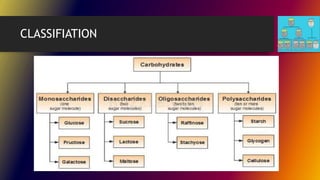
CLASSIFIATION
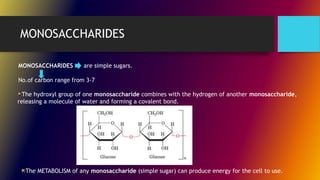
MONOSACCHARIDES
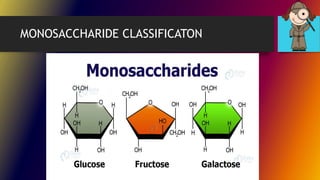
MONOSACCHARIDES are simple sugars.
No.of carbon range from 3-7
The hydroxyl group of one monosaccharide combines with the hydrogen of another monosaccharide,
releasing a molecule of water and forming a covalent bond.
The METABOLISM of any monosaccharide (simple sugar) can produce energy for the cell to use.
MONOSACCHARIDE CLASSIFICATON
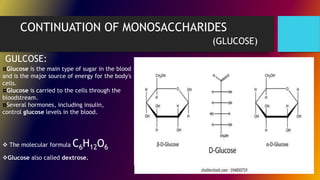
CONTINUATION OF MONOSACCHARIDES
(GLUCOSE)
Glucose is the main type of sugar in the blood
and is the major source of energy for the body's
cells.
Glucose is carried to the cells through the
bloodstream.
Several hormones, including insulin,
control glucose levels in the blood.
GULCOSE:
 The molecular formula C6H12O6
Glucose also called dextrose.
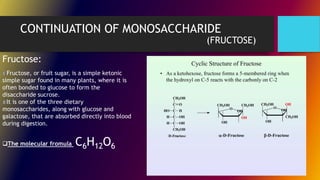
CONTINUATION OF MONOSACCHARIDE
(FRUCTOSE)
Fructose, or fruit sugar, is a simple ketonic
simple sugar found in many plants, where it is
often bonded to glucose to form the
disaccharide sucrose.
It is one of the three dietary
monosaccharides, along with glucose and
galactose, that are absorbed directly into blood
during digestion.
Fructose:
The molecular fromula C6H12O6
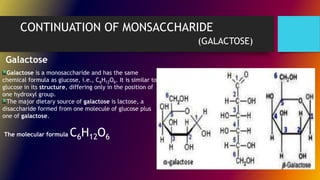
CONTINUATION OF MONSACCHARIDE
(GALACTOSE)
Galactose is a monosaccharide and has the same
chemical formula as glucose, i.e., C6H12O6. It is similar to
glucose in its structure, differing only in the position of
one hydroxyl group.
The major dietary source of galactose is lactose, a
disaccharide formed from one molecule of glucose plus
one of galactose.
The molecular formula C6H12O6
Galactose
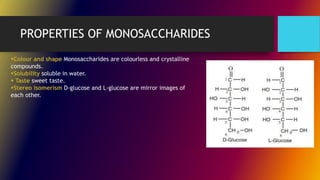
PROPERTIES OF MONOSACCHARIDES
Colour and shape Monosaccharides are colourless and crystalline
compounds.
Solubility soluble in water.
 Taste sweet taste.
Stereo isomerism D-glucose and L-glucose are mirror images of
each other.
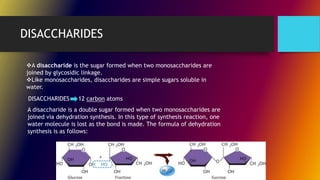
DISACCHARIDES
A disaccharide is the sugar formed when two monosaccharides are
joined by glycosidic linkage.
Like monosaccharides, disaccharides are simple sugars soluble in
water.
DISACCHARIDES 12 carbon atoms
A disaccharide is a double sugar formed when two monosaccharides are
joined via dehydration synthesis. In this type of synthesis reaction, one
water molecule is lost as the bond is made. The formula of dehydration
synthesis is as follows:
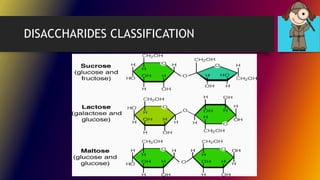
DISACCHARIDES CLASSIFICATION
COTINUATION OF DISACCHARIDE
(Sucrose)
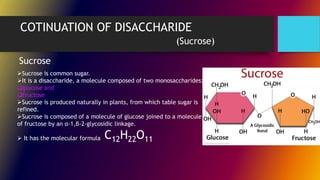
Sucrose is common sugar.
It is a disaccharide, a molecule composed of two monosaccharides:
glucose and
fructose
Sucrose is produced naturally in plants, from which table sugar is
refined.
Sucrose is composed of a molecule of glucose joined to a molecule
of fructose by an α-1,β-2-glycosidic linkage.
 It has the molecular formula
Sucrose
C12H22O11
COTINUATION OF DISACCHARIDE
(LACTOSE)
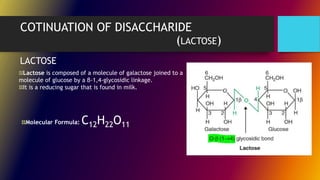
Lactose is composed of a molecule of galactose joined to a
molecule of glucose by a β-1,4-glycosidic linkage.
It is a reducing sugar that is found in milk.
LACTOSE
Molecular Formula: C12H22O11
COTINUATION OF DISACCHARIDE
(MALTOSE)
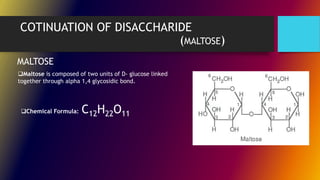
Maltose is composed of two units of D- glucose linked
together through alpha 1,4 glycosidic bond.
MALTOSE
Chemical Formula: C12H22O11
PROPERTIES OF DISACCHARIDES
The glycosidic bond can be formed between any hydroxy group on
the component monosaccharide.
Depending on the monosaccharide constituents, disaccharides are
sometimes crystalline, sometimes water-soluble, and sometimes
sweet-tasting and sticky-feeling.
Disaccharides can serve as functional groups by forming glycosidic
bonds with other organic compounds, forming biosides.
OLIGOSACCHARIDES
An oligosaccharide is
a saccharide polymer containing a small
number of monosaccharides (simple sugars).
Oligosaccharides can have many functions
including cell recognition and cell binding.
For example, glycolipids have an important
role in the immune response.
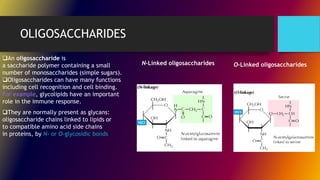
They are normally present as glycans:
oligosaccharide chains linked to lipids or
to compatible amino acid side chains
in proteins, by N- or O-glycosidic bonds
N-Linked oligosaccharides O-Linked oligosaccharides
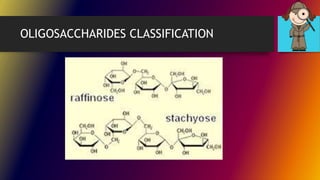
OLIGOSACCHARIDES CLASSIFICATION
CONTINUATION OF OLIGOSACCHARIDE
(RAFFINOSE)
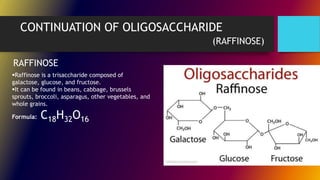
RAFFINOSE
Raffinose is a trisaccharide composed of
galactose, glucose, and fructose.
It can be found in beans, cabbage, brussels
sprouts, broccoli, asparagus, other vegetables, and
whole grains.
Formula: C18H32O16
CONTINUATION OF OLIGOSACCHARIDES
(STACHYOSE)
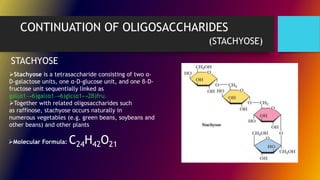
STACHYOSE
Stachyose is a tetrasaccharide consisting of two α-
D-galactose units, one α-D-glucose unit, and one β-D-
fructose unit sequentially linked as
gal(α1→6)gal(α1→6)glc(α1↔2β)fru.
Together with related oligosaccharides such
as raffinose, stachyose occurs naturally in
numerous vegetables (e.g. green beans, soybeans and
other beans) and other plants
Molecular Formula: C24H42O21
PROPERTIES OF OLIGOSACCHARIDES
Physicochemical properties of oligosaccharides
The oligosaccharides are about 0.3–0.6 times as sweet as sucrose, this low
sweetness attribute is exploited in food formulations as a replacement of sucrose.
Further, the low caloric densities make the oligosaccharides useful as bulking
agents in food formulations.
They are used as humectants because of their high moisture-retaining capacity
without increasing water activity.
Based on their physiological properties, these carbohydrates are grouped
as digestible or non-digestible.
Low pH and high temperature tend to impair the physicochemical properties
and reduce nutritional value of oligosaccharides.
POLYSACCHARIDES
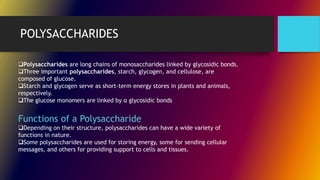
Polysaccharides are long chains of monosaccharides linked by glycosidic bonds.
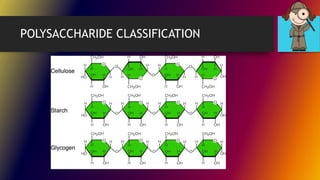
Three important polysaccharides, starch, glycogen, and cellulose, are
composed of glucose.
Starch and glycogen serve as short-term energy stores in plants and animals,
respectively.
The glucose monomers are linked by α glycosidic bonds
Functions of a Polysaccharide
Depending on their structure, polysaccharides can have a wide variety of
functions in nature.
Some polysaccharides are used for storing energy, some for sending cellular
messages, and others for providing support to cells and tissues.
POLYSACCHARIDE CLASSIFICATION
CONTINUATION OF POLYSACCHARIDES
(CELLULOSE)
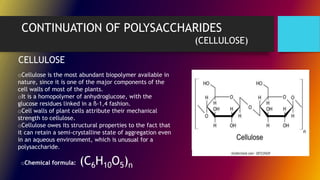
oCellulose is the most abundant biopolymer available in
nature, since it is one of the major components of the
cell walls of most of the plants.
oIt is a homopolymer of anhydroglucose, with the
glucose residues linked in a ß-1,4 fashion.
oCell walls of plant cells attribute their mechanical
strength to cellulose.
oCellulose owes its structural properties to the fact that
it can retain a semi-crystalline state of aggregation even
in an aqueous environment, which is unusual for a
polysaccharide.
CELLULOSE
oChemical formula: (C6H10O5)n
CONTINUATION OF POLYSACCHARIDES
(STARCH)
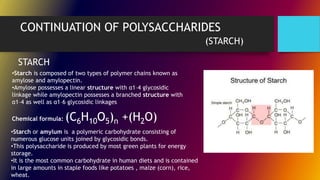
STARCH
•Starch is composed of two types of polymer chains known as
amylose and amylopectin.
•Amylose possesses a linear structure with α1–4 glycosidic
linkage while amylopectin possesses a branched structure with
α1–4 as well as α1–6 glycosidic linkages
Chemical formula: (C6H10O5)n +(H2O)
•Starch or amylum is a polymeric carbohydrate consisting of
numerous glucose units joined by glycosidic bonds.
•This polysaccharide is produced by most green plants for energy
storage.
•It is the most common carbohydrate in human diets and is contained
in large amounts in staple foods like potatoes , maize (corn), rice,
wheat.
CONTINUATION POLYSACCHARIDE
(GLYCOGEN)
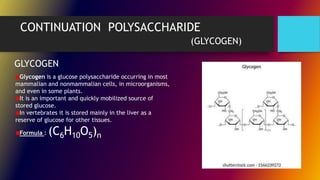
Glycogen is a glucose polysaccharide occurring in most
mammalian and nonmammalian cells, in microorganisms,
and even in some plants.
It is an important and quickly mobilized source of
stored glucose.
In vertebrates it is stored mainly in the liver as a
reserve of glucose for other tissues.
Formula : (C6H10O5)n
GLYCOGEN
PROPERTIES OF POLYSACCHARIDES
Polysaccharides are characterized by the following chemical properties:
(1) not sweet in taste,
(2) many of which are insoluble in water,
(3) do not form crystals when desiccated,
(4) compact and not osmotically active inside the cells,
(5) can be extracted to form white powder, and
(6) general chemical formula of Cx(H2O)y
BIOLOGICAL SIGNIFICANCE
1. Storage role: Carbohydrates serve as the storage of metabolic fuel for a living
organism. For example, starch and glycogen are present as the storage form in plants
and animals respectively. The storage form is broken down into glucose units which serve
to provide energy.
2. Structural role: Carbohydrates like cellulose, hemicellulose, and lignin provide a
mechanical and protective function to the cell wall of plants. It also provide a definite
shape to the plant cell. Chitin forms the part of the exoskeleton in insects and
crustaceans.
3. Communication role: Carbohydrates are covalently bound to either protein or lipid
to form glycoproteins or glycolipids. Glycoproteins act as a harmones
Glycolipid acts as an enzyme, immunoglobins
CARBOHYDRATES

CARBOHYDRATES

  • 1.
  • 2.
  • 3.
    INTRODUCTION TERMINOLOGY The term CARBOHYDRATEShas many synonyms like sugar , saccharide , ose , glucide, polyhydroxy compounds with aldehyde and ketone. GENERAL FORMULA: The formula Cn (H2O)n. SIMPLE STRCTURE Formaldehyde (CH2O) to be the simplest carbohydrate.
  • 4.
    A biomolecules refersto any molecule that is produced by living organisms. As such, most of them are organic molecules. The four major groups of biomolecules include :  amino acids, proteins,  carbohydrates (especially, polysaccharides), lipids, and nucleic acids. A carbohydrate refers to any of the group of organic compounds consisting of carbon, hydrogen, and oxygen Usually in the ratio of 1:2:1, hence the general formula: Cn (H2O) n. Carbohydrates are the most abundant among the major classes of biomolecules. Carbohydrate Definition
  • 5.
  • 6.
    MONOSACCHARIDES MONOSACCHARIDES are simplesugars. No.of carbon range from 3-7 The hydroxyl group of one monosaccharide combines with the hydrogen of another monosaccharide, releasing a molecule of water and forming a covalent bond. The METABOLISM of any monosaccharide (simple sugar) can produce energy for the cell to use.
  • 7.
  • 8.
    CONTINUATION OF MONOSACCHARIDES (GLUCOSE) Glucoseis the main type of sugar in the blood and is the major source of energy for the body's cells. Glucose is carried to the cells through the bloodstream. Several hormones, including insulin, control glucose levels in the blood. GULCOSE:  The molecular formula C6H12O6 Glucose also called dextrose.
  • 9.
    CONTINUATION OF MONOSACCHARIDE (FRUCTOSE) Fructose,or fruit sugar, is a simple ketonic simple sugar found in many plants, where it is often bonded to glucose to form the disaccharide sucrose. It is one of the three dietary monosaccharides, along with glucose and galactose, that are absorbed directly into blood during digestion. Fructose: The molecular fromula C6H12O6
  • 10.
    CONTINUATION OF MONSACCHARIDE (GALACTOSE) Galactoseis a monosaccharide and has the same chemical formula as glucose, i.e., C6H12O6. It is similar to glucose in its structure, differing only in the position of one hydroxyl group. The major dietary source of galactose is lactose, a disaccharide formed from one molecule of glucose plus one of galactose. The molecular formula C6H12O6 Galactose
  • 11.
    PROPERTIES OF MONOSACCHARIDES Colourand shape Monosaccharides are colourless and crystalline compounds. Solubility soluble in water.  Taste sweet taste. Stereo isomerism D-glucose and L-glucose are mirror images of each other.
  • 12.
    DISACCHARIDES A disaccharide isthe sugar formed when two monosaccharides are joined by glycosidic linkage. Like monosaccharides, disaccharides are simple sugars soluble in water. DISACCHARIDES 12 carbon atoms A disaccharide is a double sugar formed when two monosaccharides are joined via dehydration synthesis. In this type of synthesis reaction, one water molecule is lost as the bond is made. The formula of dehydration synthesis is as follows:
  • 13.
  • 14.
    COTINUATION OF DISACCHARIDE (Sucrose) Sucroseis common sugar. It is a disaccharide, a molecule composed of two monosaccharides: glucose and fructose Sucrose is produced naturally in plants, from which table sugar is refined. Sucrose is composed of a molecule of glucose joined to a molecule of fructose by an α-1,β-2-glycosidic linkage.  It has the molecular formula Sucrose C12H22O11
  • 15.
    COTINUATION OF DISACCHARIDE (LACTOSE) Lactoseis composed of a molecule of galactose joined to a molecule of glucose by a β-1,4-glycosidic linkage. It is a reducing sugar that is found in milk. LACTOSE Molecular Formula: C12H22O11
  • 16.
    COTINUATION OF DISACCHARIDE (MALTOSE) Maltoseis composed of two units of D- glucose linked together through alpha 1,4 glycosidic bond. MALTOSE Chemical Formula: C12H22O11
  • 17.
    PROPERTIES OF DISACCHARIDES Theglycosidic bond can be formed between any hydroxy group on the component monosaccharide. Depending on the monosaccharide constituents, disaccharides are sometimes crystalline, sometimes water-soluble, and sometimes sweet-tasting and sticky-feeling. Disaccharides can serve as functional groups by forming glycosidic bonds with other organic compounds, forming biosides.
  • 18.
    OLIGOSACCHARIDES An oligosaccharide is asaccharide polymer containing a small number of monosaccharides (simple sugars). Oligosaccharides can have many functions including cell recognition and cell binding. For example, glycolipids have an important role in the immune response. They are normally present as glycans: oligosaccharide chains linked to lipids or to compatible amino acid side chains in proteins, by N- or O-glycosidic bonds N-Linked oligosaccharides O-Linked oligosaccharides
  • 19.
  • 20.
    CONTINUATION OF OLIGOSACCHARIDE (RAFFINOSE) RAFFINOSE Raffinoseis a trisaccharide composed of galactose, glucose, and fructose. It can be found in beans, cabbage, brussels sprouts, broccoli, asparagus, other vegetables, and whole grains. Formula: C18H32O16
  • 21.
    CONTINUATION OF OLIGOSACCHARIDES (STACHYOSE) STACHYOSE Stachyoseis a tetrasaccharide consisting of two α- D-galactose units, one α-D-glucose unit, and one β-D- fructose unit sequentially linked as gal(α1→6)gal(α1→6)glc(α1↔2β)fru. Together with related oligosaccharides such as raffinose, stachyose occurs naturally in numerous vegetables (e.g. green beans, soybeans and other beans) and other plants Molecular Formula: C24H42O21
  • 22.
    PROPERTIES OF OLIGOSACCHARIDES Physicochemicalproperties of oligosaccharides The oligosaccharides are about 0.3–0.6 times as sweet as sucrose, this low sweetness attribute is exploited in food formulations as a replacement of sucrose. Further, the low caloric densities make the oligosaccharides useful as bulking agents in food formulations. They are used as humectants because of their high moisture-retaining capacity without increasing water activity. Based on their physiological properties, these carbohydrates are grouped as digestible or non-digestible. Low pH and high temperature tend to impair the physicochemical properties and reduce nutritional value of oligosaccharides.
  • 23.
    POLYSACCHARIDES Polysaccharides are longchains of monosaccharides linked by glycosidic bonds. Three important polysaccharides, starch, glycogen, and cellulose, are composed of glucose. Starch and glycogen serve as short-term energy stores in plants and animals, respectively. The glucose monomers are linked by α glycosidic bonds Functions of a Polysaccharide Depending on their structure, polysaccharides can have a wide variety of functions in nature. Some polysaccharides are used for storing energy, some for sending cellular messages, and others for providing support to cells and tissues.
  • 24.
  • 25.
    CONTINUATION OF POLYSACCHARIDES (CELLULOSE) oCelluloseis the most abundant biopolymer available in nature, since it is one of the major components of the cell walls of most of the plants. oIt is a homopolymer of anhydroglucose, with the glucose residues linked in a ß-1,4 fashion. oCell walls of plant cells attribute their mechanical strength to cellulose. oCellulose owes its structural properties to the fact that it can retain a semi-crystalline state of aggregation even in an aqueous environment, which is unusual for a polysaccharide. CELLULOSE oChemical formula: (C6H10O5)n
  • 26.
    CONTINUATION OF POLYSACCHARIDES (STARCH) STARCH •Starchis composed of two types of polymer chains known as amylose and amylopectin. •Amylose possesses a linear structure with α1–4 glycosidic linkage while amylopectin possesses a branched structure with α1–4 as well as α1–6 glycosidic linkages Chemical formula: (C6H10O5)n +(H2O) •Starch or amylum is a polymeric carbohydrate consisting of numerous glucose units joined by glycosidic bonds. •This polysaccharide is produced by most green plants for energy storage. •It is the most common carbohydrate in human diets and is contained in large amounts in staple foods like potatoes , maize (corn), rice, wheat.
  • 27.
    CONTINUATION POLYSACCHARIDE (GLYCOGEN) Glycogen isa glucose polysaccharide occurring in most mammalian and nonmammalian cells, in microorganisms, and even in some plants. It is an important and quickly mobilized source of stored glucose. In vertebrates it is stored mainly in the liver as a reserve of glucose for other tissues. Formula : (C6H10O5)n GLYCOGEN
  • 28.
    PROPERTIES OF POLYSACCHARIDES Polysaccharidesare characterized by the following chemical properties: (1) not sweet in taste, (2) many of which are insoluble in water, (3) do not form crystals when desiccated, (4) compact and not osmotically active inside the cells, (5) can be extracted to form white powder, and (6) general chemical formula of Cx(H2O)y
  • 29.
    BIOLOGICAL SIGNIFICANCE 1. Storagerole: Carbohydrates serve as the storage of metabolic fuel for a living organism. For example, starch and glycogen are present as the storage form in plants and animals respectively. The storage form is broken down into glucose units which serve to provide energy. 2. Structural role: Carbohydrates like cellulose, hemicellulose, and lignin provide a mechanical and protective function to the cell wall of plants. It also provide a definite shape to the plant cell. Chitin forms the part of the exoskeleton in insects and crustaceans. 3. Communication role: Carbohydrates are covalently bound to either protein or lipid to form glycoproteins or glycolipids. Glycoproteins act as a harmones Glycolipid acts as an enzyme, immunoglobins

Editor's Notes