Carbohydrates:
The carbohydrates, often termed as sugars, are the “staff of
life” for the organisms. Carbohydrates are “Hydrates of
carbon”. They contain carbon, hydrogen and oxygen in the
ratio of 1:2:1. Hydrogen and Oxygen are combined in the
same ratio as in the water (H2O).
Definition:
Are optically active polyhydroxy aldehyde or ketones or
substance giving polyhydroxy aldehydes or ketones on
hydrolysis. Carbohydrates are
represented by formula as Cx (H2O)y.
Example: Glucose is a carbohydrate have molecular
formula C6H12O6.
Main Source of Carbohydrates?
Produced by plants during photosynthesis. After eating plant
foods, humans convert the carbohydrates into glucose.
Glucose: Most abundant carbohydrate. It is a preferred
source of energy for the blood, brain, and nervous system.
Classification of Carbohydrates:
Carbohydrates are of two types: Simple and Complex.
Simple carbohydrates
These are Monosaccharide, Disaccharide and
Oligosaccharides.
Complex carbohydrates
These includes Polysaccharides.
Food Sources of Carbohydrates in Plants:
Grains, Cereals, & Legumes: Pasta, bread, cold/hot cereal,
rice, oats, kidney beans, etc.
Fruits & Vegetables
Starchy Vegetables: Corn, potato, peas, acorn squash, etc.
Food Sources of Carbohydrates in Plants:
Milk (& milk products yogurt & cheese) contain lactose.
Honey contains glucose, fructose & small amounts of other
sugars.
Animal foods usually provide mostly proteins & fats.
Milk & milk products also provide proteins & varying
amounts of fats.
Food Sources of Carbohydrates
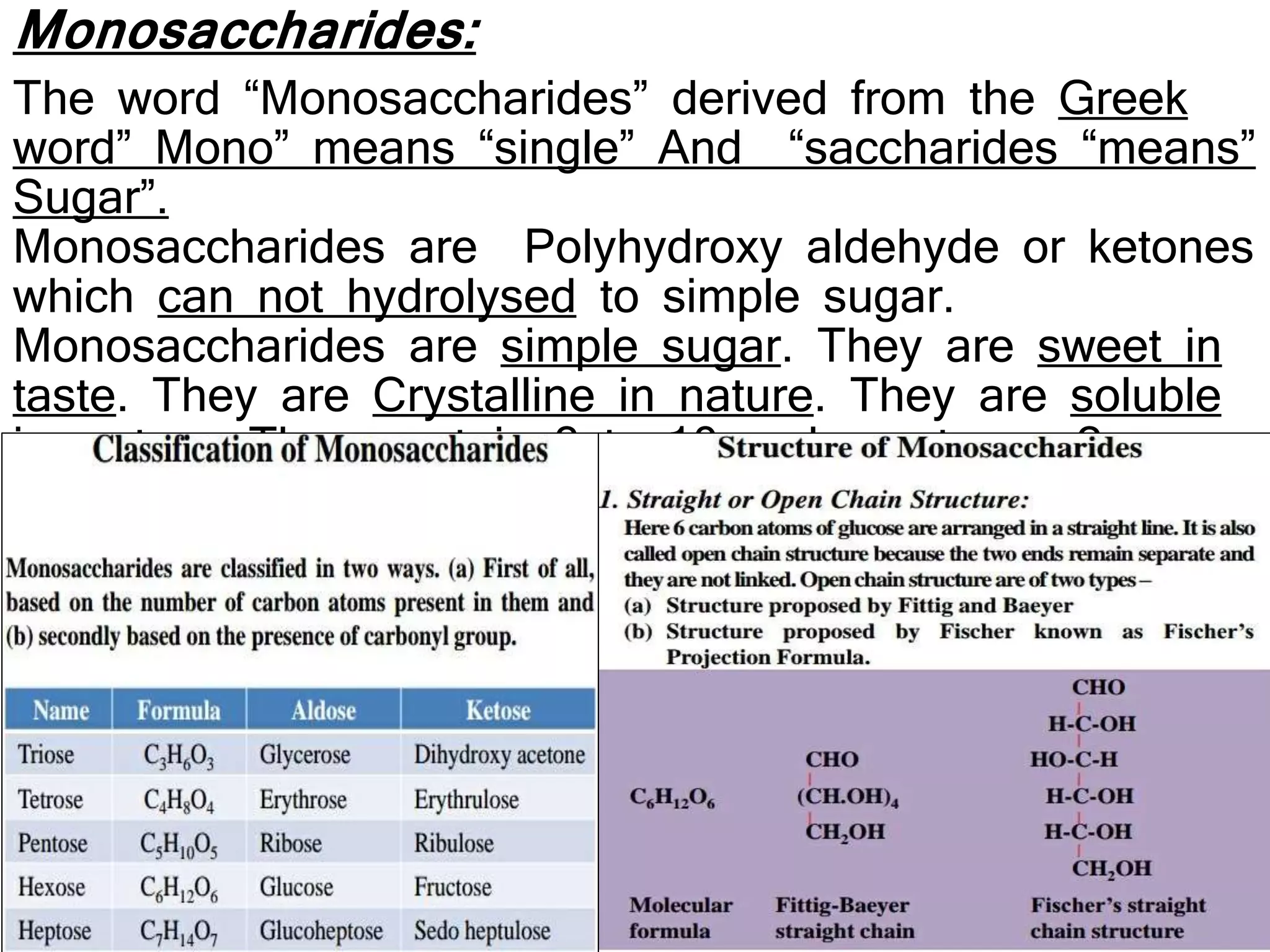
Monosaccharides:
The word “Monosaccharides” derived from the Greek
word” Mono” means “single” And “saccharides “means”
Sugar”.
Monosaccharides are Polyhydroxy aldehyde or ketones
which can not hydrolysed to simple sugar.
Monosaccharides are simple sugar. They are sweet in
taste. They are Crystalline in nature. They are soluble
in water. They contain 3 to 10 carbon atoms, 2 or
more hydroxy (OH) group and one aldehyde group or
one ketone group.
Properties of Monosaccharides
1.Colour- colourless 2.Shape –
crystalline
3.Solubility – water soluble 4.Taste – sweet
5.Optical activity – Dexto-rotatory and Levorotatory
6.Mutarotation – The change in specific rotation of an
optically active compound is called Mutarotation.
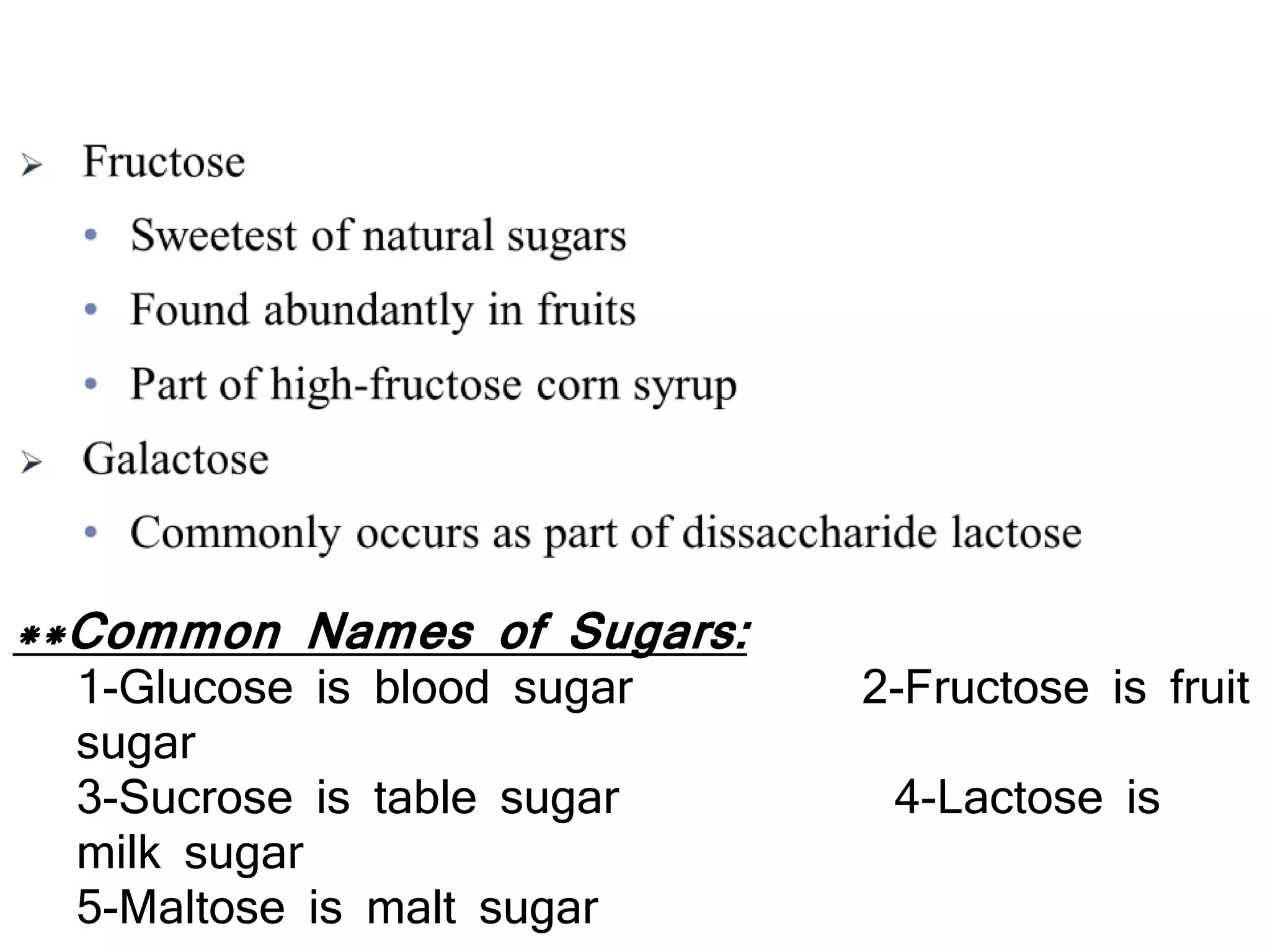
**Common Names of Sugars:
1-Glucose is blood sugar 2-Fructose is fruit
sugar
3-Sucrose is table sugar 4-Lactose is
milk sugar
5-Maltose is malt sugar
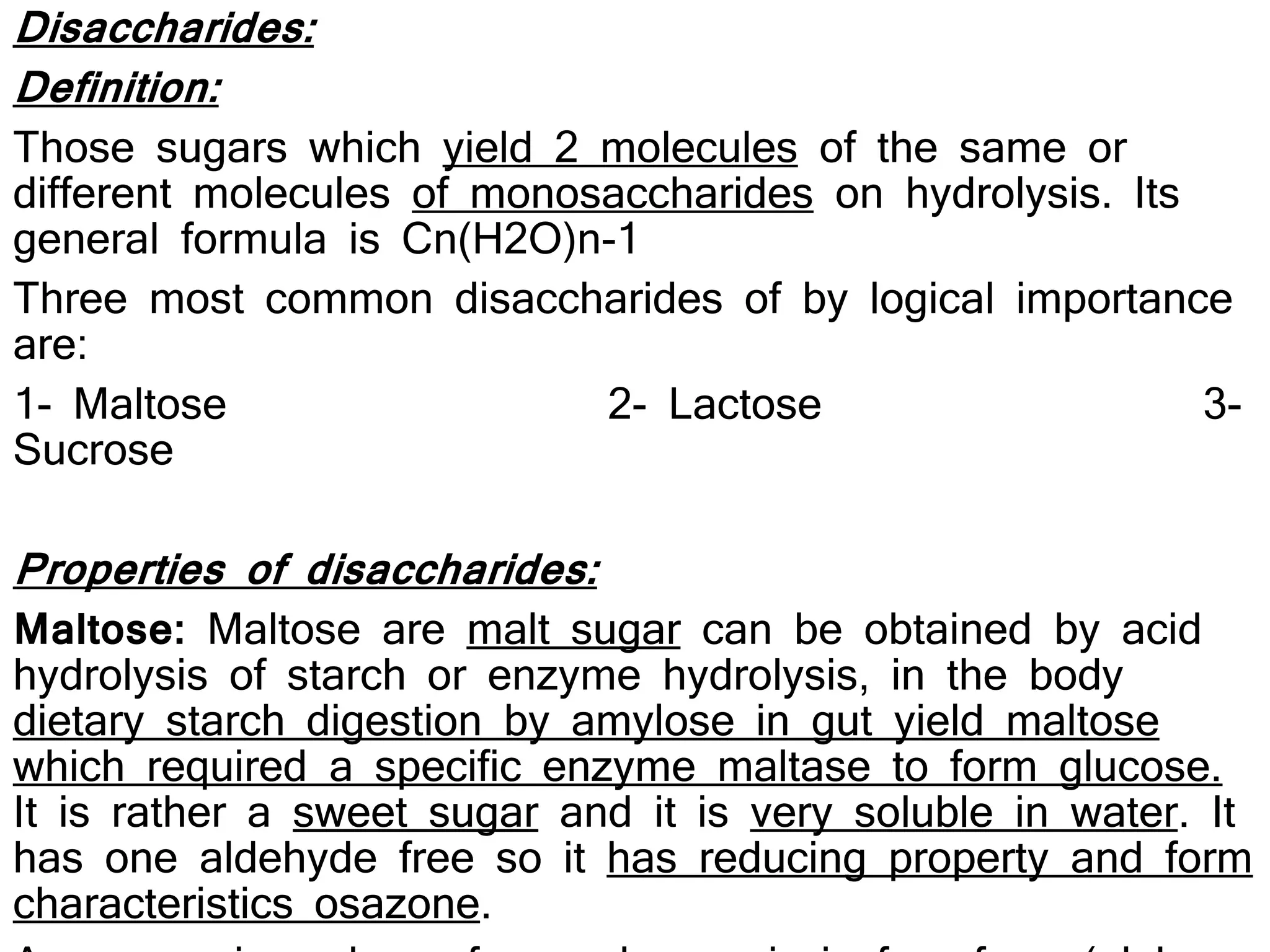
Disaccharides:
Definition:
Those sugars which yield 2 molecules of the same or
different molecules of monosaccharides on hydrolysis. Its
general formula is Cn(H2O)n-1
Three most common disaccharides of by logical importance
are:
1- Maltose 2- Lactose 3-
Sucrose
Properties of disaccharides:
Maltose: Maltose are malt sugar can be obtained by acid
hydrolysis of starch or enzyme hydrolysis, in the body
dietary starch digestion by amylose in gut yield maltose
which required a specific enzyme maltase to form glucose.
It is rather a sweet sugar and it is very soluble in water. It
has one aldehyde free so it has reducing property and form
characteristics osazone.
Lactose:
It is also known as milk sugar and found in appreciable
quantities in milk to extend of about 5% and occurs at
the body temperature, as an equilibrium mixture of alpha
and beta form. It is very soluble and is not so sweet. It
is dextrorotatory. Specific enzyme which hydrolyzed it is
lactase present in intestinal juice. On hydrolysis it yield
one molecule of glucose and one molecule of galactose.
As one of aldehyde group is free so it has reducing
property and can form osazone.
Sucrose (Table sugar):
It is also called as cane sugar and can also obtained
from sugar cane and sugar beat and sugar maple. It is
very soluble and very sweet and on hydrolysis yield one
molecule of glucose and one molecule of fructose. The
specific enzyme which hydrolyzed sucrose is sucrase
present in intestinal juice. As both aldehyde or ketone
groups are linked together it does not have reducing
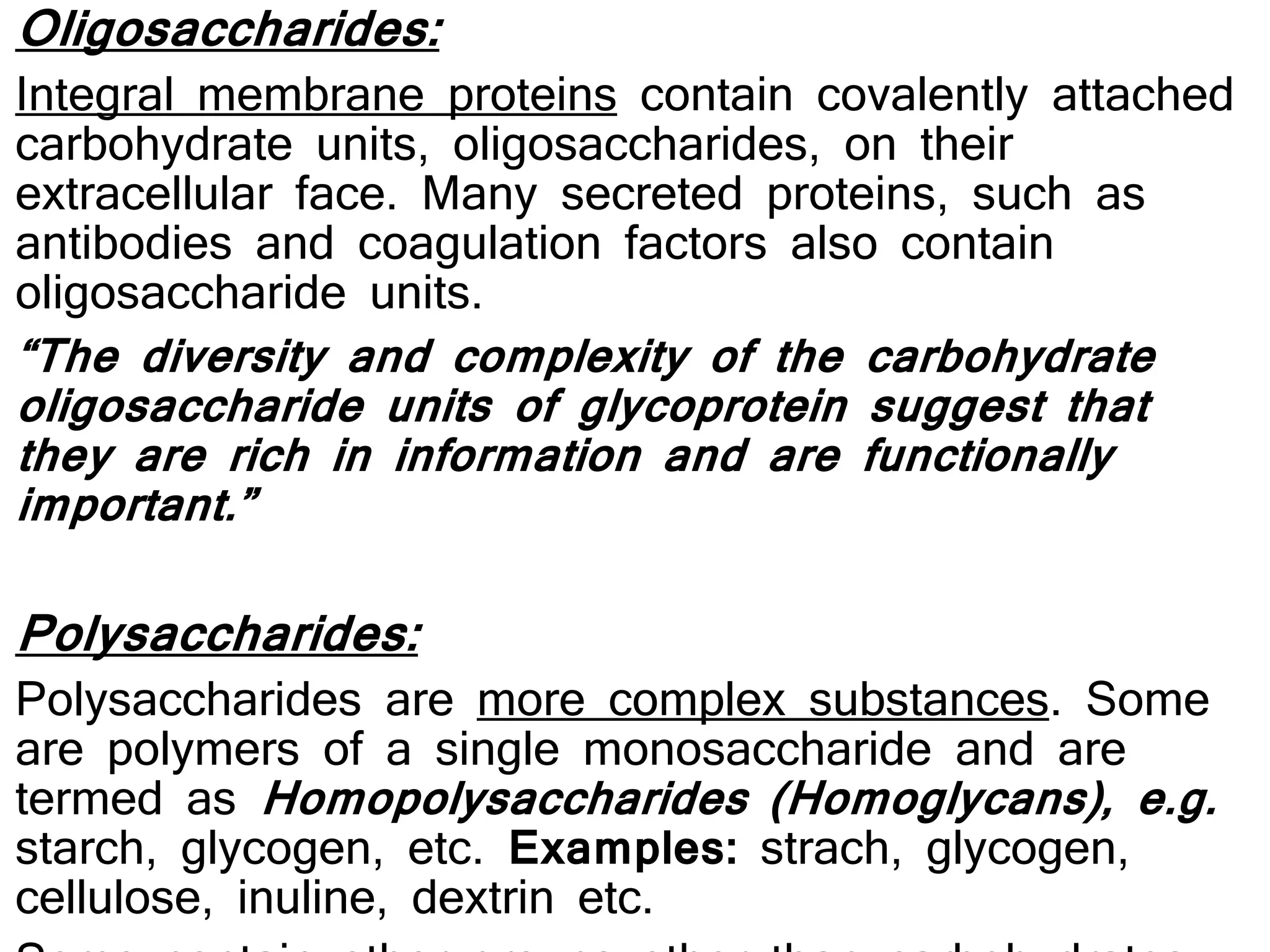
Oligosaccharides:
Integral membrane proteins contain covalently attached
carbohydrate units, oligosaccharides, on their
extracellular face. Many secreted proteins, such as
antibodies and coagulation factors also contain
oligosaccharide units.
“The diversity and complexity of the carbohydrate
oligosaccharide units of glycoprotein suggest that
they are rich in information and are functionally
important.”
Polysaccharides:
Polysaccharides are more complex substances. Some
are polymers of a single monosaccharide and are
termed as Homopolysaccharides (Homoglycans), e.g.
starch, glycogen, etc. Examples: strach, glycogen,
cellulose, inuline, dextrin etc.
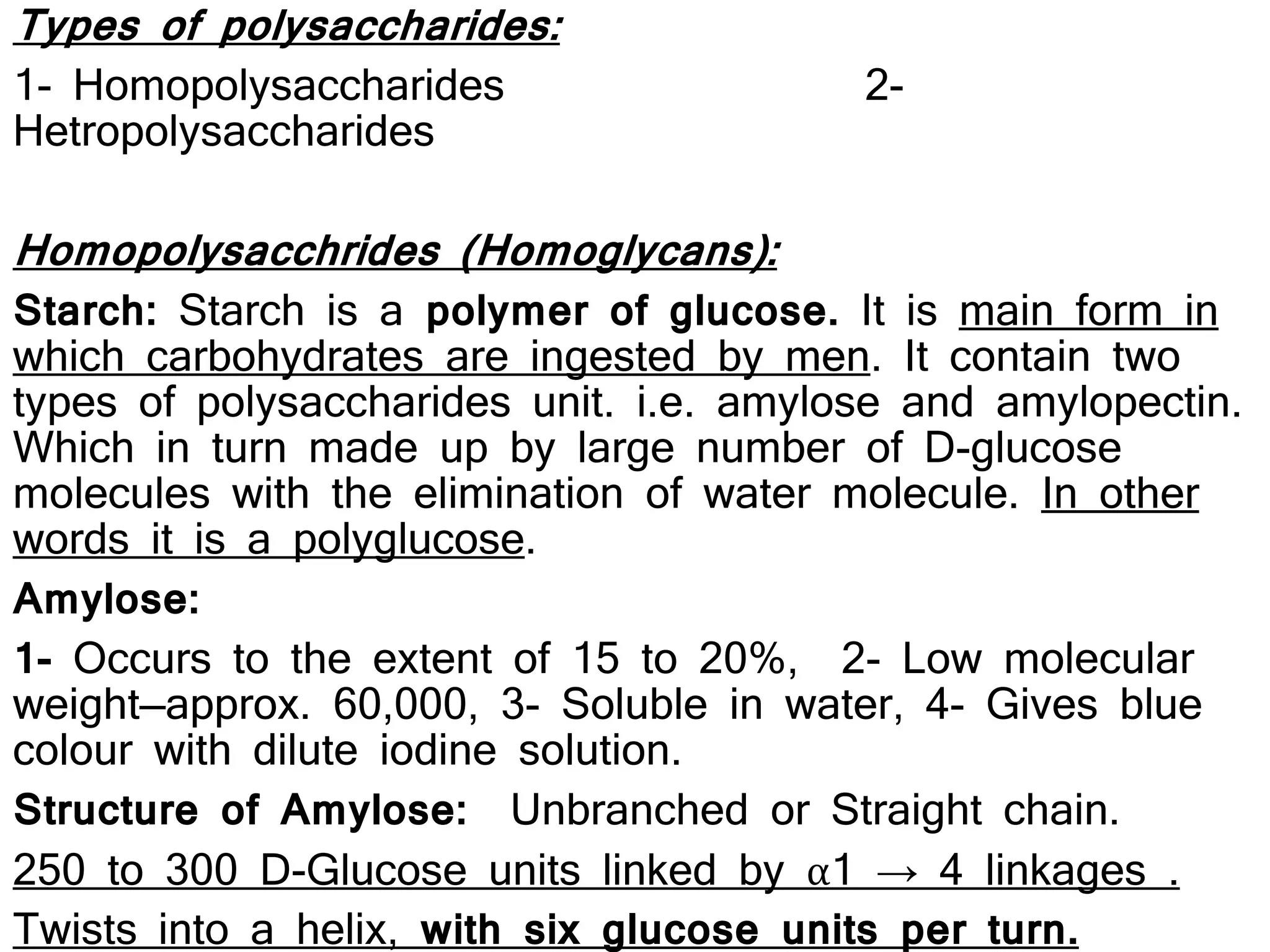
Types of polysaccharides:
1- Homopolysaccharides 2-
Hetropolysaccharides
Homopolysacchrides (Homoglycans):
Starch: Starch is a polymer of glucose. It is main form in
which carbohydrates are ingested by men. It contain two
types of polysaccharides unit. i.e. amylose and amylopectin.
Which in turn made up by large number of D-glucose
molecules with the elimination of water molecule. In other
words it is a polyglucose.
Amylose:
1- Occurs to the extent of 15 to 20%, 2- Low molecular
weight—approx. 60,000, 3- Soluble in water, 4- Gives blue
colour with dilute iodine solution.
Structure of Amylose: Unbranched or Straight chain.
250 to 300 D-Glucose units linked by α1 → 4 linkages .
Twists into a helix, with six glucose units per turn.
Amylopectin:
1. Occurs 80 to 85%,
2. High molecular weight—approx. 5,00,000
3. Insoluble in water, can absorb water and swells up
4. Gives reddish-violet colour with I2 solution
Structure:
Highly branched structure, More D-Glucose, Units joined
together,
Structure similar to glycogen, Main stem has α-1 → 4
glycoside bonds
At branch point α1 → 6 linkage, Approx 80 branches.
One branch after every 24 to 30 D-Glucose units.
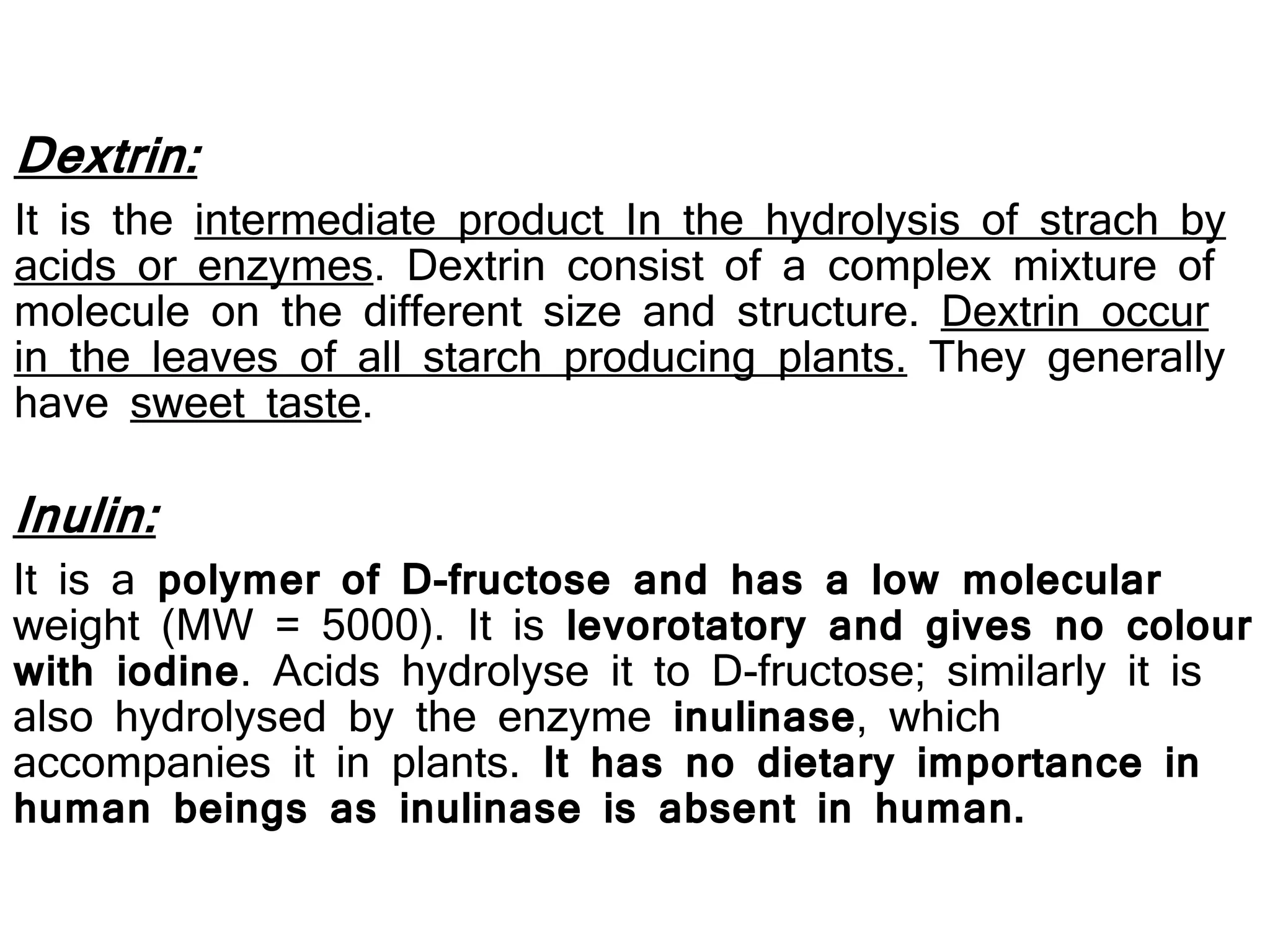
Dextrin:
It is the intermediate product In the hydrolysis of strach by
acids or enzymes. Dextrin consist of a complex mixture of
molecule on the different size and structure. Dextrin occur
in the leaves of all starch producing plants. They generally
have sweet taste.
Inulin:
It is a polymer of D-fructose and has a low molecular
weight (MW = 5000). It is levorotatory and gives no colour
with iodine. Acids hydrolyse it to D-fructose; similarly it is
also hydrolysed by the enzyme inulinase, which
accompanies it in plants. It has no dietary importance in
human beings as inulinase is absent in human.
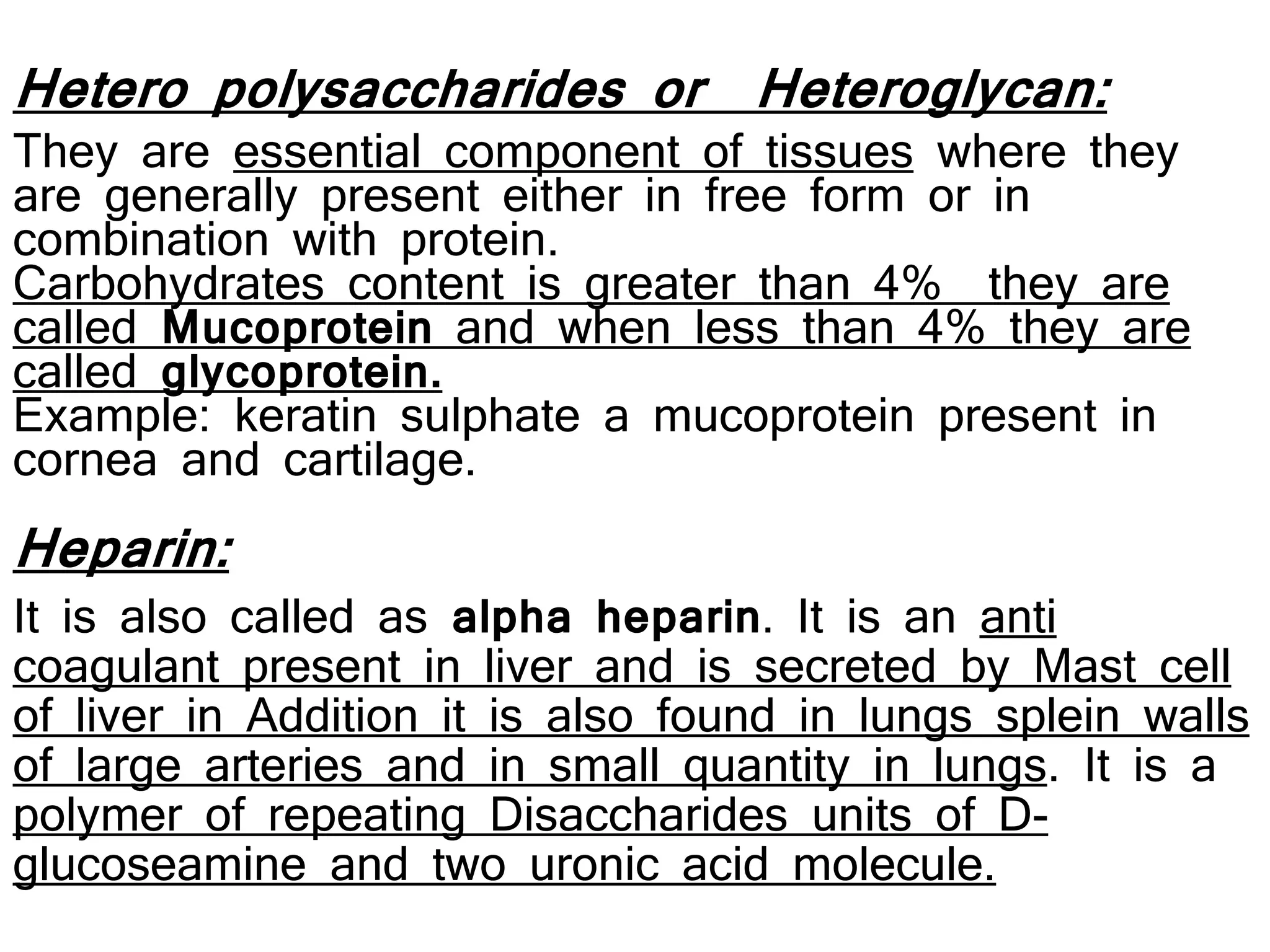
Heparin:
It is also called as alpha heparin. It is an anti
coagulant present in liver and is secreted by Mast cell
of liver in Addition it is also found in lungs splein walls
of large arteries and in small quantity in lungs. It is a
polymer of repeating Disaccharides units of D-
glucoseamine and two uronic acid molecule.
Hetero polysaccharides or Heteroglycan:
They are essential component of tissues where they
are generally present either in free form or in
combination with protein.
Carbohydrates content is greater than 4% they are
called Mucoprotein and when less than 4% they are
called glycoprotein.
Example: keratin sulphate a mucoprotein present in
cornea and cartilage.
Glycogen:
In higher animals, it is deposited in the liver and muscle as
storage material which are readily available as immediate
source of energy. Glycogen is the reserve carbohydrate of
the animal, hence it is called as animal starch. Its structure
closely resemble that of amylopectin. In that it is a
polymer of D-glucose unit. And in its molecule both 1-4 and
1-6 linkage are present. On hydrolysis it yield glucose.

Carbohydrates and its types

  • 2.
    Carbohydrates: The carbohydrates, oftentermed as sugars, are the “staff of life” for the organisms. Carbohydrates are “Hydrates of carbon”. They contain carbon, hydrogen and oxygen in the ratio of 1:2:1. Hydrogen and Oxygen are combined in the same ratio as in the water (H2O). Definition: Are optically active polyhydroxy aldehyde or ketones or substance giving polyhydroxy aldehydes or ketones on hydrolysis. Carbohydrates are represented by formula as Cx (H2O)y. Example: Glucose is a carbohydrate have molecular formula C6H12O6. Main Source of Carbohydrates? Produced by plants during photosynthesis. After eating plant foods, humans convert the carbohydrates into glucose. Glucose: Most abundant carbohydrate. It is a preferred source of energy for the blood, brain, and nervous system.
  • 3.
    Classification of Carbohydrates: Carbohydratesare of two types: Simple and Complex. Simple carbohydrates These are Monosaccharide, Disaccharide and Oligosaccharides. Complex carbohydrates These includes Polysaccharides. Food Sources of Carbohydrates in Plants: Grains, Cereals, & Legumes: Pasta, bread, cold/hot cereal, rice, oats, kidney beans, etc. Fruits & Vegetables Starchy Vegetables: Corn, potato, peas, acorn squash, etc. Food Sources of Carbohydrates in Plants: Milk (& milk products yogurt & cheese) contain lactose. Honey contains glucose, fructose & small amounts of other sugars. Animal foods usually provide mostly proteins & fats. Milk & milk products also provide proteins & varying amounts of fats.
  • 4.
    Food Sources ofCarbohydrates
  • 5.
    Monosaccharides: The word “Monosaccharides”derived from the Greek word” Mono” means “single” And “saccharides “means” Sugar”. Monosaccharides are Polyhydroxy aldehyde or ketones which can not hydrolysed to simple sugar. Monosaccharides are simple sugar. They are sweet in taste. They are Crystalline in nature. They are soluble in water. They contain 3 to 10 carbon atoms, 2 or more hydroxy (OH) group and one aldehyde group or one ketone group.
  • 6.
    Properties of Monosaccharides 1.Colour-colourless 2.Shape – crystalline 3.Solubility – water soluble 4.Taste – sweet 5.Optical activity – Dexto-rotatory and Levorotatory 6.Mutarotation – The change in specific rotation of an optically active compound is called Mutarotation.
  • 7.
    **Common Names ofSugars: 1-Glucose is blood sugar 2-Fructose is fruit sugar 3-Sucrose is table sugar 4-Lactose is milk sugar 5-Maltose is malt sugar
  • 8.
    Disaccharides: Definition: Those sugars whichyield 2 molecules of the same or different molecules of monosaccharides on hydrolysis. Its general formula is Cn(H2O)n-1 Three most common disaccharides of by logical importance are: 1- Maltose 2- Lactose 3- Sucrose Properties of disaccharides: Maltose: Maltose are malt sugar can be obtained by acid hydrolysis of starch or enzyme hydrolysis, in the body dietary starch digestion by amylose in gut yield maltose which required a specific enzyme maltase to form glucose. It is rather a sweet sugar and it is very soluble in water. It has one aldehyde free so it has reducing property and form characteristics osazone.
  • 9.
    Lactose: It is alsoknown as milk sugar and found in appreciable quantities in milk to extend of about 5% and occurs at the body temperature, as an equilibrium mixture of alpha and beta form. It is very soluble and is not so sweet. It is dextrorotatory. Specific enzyme which hydrolyzed it is lactase present in intestinal juice. On hydrolysis it yield one molecule of glucose and one molecule of galactose. As one of aldehyde group is free so it has reducing property and can form osazone. Sucrose (Table sugar): It is also called as cane sugar and can also obtained from sugar cane and sugar beat and sugar maple. It is very soluble and very sweet and on hydrolysis yield one molecule of glucose and one molecule of fructose. The specific enzyme which hydrolyzed sucrose is sucrase present in intestinal juice. As both aldehyde or ketone groups are linked together it does not have reducing
  • 10.
    Oligosaccharides: Integral membrane proteinscontain covalently attached carbohydrate units, oligosaccharides, on their extracellular face. Many secreted proteins, such as antibodies and coagulation factors also contain oligosaccharide units. “The diversity and complexity of the carbohydrate oligosaccharide units of glycoprotein suggest that they are rich in information and are functionally important.” Polysaccharides: Polysaccharides are more complex substances. Some are polymers of a single monosaccharide and are termed as Homopolysaccharides (Homoglycans), e.g. starch, glycogen, etc. Examples: strach, glycogen, cellulose, inuline, dextrin etc.
  • 11.
    Types of polysaccharides: 1-Homopolysaccharides 2- Hetropolysaccharides Homopolysacchrides (Homoglycans): Starch: Starch is a polymer of glucose. It is main form in which carbohydrates are ingested by men. It contain two types of polysaccharides unit. i.e. amylose and amylopectin. Which in turn made up by large number of D-glucose molecules with the elimination of water molecule. In other words it is a polyglucose. Amylose: 1- Occurs to the extent of 15 to 20%, 2- Low molecular weight—approx. 60,000, 3- Soluble in water, 4- Gives blue colour with dilute iodine solution. Structure of Amylose: Unbranched or Straight chain. 250 to 300 D-Glucose units linked by α1 → 4 linkages . Twists into a helix, with six glucose units per turn.
  • 12.
    Amylopectin: 1. Occurs 80to 85%, 2. High molecular weight—approx. 5,00,000 3. Insoluble in water, can absorb water and swells up 4. Gives reddish-violet colour with I2 solution Structure: Highly branched structure, More D-Glucose, Units joined together, Structure similar to glycogen, Main stem has α-1 → 4 glycoside bonds At branch point α1 → 6 linkage, Approx 80 branches. One branch after every 24 to 30 D-Glucose units.
  • 13.
    Dextrin: It is theintermediate product In the hydrolysis of strach by acids or enzymes. Dextrin consist of a complex mixture of molecule on the different size and structure. Dextrin occur in the leaves of all starch producing plants. They generally have sweet taste. Inulin: It is a polymer of D-fructose and has a low molecular weight (MW = 5000). It is levorotatory and gives no colour with iodine. Acids hydrolyse it to D-fructose; similarly it is also hydrolysed by the enzyme inulinase, which accompanies it in plants. It has no dietary importance in human beings as inulinase is absent in human.
  • 14.
    Heparin: It is alsocalled as alpha heparin. It is an anti coagulant present in liver and is secreted by Mast cell of liver in Addition it is also found in lungs splein walls of large arteries and in small quantity in lungs. It is a polymer of repeating Disaccharides units of D- glucoseamine and two uronic acid molecule. Hetero polysaccharides or Heteroglycan: They are essential component of tissues where they are generally present either in free form or in combination with protein. Carbohydrates content is greater than 4% they are called Mucoprotein and when less than 4% they are called glycoprotein. Example: keratin sulphate a mucoprotein present in cornea and cartilage.
  • 15.
    Glycogen: In higher animals,it is deposited in the liver and muscle as storage material which are readily available as immediate source of energy. Glycogen is the reserve carbohydrate of the animal, hence it is called as animal starch. Its structure closely resemble that of amylopectin. In that it is a polymer of D-glucose unit. And in its molecule both 1-4 and 1-6 linkage are present. On hydrolysis it yield glucose.