

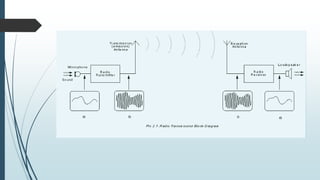

AM-Radio
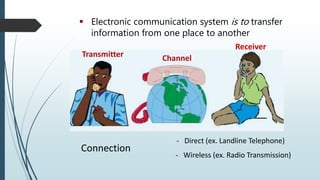
- Direct (ex. Landline Telephone)
 Electronic communication system is to transfer
information from one place to another
Receiver
Transmitter Channel
Connection
- Wireless (ex. Radio Transmission)
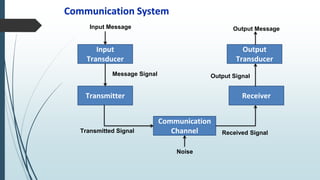
Communication System
Message Signal
Output
Transducer
Output Signal
Input
Transducer
Transmitter
Communication
Channel
Input Message
Transmitted Signal
Receiver
Output Message
Received Signal
Noise
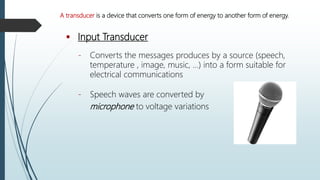
 Input Transducer
- Converts the messages produces by a source (speech,
temperature , image, music, …) into a form suitable for
electrical communications
- Speech waves are converted by
microphone to voltage variations
A transducer is a device that converts one form of energy to another form of energy.
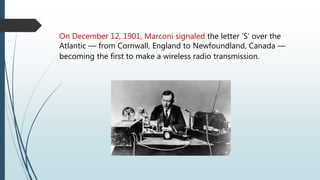
On December 12, 1901, Marconi signaled the letter ‘S’ over the
Atlantic — from Cornwall, England to Newfoundland, Canada —
becoming the first to make a wireless radio transmission.
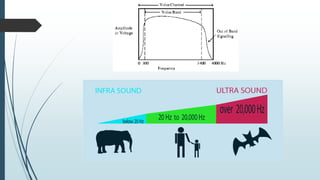
 Voice pattern or any other pattern of information
are low frequency, (Human Voice frequency
range 300 – 3400 Hz)
 All forms of information must be converted
to electromagnetic energy before being
propagated through an electronic
communication system.
FrequencySignalEnergy 
 Modulation is the process of increasing the
frequency content of a signal (and so energy
of the signal to enable it to travel long
distance).
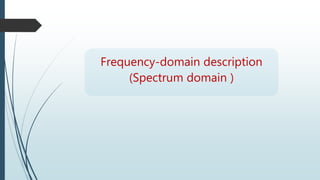
Frequency-domain description
(Spectrum domain )
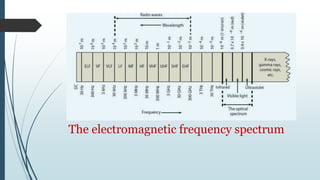
The electromagnetic frequency spectrum
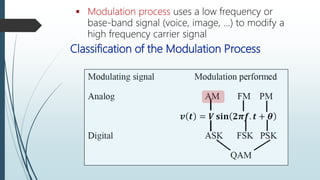
Classification of the Modulation Process
 Modulation process uses a low frequency or
base-band signal (voice, image, …) to modify a
high frequency carrier signal
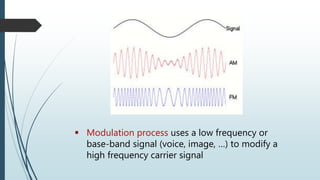
 Modulation process uses a low frequency or
base-band signal (voice, image, …) to modify a
high frequency carrier signal
Ex m(t)M(f) c(t) C(f)
C(t) = cos(2π1500𝑘)
S(t) = m(t) cos(2π1500𝑘)
M(t)AM-Radio channel
M
15KHz
1500KHz
fc
C(t) C(f)m(t)M(f)
 Modulation is the process of increasing the
frequency content of a signal (and so energy
of the signal to enable it to travel long
distance).
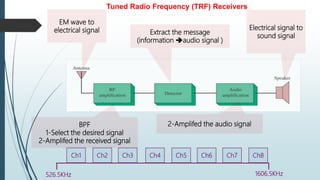
Ch1 Ch2 Ch3 Ch4 Ch5 Ch6 Ch7 Ch8
526.5KHz 1606.5KHz
EM wave to
electrical signal
BPF
1-Select the desired signal
2-Amplifed the received signal
Extract the message
(information audio signal )
2-Amplifed the audio signal
Electrical signal to
sound signal
Tuned Radio Frequency (TRF) Receivers
Problem
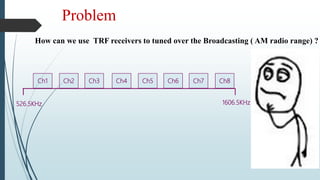
How can we use TRF receivers to tuned over the Broadcasting ( AM radio range) ?
Ch1 Ch2 Ch3 Ch4 Ch5 Ch6 Ch7 Ch8
526.5KHz 1606.5KHz
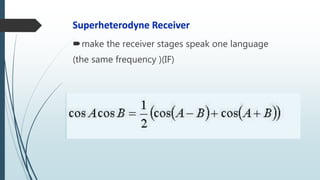
make the receiver stages speak one language
(the same frequency )(IF)
Superheterodyne Receiver
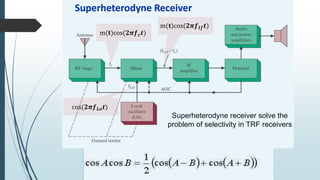
Superheterodyne receiver solve the
problem of selectivity in TRF receivers
m(𝐭)cos(𝟐𝝅𝒇 𝒄 𝒕)
cos(𝟐𝝅𝒇 𝑳𝒐 𝒕)
m(𝐭)cos(𝟐𝝅𝒇 𝑰𝒇 𝒕)
communication system Introduction - AM

communication system Introduction - AM

  • 1.
  • 2.
    - Direct (ex.Landline Telephone)  Electronic communication system is to transfer information from one place to another Receiver Transmitter Channel Connection - Wireless (ex. Radio Transmission)
  • 3.
    Communication System Message Signal Output Transducer OutputSignal Input Transducer Transmitter Communication Channel Input Message Transmitted Signal Receiver Output Message Received Signal Noise
  • 4.
     Input Transducer -Converts the messages produces by a source (speech, temperature , image, music, …) into a form suitable for electrical communications - Speech waves are converted by microphone to voltage variations A transducer is a device that converts one form of energy to another form of energy.
  • 5.
    On December 12,1901, Marconi signaled the letter ‘S’ over the Atlantic — from Cornwall, England to Newfoundland, Canada — becoming the first to make a wireless radio transmission.
  • 6.
     Voice patternor any other pattern of information are low frequency, (Human Voice frequency range 300 – 3400 Hz)  All forms of information must be converted to electromagnetic energy before being propagated through an electronic communication system. FrequencySignalEnergy   Modulation is the process of increasing the frequency content of a signal (and so energy of the signal to enable it to travel long distance).
  • 7.
  • 9.
  • 11.
    Classification of theModulation Process  Modulation process uses a low frequency or base-band signal (voice, image, …) to modify a high frequency carrier signal
  • 12.
     Modulation processuses a low frequency or base-band signal (voice, image, …) to modify a high frequency carrier signal
  • 13.
    Ex m(t)M(f) c(t)C(f) C(t) = cos(2π1500𝑘) S(t) = m(t) cos(2π1500𝑘) M(t)AM-Radio channel M 15KHz 1500KHz fc C(t) C(f)m(t)M(f)  Modulation is the process of increasing the frequency content of a signal (and so energy of the signal to enable it to travel long distance).
  • 15.
    Ch1 Ch2 Ch3Ch4 Ch5 Ch6 Ch7 Ch8 526.5KHz 1606.5KHz EM wave to electrical signal BPF 1-Select the desired signal 2-Amplifed the received signal Extract the message (information audio signal ) 2-Amplifed the audio signal Electrical signal to sound signal Tuned Radio Frequency (TRF) Receivers
  • 16.
    Problem How can weuse TRF receivers to tuned over the Broadcasting ( AM radio range) ? Ch1 Ch2 Ch3 Ch4 Ch5 Ch6 Ch7 Ch8 526.5KHz 1606.5KHz
  • 17.
    make the receiverstages speak one language (the same frequency )(IF) Superheterodyne Receiver
  • 19.
    Superheterodyne Receiver Superheterodyne receiversolve the problem of selectivity in TRF receivers m(𝐭)cos(𝟐𝝅𝒇 𝒄 𝒕) cos(𝟐𝝅𝒇 𝑳𝒐 𝒕) m(𝐭)cos(𝟐𝝅𝒇 𝑰𝒇 𝒕)