Chapter 1Getting Started with Application Software
What’s Inside and on the CD?In this chapter, you will:Look at common features found in most Windows applicationsGain a foundation for working with Word, Excel, PowerPoint, and AccessDiscover this material also applies to working with a browser and e-mail2Practical Microsoft Office 2010
How do I start and exit Windows applications? Before you startComputer should be on Start button should be displayed at bottom of  screenClose all programsWhen you are finished using, to free up memoryBefore initiating shut down procedures3Practical Microsoft Office 2010
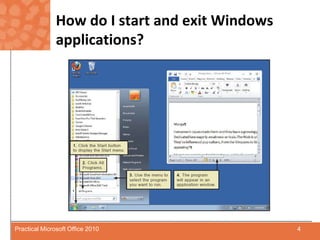
How do I start and exit Windows applications?4Practical Microsoft Office 2010
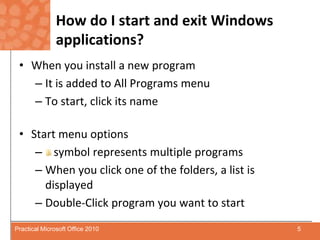
How do I start and exit Windows applications?When you install a new programIt is added to All Programs menuTo start, click its name Start menu optionssymbol represents multiple programs When you click one of the folders, a list is displayedDouble-Click program you want to start5Practical Microsoft Office 2010
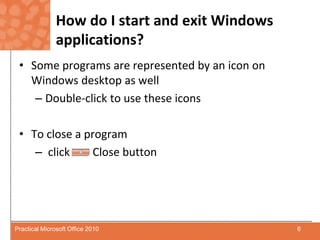
How do I start and exit Windows applications?Some programs are represented by an icon on Windows desktop as wellDouble-click to use these iconsTo close a program click        Close button6Practical Microsoft Office 2010
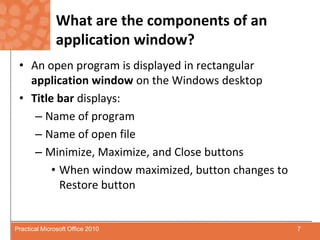
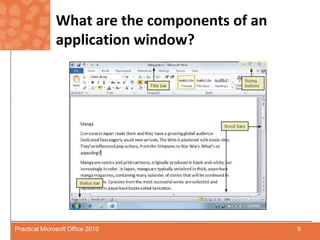
What are the components of an application window?An open program is displayed in rectangular application window on the Windows desktopTitle bar displays:Name of programName of open fileMinimize, Maximize, and Close buttonsWhen window maximized, button changes to Restore button7Practical Microsoft Office 2010
What are the components of an application window?Status bar contains information about current condition of programCurrentpagenumberZoom levelWeb page addressSide scroll bar moves text or graphic up or down  windowHorizontal scroll bar scrolls documents from side to side8Practical Microsoft Office 2010
What are the components of an application window?9Practical Microsoft Office 2010
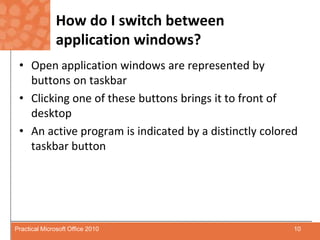
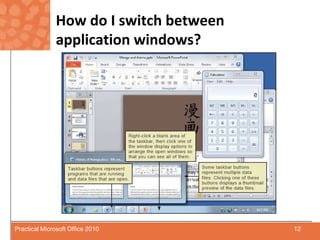
How do I switch between application windows?Open application windows are represented by buttons on taskbarClicking one of these buttons brings it to front of desktopAn active program is indicated by a distinctly colored taskbar button10Practical Microsoft Office 2010
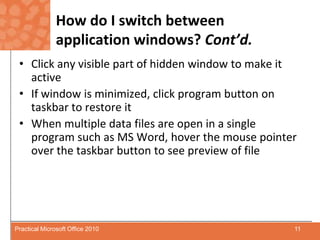
How do I switch between application windows? Cont’d.Click any visible part of hidden window to make it activeIf window is minimized, click program button on taskbar to restore itWhen multiple data files are open in a single program such as MS Word, hover the mouse pointer over the taskbar button to see preview of file11Practical Microsoft Office 2010
How do I switch between application windows?12Practical Microsoft Office 2010
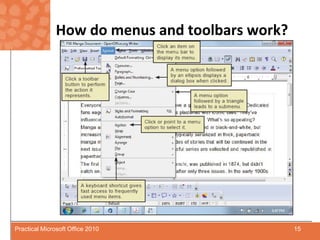
How do menus and toolbars work?Most applications include menu barTypically, a menu bar provides access to all features of programToolbars are typically displayed below menu bar and contain several buttons13Practical Microsoft Office 2010
How do menus and toolbars work?You can browse through menu items to find all features of programTo close menu, click menu title or press EscFor fast menu access, hold Alt key and press underlined letterKeyboard Shortcut14Practical Microsoft Office 2010
How do menus and toolbars work?15Practical Microsoft Office 2010
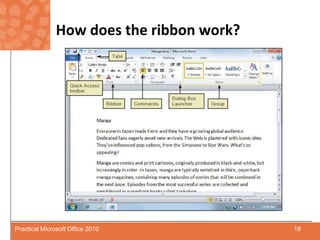
How does the ribbon work?In Microsoft Office 2010, the ribbon replaces the menu bar and toolbarsDivided into a hierarchy consisting of tabs, groups, and commandsTabs are divided into groupsGroups contain commands16Practical Microsoft Office 2010
How does the ribbon work?The Quick Access toolbar contains commands that you use regularlyContextual tabs contain formatting options for an object and appear when an object is selectedDialog boxes can be opened from the Dialog Box Launcher in the lower-right corner of a group17Practical Microsoft Office 2010
How does the ribbon work?18Practical Microsoft Office 2010
How do I open a file?Data is stored in files on hard disks, CDs, DVDs, USB flash drives, and other storage mediaFiles are referred to in different ways, e.g.:A Microsoft Word file is called a document, while a PowerPoint file is called a presentation19Practical Microsoft Office 2010
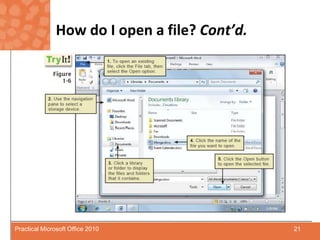
How do I open a file? Cont’d.There are several ways to open file:Use the application’s jump list from the Start menuDouble-click file shortcut icon if one exists on windows desktopDouble-click file name from within Windows ExplorerUse Open dialog box provided by application20Practical Microsoft Office 2010
How do I open a file? Cont’d.21Practical Microsoft Office 2010
What if a file doesn’t open?Common file problems include:Storage device not availableFile not savedFile stored in the wrong folderFile movedFile is corruptedIncompatible file typeWrong associationFile has the wrong extensionProduct or version incompatibility22Practical Microsoft Office 2010
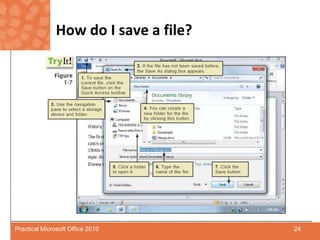
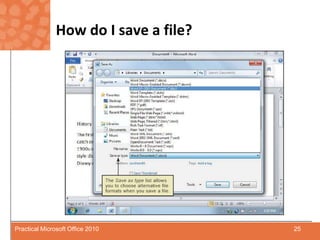
How do I save a file?When you first save a file, you must name itThe file extension is separated from file name by (.) period. Windows will automatically add appropriate extension File name extension is associated with particular file formatClicking save button automatically stores a file using original name, drive, and folderUse Save As when you want to change a file’s name or its location23Practical Microsoft Office 2010
How do I save a file?24Practical Microsoft Office 2010
How do I save a file?25Practical Microsoft Office 2010
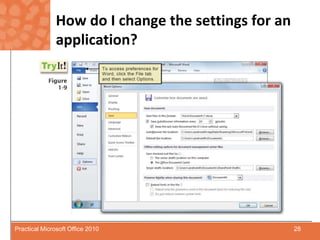
How do I change the settings for an application?Most application software is preconfigured with a set of application defaultsMost software allows you to modify application defaultsLook for Options or Preferences on the File or Tools menu26Practical Microsoft Office 2010
How do I change the settings for an application?Microsoft Office applications default to your personal libraries and foldersDon’t assume that the autosave feature is activated as your application defaultBe conservative when you change application defaults27Practical Microsoft Office 2010
How do I change the settings for an application?28Practical Microsoft Office 2010
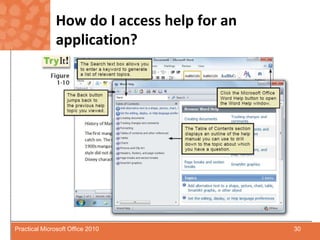
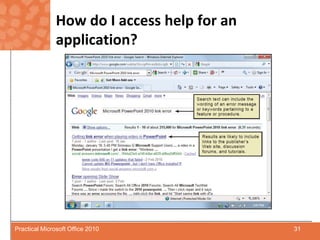
How do I access help for an application?Access help from variety of sourcesOn-Screen HelpPrinted users manualsReadme files on a CDThird-Party reference booksAccess electronic user manual for Office modules by clicking the Help button or pressing F1Check on-line user groups or publisher’s Web sitesUse a search engine such as Google to get help29Practical Microsoft Office 2010
How do I access help for an application?30Practical Microsoft Office 2010
How do I access help for an application?31Practical Microsoft Office 2010

Chapter.01

  • 1.
    Chapter 1Getting Startedwith Application Software
  • 2.
    What’s Inside andon the CD?In this chapter, you will:Look at common features found in most Windows applicationsGain a foundation for working with Word, Excel, PowerPoint, and AccessDiscover this material also applies to working with a browser and e-mail2Practical Microsoft Office 2010
  • 3.
    How do Istart and exit Windows applications? Before you startComputer should be on Start button should be displayed at bottom of screenClose all programsWhen you are finished using, to free up memoryBefore initiating shut down procedures3Practical Microsoft Office 2010
  • 4.
    How do Istart and exit Windows applications?4Practical Microsoft Office 2010
  • 5.
    How do Istart and exit Windows applications?When you install a new programIt is added to All Programs menuTo start, click its name Start menu optionssymbol represents multiple programs When you click one of the folders, a list is displayedDouble-Click program you want to start5Practical Microsoft Office 2010
  • 6.
    How do Istart and exit Windows applications?Some programs are represented by an icon on Windows desktop as wellDouble-click to use these iconsTo close a program click Close button6Practical Microsoft Office 2010
  • 7.
    What are thecomponents of an application window?An open program is displayed in rectangular application window on the Windows desktopTitle bar displays:Name of programName of open fileMinimize, Maximize, and Close buttonsWhen window maximized, button changes to Restore button7Practical Microsoft Office 2010
  • 8.
    What are thecomponents of an application window?Status bar contains information about current condition of programCurrentpagenumberZoom levelWeb page addressSide scroll bar moves text or graphic up or down windowHorizontal scroll bar scrolls documents from side to side8Practical Microsoft Office 2010
  • 9.
    What are thecomponents of an application window?9Practical Microsoft Office 2010
  • 10.
    How do Iswitch between application windows?Open application windows are represented by buttons on taskbarClicking one of these buttons brings it to front of desktopAn active program is indicated by a distinctly colored taskbar button10Practical Microsoft Office 2010
  • 11.
    How do Iswitch between application windows? Cont’d.Click any visible part of hidden window to make it activeIf window is minimized, click program button on taskbar to restore itWhen multiple data files are open in a single program such as MS Word, hover the mouse pointer over the taskbar button to see preview of file11Practical Microsoft Office 2010
  • 12.
    How do Iswitch between application windows?12Practical Microsoft Office 2010
  • 13.
    How do menusand toolbars work?Most applications include menu barTypically, a menu bar provides access to all features of programToolbars are typically displayed below menu bar and contain several buttons13Practical Microsoft Office 2010
  • 14.
    How do menusand toolbars work?You can browse through menu items to find all features of programTo close menu, click menu title or press EscFor fast menu access, hold Alt key and press underlined letterKeyboard Shortcut14Practical Microsoft Office 2010
  • 15.
    How do menusand toolbars work?15Practical Microsoft Office 2010
  • 16.
    How does theribbon work?In Microsoft Office 2010, the ribbon replaces the menu bar and toolbarsDivided into a hierarchy consisting of tabs, groups, and commandsTabs are divided into groupsGroups contain commands16Practical Microsoft Office 2010
  • 17.
    How does theribbon work?The Quick Access toolbar contains commands that you use regularlyContextual tabs contain formatting options for an object and appear when an object is selectedDialog boxes can be opened from the Dialog Box Launcher in the lower-right corner of a group17Practical Microsoft Office 2010
  • 18.
    How does theribbon work?18Practical Microsoft Office 2010
  • 19.
    How do Iopen a file?Data is stored in files on hard disks, CDs, DVDs, USB flash drives, and other storage mediaFiles are referred to in different ways, e.g.:A Microsoft Word file is called a document, while a PowerPoint file is called a presentation19Practical Microsoft Office 2010
  • 20.
    How do Iopen a file? Cont’d.There are several ways to open file:Use the application’s jump list from the Start menuDouble-click file shortcut icon if one exists on windows desktopDouble-click file name from within Windows ExplorerUse Open dialog box provided by application20Practical Microsoft Office 2010
  • 21.
    How do Iopen a file? Cont’d.21Practical Microsoft Office 2010
  • 22.
    What if afile doesn’t open?Common file problems include:Storage device not availableFile not savedFile stored in the wrong folderFile movedFile is corruptedIncompatible file typeWrong associationFile has the wrong extensionProduct or version incompatibility22Practical Microsoft Office 2010
  • 23.
    How do Isave a file?When you first save a file, you must name itThe file extension is separated from file name by (.) period. Windows will automatically add appropriate extension File name extension is associated with particular file formatClicking save button automatically stores a file using original name, drive, and folderUse Save As when you want to change a file’s name or its location23Practical Microsoft Office 2010
  • 24.
    How do Isave a file?24Practical Microsoft Office 2010
  • 25.
    How do Isave a file?25Practical Microsoft Office 2010
  • 26.
    How do Ichange the settings for an application?Most application software is preconfigured with a set of application defaultsMost software allows you to modify application defaultsLook for Options or Preferences on the File or Tools menu26Practical Microsoft Office 2010
  • 27.
    How do Ichange the settings for an application?Microsoft Office applications default to your personal libraries and foldersDon’t assume that the autosave feature is activated as your application defaultBe conservative when you change application defaults27Practical Microsoft Office 2010
  • 28.
    How do Ichange the settings for an application?28Practical Microsoft Office 2010
  • 29.
    How do Iaccess help for an application?Access help from variety of sourcesOn-Screen HelpPrinted users manualsReadme files on a CDThird-Party reference booksAccess electronic user manual for Office modules by clicking the Help button or pressing F1Check on-line user groups or publisher’s Web sitesUse a search engine such as Google to get help29Practical Microsoft Office 2010
  • 30.
    How do Iaccess help for an application?30Practical Microsoft Office 2010
  • 31.
    How do Iaccess help for an application?31Practical Microsoft Office 2010