Organic Chemistry V
Introduction to Polymer Chemistry
Indra Yudhipratama
Outline
 Defining the terms in polymer
 Type of polymers
 Polymer synthesis (Polymerisation) and the properties of its
product
 Addition polymerisation
 Polyalkenes
 Condensation polymerisation
 Polyesters
 Polyamides
 Enhancing the polymers
Introduction
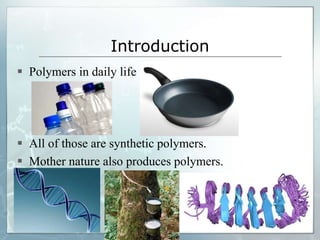
 Polymers in daily life
 All of those are synthetic polymers.
 Mother nature also produces polymers.
Defining Polymer
 Polymers  Poly (many) + mer (unit)
 Hence polymer is a macromolecule that is built from
smaller unit (monomer)
 Proteins are built from many amino acids. Proteins are
polymers, amino acids are the monomers
 A polymer can be built from the same monomer
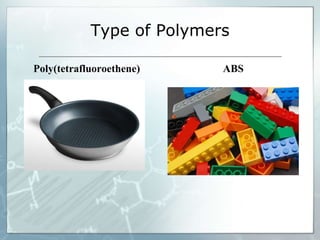
Homopolymer e.g. Poly(tetrafluoroethene)
 Also can be built from different monomers Copolymer
e.g. ABS (Acrylonitrile-Butadiene-Styrene)
Type of Polymers
Poly(tetrafluoroethene) ABS
Polymerisation
 Addition polymerisation
 Involving radicals chemistry
 Three main steps:
 Initiation
 An initiator is required to start reaction
 Propagation
 The chain is propagated to form a long chain
 Termination
 Reacts with another radical species to stop the reaction
Addition Polymerisation
 E.g. Synthesis of Poly(chloroethene) or PVC
 Initiation step
 Propagation step
 Termination step
Addition Polymerisation
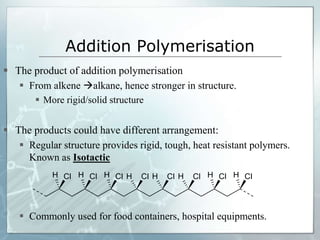
 The product of addition polymerisation
 From alkene alkane, hence stronger in structure.
 More rigid/solid structure
 The products could have different arrangement:
 Regular structure provides rigid, tough, heat resistant polymers.
Known as Isotactic
 Commonly used for food containers, hospital equipments.
Addition Polymerisation
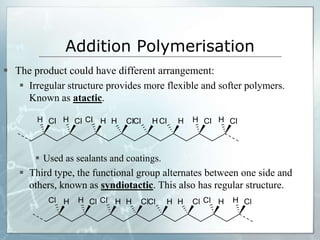
 The product could have different arrangement:
 Irregular structure provides more flexible and softer polymers.
Known as atactic.
 Used as sealants and coatings.
 Third type, the functional group alternates between one side and
others, known as syndiotactic. This also has regular structure.
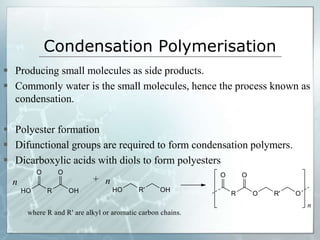
Condensation Polymerisation
 Producing small molecules as side products.
 Commonly water is the small molecules, hence the process known as
condensation.
 Polyester formation
 Difunctional groups are required to form condensation polymers.
 Dicarboxylic acids with diols to form polyesters
Polyesters
Polyesters in daily life
 Poly(ethylene terephtalate) or known as PET.
 The monomers are phtalic acid and ethane-1,2-diol.
 A rigid structure due to benzene rings.
 Used as plastic bottle
Polyamides
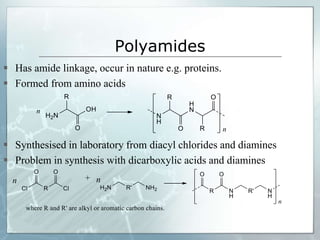
 Has amide linkage, occur in nature e.g. proteins.
 Formed from amino acids
 Synthesised in laboratory from diacyl chlorides and diamines
 Problem in synthesis with dicarboxylic acids and diamines
Polyamides
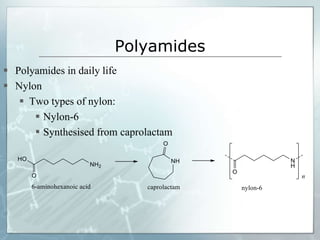
 Polyamides in daily life
 Nylon
 Two types of nylon:
 Nylon-6
 Synthesised from caprolactam
Polyamides
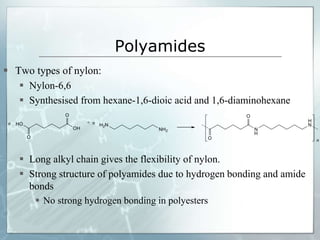
 Two types of nylon:
 Nylon-6,6
 Synthesised from hexane-1,6-dioic acid and 1,6-diaminohexane
 Long alkyl chain gives the flexibility of nylon.
 Strong structure of polyamides due to hydrogen bonding and amide
bonds
 No strong hydrogen bonding in polyesters
Enhancing the Polymers’ Properties
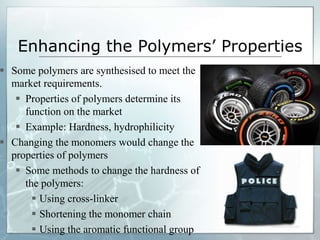
 Some polymers are synthesised to meet the
market requirements.
 Properties of polymers determine its
function on the market
 Example: Hardness, hydrophilicity
 Changing the monomers would change the
properties of polymers
 Some methods to change the hardness of
the polymers:
 Using cross-linker
 Shortening the monomer chain
 Using the aromatic functional group
Enhancing the Polymers’ Properties
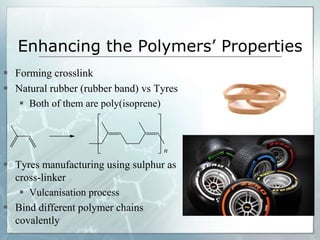
 Forming crosslink
 Natural rubber (rubber band) vs Tyres
 Both of them are poly(isoprene)
 Tyres manufacturing using sulphur as
cross-linker
 Vulcanisation process
 Bind different polymer chains
covalently
Enhancing the Polymers
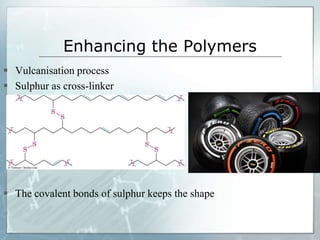
 Vulcanisation process
 Sulphur as cross-linker
 The covalent bonds of sulphur keeps the shape
Enhancing the Polymers
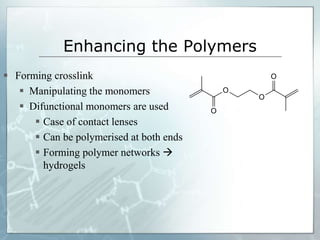
 Forming crosslink
 Manipulating the monomers
 Difunctional monomers are used
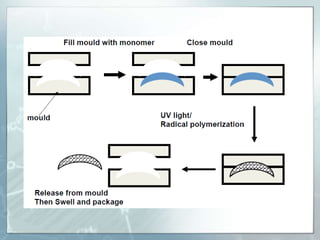
 Case of contact lenses
 Can be polymerised at both ends
 Forming polymer networks 
hydrogels
Enhancing the Polymers
 Shortening the monomers
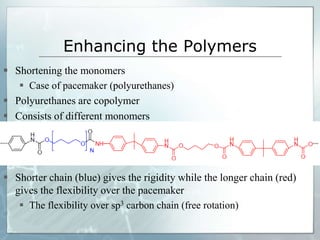
 Case of pacemaker (polyurethanes)
 Polyurethanes are copolymer
 Consists of different monomers
 Shorter chain (blue) gives the rigidity while the longer chain (red)
gives the flexibility over the pacemaker
 The flexibility over sp3 carbon chain (free rotation)
Enhancing the Polymers
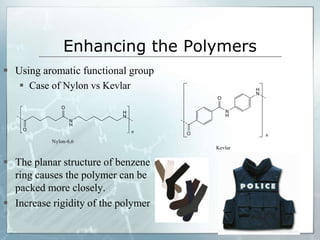
 Using aromatic functional group
 Case of Nylon vs Kevlar
 The planar structure of benzene
ring causes the polymer can be
packed more closely.
 Increase rigidity of the polymer
Inorganic Polymers
 Non-carbon based polymers can
also be synthesised
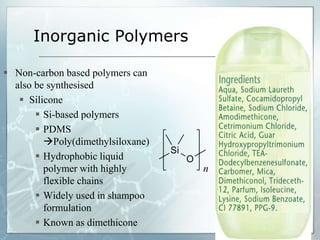
 Silicone
 Si-based polymers
 PDMS
Poly(dimethylsiloxane)
 Hydrophobic liquid
polymer with highly
flexible chains
 Widely used in shampoo
formulation
 Known as dimethicone
Inorganic Polymers
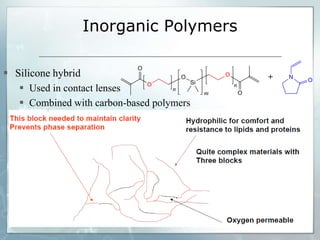
 Silicone hybrid
 Used in contact lenses
 Combined with carbon-based polymers

Introduction to Polymer Chemistry

  • 1.
    Organic Chemistry V Introductionto Polymer Chemistry Indra Yudhipratama
  • 2.
    Outline  Defining theterms in polymer  Type of polymers  Polymer synthesis (Polymerisation) and the properties of its product  Addition polymerisation  Polyalkenes  Condensation polymerisation  Polyesters  Polyamides  Enhancing the polymers
  • 3.
    Introduction  Polymers indaily life  All of those are synthetic polymers.  Mother nature also produces polymers.
  • 4.
    Defining Polymer  Polymers Poly (many) + mer (unit)  Hence polymer is a macromolecule that is built from smaller unit (monomer)  Proteins are built from many amino acids. Proteins are polymers, amino acids are the monomers  A polymer can be built from the same monomer Homopolymer e.g. Poly(tetrafluoroethene)  Also can be built from different monomers Copolymer e.g. ABS (Acrylonitrile-Butadiene-Styrene)
  • 5.
  • 6.
    Polymerisation  Addition polymerisation Involving radicals chemistry  Three main steps:  Initiation  An initiator is required to start reaction  Propagation  The chain is propagated to form a long chain  Termination  Reacts with another radical species to stop the reaction
  • 7.
    Addition Polymerisation  E.g.Synthesis of Poly(chloroethene) or PVC  Initiation step  Propagation step  Termination step
  • 9.
    Addition Polymerisation  Theproduct of addition polymerisation  From alkene alkane, hence stronger in structure.  More rigid/solid structure  The products could have different arrangement:  Regular structure provides rigid, tough, heat resistant polymers. Known as Isotactic  Commonly used for food containers, hospital equipments.
  • 10.
    Addition Polymerisation  Theproduct could have different arrangement:  Irregular structure provides more flexible and softer polymers. Known as atactic.  Used as sealants and coatings.  Third type, the functional group alternates between one side and others, known as syndiotactic. This also has regular structure.
  • 11.
    Condensation Polymerisation  Producingsmall molecules as side products.  Commonly water is the small molecules, hence the process known as condensation.  Polyester formation  Difunctional groups are required to form condensation polymers.  Dicarboxylic acids with diols to form polyesters
  • 12.
    Polyesters Polyesters in dailylife  Poly(ethylene terephtalate) or known as PET.  The monomers are phtalic acid and ethane-1,2-diol.  A rigid structure due to benzene rings.  Used as plastic bottle
  • 13.
    Polyamides  Has amidelinkage, occur in nature e.g. proteins.  Formed from amino acids  Synthesised in laboratory from diacyl chlorides and diamines  Problem in synthesis with dicarboxylic acids and diamines
  • 14.
    Polyamides  Polyamides indaily life  Nylon  Two types of nylon:  Nylon-6  Synthesised from caprolactam
  • 15.
    Polyamides  Two typesof nylon:  Nylon-6,6  Synthesised from hexane-1,6-dioic acid and 1,6-diaminohexane  Long alkyl chain gives the flexibility of nylon.  Strong structure of polyamides due to hydrogen bonding and amide bonds  No strong hydrogen bonding in polyesters
  • 16.
    Enhancing the Polymers’Properties  Some polymers are synthesised to meet the market requirements.  Properties of polymers determine its function on the market  Example: Hardness, hydrophilicity  Changing the monomers would change the properties of polymers  Some methods to change the hardness of the polymers:  Using cross-linker  Shortening the monomer chain  Using the aromatic functional group
  • 17.
    Enhancing the Polymers’Properties  Forming crosslink  Natural rubber (rubber band) vs Tyres  Both of them are poly(isoprene)  Tyres manufacturing using sulphur as cross-linker  Vulcanisation process  Bind different polymer chains covalently
  • 18.
    Enhancing the Polymers Vulcanisation process  Sulphur as cross-linker  The covalent bonds of sulphur keeps the shape
  • 19.
    Enhancing the Polymers Forming crosslink  Manipulating the monomers  Difunctional monomers are used  Case of contact lenses  Can be polymerised at both ends  Forming polymer networks  hydrogels
  • 20.
    Enhancing the Polymers Shortening the monomers  Case of pacemaker (polyurethanes)  Polyurethanes are copolymer  Consists of different monomers  Shorter chain (blue) gives the rigidity while the longer chain (red) gives the flexibility over the pacemaker  The flexibility over sp3 carbon chain (free rotation)
  • 21.
    Enhancing the Polymers Using aromatic functional group  Case of Nylon vs Kevlar  The planar structure of benzene ring causes the polymer can be packed more closely.  Increase rigidity of the polymer
  • 22.
    Inorganic Polymers  Non-carbonbased polymers can also be synthesised  Silicone  Si-based polymers  PDMS Poly(dimethylsiloxane)  Hydrophobic liquid polymer with highly flexible chains  Widely used in shampoo formulation  Known as dimethicone
  • 23.
    Inorganic Polymers  Siliconehybrid  Used in contact lenses  Combined with carbon-based polymers

Editor's Notes