1
Microsoft Office 2010 Basics and
the Internet
Microsoft Office 2010
Introductory
Pasewark & Pasewark
Office
2010
Basics
and
the
Internet
Pasewark & Pasewark Microsoft Office 2010 Introductory
2
2
2
Objectives
 Explain the concept of an integrated software
package.
 Start an Office program from Windows.
 Explain the features of the program window.
 Know how to use the Ribbon and contextual
tools.
 Open an existing Office file.
Office
2010
Basics
and
the
Internet
Pasewark & Pasewark Microsoft Office 2010 Introductory
3
3
3
Objectives (continued)
 Save and close an Office file.
 Know the shortcut for opening recently used
files.
 Use the Office Help system.
 Exit an Office program.
 Use a Web browser to visit a Web site.
Office
2010
Basics
and
the
Internet
Pasewark & Pasewark Microsoft Office 2010 Introductory
4
4
4
Vocabulary
 Backstage view
 contextual tab
 gallery
 home page
 Internet
 link
 Live Preview
 Microsoft Office 2010
(Office)
 Mini toolbar
 Ribbon
 ScreenTip
 SharePoint
 shortcut menu
 SkyDrive
 tab
 task pane
Office
2010
Basics
and
the
Internet
Pasewark & Pasewark Microsoft Office 2010 Introductory
5
5
5
Vocabulary (continued)
 toolbar
 Uniform Resource
Locator (URL)
 Web browser
 World Wide Web (Web)
Office
2010
Basics
and
the
Internet
Pasewark & Pasewark Microsoft Office 2010 Introductory
6
6
6
Introducing Microsoft Office 2010
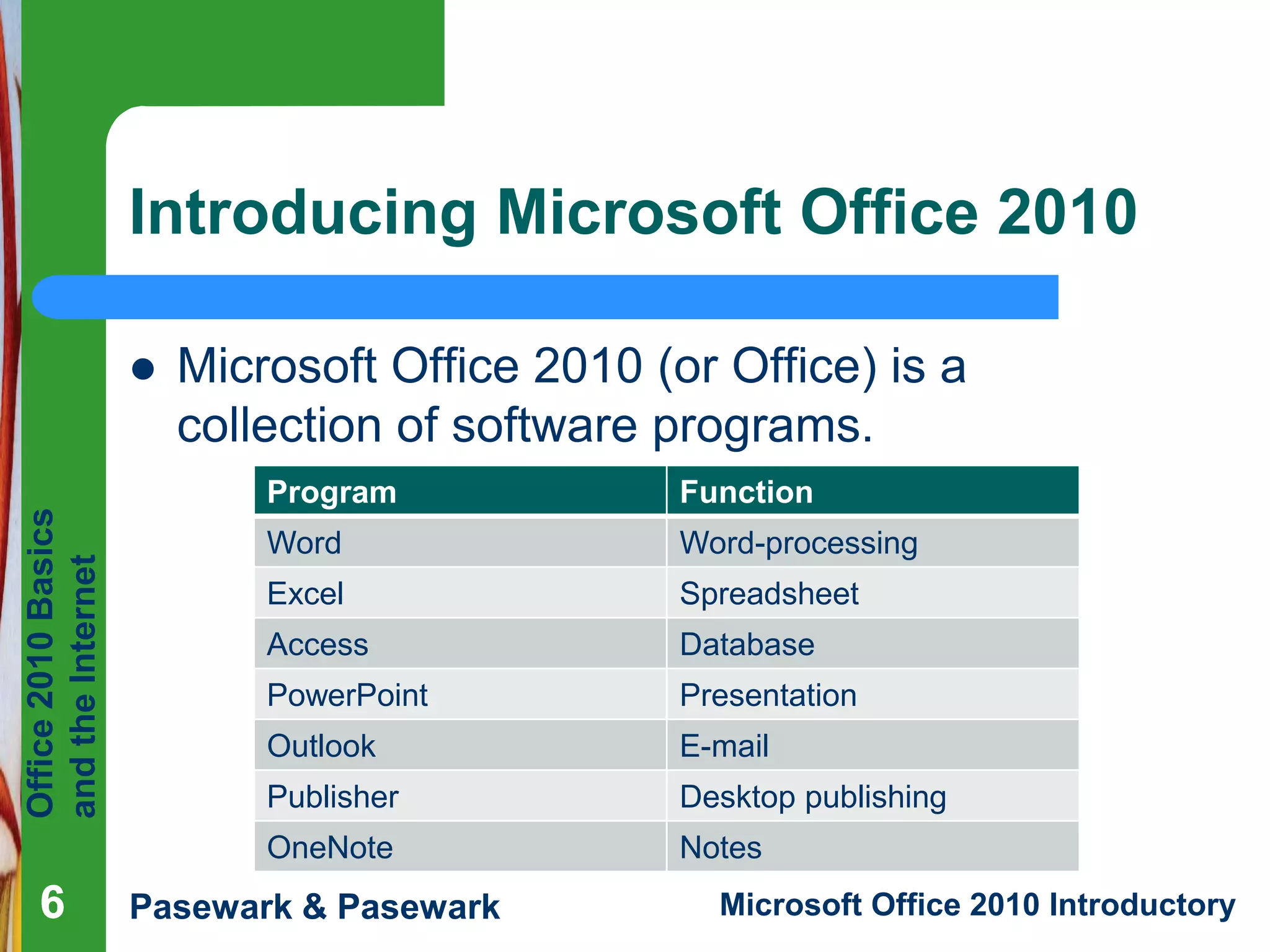
 Microsoft Office 2010 (or Office) is a
collection of software programs.
Program Function
Word Word-processing
Excel Spreadsheet
Access Database
PowerPoint Presentation
Outlook E-mail
Publisher Desktop publishing
OneNote Notes
Office
2010
Basics
and
the
Internet
Pasewark & Pasewark Microsoft Office 2010 Introductory
7
7
7
Introducing Microsoft Office 2010
(continued)
 Office programs can be used together.
 To start an Office program, click the Start
button on the taskbar, click All Programs,
then click Microsoft Office. A list of the Office
programs on your computer appears.
 You can open more than one file at a time.
To move between files, just click the taskbar
button for the file you want to display.
Office
2010
Basics
and
the
Internet
Pasewark & Pasewark Microsoft Office 2010 Introductory
8
8
8
Introducing Microsoft Office 2010
(continued)
 A program window is the rectangle that
contains the open program, tools for working
with the file, and the work area.
 The Ribbon is "command central" for the
Office programs. The tabs on the Ribbon
organize the commands into related tasks.
 By clicking a button to choose a command,
you give the program instructions about what
you want to do.
Office
2010
Basics
and
the
Internet
Pasewark & Pasewark Microsoft Office 2010 Introductory
Introducing Microsoft Office 2010
(continued)
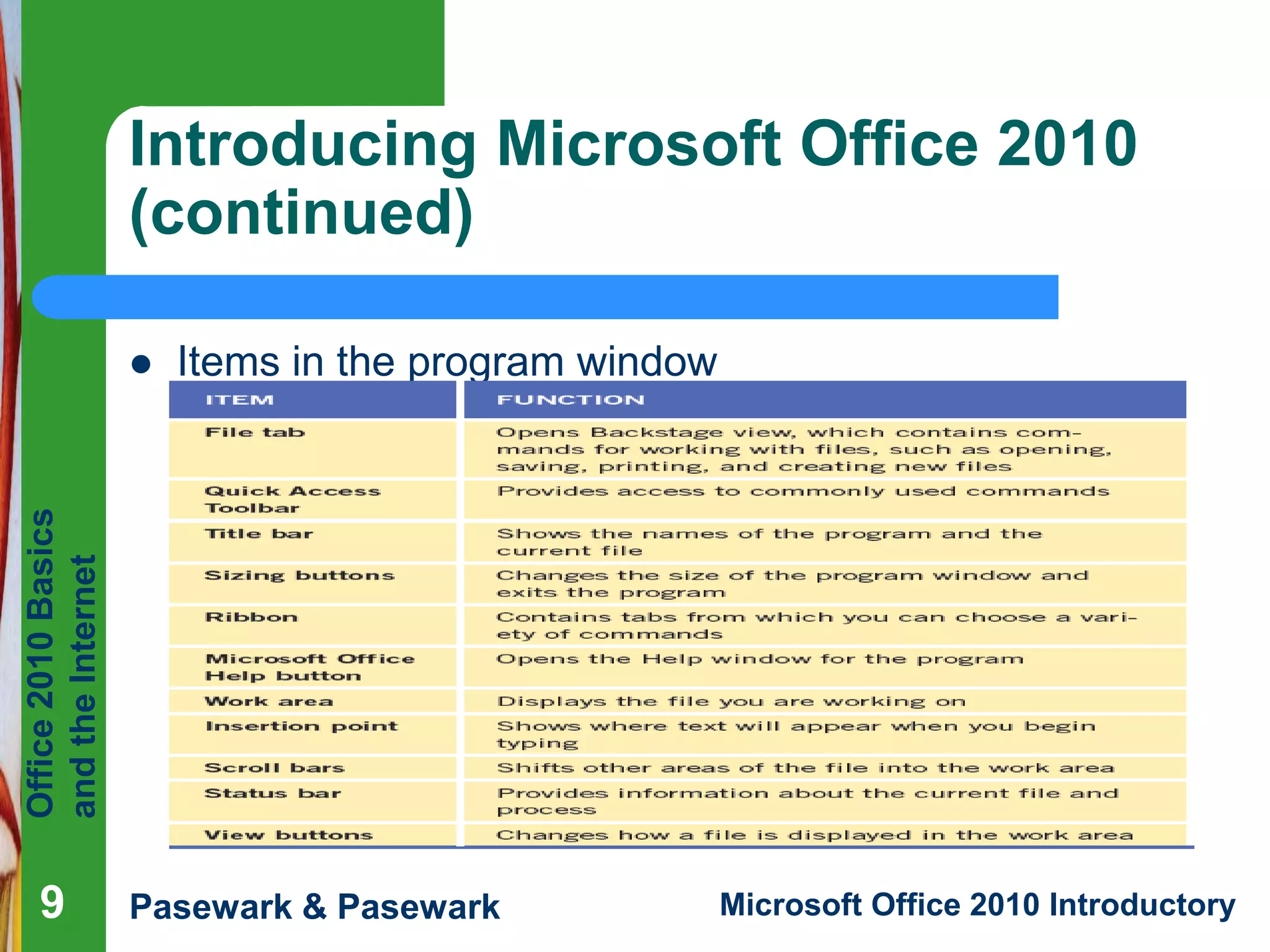
 Items in the program window
9
Office
2010
Basics
and
the
Internet
Pasewark & Pasewark Microsoft Office 2010 Introductory
10
10
10
Introducing Microsoft Office 2010
(continued)
 Some buttons are like light switches: one
click turns on the feature and the next click
turns it off. This is often referred to as a
toggle.
 Other buttons have two parts: a button that
you can click to choose the command and an
arrow that you can click to open a menu, or
list, of other commands related to the button.
Office
2010
Basics
and
the
Internet
Pasewark & Pasewark Microsoft Office 2010 Introductory
11
11
11
Introducing Microsoft Office 2010
(continued)
 When a gallery is available, Live Preview lets
you see how a gallery option affects your file
without making the change.
 The Dialog Box Launcher on the ribbon
opens either a dialog box or task pane.
– A dialog box is a window that opens on top of the
program window.
– A task pane is a pane that opens on the right or
left side of the program window.
Office
2010
Basics
and
the
Internet
Pasewark & Pasewark Microsoft Office 2010 Introductory
12
12
12
Introducing Microsoft Office 2010
(continued)
 A toolbar contains buttons that you can click
to perform common tasks. The Ribbon is
actually a large toolbar.
 Contextual tabs appear on the Ribbon only
when you select certain items in a file, and
they contain commands related to that item
and include the Mini toolbar and shortcut
menus.
Office
2010
Basics
and
the
Internet
Pasewark & Pasewark Microsoft Office 2010 Introductory
13
13
Using Backstage View to Open,
Save, and Close Files
 In all Office programs, you open, save, and
close files in Backstage view.
– Opening a file means loading a file from a disk
into the program window.
– Saving a file stores it on a disk.
– Closing a file removes it from the program
window.
 A disk can be an internal (hard drive) or
external storage location (Flash drive).
13
Office
2010
Basics
and
the
Internet
Pasewark & Pasewark Microsoft Office 2010 Introductory
Using Backstage View to Open,
Save, and Close Files (continued)
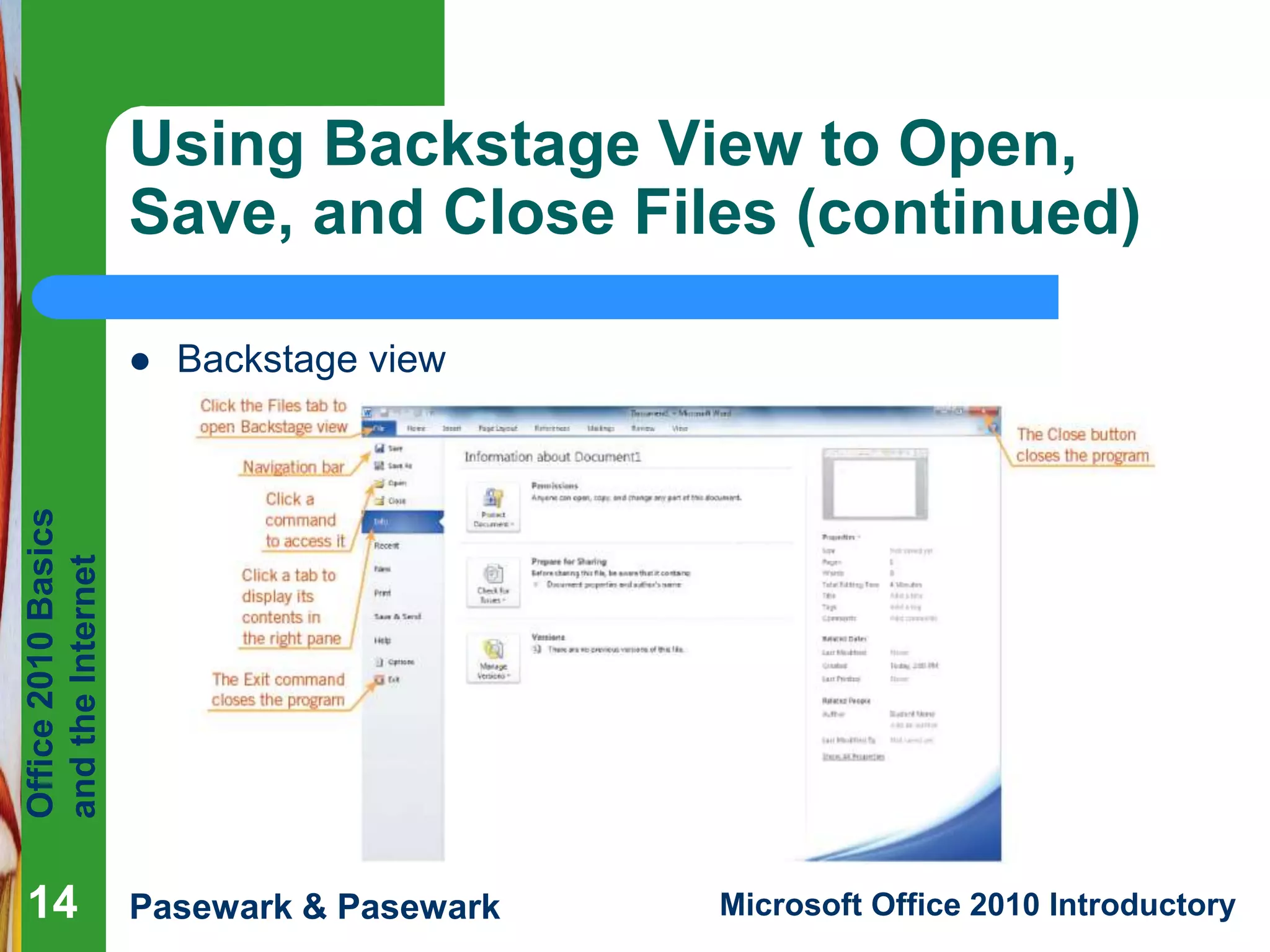
 Backstage view
14
Office
2010
Basics
and
the
Internet
Pasewark & Pasewark Microsoft Office 2010 Introductory
15
15
Using Backstage View to Open,
Save, and Close Files (continued)
 Backstage view is where you do “behind the
scenes” tasks such as getting information
about the current file, creating new files,
printing the current file, sharing files with
others, and defining file properties.
 To open an existing file, you can click the File
tab on the Ribbon, and then, in Backstage
view, click Open.
-
15
Office
2010
Basics
and
the
Internet
Pasewark & Pasewark Microsoft Office 2010 Introductory
16
16
Using Backstage View to Open,
Save, and Close Files (continued)
 Files you open that were downloaded from
the Internet or received as an e-mail
attachment may open in a read-only format,
called Protected View.
 Saving is done using one of two methods:
– The Save command saves a file on a disk using
its current name and save location.
– The Save As command lets you save a file with a
new name or to a new location.
16
Office
2010
Basics
and
the
Internet
Pasewark & Pasewark Microsoft Office 2010 Introductory
17
17
Using Backstage View to Open,
Save, and Close Files (continued)
 Each program has a different file extension.
 To share a file with others, use Background
view from the Save & Send tab.
 You can close an Office file by clicking the
File tab on the Ribbon, and then Close.
 To access a recently used file, click the File
tab in any of the Office programs, and then
click Recent in the navigation bar.
17
Office
2010
Basics
and
the
Internet
Pasewark & Pasewark Microsoft Office 2010 Introductory
18
18
Getting Help in Office
18
 A ScreenTip is a box that appears when you
point to a button. It contains the button's
name and a description of its function.
 To get specific help about topics relating to
the program you are using, you use the Help
window. You can search the Help system by
browsing topics or using keywords.
Office
2010
Basics
and
the
Internet
Pasewark & Pasewark Microsoft Office 2010 Introductory
Getting Help in Office (continued)
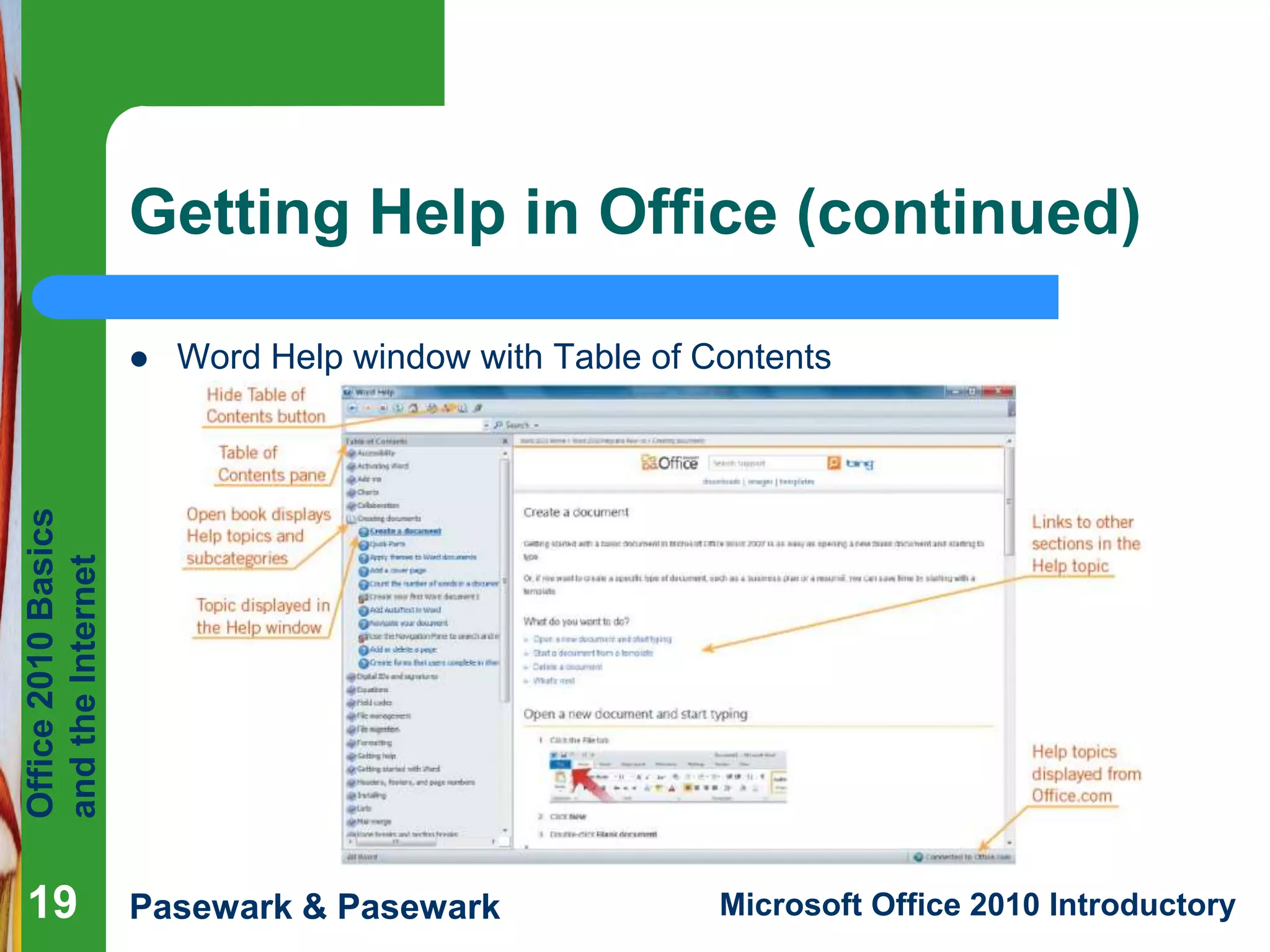
 Word Help window with Table of Contents
19
Office
2010
Basics
and
the
Internet
Pasewark & Pasewark Microsoft Office 2010 Introductory
20
20
Exiting an Office Program
20
 The Exit command, which is located in
Backstage view, closes the open Office
program.
 If you have not saved the final version of your
file, a dialog box opens, asking whether you
want to save your changes.
Office
2010
Basics
and
the
Internet
Pasewark & Pasewark Microsoft Office 2010 Introductory
21
21
Viewing a Web Page
21
 The Internet is a vast network of computers
that are located all over the world and linked
to one another.
 Connecting to the Internet requires special
hardware and software and an Internet
service provider (ISP).
 The World Wide Web (or Web) is a system
of computers that share information by
means of links on Web pages.
Office
2010
Basics
and
the
Internet
Pasewark & Pasewark Microsoft Office 2010 Introductory
22
22
Viewing a Web Page (continued)
22
 A link is text (often colored and underlined) or
a graphic that you click to "jump" to another
location or Web page.
 A Web page is a document specially formatted
to be displayed on computers connected to
the Internet.
 The Web uses an address system. The name
for a Web address is Uniform Resource
Locator (URL).
Office
2010
Basics
and
the
Internet
Pasewark & Pasewark Microsoft Office 2010 Introductory
23
23
Viewing a Web Page (continued)
23
 Internet Explorer Web browser
Office
2010
Basics
and
the
Internet
Pasewark & Pasewark Microsoft Office 2010 Introductory
24
24
Viewing a Web Page (continued)
24
 To view Web pages, you need special
software called a Web browser.
 To go to a specific Web page, you click the
Address bar in your browser, type the URL,
and then press Enter.
Office
2010
Basics
and
the
Internet
Pasewark & Pasewark Microsoft Office 2010 Introductory
25
25
Summary
In this lesson, you learned:
 Microsoft Office 2010 is a combination of programs that
can include a word-processor program, a spreadsheet
program, a database program, a presentation program, a
schedule/organizer program, a desktop publishing
program, and a notes program. The files of these
programs can be used together.
 Office programs can be started by clicking the Start button,
clicking All Programs, clicking Microsoft Office, and then
clicking the program name.
25
Office
2010
Basics
and
the
Internet
Pasewark & Pasewark Microsoft Office 2010 Introductory
26
26
Summary (continued)
 The basic parts of the program window are similar in
all of the Office programs.
 The Ribbon is “command central” for all the Office
programs. Commands are organized in groups on
tabs on the Ribbon. You click a button to choose the
command you want. Some buttons open a menu of
additional commands or a gallery of options.
 Contextual tabs on the Ribbon, the Mini toolbar, and
shortcut menus are tools that appear when you work
with a specific object in the program window.
26
Office
2010
Basics
and
the
Internet
Pasewark & Pasewark Microsoft Office 2010 Introductory
27
27
Summary (continued)
 No matter which Office program you are using, the files
are opened, saved, and closed the same way.
 You can open an existing file from the Backstage view.
The Open dialog box enables you to open a file from any
available disk or directory. You can open recently used
files quickly by clicking the file name in the Recent
Documents list in Backstage view.
 To exit an Office program, click the Exit button in
Backstage view, or click the Close button on the program
window title bar.
27
Office
2010
Basics
and
the
Internet
Pasewark & Pasewark Microsoft Office 2010 Introductory
Summary (continued)
 The Office Help system provides additional
information about the many features of the Office
programs. In the Help window, you can browse
topics, use the Table of Contents or use the Type
word to search for box to get information. If your
computer is connected to the Internet, you see Help
topics and additional information from Office.com.
 Internet Explorer is a Web browser. You can use it to
view Web pages.
28

Office2010 basicsandtheinternet (1)

  • 1.
    1 Microsoft Office 2010Basics and the Internet Microsoft Office 2010 Introductory Pasewark & Pasewark
  • 2.
    Office 2010 Basics and the Internet Pasewark & PasewarkMicrosoft Office 2010 Introductory 2 2 2 Objectives  Explain the concept of an integrated software package.  Start an Office program from Windows.  Explain the features of the program window.  Know how to use the Ribbon and contextual tools.  Open an existing Office file.
  • 3.
    Office 2010 Basics and the Internet Pasewark & PasewarkMicrosoft Office 2010 Introductory 3 3 3 Objectives (continued)  Save and close an Office file.  Know the shortcut for opening recently used files.  Use the Office Help system.  Exit an Office program.  Use a Web browser to visit a Web site.
  • 4.
    Office 2010 Basics and the Internet Pasewark & PasewarkMicrosoft Office 2010 Introductory 4 4 4 Vocabulary  Backstage view  contextual tab  gallery  home page  Internet  link  Live Preview  Microsoft Office 2010 (Office)  Mini toolbar  Ribbon  ScreenTip  SharePoint  shortcut menu  SkyDrive  tab  task pane
  • 5.
    Office 2010 Basics and the Internet Pasewark & PasewarkMicrosoft Office 2010 Introductory 5 5 5 Vocabulary (continued)  toolbar  Uniform Resource Locator (URL)  Web browser  World Wide Web (Web)
  • 6.
    Office 2010 Basics and the Internet Pasewark & PasewarkMicrosoft Office 2010 Introductory 6 6 6 Introducing Microsoft Office 2010  Microsoft Office 2010 (or Office) is a collection of software programs. Program Function Word Word-processing Excel Spreadsheet Access Database PowerPoint Presentation Outlook E-mail Publisher Desktop publishing OneNote Notes
  • 7.
    Office 2010 Basics and the Internet Pasewark & PasewarkMicrosoft Office 2010 Introductory 7 7 7 Introducing Microsoft Office 2010 (continued)  Office programs can be used together.  To start an Office program, click the Start button on the taskbar, click All Programs, then click Microsoft Office. A list of the Office programs on your computer appears.  You can open more than one file at a time. To move between files, just click the taskbar button for the file you want to display.
  • 8.
    Office 2010 Basics and the Internet Pasewark & PasewarkMicrosoft Office 2010 Introductory 8 8 8 Introducing Microsoft Office 2010 (continued)  A program window is the rectangle that contains the open program, tools for working with the file, and the work area.  The Ribbon is "command central" for the Office programs. The tabs on the Ribbon organize the commands into related tasks.  By clicking a button to choose a command, you give the program instructions about what you want to do.
  • 9.
    Office 2010 Basics and the Internet Pasewark & PasewarkMicrosoft Office 2010 Introductory Introducing Microsoft Office 2010 (continued)  Items in the program window 9
  • 10.
    Office 2010 Basics and the Internet Pasewark & PasewarkMicrosoft Office 2010 Introductory 10 10 10 Introducing Microsoft Office 2010 (continued)  Some buttons are like light switches: one click turns on the feature and the next click turns it off. This is often referred to as a toggle.  Other buttons have two parts: a button that you can click to choose the command and an arrow that you can click to open a menu, or list, of other commands related to the button.
  • 11.
    Office 2010 Basics and the Internet Pasewark & PasewarkMicrosoft Office 2010 Introductory 11 11 11 Introducing Microsoft Office 2010 (continued)  When a gallery is available, Live Preview lets you see how a gallery option affects your file without making the change.  The Dialog Box Launcher on the ribbon opens either a dialog box or task pane. – A dialog box is a window that opens on top of the program window. – A task pane is a pane that opens on the right or left side of the program window.
  • 12.
    Office 2010 Basics and the Internet Pasewark & PasewarkMicrosoft Office 2010 Introductory 12 12 12 Introducing Microsoft Office 2010 (continued)  A toolbar contains buttons that you can click to perform common tasks. The Ribbon is actually a large toolbar.  Contextual tabs appear on the Ribbon only when you select certain items in a file, and they contain commands related to that item and include the Mini toolbar and shortcut menus.
  • 13.
    Office 2010 Basics and the Internet Pasewark & PasewarkMicrosoft Office 2010 Introductory 13 13 Using Backstage View to Open, Save, and Close Files  In all Office programs, you open, save, and close files in Backstage view. – Opening a file means loading a file from a disk into the program window. – Saving a file stores it on a disk. – Closing a file removes it from the program window.  A disk can be an internal (hard drive) or external storage location (Flash drive). 13
  • 14.
    Office 2010 Basics and the Internet Pasewark & PasewarkMicrosoft Office 2010 Introductory Using Backstage View to Open, Save, and Close Files (continued)  Backstage view 14
  • 15.
    Office 2010 Basics and the Internet Pasewark & PasewarkMicrosoft Office 2010 Introductory 15 15 Using Backstage View to Open, Save, and Close Files (continued)  Backstage view is where you do “behind the scenes” tasks such as getting information about the current file, creating new files, printing the current file, sharing files with others, and defining file properties.  To open an existing file, you can click the File tab on the Ribbon, and then, in Backstage view, click Open. - 15
  • 16.
    Office 2010 Basics and the Internet Pasewark & PasewarkMicrosoft Office 2010 Introductory 16 16 Using Backstage View to Open, Save, and Close Files (continued)  Files you open that were downloaded from the Internet or received as an e-mail attachment may open in a read-only format, called Protected View.  Saving is done using one of two methods: – The Save command saves a file on a disk using its current name and save location. – The Save As command lets you save a file with a new name or to a new location. 16
  • 17.
    Office 2010 Basics and the Internet Pasewark & PasewarkMicrosoft Office 2010 Introductory 17 17 Using Backstage View to Open, Save, and Close Files (continued)  Each program has a different file extension.  To share a file with others, use Background view from the Save & Send tab.  You can close an Office file by clicking the File tab on the Ribbon, and then Close.  To access a recently used file, click the File tab in any of the Office programs, and then click Recent in the navigation bar. 17
  • 18.
    Office 2010 Basics and the Internet Pasewark & PasewarkMicrosoft Office 2010 Introductory 18 18 Getting Help in Office 18  A ScreenTip is a box that appears when you point to a button. It contains the button's name and a description of its function.  To get specific help about topics relating to the program you are using, you use the Help window. You can search the Help system by browsing topics or using keywords.
  • 19.
    Office 2010 Basics and the Internet Pasewark & PasewarkMicrosoft Office 2010 Introductory Getting Help in Office (continued)  Word Help window with Table of Contents 19
  • 20.
    Office 2010 Basics and the Internet Pasewark & PasewarkMicrosoft Office 2010 Introductory 20 20 Exiting an Office Program 20  The Exit command, which is located in Backstage view, closes the open Office program.  If you have not saved the final version of your file, a dialog box opens, asking whether you want to save your changes.
  • 21.
    Office 2010 Basics and the Internet Pasewark & PasewarkMicrosoft Office 2010 Introductory 21 21 Viewing a Web Page 21  The Internet is a vast network of computers that are located all over the world and linked to one another.  Connecting to the Internet requires special hardware and software and an Internet service provider (ISP).  The World Wide Web (or Web) is a system of computers that share information by means of links on Web pages.
  • 22.
    Office 2010 Basics and the Internet Pasewark & PasewarkMicrosoft Office 2010 Introductory 22 22 Viewing a Web Page (continued) 22  A link is text (often colored and underlined) or a graphic that you click to "jump" to another location or Web page.  A Web page is a document specially formatted to be displayed on computers connected to the Internet.  The Web uses an address system. The name for a Web address is Uniform Resource Locator (URL).
  • 23.
    Office 2010 Basics and the Internet Pasewark & PasewarkMicrosoft Office 2010 Introductory 23 23 Viewing a Web Page (continued) 23  Internet Explorer Web browser
  • 24.
    Office 2010 Basics and the Internet Pasewark & PasewarkMicrosoft Office 2010 Introductory 24 24 Viewing a Web Page (continued) 24  To view Web pages, you need special software called a Web browser.  To go to a specific Web page, you click the Address bar in your browser, type the URL, and then press Enter.
  • 25.
    Office 2010 Basics and the Internet Pasewark & PasewarkMicrosoft Office 2010 Introductory 25 25 Summary In this lesson, you learned:  Microsoft Office 2010 is a combination of programs that can include a word-processor program, a spreadsheet program, a database program, a presentation program, a schedule/organizer program, a desktop publishing program, and a notes program. The files of these programs can be used together.  Office programs can be started by clicking the Start button, clicking All Programs, clicking Microsoft Office, and then clicking the program name. 25
  • 26.
    Office 2010 Basics and the Internet Pasewark & PasewarkMicrosoft Office 2010 Introductory 26 26 Summary (continued)  The basic parts of the program window are similar in all of the Office programs.  The Ribbon is “command central” for all the Office programs. Commands are organized in groups on tabs on the Ribbon. You click a button to choose the command you want. Some buttons open a menu of additional commands or a gallery of options.  Contextual tabs on the Ribbon, the Mini toolbar, and shortcut menus are tools that appear when you work with a specific object in the program window. 26
  • 27.
    Office 2010 Basics and the Internet Pasewark & PasewarkMicrosoft Office 2010 Introductory 27 27 Summary (continued)  No matter which Office program you are using, the files are opened, saved, and closed the same way.  You can open an existing file from the Backstage view. The Open dialog box enables you to open a file from any available disk or directory. You can open recently used files quickly by clicking the file name in the Recent Documents list in Backstage view.  To exit an Office program, click the Exit button in Backstage view, or click the Close button on the program window title bar. 27
  • 28.
    Office 2010 Basics and the Internet Pasewark & PasewarkMicrosoft Office 2010 Introductory Summary (continued)  The Office Help system provides additional information about the many features of the Office programs. In the Help window, you can browse topics, use the Table of Contents or use the Type word to search for box to get information. If your computer is connected to the Internet, you see Help topics and additional information from Office.com.  Internet Explorer is a Web browser. You can use it to view Web pages. 28