Performance measurement and
controls in SCM.
Chapter No.07
By:- Israr K. Raja
Benchmarking
• A method for identifying and importing best
practices in order to improve performance
• The process of learning, adapting, and
measuring outstanding practices and
processes from any organization to improve
performance
Importance of Benchmark
• Identify opportunities to improve
performance
• Learn from others’ experiences
• Set realistic but ambitious targets
• Uncover strengths in one’s own organization
• Better prioritize and allocate resources
Types of Benchmarking
• Internal benchmarking– a comparison of internal
operations such as one site (or project team) against
another within the same company.
•
• Competitive benchmarking – a comparison against a
specific competitor for the product, service or function
of interest.
•
• Generic benchmarking – a comparison of business
functions or processes that are the same, regardless
of industry or country.
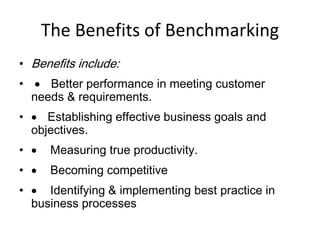
The Benefits of Benchmarking
• Benefits include:
•  Better performance in meeting customer
needs & requirements.
•  Establishing effective business goals and
objectives.
•  Measuring true productivity.
•  Becoming competitive
•  Identifying & implementing best practice in
business processes
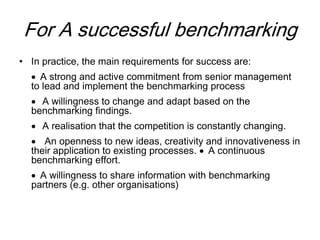
For A successful benchmarking
• In practice, the main requirements for success are:
 A strong and active commitment from senior management
to lead and implement the benchmarking process
 A willingness to change and adapt based on the
benchmarking findings.
 A realisation that the competition is constantly changing.
 An openness to new ideas, creativity and innovativeness in
their application to existing processes.  A continuous
benchmarking effort.
 A willingness to share information with benchmarking
partners (e.g. other organisations)
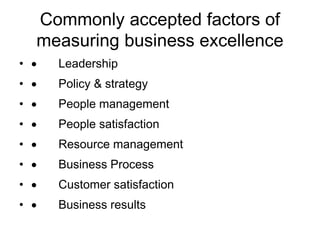
Commonly accepted factors of
measuring business excellence
•  Leadership
•  Policy & strategy
•  People management
•  People satisfaction
•  Resource management
•  Business Process
•  Customer satisfaction
•  Business results
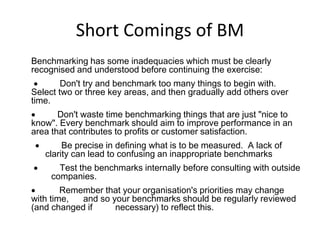
Short Comings of BM
Benchmarking has some inadequacies which must be clearly
recognised and understood before continuing the exercise:
 Don't try and benchmark too many things to begin with.
Select two or three key areas, and then gradually add others over
time.
 Don't waste time benchmarking things that are just "nice to
know". Every benchmark should aim to improve performance in an
area that contributes to profits or customer satisfaction.
 Be precise in defining what is to be measured. A lack of
clarity can lead to confusing an inappropriate benchmarks
 Test the benchmarks internally before consulting with outside
companies.
 Remember that your organisation's priorities may change
with time, and so your benchmarks should be regularly reviewed
(and changed if necessary) to reflect this.
Supply Chain Operations Reference-
model (SCOR)
• Build around five major processes: Plan, Source,
Make, Deliver and Return, as the cross-industry
standard for supply chain management
• Provides a standard way to measure supply chain
performance and to use common metrics to
benchmark against other organisations
– The model is regularly updated based on most recent
study and research results.
– The Supply Chain Council provides regular workshop
for its members to understand the model
– Website address: www.supply-chain.org
SCOR: Three levels of process detail
1. Top level
– Defines the scope and content for the SCOR model
– Basis of competition performance target set
2. Configuration level
– Representation of the company’s supply chain using 30 core
“process categories”
3. Process Element level
– Defines company’s ability to compete in chosen market
– Process element definitions, inputs, outputs, systems/tools;
– Performance metrics, best practices, systems capabilities
4. Implementation level
– Defines practices to achieve competitive advantage and adapt
to change
SCOR Level 1: Core Process Definitions
• Plan
– Processes that balance aggregate supply and demand to develop
strategies to best meet sourcing, production and delivery requirements
• Source
– Processes that procure goods and services to meet demand
• Make
– Processes that transform product to a finished state to meet planned or
actual demand
• Deliver
– Processes that provide finished goods or services to meet demand (order
management, transportation, distribution)
• Return
– Processes associated with returning or receiving returned products; post-
delivery customer support
SCOR Level 2:
Each SCOR process can be further described by process type:
• Planning
– Balance aggregated demand and supply
– Occur at regular intervals, consistent planning horizon
– Contribute to supply-chain response time
• Execution
– Scheduling/sequencing, transform product and/or moving product
– Contribute to order fulfilment cycle time
• Enable
– Prepares, maintains, or manages information or relationships on which
planning and execution processes rely
“SCOR Configuration Toolkit”
– 30 categories of process-type combinations
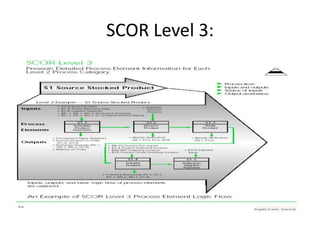
SCOR Level 3:
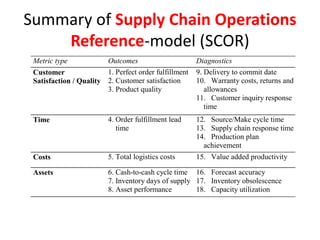
Summary of Supply Chain Operations
Reference-model (SCOR)
Metric type Outcomes Diagnostics
Customer
Satisfaction / Quality
1. Perfect order fulfillment
2. Customer satisfaction
3. Product quality
9. Delivery to commit date
10. Warranty costs, returns and
allowances
11. Customer inquiry response
time
Time 4. Order fulfillment lead
time
12. Source/Make cycle time
13. Supply chain response time
14. Production plan
achievement
Costs 5. Total logistics costs 15. Value added productivity
Assets 6. Cash-to-cash cycle time
7. Inventory days of supply
8. Asset performance
16. Forecast accuracy
17. Inventory obsolescence
18. Capacity utilization
Goals of SCM Performance
Measurement
• Better alignment of channel capabilities and
customer requirements and expectation
• Increased optimization of collective channel
operations
• Increased visibility to demand and supply
• Increased opportunities for collaboration
• Increased opportunities for channel alignment
• Increased opportunities for information exchange
• Increased profitability
SCM Performance Attributes
• Velocity
• Visibility
• Collaboration
• Trust
• Customer focus
• Flexibility
• Security (risk management)
• Compliance and Environmental Excellence
Obstacles Hindering Performance
Effort
• Technical barriers, such as difficulty locating, cleansing,
and integrating data from multiple sources
• Design problems that stem from not understanding
how to use methodologies, strategy maps, and
appropriate performance indicators and targets
• Social constraints, such as an organizational culture
• adverse to measurement and accountability, non
supportive executive team, unrealistic standards, and
conflicting goals.
SCOR Model
• Plan
• Source
• Make
• Deliver
• Return
Plan
• • Demand/Shipment Forecast
• • Accuracy
• • Adherence to Plans
• • Inventory Turns
• • Planning Cycle time
Source
• Procurement Costs
• Vendor Lead Times
• Materials Quality
• Materials
• Inventories
Make
• Production Costs
• Product Quality
• Changeover Time
• Capacity Utilization
Deliver
• On-Time Shipment
• On-Time Delivery
• Order Fulfillment
• Returns
Return
• Packaging Return
• Carbon Footprint
• Energy Reduction
SCOR Metrics and Performance
Attributes
• Supply chain reliability :- Delivery of right product, to right
place, at right time =Perfect order fulfillment
• Supply chain responsiveness:- Supply chain speed
providing product to the customer =Order fulfillment cycle
• Supply chain flexibility:- Agility of a supply chain to
respond to marketplace change=Upside supply chain
flexibility, Upside/Downside supply chain adaptability
• Supply chain costs :-Costs associated with operating the
supply chain =SCM cost, Cost of goods sold
• Supply chain asset management:-Effectiveness in
managing assets to support demand Satisfaction =Cash-to-
cash cycle time, Return on supply chain fixed assets

Chapter no .07 performance measurement and controls in scm

  • 1.
    Performance measurement and controlsin SCM. Chapter No.07 By:- Israr K. Raja
  • 2.
    Benchmarking • A methodfor identifying and importing best practices in order to improve performance • The process of learning, adapting, and measuring outstanding practices and processes from any organization to improve performance
  • 3.
    Importance of Benchmark •Identify opportunities to improve performance • Learn from others’ experiences • Set realistic but ambitious targets • Uncover strengths in one’s own organization • Better prioritize and allocate resources
  • 4.
    Types of Benchmarking •Internal benchmarking– a comparison of internal operations such as one site (or project team) against another within the same company. • • Competitive benchmarking – a comparison against a specific competitor for the product, service or function of interest. • • Generic benchmarking – a comparison of business functions or processes that are the same, regardless of industry or country.
  • 5.
    The Benefits ofBenchmarking • Benefits include: •  Better performance in meeting customer needs & requirements. •  Establishing effective business goals and objectives. •  Measuring true productivity. •  Becoming competitive •  Identifying & implementing best practice in business processes
  • 6.
    For A successfulbenchmarking • In practice, the main requirements for success are:  A strong and active commitment from senior management to lead and implement the benchmarking process  A willingness to change and adapt based on the benchmarking findings.  A realisation that the competition is constantly changing.  An openness to new ideas, creativity and innovativeness in their application to existing processes.  A continuous benchmarking effort.  A willingness to share information with benchmarking partners (e.g. other organisations)
  • 7.
    Commonly accepted factorsof measuring business excellence •  Leadership •  Policy & strategy •  People management •  People satisfaction •  Resource management •  Business Process •  Customer satisfaction •  Business results
  • 8.
    Short Comings ofBM Benchmarking has some inadequacies which must be clearly recognised and understood before continuing the exercise:  Don't try and benchmark too many things to begin with. Select two or three key areas, and then gradually add others over time.  Don't waste time benchmarking things that are just "nice to know". Every benchmark should aim to improve performance in an area that contributes to profits or customer satisfaction.  Be precise in defining what is to be measured. A lack of clarity can lead to confusing an inappropriate benchmarks  Test the benchmarks internally before consulting with outside companies.  Remember that your organisation's priorities may change with time, and so your benchmarks should be regularly reviewed (and changed if necessary) to reflect this.
  • 9.
    Supply Chain OperationsReference- model (SCOR) • Build around five major processes: Plan, Source, Make, Deliver and Return, as the cross-industry standard for supply chain management • Provides a standard way to measure supply chain performance and to use common metrics to benchmark against other organisations – The model is regularly updated based on most recent study and research results. – The Supply Chain Council provides regular workshop for its members to understand the model – Website address: www.supply-chain.org
  • 10.
    SCOR: Three levelsof process detail 1. Top level – Defines the scope and content for the SCOR model – Basis of competition performance target set 2. Configuration level – Representation of the company’s supply chain using 30 core “process categories” 3. Process Element level – Defines company’s ability to compete in chosen market – Process element definitions, inputs, outputs, systems/tools; – Performance metrics, best practices, systems capabilities 4. Implementation level – Defines practices to achieve competitive advantage and adapt to change
  • 11.
    SCOR Level 1:Core Process Definitions • Plan – Processes that balance aggregate supply and demand to develop strategies to best meet sourcing, production and delivery requirements • Source – Processes that procure goods and services to meet demand • Make – Processes that transform product to a finished state to meet planned or actual demand • Deliver – Processes that provide finished goods or services to meet demand (order management, transportation, distribution) • Return – Processes associated with returning or receiving returned products; post- delivery customer support
  • 12.
    SCOR Level 2: EachSCOR process can be further described by process type: • Planning – Balance aggregated demand and supply – Occur at regular intervals, consistent planning horizon – Contribute to supply-chain response time • Execution – Scheduling/sequencing, transform product and/or moving product – Contribute to order fulfilment cycle time • Enable – Prepares, maintains, or manages information or relationships on which planning and execution processes rely “SCOR Configuration Toolkit” – 30 categories of process-type combinations
  • 13.
  • 14.
    Summary of SupplyChain Operations Reference-model (SCOR) Metric type Outcomes Diagnostics Customer Satisfaction / Quality 1. Perfect order fulfillment 2. Customer satisfaction 3. Product quality 9. Delivery to commit date 10. Warranty costs, returns and allowances 11. Customer inquiry response time Time 4. Order fulfillment lead time 12. Source/Make cycle time 13. Supply chain response time 14. Production plan achievement Costs 5. Total logistics costs 15. Value added productivity Assets 6. Cash-to-cash cycle time 7. Inventory days of supply 8. Asset performance 16. Forecast accuracy 17. Inventory obsolescence 18. Capacity utilization
  • 15.
    Goals of SCMPerformance Measurement • Better alignment of channel capabilities and customer requirements and expectation • Increased optimization of collective channel operations • Increased visibility to demand and supply • Increased opportunities for collaboration • Increased opportunities for channel alignment • Increased opportunities for information exchange • Increased profitability
  • 16.
    SCM Performance Attributes •Velocity • Visibility • Collaboration • Trust • Customer focus • Flexibility • Security (risk management) • Compliance and Environmental Excellence
  • 17.
    Obstacles Hindering Performance Effort •Technical barriers, such as difficulty locating, cleansing, and integrating data from multiple sources • Design problems that stem from not understanding how to use methodologies, strategy maps, and appropriate performance indicators and targets • Social constraints, such as an organizational culture • adverse to measurement and accountability, non supportive executive team, unrealistic standards, and conflicting goals.
  • 18.
    SCOR Model • Plan •Source • Make • Deliver • Return
  • 19.
    Plan • • Demand/ShipmentForecast • • Accuracy • • Adherence to Plans • • Inventory Turns • • Planning Cycle time
  • 20.
    Source • Procurement Costs •Vendor Lead Times • Materials Quality • Materials • Inventories
  • 21.
    Make • Production Costs •Product Quality • Changeover Time • Capacity Utilization
  • 22.
    Deliver • On-Time Shipment •On-Time Delivery • Order Fulfillment • Returns
  • 23.
    Return • Packaging Return •Carbon Footprint • Energy Reduction
  • 24.
    SCOR Metrics andPerformance Attributes • Supply chain reliability :- Delivery of right product, to right place, at right time =Perfect order fulfillment • Supply chain responsiveness:- Supply chain speed providing product to the customer =Order fulfillment cycle • Supply chain flexibility:- Agility of a supply chain to respond to marketplace change=Upside supply chain flexibility, Upside/Downside supply chain adaptability • Supply chain costs :-Costs associated with operating the supply chain =SCM cost, Cost of goods sold • Supply chain asset management:-Effectiveness in managing assets to support demand Satisfaction =Cash-to- cash cycle time, Return on supply chain fixed assets