Supply-Chain Council & SCOR®
The World of Supply Chain Management
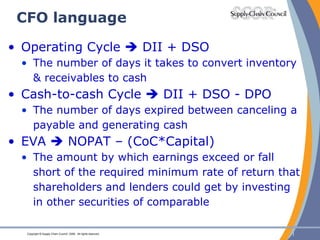
CFO language Operating Cycle    DII + DSO The number of days it takes to convert inventory & receivables to cash Cash-to-cash Cycle    DII + DSO - DPO The number of days expired between canceling a payable and generating cash EVA    NOPAT – (CoC*Capital) The amount by which earnings exceed or fall short of the required minimum rate of return that shareholders and lenders could get by investing in other securities of comparable
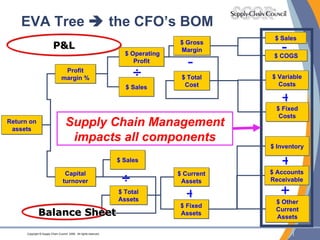
Return on assets Capital turnover $ Other Current Assets $ Inventory $ Accounts Receivable $ Current Assets $ Fixed Assets $ Total Assets $ Sales Profit margin % $ Sales $ COGS $ Variable Costs $ Fixed Costs $ Gross Margin $ Total Cost $ Operating Profit Supply Chain Management impacts all components ÷ - + - ÷ + + + EVA Tree    the CFO’s BOM $ Sales Balance Sheet P&L
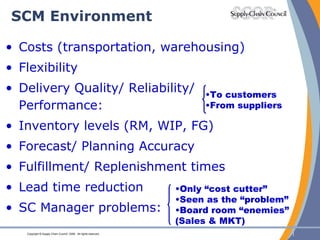
SCM Environment Costs (transportation, warehousing)  Flexibility Delivery Quality/ Reliability/ Performance: Inventory levels (RM, WIP, FG) Forecast/ Planning Accuracy Fulfillment/ Replenishment times Lead time reduction SC Manager problems: To customers From suppliers Only “cost cutter” Seen as the “problem” Board room “enemies” (Sales & MKT)
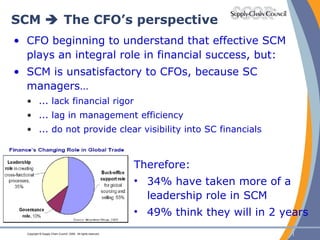
SCM    The CFO’s perspective CFO beginning to understand that effective SCM plays an integral role in financial success, but: SCM is unsatisfactory to CFOs, because SC managers… ... lack financial rigor ... lag in management efficiency ... do not provide clear visibility into SC financials Therefore: 34% have taken more of a leadership role in SCM 49% think they will in 2 years
The Value of Metrics
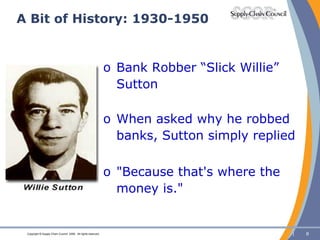
A Bit of History: 1930-1950 Bank Robber “Slick Willie” Sutton When asked why he robbed banks, Sutton simply replied "Because that's where the money is."
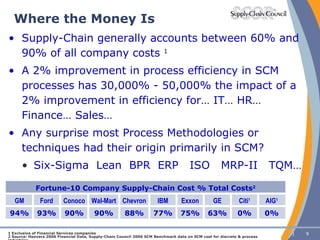
Where the Money Is Supply-Chain generally accounts between 60% and 90% of all company costs  1 A 2% improvement in process efficiency in SCM processes has 30,000% - 50,000% the impact of a 2% improvement in efficiency for… IT… HR… Finance… Sales… Any surprise most Process Methodologies or techniques had their origin primarily in SCM? Six-Sigma  Lean  BPR  ERP  ISO  MRP-II  TQM… 1 Exclusive of Financial Services companies 2 Source: Hoovers 2006 Financial Data, Supply-Chain Council 2006 SCM Benchmark data on SCM cost for discrete & process industries Fortune-10 Company Supply-Chain Cost % Total Costs 2 GM Ford Conoco Wal-Mart Chevron IBM Exxon GE Citi 1 AIG 1 94% 93% 90% 90% 88% 77% 75% 63% 0% 0%
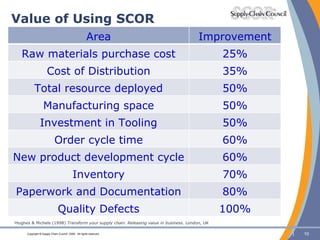
Value of Using SCOR 1 Hughes & Michels (1998)  Transform your supply chain. Releasing value in business.  London, UK Area Improvement Raw materials purchase cost 25% Cost of Distribution 35% Total resource deployed 50% Manufacturing space 50% Investment in Tooling 50% Order cycle time 60% New product development cycle 60% Inventory 70% Paperwork and Documentation 80% Quality Defects 100%
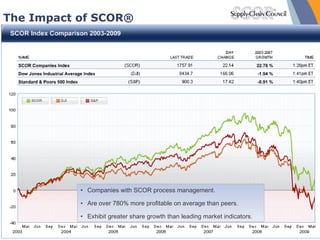
The Impact of SCOR® Companies with SCOR process management. Are over 780% more profitable on average than peers.  Exhibit greater share growth than leading market indicators.
Supply Chain Council
Supply-Chain Council Independent, not-for-profit, global corporation with membership open to all companies and organizations interested in applying and advancing state-of-the-art supply chain management systems and practices: Founded in 1996; Over 600 global Members; Cross-industry representation; The Supply-Chain Council (SCC) has developed and endorsed the Supply Chain Operations Reference model (SCOR) as the cross-industry standard for supply chain management.
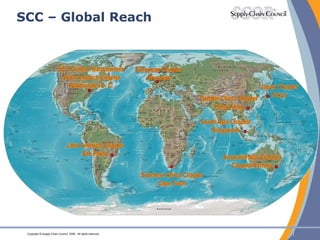
SCC – Global Reach
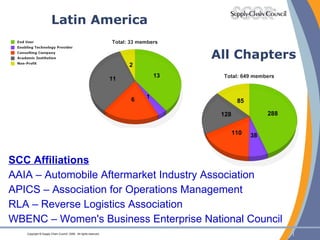
Latin America All Chapters SCC Affiliations AAIA – Automobile Aftermarket Industry Association APICS – Association for Operations Management RLA – Reverse Logistics Association WBENC – Women's Business Enterprise National Council
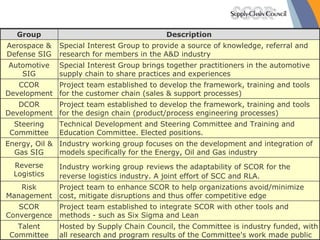
Hosted by Supply Chain Council, the Committee is industry funded, with all research and program results of the Committee's work made public Talent Committee Project team established to integrate SCOR with other tools and methods - such as Six Sigma and Lean SCOR Convergence Project team to enhance SCOR to help organizations avoid/minimize cost, mitigate disruptions and thus offer competitive edge Risk Management Industry working group   reviews the adaptability of SCOR for the reverse logistics industry. A joint effort of SCC and RLA. Reverse Logistics Industry working group focuses on the development and integration of models specifically for the Energy, Oil and Gas industry Energy, Oil & Gas SIG Technical Development and Steering Committee and Training and Education Committee. Elected positions. Steering Committee Project team established to develop the framework, training and tools for the design chain (product/process engineering processes) DCOR Development Project team established to develop the framework, training and tools for the customer chain (sales & support processes) CCOR Development Special Interest Group brings together practitioners in the automotive supply chain to share practices and experiences Automotive SIG Special Interest Group to provide a source of knowledge, referral and research for members in the A&D industry Aerospace & Defense SIG Description Group
Global Members...
In Brasil...
... And in Latin America
SCC Models
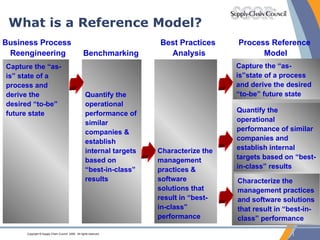
What is a Reference Model? Quantify the operational performance of similar companies & establish internal targets based on “best-in-class” results Benchmarking Characterize the management practices & software solutions that result in “best-in-class” performance Best Practices  Analysis Process Reference  Model Capture the “as-is” state of a process and derive the desired “to-be” future state Business Process  Reengineering Quantify the operational performance of similar companies and establish internal targets based on “best-in-class” results Characterize the management practices  and software solutions that result in “best-in-class” performance Capture the “as-is”state of a process and derive the desired “to-be” future state
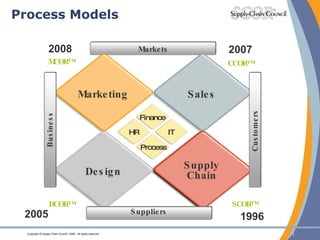
Process Models SCOR™ CCOR™ DCOR™ MCOR™ 2005 1996 2007 2008 Supply Chain Supply Chain Supply Chain Supply Chain Markets Marketing Sales Design HR IT Finance Process Suppliers Business Customers
SCOR Supply Chain Operations Reference model
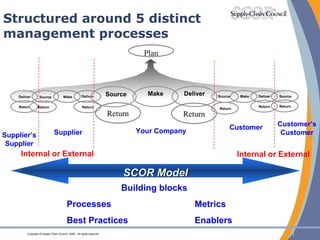
Structured around 5 distinct management processes Supplier Customer Customer’s Customer Supplier’s Supplier Internal or External Internal or External Your Company SCOR Model Building blocks  Processes Metrics Best Practices Enablers Plan Make Deliver Make Deliver Make Source Deliver Source Source Return Return Source Deliver Return Return Return Return Return Return
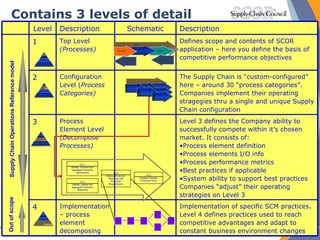
Contains 3 levels of detail Supply Chain Operations Reference model Out of scope Level 3 defines the Company ability to successfully compete within it’s chosen market. It consists of:  Process element definition  Process elements I/O info  Process performance metrics  Best practices if applicable  System ability to support best practices Companies “adjust” their operating strategies on Level 3 Process Element Level ( Decompose Processes) 3 Implementation of specific SCM practices. Level 4 defines practices used to reach competitive advantages and adapt to constant business environment changes Implementation – process element decomposing 4 The Supply Chain is “custom-configured” here – around 30 “process categories”. Companies implement their operating stragegies thru a single and unique Supply Chain configuration Configuration Level ( Process Categories) 2 Defines scope and contents of SCOR application – here you define the basis of competitive performance objectives Top Level  (Processes) 1 Description Schematic Description Level Plan Deliver Make Source Return Return P3.1 Identify, Prioritize and Aggregate Production requirements P3.3 Balance Production Resources with Production Requirements P3.2 Identify, Assess and Aggregate Production Resources P3.4 Establish Detailed Production Plans
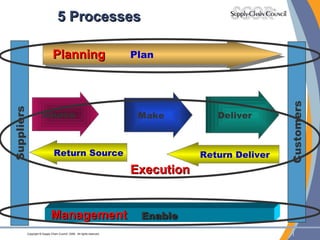
5 Processes Customers Suppliers Deliver Make Source Plan Return Source Return Deliver Enable Execution Management Planning
Models Contents
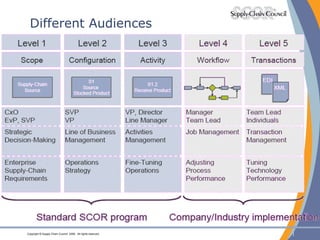
Different Audiences
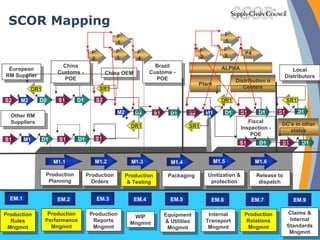
SCOR Mapping M2 S2 D2 S1 European RM Supplier Other RM Suppliers Plant ALPHA Local Distributors M1 S1 D1 D1 S1 D1 M2 S2 D2 S1 China Customs - POE China OEM Distribution n Centers S1 D1 Brazil Customs - POE S2 M1 D1 Fiscal Inspection - POE DC’s in other states S1 D1 S1 D1 S1 D1 S1 D1 M1.1 M1.2 M1.3 M1.4 M1.5 Production Planning Production Orders Production & Testing Packaging Unitization & protection M1.6 Release to dispatch SR1 DR1 SR1 SR1 DR1 DR1 P4 P3 P2 P1 Production Rules Mngmnt EM.1 Production Performance Mngmnt EM.2 Production Reports Mngmnt EM.3 WIP Mngmnt EM.4 Equipment & Utilities Mngmnt EM.5 Internal Transport Mngmnt EM.6 Production Relations Mngmnt EM.7 Claims & Internal Standards Mngmnt EM.9 P4 P3 P2 P1
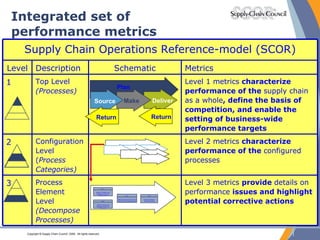
Integrated set of performance metrics Level 3 metrics  provide  details on performance  issues and highlight potential corrective actions Process Element Level  (Decompose Processes) 3 Level 2 metrics  characterize performance of the  configured processes Configuration Level ( Process Categories) 2 Level 1 metrics  characterize performance of the  supply chain as a whole , define the basis of competition, and enable the setting of business-wide performance targets Top Level  (Processes) 1 Metrics Schematic Description Level Supply Chain Operations Reference-model (SCOR) Balance Production Resources with Production Requirements Establish Detailed  Production Plans Identify, Prioritize, and Aggregate Production Requirements Identify, Assess, and Aggregate Production Resources P3.1 P3.3 P3.4 P3.2 Plan Deliver Make Source Return Return
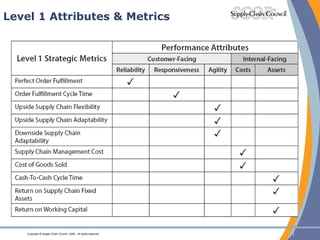
Level 1 Attributes & Metrics
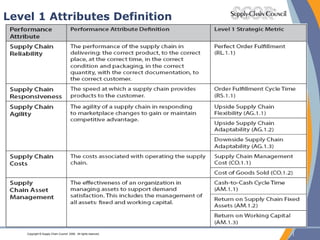
Level 1 Attributes Definition
 
 
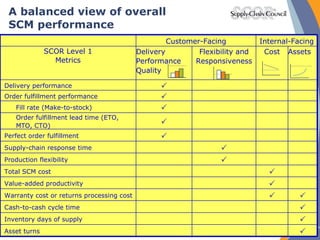
A balanced view of overall SCM performance  Asset turns  Inventory days of supply  Cash-to-cash cycle time   Warranty cost or returns processing cost  Value-added productivity  Total SCM cost  Production flexibility  Supply-chain response time  Perfect order fulfillment   Order fulfillment lead time (ETO, MTO, CTO)  Fill rate (Make-to-stock)  Order fulfillment performance  Delivery performance Assets Cost Flexibility and Responsiveness Delivery Performance Quality SCOR Level 1 Metrics Internal-Facing Customer-Facing
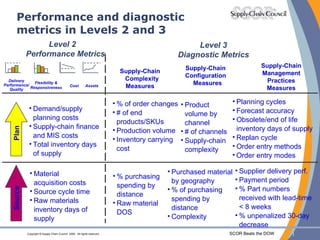
Performance and diagnostic metrics in Levels 2 and 3 % of order changes # of end products/SKUs Production volume Inventory carrying cost Level 3 Diagnostic Metrics Product volume by channel # of channels Supply-chain complexity Planning cycles Forecast accuracy Obsolete/end of life inventory days of supply Replan cycle Order entry methods Order entry modes Supply-Chain Management Practices Measures Level 2  Performance Metrics Supply-Chain Complexity Measures Supply-Chain Configuration Measures Material acquisition costs Source cycle time Raw materials inventory days of supply Purchased material by geography % of purchasing spending by distance Complexity Supplier delivery perf. Payment period % Part numbers received with lead-time  < 8 weeks % unpenalized 30-day decrease % purchasing spending by distance Raw material DOS Demand/supply planning costs Supply-chain finance and MIS costs Total inventory days of supply Source Plan Assets Delivery Performance/ Quality Cost Flexibility & Responsiveness
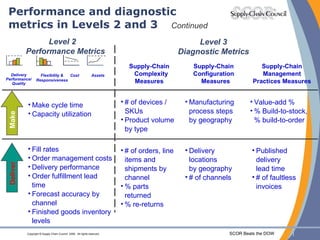
Performance and diagnostic metrics in Levels 2 and 3 Continued Value-add % % Build-to-stock,  % build-to-order # of devices / SKUs Product volume  by type # of orders, line items and shipments by channel % parts returned % re-returns Delivery locations  by geography # of channels Published delivery  lead time # of faultless invoices Manufacturing process steps by geography Fill rates Order management costs Delivery performance Order fulfillment lead time Forecast accuracy by channel Finished goods inventory levels Make cycle time Capacity utilization Supply-Chain Management Practices Measures Supply-Chain Complexity Measures Supply-Chain Configuration Measures Deliver Make Assets Cost Flexibility & Responsiveness Delivery Performance/ Quality Level 3 Diagnostic Metrics Level 2  Performance Metrics
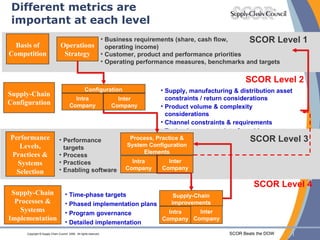
Different metrics are important at each level Business requirements (share, cash flow,  operating income) Customer, product and performance priorities Operating performance measures, benchmarks and targets Basis of Competition SCOR Level 1 Configuration Supply, manufacturing & distribution asset constraints / return considerations Product volume & complexity considerations Channel constraints & requirements  Technology constraints & enablers Supply-Chain Configuration SCOR Level 2 Operations Strategy Performance targets Process Practices Enabling software Performance Levels, Practices & Systems Selection SCOR Level 3 Time-phase targets Phased implementation plans Program governance Detailed implementation Supply-Chain Processes & Systems Implementation SCOR Level 4 Intra Company Supply-Chain improvements Inter Company Intra Company Process, Practice & System Configuration Elements Intra Company Inter Company Inter Company
Learning SCOR
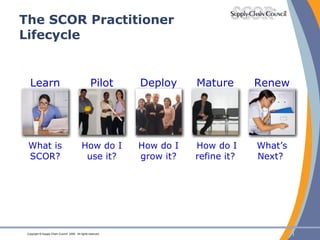
The SCOR Practitioner Lifecycle How do I use it? Pilot What is SCOR? Learn How do I grow it? Deploy How do I refine it? Mature What’s Next?  Renew
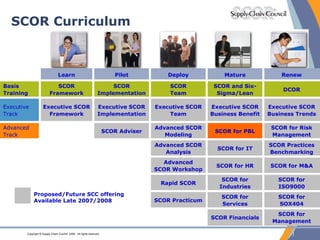
SCOR Curriculum Proposed/Future SCC offering Available Late 2007/2008 SCOR for Management SCOR Financials Advanced Track Executive Track Basis Training Executive SCOR Business Trends Executive SCOR Business Benefit Executive SCOR Team Executive SCOR Implementation Executive SCOR Framework DCOR SCOR and Six-Sigma/Lean SCOR Team SCOR Implementation SCOR Framework SCOR for Risk Management SCOR for PBL Advanced SCOR Modeling SCOR Adviser SCOR Practices Benchmarking SCOR for IT Advanced SCOR Analysis SCOR for SOX404 SCOR for Services SCOR Practicum SCOR for ISO9000 SCOR for Industries Rapid SCOR SCOR for M&A SCOR for HR Advanced SCOR Workshop Renew Mature Deploy Pilot Learn
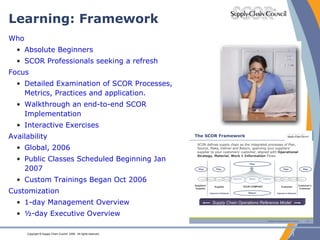
Learning: Framework Who Absolute Beginners SCOR Professionals seeking a refresh Focus Detailed Examination of SCOR Processes, Metrics, Practices and application. Walkthrough an end-to-end SCOR Implementation Interactive Exercises Availability Global, 2006 Public Classes Scheduled Beginning Jan 2007 Custom Trainings Began Oct 2006 Customization 1-day Management Overview ½-day Executive Overview
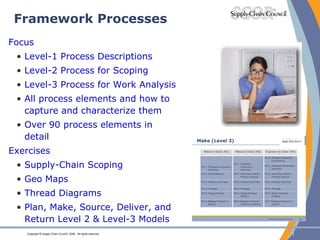
Framework Processes Focus Level-1 Process Descriptions Level-2 Process for Scoping Level-3 Process for Work Analysis All process elements and how to capture and characterize them Over 90 process elements in detail Exercises Supply-Chain Scoping Geo Maps Thread Diagrams Plan, Make, Source, Deliver, and Return Level 2 & Level-3 Models
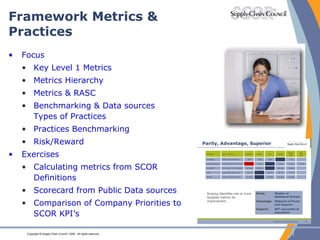
Framework Metrics & Practices Focus Key Level 1 Metrics Metrics Hierarchy Metrics & RASC Benchmarking & Data sources Types of Practices Practices Benchmarking Risk/Reward Exercises Calculating metrics from SCOR Definitions Scorecard from Public Data sources Comparison of Company Priorities to SCOR KPI’s
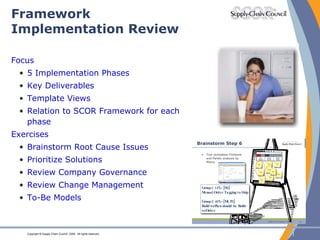
Framework Implementation Review Focus 5 Implementation Phases Key Deliverables Template Views Relation to SCOR Framework for each phase Exercises Brainstorm Root Cause Issues Prioritize Solutions Review Company Governance Review Change Management To-Be Models
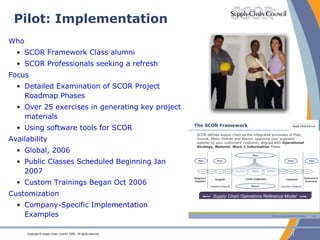
Pilot: Implementation Who SCOR Framework Class alumni SCOR Professionals seeking a refresh Focus Detailed Examination of SCOR Project Roadmap Phases Over 25 exercises in generating key project materials Using software tools for SCOR Availability Global, 2006 Public Classes Scheduled Beginning Jan 2007 Custom Trainings Began Oct 2006 Customization Company-Specific Implementation Examples
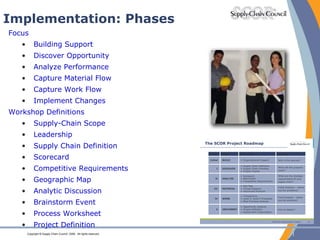
Implementation: Phases Focus Building Support Discover Opportunity Analyze Performance Capture Material Flow Capture Work Flow Implement Changes Workshop Definitions Supply-Chain Scope Leadership Supply Chain Definition Scorecard Competitive Requirements Geographic Map Analytic Discussion Brainstorm Event Process Worksheet Project Definition
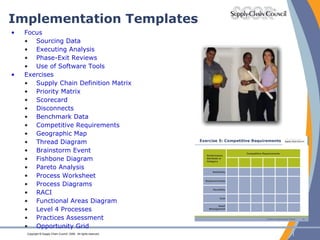
Implementation Templates Focus Sourcing Data Executing Analysis Phase-Exit Reviews Use of Software Tools Exercises Supply Chain Definition Matrix Priority Matrix Scorecard Disconnects Benchmark Data Competitive Requirements Geographic Map Thread Diagram Brainstorm Event Fishbone Diagram Pareto Analysis Process Worksheet Process Diagrams RACI Functional Areas Diagram Level 4 Processes Practices Assessment Opportunity Grid
Benchmarking with SCOR
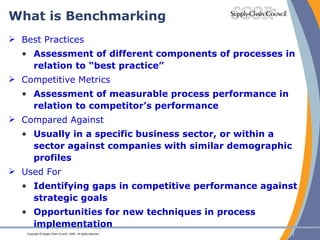
What is Benchmarking Best Practices Assessment of different components of processes in relation to “best practice” Competitive Metrics Assessment of measurable process performance in relation to competitor’s performance Compared Against Usually in a specific business sector, or within a sector against companies with similar demographic profiles Used For Identifying gaps in competitive performance against strategic goals Opportunities for new techniques in process implementation
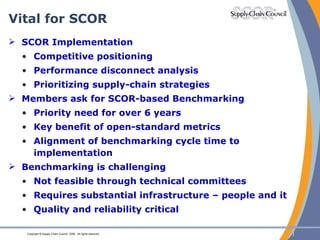
Vital for SCOR SCOR Implementation Competitive positioning Performance disconnect analysis Prioritizing supply-chain strategies Members ask for SCOR-based Benchmarking Priority need for over 6 years Key benefit of open-standard metrics Alignment of benchmarking cycle time to implementation Benchmarking is challenging Not feasible through technical committees Requires substantial infrastructure – people and it Quality and reliability critical
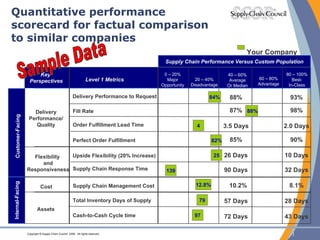
Quantitative performance scorecard for factual comparison to similar companies Your Company Supply Chain Performance Versus Custom Population Customer-Facing Internal-Facing Delivery Performance/ Quality Flexibility  and Responsiveness Cost Assets Delivery Performance to Request Order Fulfillment Lead Time Perfect Order Fulfillment Upside Flexibility (20% Increase) Supply Chain Response Time Supply Chain Management Cost Total Inventory Days of Supply Cash-to-Cash Cycle time Fill Rate Key  Perspectives Level 1 Metrics 0 – 20% Major Opportunity 20 – 40% Disadvantage 40 – 60% Average Or Median 60 – 80% Advantage 80 – 100% Best- In-Class 88% 87% 3.5 Days 85% 26 Days 57 Days 72 Days 10.2% 90 Days 12.8% 97 79 25 139 4 82% 88% 84% Sample Data 93% 98% 2.0 Days 90% 10 Days 32 Days 28 Days 43 Days 8.1%
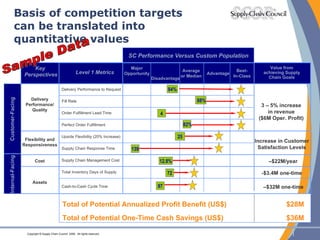
Basis of competition targets can be translated into quantitative values Total of Potential Annualized Profit Benefit (US$)   $28M Total of Potential One-Time Cash Savings (US$)   $36M SC Performance Versus Custom Population Key  Perspectives Level 1 Metrics Major Opportunity Disadvantage Average or Median Advantage Best- In-Class Value from achieving Supply Chain Goals Delivery Performance to Request Order Fulfillment Lead Time Perfect Order Fulfillment Upside Flexibility (20% Increase) Supply Chain Response Time Increase in Customer Satisfaction Levels Supply Chain Management Cost – $22M/year Total Inventory Days of Supply – $32M one-time Cash-to-Cash Cycle Time -$3.4M one-time Delivery Performance/ Quality Flexibility and Responsiveness Cost Assets Customer-Facing Internal-Facing Fill Rate 3 – 5% increase in revenue ($6M Oper. Profit) 12.8% 97 72 139 4 82% 88% 84% 25 Sample Data
Andres von Simson – LATAM Chapter Administration   [email_address] Further info     www.supply-chain.org Elcio Grassia – LATAM Chapter Chair  [email_address]

Supply Chain Council

  • 1.
  • 2.
    The World ofSupply Chain Management
  • 3.
    CFO language OperatingCycle  DII + DSO The number of days it takes to convert inventory & receivables to cash Cash-to-cash Cycle  DII + DSO - DPO The number of days expired between canceling a payable and generating cash EVA  NOPAT – (CoC*Capital) The amount by which earnings exceed or fall short of the required minimum rate of return that shareholders and lenders could get by investing in other securities of comparable
  • 4.
    Return on assetsCapital turnover $ Other Current Assets $ Inventory $ Accounts Receivable $ Current Assets $ Fixed Assets $ Total Assets $ Sales Profit margin % $ Sales $ COGS $ Variable Costs $ Fixed Costs $ Gross Margin $ Total Cost $ Operating Profit Supply Chain Management impacts all components ÷ - + - ÷ + + + EVA Tree  the CFO’s BOM $ Sales Balance Sheet P&L
  • 5.
    SCM Environment Costs(transportation, warehousing) Flexibility Delivery Quality/ Reliability/ Performance: Inventory levels (RM, WIP, FG) Forecast/ Planning Accuracy Fulfillment/ Replenishment times Lead time reduction SC Manager problems: To customers From suppliers Only “cost cutter” Seen as the “problem” Board room “enemies” (Sales & MKT)
  • 6.
    SCM  The CFO’s perspective CFO beginning to understand that effective SCM plays an integral role in financial success, but: SCM is unsatisfactory to CFOs, because SC managers… ... lack financial rigor ... lag in management efficiency ... do not provide clear visibility into SC financials Therefore: 34% have taken more of a leadership role in SCM 49% think they will in 2 years
  • 7.
    The Value ofMetrics
  • 8.
    A Bit ofHistory: 1930-1950 Bank Robber “Slick Willie” Sutton When asked why he robbed banks, Sutton simply replied &quot;Because that's where the money is.&quot;
  • 9.
    Where the MoneyIs Supply-Chain generally accounts between 60% and 90% of all company costs 1 A 2% improvement in process efficiency in SCM processes has 30,000% - 50,000% the impact of a 2% improvement in efficiency for… IT… HR… Finance… Sales… Any surprise most Process Methodologies or techniques had their origin primarily in SCM? Six-Sigma Lean BPR ERP ISO MRP-II TQM… 1 Exclusive of Financial Services companies 2 Source: Hoovers 2006 Financial Data, Supply-Chain Council 2006 SCM Benchmark data on SCM cost for discrete & process industries Fortune-10 Company Supply-Chain Cost % Total Costs 2 GM Ford Conoco Wal-Mart Chevron IBM Exxon GE Citi 1 AIG 1 94% 93% 90% 90% 88% 77% 75% 63% 0% 0%
  • 10.
    Value of UsingSCOR 1 Hughes & Michels (1998) Transform your supply chain. Releasing value in business. London, UK Area Improvement Raw materials purchase cost 25% Cost of Distribution 35% Total resource deployed 50% Manufacturing space 50% Investment in Tooling 50% Order cycle time 60% New product development cycle 60% Inventory 70% Paperwork and Documentation 80% Quality Defects 100%
  • 11.
    The Impact ofSCOR® Companies with SCOR process management. Are over 780% more profitable on average than peers. Exhibit greater share growth than leading market indicators.
  • 12.
  • 13.
    Supply-Chain Council Independent,not-for-profit, global corporation with membership open to all companies and organizations interested in applying and advancing state-of-the-art supply chain management systems and practices: Founded in 1996; Over 600 global Members; Cross-industry representation; The Supply-Chain Council (SCC) has developed and endorsed the Supply Chain Operations Reference model (SCOR) as the cross-industry standard for supply chain management.
  • 14.
  • 15.
    Latin America AllChapters SCC Affiliations AAIA – Automobile Aftermarket Industry Association APICS – Association for Operations Management RLA – Reverse Logistics Association WBENC – Women's Business Enterprise National Council
  • 16.
    Hosted by SupplyChain Council, the Committee is industry funded, with all research and program results of the Committee's work made public Talent Committee Project team established to integrate SCOR with other tools and methods - such as Six Sigma and Lean SCOR Convergence Project team to enhance SCOR to help organizations avoid/minimize cost, mitigate disruptions and thus offer competitive edge Risk Management Industry working group reviews the adaptability of SCOR for the reverse logistics industry. A joint effort of SCC and RLA. Reverse Logistics Industry working group focuses on the development and integration of models specifically for the Energy, Oil and Gas industry Energy, Oil & Gas SIG Technical Development and Steering Committee and Training and Education Committee. Elected positions. Steering Committee Project team established to develop the framework, training and tools for the design chain (product/process engineering processes) DCOR Development Project team established to develop the framework, training and tools for the customer chain (sales & support processes) CCOR Development Special Interest Group brings together practitioners in the automotive supply chain to share practices and experiences Automotive SIG Special Interest Group to provide a source of knowledge, referral and research for members in the A&D industry Aerospace & Defense SIG Description Group
  • 17.
  • 18.
  • 19.
    ... And inLatin America
  • 20.
  • 21.
    What is aReference Model? Quantify the operational performance of similar companies & establish internal targets based on “best-in-class” results Benchmarking Characterize the management practices & software solutions that result in “best-in-class” performance Best Practices Analysis Process Reference Model Capture the “as-is” state of a process and derive the desired “to-be” future state Business Process Reengineering Quantify the operational performance of similar companies and establish internal targets based on “best-in-class” results Characterize the management practices and software solutions that result in “best-in-class” performance Capture the “as-is”state of a process and derive the desired “to-be” future state
  • 22.
    Process Models SCOR™CCOR™ DCOR™ MCOR™ 2005 1996 2007 2008 Supply Chain Supply Chain Supply Chain Supply Chain Markets Marketing Sales Design HR IT Finance Process Suppliers Business Customers
  • 23.
    SCOR Supply ChainOperations Reference model
  • 24.
    Structured around 5distinct management processes Supplier Customer Customer’s Customer Supplier’s Supplier Internal or External Internal or External Your Company SCOR Model Building blocks Processes Metrics Best Practices Enablers Plan Make Deliver Make Deliver Make Source Deliver Source Source Return Return Source Deliver Return Return Return Return Return Return
  • 25.
    Contains 3 levelsof detail Supply Chain Operations Reference model Out of scope Level 3 defines the Company ability to successfully compete within it’s chosen market. It consists of: Process element definition Process elements I/O info Process performance metrics Best practices if applicable System ability to support best practices Companies “adjust” their operating strategies on Level 3 Process Element Level ( Decompose Processes) 3 Implementation of specific SCM practices. Level 4 defines practices used to reach competitive advantages and adapt to constant business environment changes Implementation – process element decomposing 4 The Supply Chain is “custom-configured” here – around 30 “process categories”. Companies implement their operating stragegies thru a single and unique Supply Chain configuration Configuration Level ( Process Categories) 2 Defines scope and contents of SCOR application – here you define the basis of competitive performance objectives Top Level (Processes) 1 Description Schematic Description Level Plan Deliver Make Source Return Return P3.1 Identify, Prioritize and Aggregate Production requirements P3.3 Balance Production Resources with Production Requirements P3.2 Identify, Assess and Aggregate Production Resources P3.4 Establish Detailed Production Plans
  • 26.
    5 Processes CustomersSuppliers Deliver Make Source Plan Return Source Return Deliver Enable Execution Management Planning
  • 27.
  • 28.
  • 29.
    SCOR Mapping M2S2 D2 S1 European RM Supplier Other RM Suppliers Plant ALPHA Local Distributors M1 S1 D1 D1 S1 D1 M2 S2 D2 S1 China Customs - POE China OEM Distribution n Centers S1 D1 Brazil Customs - POE S2 M1 D1 Fiscal Inspection - POE DC’s in other states S1 D1 S1 D1 S1 D1 S1 D1 M1.1 M1.2 M1.3 M1.4 M1.5 Production Planning Production Orders Production & Testing Packaging Unitization & protection M1.6 Release to dispatch SR1 DR1 SR1 SR1 DR1 DR1 P4 P3 P2 P1 Production Rules Mngmnt EM.1 Production Performance Mngmnt EM.2 Production Reports Mngmnt EM.3 WIP Mngmnt EM.4 Equipment & Utilities Mngmnt EM.5 Internal Transport Mngmnt EM.6 Production Relations Mngmnt EM.7 Claims & Internal Standards Mngmnt EM.9 P4 P3 P2 P1
  • 30.
    Integrated set ofperformance metrics Level 3 metrics provide details on performance issues and highlight potential corrective actions Process Element Level (Decompose Processes) 3 Level 2 metrics characterize performance of the configured processes Configuration Level ( Process Categories) 2 Level 1 metrics characterize performance of the supply chain as a whole , define the basis of competition, and enable the setting of business-wide performance targets Top Level (Processes) 1 Metrics Schematic Description Level Supply Chain Operations Reference-model (SCOR) Balance Production Resources with Production Requirements Establish Detailed Production Plans Identify, Prioritize, and Aggregate Production Requirements Identify, Assess, and Aggregate Production Resources P3.1 P3.3 P3.4 P3.2 Plan Deliver Make Source Return Return
  • 31.
  • 32.
  • 33.
  • 34.
  • 35.
    A balanced viewof overall SCM performance  Asset turns  Inventory days of supply  Cash-to-cash cycle time   Warranty cost or returns processing cost  Value-added productivity  Total SCM cost  Production flexibility  Supply-chain response time  Perfect order fulfillment  Order fulfillment lead time (ETO, MTO, CTO)  Fill rate (Make-to-stock)  Order fulfillment performance  Delivery performance Assets Cost Flexibility and Responsiveness Delivery Performance Quality SCOR Level 1 Metrics Internal-Facing Customer-Facing
  • 36.
    Performance and diagnosticmetrics in Levels 2 and 3 % of order changes # of end products/SKUs Production volume Inventory carrying cost Level 3 Diagnostic Metrics Product volume by channel # of channels Supply-chain complexity Planning cycles Forecast accuracy Obsolete/end of life inventory days of supply Replan cycle Order entry methods Order entry modes Supply-Chain Management Practices Measures Level 2 Performance Metrics Supply-Chain Complexity Measures Supply-Chain Configuration Measures Material acquisition costs Source cycle time Raw materials inventory days of supply Purchased material by geography % of purchasing spending by distance Complexity Supplier delivery perf. Payment period % Part numbers received with lead-time < 8 weeks % unpenalized 30-day decrease % purchasing spending by distance Raw material DOS Demand/supply planning costs Supply-chain finance and MIS costs Total inventory days of supply Source Plan Assets Delivery Performance/ Quality Cost Flexibility & Responsiveness
  • 37.
    Performance and diagnosticmetrics in Levels 2 and 3 Continued Value-add % % Build-to-stock, % build-to-order # of devices / SKUs Product volume by type # of orders, line items and shipments by channel % parts returned % re-returns Delivery locations by geography # of channels Published delivery lead time # of faultless invoices Manufacturing process steps by geography Fill rates Order management costs Delivery performance Order fulfillment lead time Forecast accuracy by channel Finished goods inventory levels Make cycle time Capacity utilization Supply-Chain Management Practices Measures Supply-Chain Complexity Measures Supply-Chain Configuration Measures Deliver Make Assets Cost Flexibility & Responsiveness Delivery Performance/ Quality Level 3 Diagnostic Metrics Level 2 Performance Metrics
  • 38.
    Different metrics areimportant at each level Business requirements (share, cash flow, operating income) Customer, product and performance priorities Operating performance measures, benchmarks and targets Basis of Competition SCOR Level 1 Configuration Supply, manufacturing & distribution asset constraints / return considerations Product volume & complexity considerations Channel constraints & requirements Technology constraints & enablers Supply-Chain Configuration SCOR Level 2 Operations Strategy Performance targets Process Practices Enabling software Performance Levels, Practices & Systems Selection SCOR Level 3 Time-phase targets Phased implementation plans Program governance Detailed implementation Supply-Chain Processes & Systems Implementation SCOR Level 4 Intra Company Supply-Chain improvements Inter Company Intra Company Process, Practice & System Configuration Elements Intra Company Inter Company Inter Company
  • 39.
  • 40.
    The SCOR PractitionerLifecycle How do I use it? Pilot What is SCOR? Learn How do I grow it? Deploy How do I refine it? Mature What’s Next? Renew
  • 41.
    SCOR Curriculum Proposed/FutureSCC offering Available Late 2007/2008 SCOR for Management SCOR Financials Advanced Track Executive Track Basis Training Executive SCOR Business Trends Executive SCOR Business Benefit Executive SCOR Team Executive SCOR Implementation Executive SCOR Framework DCOR SCOR and Six-Sigma/Lean SCOR Team SCOR Implementation SCOR Framework SCOR for Risk Management SCOR for PBL Advanced SCOR Modeling SCOR Adviser SCOR Practices Benchmarking SCOR for IT Advanced SCOR Analysis SCOR for SOX404 SCOR for Services SCOR Practicum SCOR for ISO9000 SCOR for Industries Rapid SCOR SCOR for M&A SCOR for HR Advanced SCOR Workshop Renew Mature Deploy Pilot Learn
  • 42.
    Learning: Framework WhoAbsolute Beginners SCOR Professionals seeking a refresh Focus Detailed Examination of SCOR Processes, Metrics, Practices and application. Walkthrough an end-to-end SCOR Implementation Interactive Exercises Availability Global, 2006 Public Classes Scheduled Beginning Jan 2007 Custom Trainings Began Oct 2006 Customization 1-day Management Overview ½-day Executive Overview
  • 43.
    Framework Processes FocusLevel-1 Process Descriptions Level-2 Process for Scoping Level-3 Process for Work Analysis All process elements and how to capture and characterize them Over 90 process elements in detail Exercises Supply-Chain Scoping Geo Maps Thread Diagrams Plan, Make, Source, Deliver, and Return Level 2 & Level-3 Models
  • 44.
    Framework Metrics &Practices Focus Key Level 1 Metrics Metrics Hierarchy Metrics & RASC Benchmarking & Data sources Types of Practices Practices Benchmarking Risk/Reward Exercises Calculating metrics from SCOR Definitions Scorecard from Public Data sources Comparison of Company Priorities to SCOR KPI’s
  • 45.
    Framework Implementation ReviewFocus 5 Implementation Phases Key Deliverables Template Views Relation to SCOR Framework for each phase Exercises Brainstorm Root Cause Issues Prioritize Solutions Review Company Governance Review Change Management To-Be Models
  • 46.
    Pilot: Implementation WhoSCOR Framework Class alumni SCOR Professionals seeking a refresh Focus Detailed Examination of SCOR Project Roadmap Phases Over 25 exercises in generating key project materials Using software tools for SCOR Availability Global, 2006 Public Classes Scheduled Beginning Jan 2007 Custom Trainings Began Oct 2006 Customization Company-Specific Implementation Examples
  • 47.
    Implementation: Phases FocusBuilding Support Discover Opportunity Analyze Performance Capture Material Flow Capture Work Flow Implement Changes Workshop Definitions Supply-Chain Scope Leadership Supply Chain Definition Scorecard Competitive Requirements Geographic Map Analytic Discussion Brainstorm Event Process Worksheet Project Definition
  • 48.
    Implementation Templates FocusSourcing Data Executing Analysis Phase-Exit Reviews Use of Software Tools Exercises Supply Chain Definition Matrix Priority Matrix Scorecard Disconnects Benchmark Data Competitive Requirements Geographic Map Thread Diagram Brainstorm Event Fishbone Diagram Pareto Analysis Process Worksheet Process Diagrams RACI Functional Areas Diagram Level 4 Processes Practices Assessment Opportunity Grid
  • 49.
  • 50.
    What is BenchmarkingBest Practices Assessment of different components of processes in relation to “best practice” Competitive Metrics Assessment of measurable process performance in relation to competitor’s performance Compared Against Usually in a specific business sector, or within a sector against companies with similar demographic profiles Used For Identifying gaps in competitive performance against strategic goals Opportunities for new techniques in process implementation
  • 51.
    Vital for SCORSCOR Implementation Competitive positioning Performance disconnect analysis Prioritizing supply-chain strategies Members ask for SCOR-based Benchmarking Priority need for over 6 years Key benefit of open-standard metrics Alignment of benchmarking cycle time to implementation Benchmarking is challenging Not feasible through technical committees Requires substantial infrastructure – people and it Quality and reliability critical
  • 52.
    Quantitative performance scorecardfor factual comparison to similar companies Your Company Supply Chain Performance Versus Custom Population Customer-Facing Internal-Facing Delivery Performance/ Quality Flexibility and Responsiveness Cost Assets Delivery Performance to Request Order Fulfillment Lead Time Perfect Order Fulfillment Upside Flexibility (20% Increase) Supply Chain Response Time Supply Chain Management Cost Total Inventory Days of Supply Cash-to-Cash Cycle time Fill Rate Key Perspectives Level 1 Metrics 0 – 20% Major Opportunity 20 – 40% Disadvantage 40 – 60% Average Or Median 60 – 80% Advantage 80 – 100% Best- In-Class 88% 87% 3.5 Days 85% 26 Days 57 Days 72 Days 10.2% 90 Days 12.8% 97 79 25 139 4 82% 88% 84% Sample Data 93% 98% 2.0 Days 90% 10 Days 32 Days 28 Days 43 Days 8.1%
  • 53.
    Basis of competitiontargets can be translated into quantitative values Total of Potential Annualized Profit Benefit (US$) $28M Total of Potential One-Time Cash Savings (US$) $36M SC Performance Versus Custom Population Key Perspectives Level 1 Metrics Major Opportunity Disadvantage Average or Median Advantage Best- In-Class Value from achieving Supply Chain Goals Delivery Performance to Request Order Fulfillment Lead Time Perfect Order Fulfillment Upside Flexibility (20% Increase) Supply Chain Response Time Increase in Customer Satisfaction Levels Supply Chain Management Cost – $22M/year Total Inventory Days of Supply – $32M one-time Cash-to-Cash Cycle Time -$3.4M one-time Delivery Performance/ Quality Flexibility and Responsiveness Cost Assets Customer-Facing Internal-Facing Fill Rate 3 – 5% increase in revenue ($6M Oper. Profit) 12.8% 97 72 139 4 82% 88% 84% 25 Sample Data
  • 54.
    Andres von Simson– LATAM Chapter Administration [email_address] Further info  www.supply-chain.org Elcio Grassia – LATAM Chapter Chair [email_address]

Editor's Notes

  • #12 Business Process Management is the characterization at multiple levels of business process activity in a company, measurement, and guidance of the process to perform to specific goals. Many groups have focused on business process management as a key differentiator in the ‘new world’ of business and IT management. &lt;joe to fill in later&gt;
  • #14 This slide highlights the current state of affairs of the supply-chain council (2006-2007). Instructors can highlight additional information as appropriate, including industries covered (from Oil and Gas to Automotive to Aerospace), sectors (Private, Defense, Governmental, Educational Institutions). Another point which can be supplied is that council members in two recent studies have outperformed their peers both in revenue and profit (2003 study) as well as outperformed the DOW and S&amp;P 500 Stock indicators in the united states (2003-2006 benchmark). The council itself is a non-for-profit institution run by and for it’s membership. Structurally, it has a board of directors, day-to-day operations managed through an association management agency, and as well numerous committees and groups – Training and Education oversaw the development of this material, the Technical Development and Steering Committee (TDSC) researches, improves, and adjusts the framework content, variouis SIG’s (Special Industry Groups) look at specific application and practices with SCOR for their areas, and then committees also look at the function of the council – Legal, Marketing, and Financial oversight. It’s just like a company, but there are no ‘owners’. 2006-2007 represents the 10 th anniversary of the Council.
  • #22 34
  • #23 Speaker/Trainer Notes SCOR 8.0 Training Day 1 About 10 years ago, a group of fairly forward-thinking manufacturing companies, consultants, and researchers got together and created a process language for describing how supply-chain worked. They needed to understand how to better link large supply-chains together, how to improve performance in supply-chain process, and how to form a standard for measurement which would allow for easy benchmarking. SCOR was formed, and managed through supply-chain council in the public interest. This Supply-Chain Operations Reference framework was used successfully by over 2500 companies over time, who continued to contribute to the core information about supply-chain process, metric and practice. About 4 years ago, another group of forward thinking companies realized that the SCOR framework wasn’t enough in itself to solve issues at the enterprise scale. So they got together and worked on a standard which extended and linked with SCOR, but addressed relationships to business goals, market goals, and more direct customer interactions – so the linked frameworks of DCOR for design, MCOR for marketing, and CCOR for sales were created, and later several contributed (by HP, the primary driver) to Supply-Chain council to be managed in the public interest. Lastly, everyone also realized that for ‘non-value stream’ processes (to use a Porter idea), you also should have references for enabling processes in Finance, HR, IT and… possibly process itself.
  • #25 21 4 Building block approach Source connects to supplier Deliver connects to customer Not all companies have make We can model as far up or down the supply chain as we view important (not limited to two tiers) Customers and / or suppliers can be internal or external
  • #30 Point1 Spend the time in the Model Binder, finding a good cheat sheet AND articulating what each element means...Note also that we are NOT including Suppliers Supplier and Customer&apos;s Customer for th NEW example. Point2 Be sure to articulate that ALPHA is comprised of both M and D. Point3 Use a WHITE BOARD and model the actual activity of drawing before putting the diagram on the screen.
  • #40 9 9 9 9
  • #50 9 9 9 9
  • #54 31 31 32 32 39 39