1
2
3
Objective Of SCC through SCOR
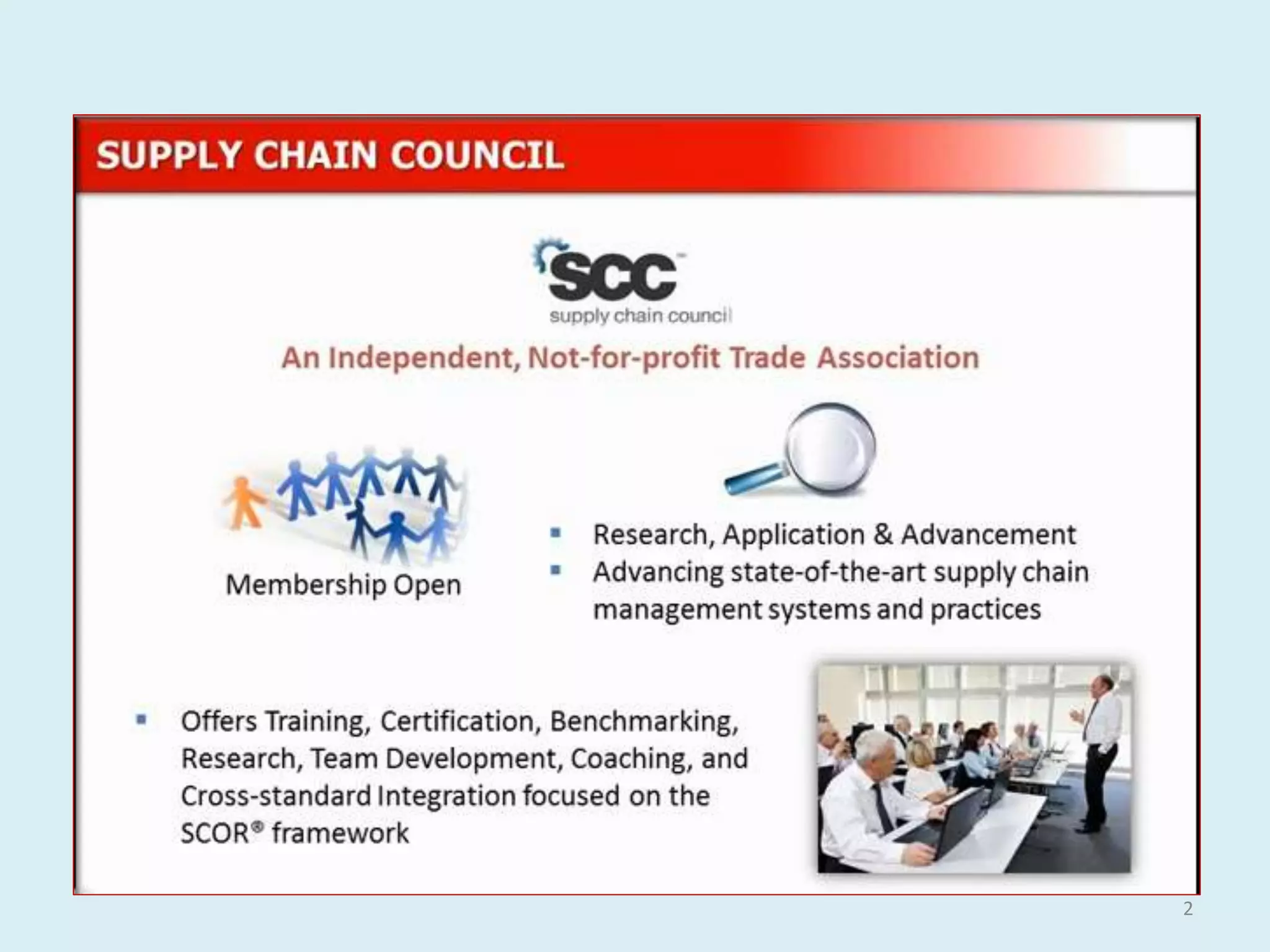
To develop a standard supply-chain process reference model that
enables effective communication and integration among the supply
chain partners, by
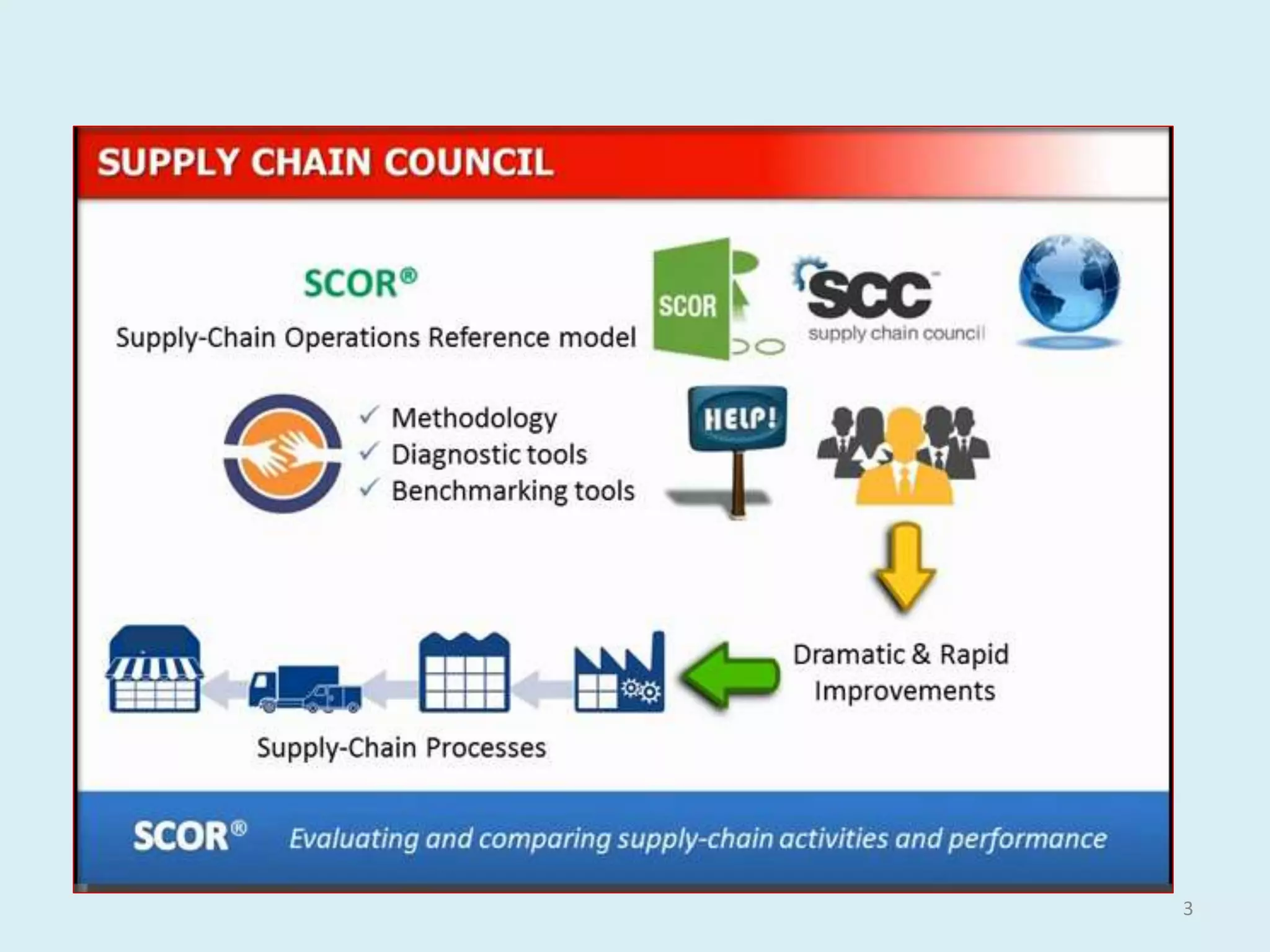
- Using standard terminology to better communicate and
learn the supply chain issues
-Using standard metrics to compare , benchmark and
measure their performances
that is applicable in every type of industry
2 Boston-based consulting firms:
Pit t iglio R abin Todd & McGrat h & A MR R esearch
d e c i d e d t o d e v e l o p a s t a n d a r d a p p r o a c h t o a n a l y z i n g a n d
d e s c r i b i n g a l l t h e a s p e c t s o f s u p p l y c h a i n p r o c e s s e s .
SC C f ormed – Independent Global N on - Pr ofit Or ganiz ation
founded in 1 9 9 6 by a c ons or tium of 69 member volunteer
or ganiz ations ; now c los e to 1000
SCOR Framework developed by the Supply Chain
Council (SCC)
4
5
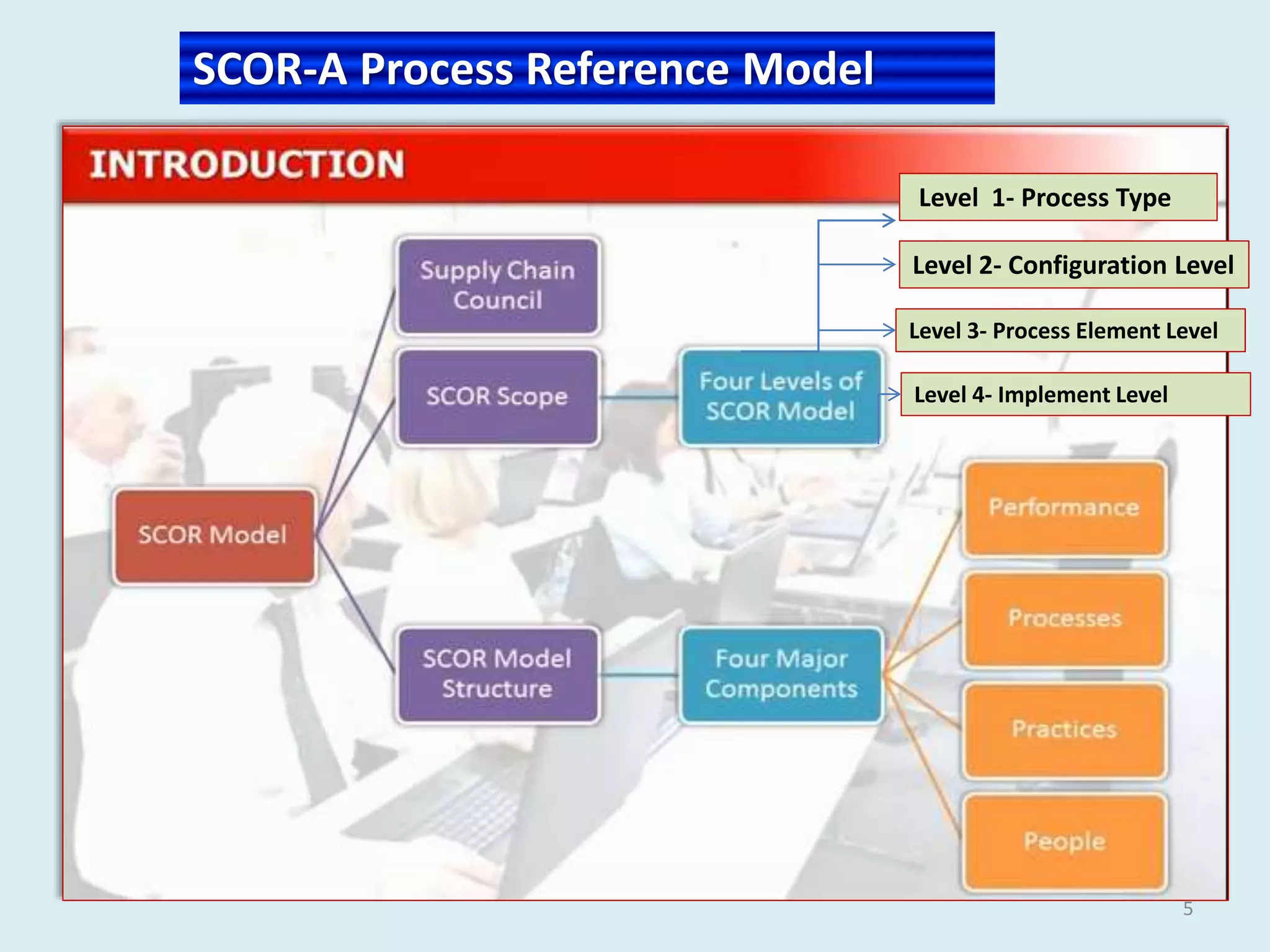
SCOR-A Process Reference Model
Level 1- Process Type
Level 2- Configuration Level
Level 3- Process Element Level
Level 4- Implement Level
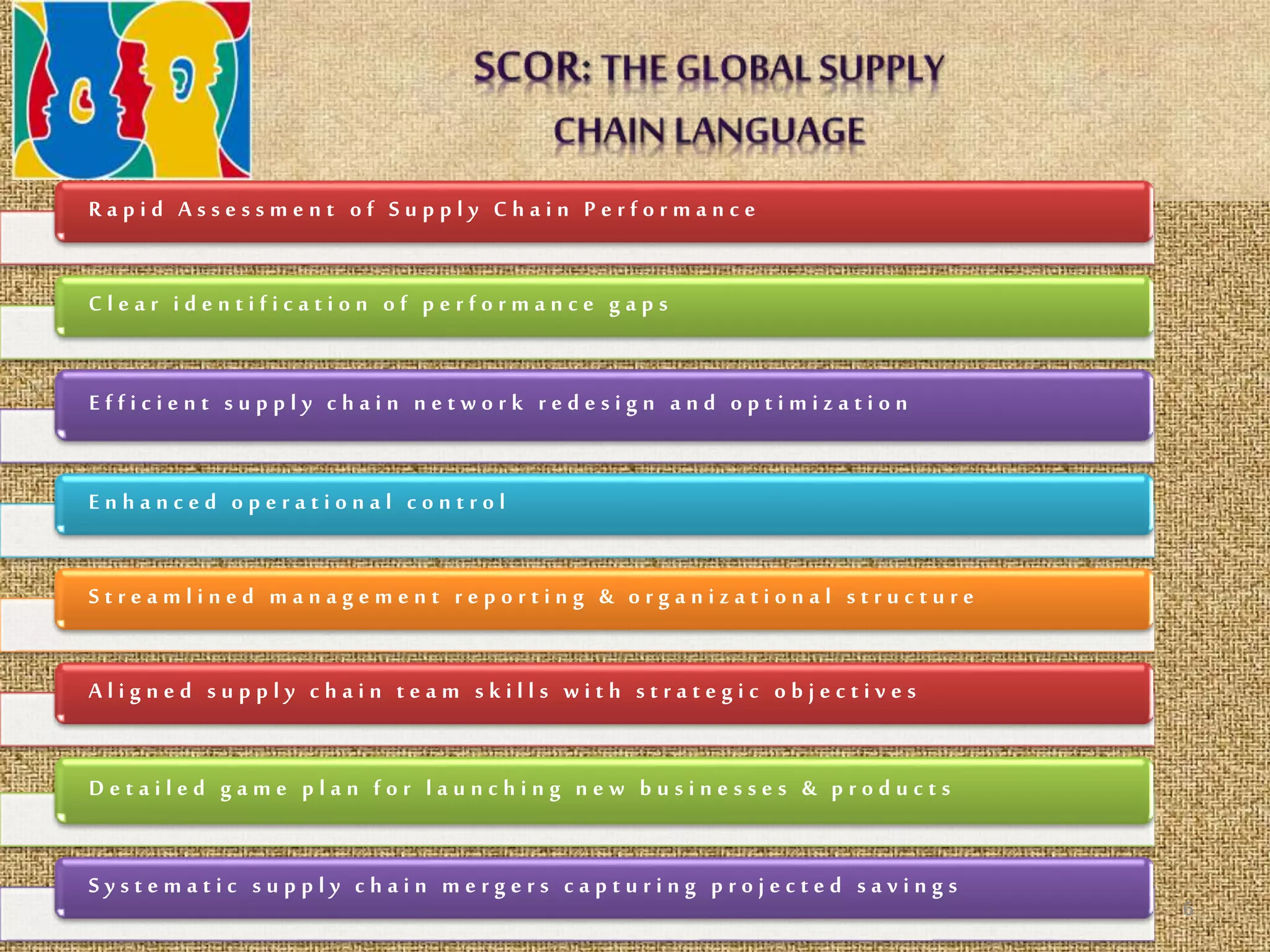
R a p i d A s s e s s m e n t o f S u p p l y C h a i n P e r f o r m a n c e
C l e a r i d e n t i f i c a t i o n o f p e r f o r m a n c e g a p s
E f f i c i e n t s u p p l y c h a i n n e t w o r k r e d e s i g n a n d o p t i m i z a t i o n
E n h a n c e d o p e r a t i o n a l c o n t r o l
S t r e a m l i n e d m a n a g e m e n t r e p o r t i n g & o r g a n i z a t i o n a l s t r u c t u r e
A l i g n e d s u p p l y c h a i n t e a m s k i l l s w i t h s t r a t e g i c o b j e c t i v e s
D e t a i l e d g a m e p l a n f o r l a u n c h i n g n e w b u s i n e s s e s & p r o d u c t s
S y s t e m a t i c s u p p l y c h a i n m e r g e r s c a p t u r i n g p r o j e c t e d s a v i n g s
6
Superior Customer
Service
Cost Control
Planning & Risk
ManagementSupplier/ Partner
Relationship
Management
Talent
SCOR DELIVERS VALUE ! 7
Characterize the
management
practices and
software
solutions that
result in “best-in-
class”
performance
Quantify the
operational
performance of
similar
companies and
establish internal
targets based on
“best-in-class”
results
Capture the “as-
is” state of a
process and
derive the
desired “to-be”
future state
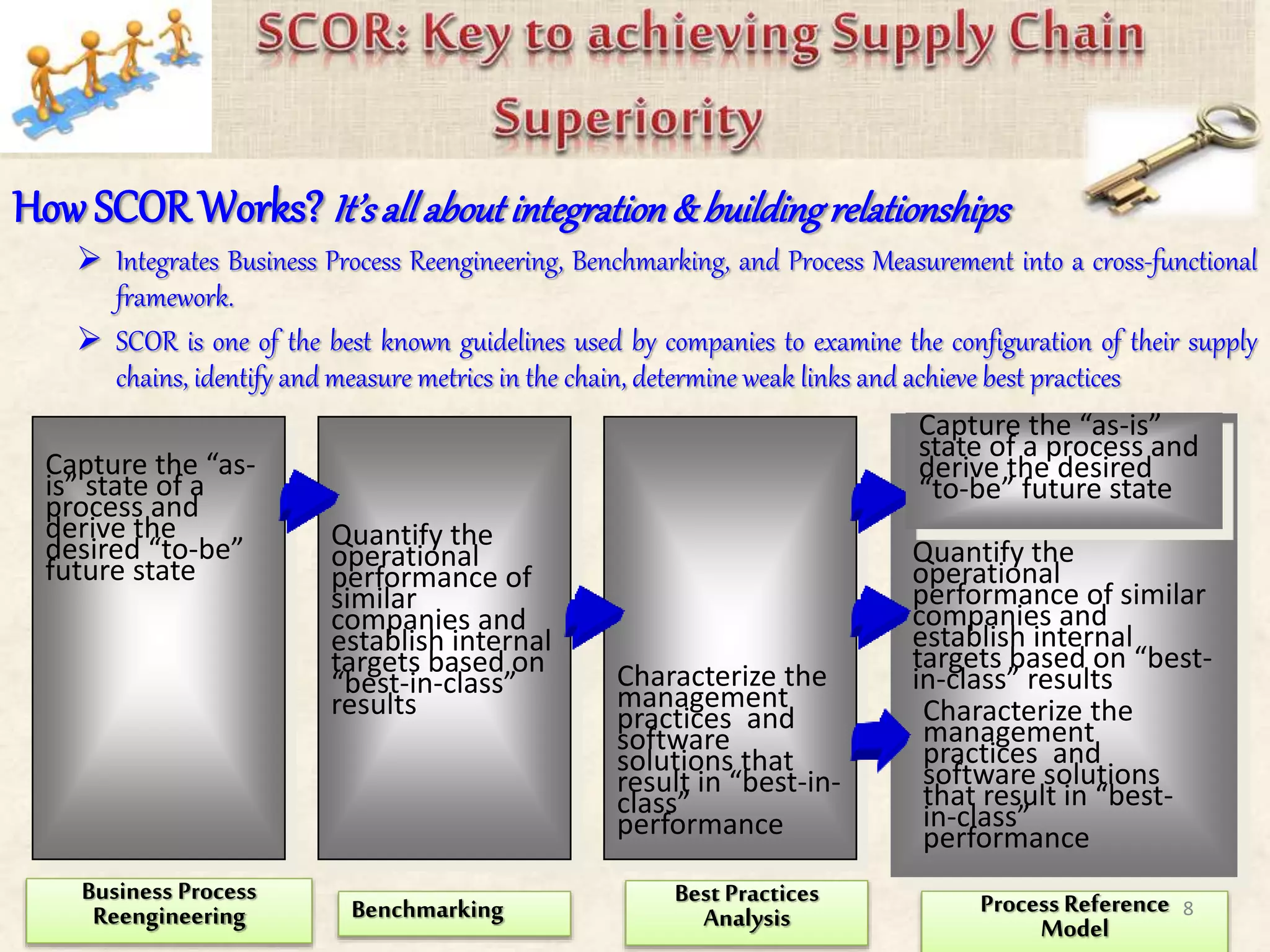
How SCOR Works? It’sall aboutintegration& buildingrelationships
 Integrates Business Process Reengineering, Benchmarking, and Process Measurement into a cross-functional
framework.
 SCOR is one of the best known guidelines used by companies to examine the configuration of their supply
chains, identify and measure metrics in the chain, determine weak links and achieve best practices
Benchmarking
Best Practices
Analysis Process Reference
Model
Business Process
Reengineering
Capture the “as-is”
state of a process and
derive the desired
“to-be” future state
Quantify the
operational
performance of similar
companies and
establish internal
targets based on “best-
in-class” results
Characterize the
management
practices and
software solutions
that result in “best-
in-class”
performance
8
SCOR MODEL – SCOPE/
BOUNDARIESSCORcovers:
• All customer interactions, from order entrythroughpaid invoice.
• All product (physical material and service) transactions, from supplier’s supplier to customer’s customer, including
equipment, supplies, spare parts, bulk product, software, etc.
• All marketinteractions, from the understanding of aggregate demand to the fulfillment of each order
SCORdoes not attempt to describe every businessprocessoractivity, including:
• Sales and marketing(demand generation)
• Research and technology development
• Product development
• Some elements of post-delivery customer support
9
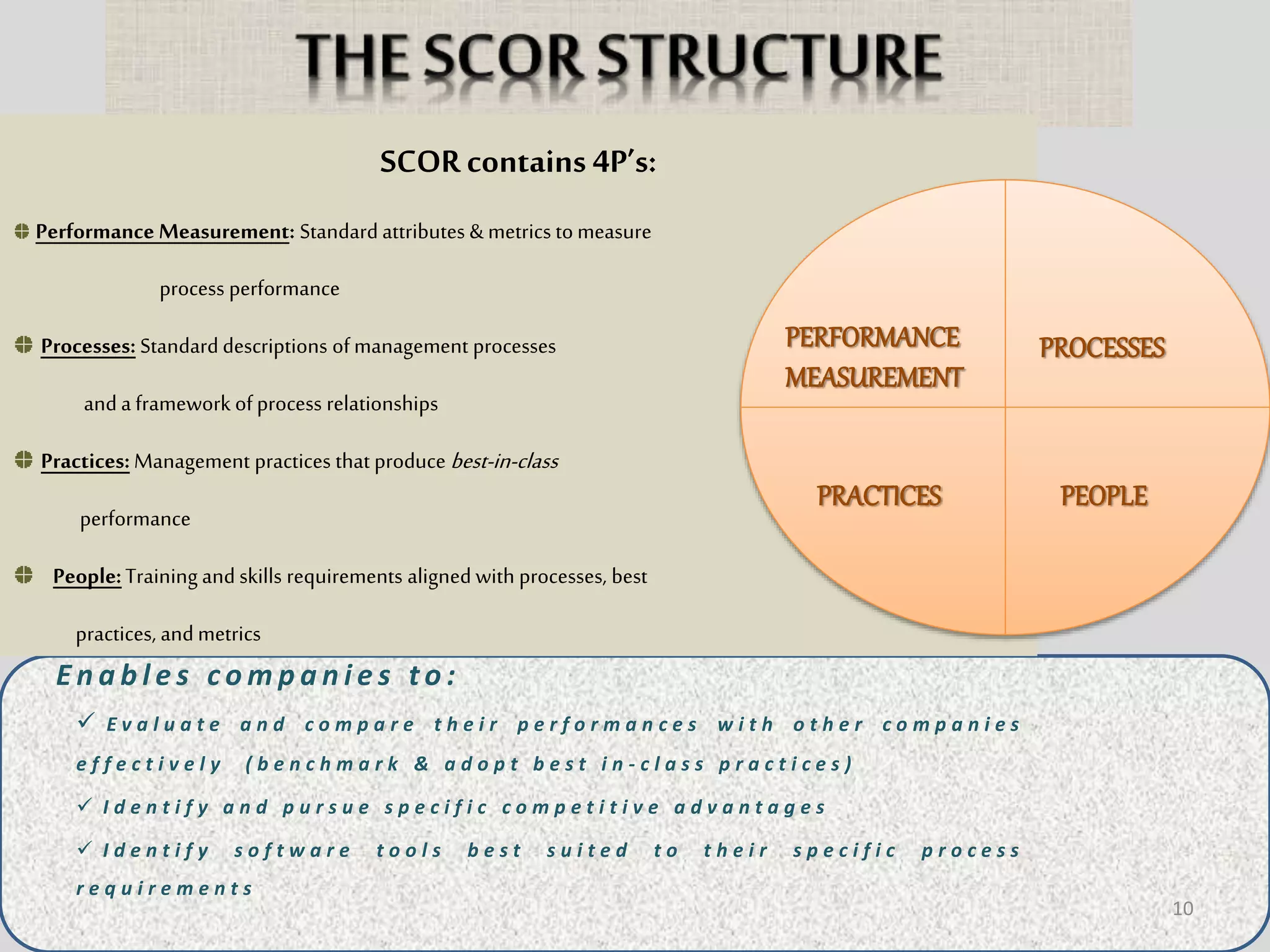
SCORcontains 4P’s:
Performance Measurement: Standardattributes & metrics tomeasure
process performance
Processes: Standarddescriptions ofmanagement processes
anda framework ofprocess relationships
Practices: Management practices that produce best-in-class
performance
People:Training and skills requirements aligned with processes, best
practices, andmetrics
E n a b l e s c o m p a n i e s t o :
 E v a l u a t e a n d c o m p a r e t h e i r p e r f o r m a n c e s w i t h o t h e r c o m p a n i e s
e f f e c t i v e l y ( b e n c h m a r k & a d o p t b e s t i n - c l a s s p r a c t i c e s )
 I d e n t i f y a n d p u r s u e s p e c i f i c c o m p e t i t i v e a d v a n t a g e s
 I d e n t i f y s o f t w a r e t o o l s b e s t s u i t e d t o t h e i r s p e c i f i c p r o c e s s
r e q u i r e m e n t s
PROCESSESPERFORMANCE
MEASUREMENT
PRACTICES PEOPLE
10
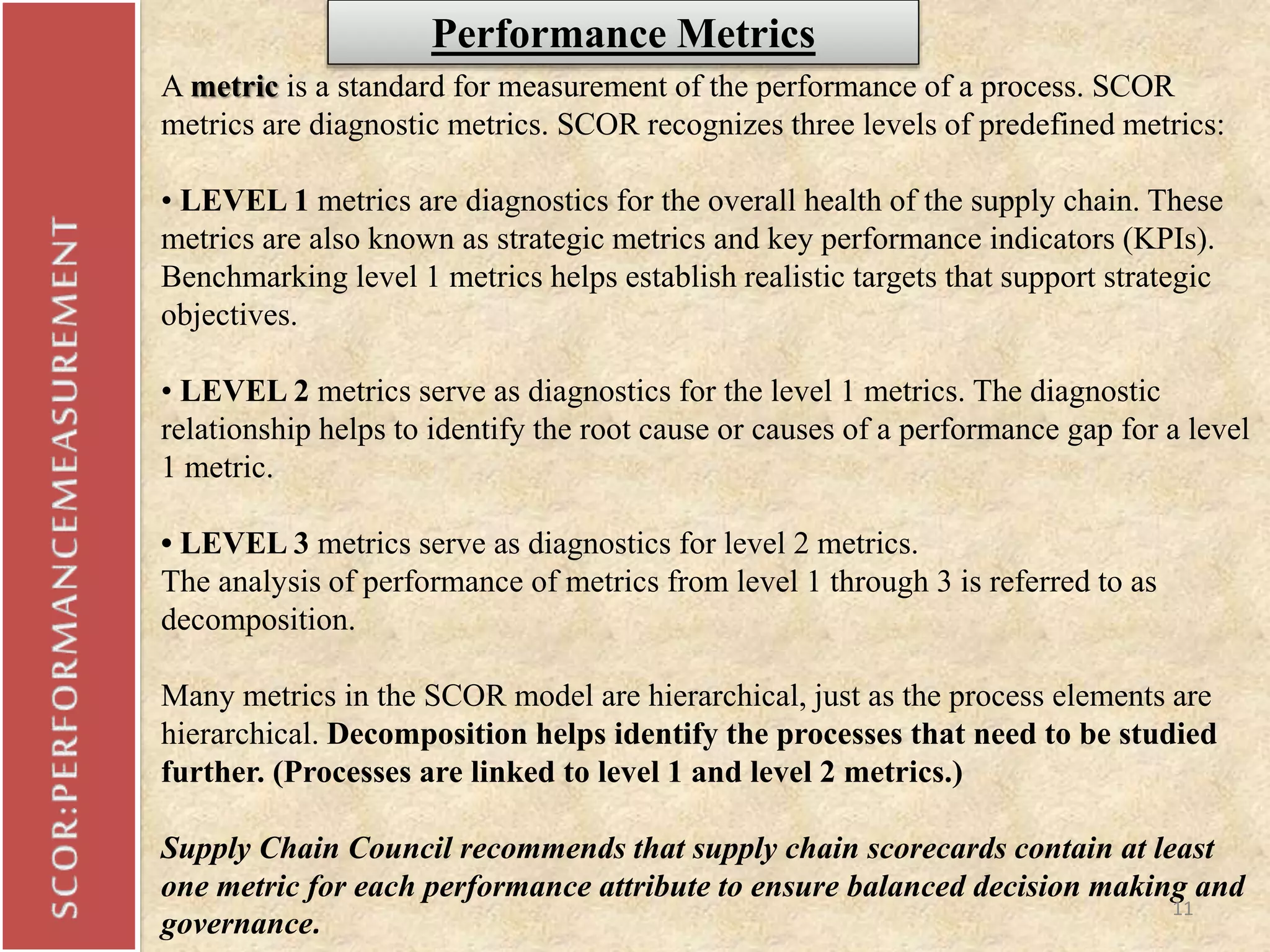
A metric is a standard for measurement of the performance of a process. SCOR
metrics are diagnostic metrics. SCOR recognizes three levels of predefined metrics:
• LEVEL 1 metrics are diagnostics for the overall health of the supply chain. These
metrics are also known as strategic metrics and key performance indicators (KPIs).
Benchmarking level 1 metrics helps establish realistic targets that support strategic
objectives.
• LEVEL 2 metrics serve as diagnostics for the level 1 metrics. The diagnostic
relationship helps to identify the root cause or causes of a performance gap for a level
1 metric.
• LEVEL 3 metrics serve as diagnostics for level 2 metrics.
The analysis of performance of metrics from level 1 through 3 is referred to as
decomposition.
Many metrics in the SCOR model are hierarchical, just as the process elements are
hierarchical. Decomposition helps identify the processes that need to be studied
further. (Processes are linked to level 1 and level 2 metrics.)
Supply Chain Council recommends that supply chain scorecards contain at least
one metric for each performance attribute to ensure balanced decision making and
governance.
Performance Metrics
11
Performance Attributes
Relationship Between Attributes And Metrics
12
Performance Attributes
Relationship Between Attributes And Metrics
13
Return
Level
Description Schematic Comments
Top Level
(Process Types)
Level 1 defines the scope and content for the
Supply chain Operations Reference-model. Here
basis of competition performance targets are set.Source Make Deliver
Plan
1
#
Configuration Level
(Process
Categories)
A company’s supply chain can be “configured-
to-order” at Level 2 from the core “process
categories.” Companies implement their
operations strategy through the configuration
they choose for their supply chain.
2
Process Element
Level (Decompose
Processes)
Level 3 defines a company’s ability to compete
successfully in its chosen markets, and consists
of:
Process element definitions
Process element information inputs, and outputs
Process performance metrics
Best practices, where applicable
System capabilities required to support best
practices
Systems/tools
3
P1.1
Identify, Prioritize, and Aggregate
Supply-Chain Requirements
P1.2
Identify, Assess, and Aggregate
Supply-Chain Requirements
P1.3
Balance Production Resources with
Supply-Chain Requirements
P1.4
Establish and
Communicate
Supply-Chain Plans
Implementation
Level (Decompose
Process Elements)
4
Not
in Scope
Return
Three Levels of Process Detail
Companies implement specific supply-chain
management practices at this level. Level 4
defines practices to achieve competitive
advantage and to adapt to changing business
conditions.
SupplyChainOperationsReferenceModel
SCOR: PROCESSES
5
26
185
14
BASIC BUSINESS PROCESSES
15
PLAN(P)
(Processesthat
balance aggregate
demand and supply)
• Forecasting
• SensitivityAnalysis
• Balanceresourceswith
requirements
• Establish/communicate
plansforthewhole
supply chain
SOURCE(S)
(Processesthat procure
goods and services to
meet planned or actual
demand)
• Scheduledeliveries(receive,
verify,transfer)
MAKE(M)
(Processesthat
transform product
toa finished state
tomeetplanned or
actual demand)
• Scheduleproduction
DELIVER(D)
(Processesthatprovide finished
goodsand servicesto meet
plannedor actualdemand,
typically includingorder
management,transportation
management,anddistribution
management)
Warehousemanagementfrom
receivingandpickingproducttoload
andshipproduct.
LEVEL 1 -KEY PROCESSES EXPLAINED…..
RETURN (R) (Processes associated with returning or receiving returned
products)– ReverseLogistics
ManageReturnbusiness rules 16
LEVEL 2 - PROCESS TYPES AND DEFINITIONS
PLANNING
A process that aligns expected resourcesto meet expected demand requirements.
Balance aggregated demand and supply
Consider consistent planning horizon
(Generally) occurat regular,periodic intervals
EXECUTION
A process triggered by planned or actual demand that changesthe state of material goods.
Scheduling/sequencing
Transformingproduct
Moving product to the next process
ENABLE
A process that prepares, maintains, or manages information orrelationships on which planningand
execution processes rely
17
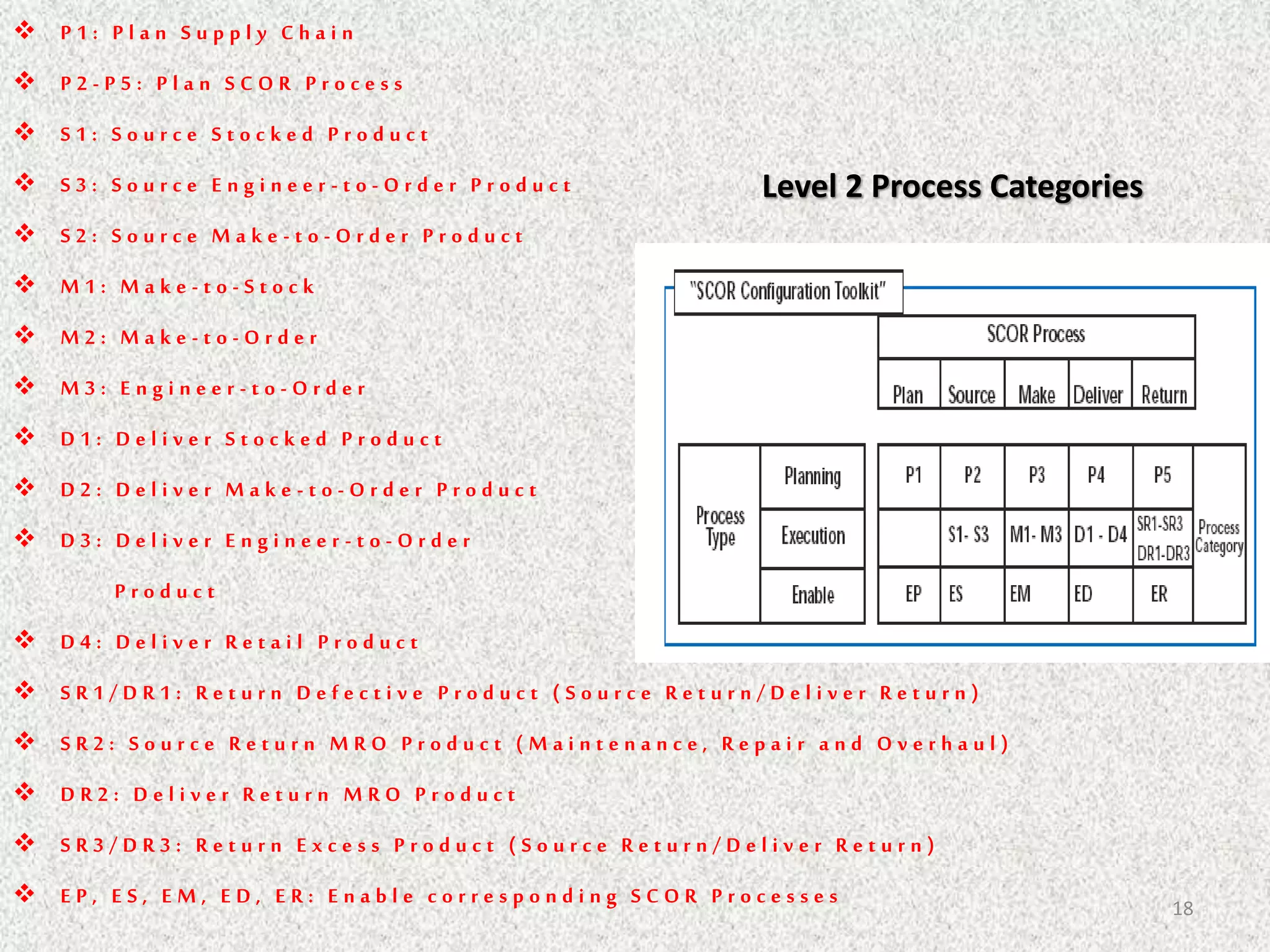
Level 2 Process Categories
 P 1 : P l a n S u p p l y C h a i n
 P 2 - P 5 : P l a n S C O R P r o c e s s
 S 1 : S o u r c e S t o c k e d P r o d u c t
 S 3 : S o u r c e E n g i n e e r - t o - O r d e r P r o d u c t
 S 2 : S o u r c e M a k e - t o - O r d e r P r o d u c t
 M 1 : M a k e - t o - S t o c k
 M 2 : M a k e - t o - O r d e r
 M 3 : E n g i n e e r - t o - O r d e r
 D 1 : D e l i v e r S t o c k e d P r o d u c t
 D 2 : D e l i v e r M a k e - t o - O r d e r P r o d u c t
 D 3 : D e l i v e r E n g i n e e r - t o - O r d e r
P r o d u c t
 D 4 : D e l i v e r R e t a i l P r o d u c t
 S R 1 / D R 1 : R e t u r n D e f e c t i v e P r o d u c t ( S o u r c e R e t u r n / D e l i v e r R e t u r n )
 S R 2 : S o u r c e R e t u r n M R O P r o d u c t ( M a i n t e n a n c e , R e p a i r a n d O v e r h a u l )
 D R 2 : D e l i v e r R e t u r n M R O P r o d u c t
 S R 3 / D R 3 : R e t u r n E x c e s s P r o d u c t ( S o u r c e R e t u r n / D e l i v e r R e t u r n )
 E P , E S , E M , E D , E R : E n a b l e c o r r e s p o n d i n g S C O R P r o c e s s e s 18
19
20
SCOR:BestPractices
21
1. SCOR Supply Chain Risk Management
The systematic identification, assessment, and mitigation of potential disruptions (both within and
outside the supply chain) in logistics networks with the objective toreduce their negative impact on the
logistics network’s performance.
T h e R e l a t e d
S C O R
P r o c e s s e s
E P. 9 , E S . 9 ,
E M . 9 , E D . 9
& E R . 9
PROCESS
SCOR:BestPractices
22
SCOR:BestPractices
2.
23
SCOR:People
1.Novice
2. Experienced Beginner
3.Competent
4. Proficient
5. Expert
24
25
WHY DOES IKEA USE SCORMODEL?
Legitimacy & Common Terminology (Integration) in supply chain for better
communication
Sustainable Supplier Relationship Management
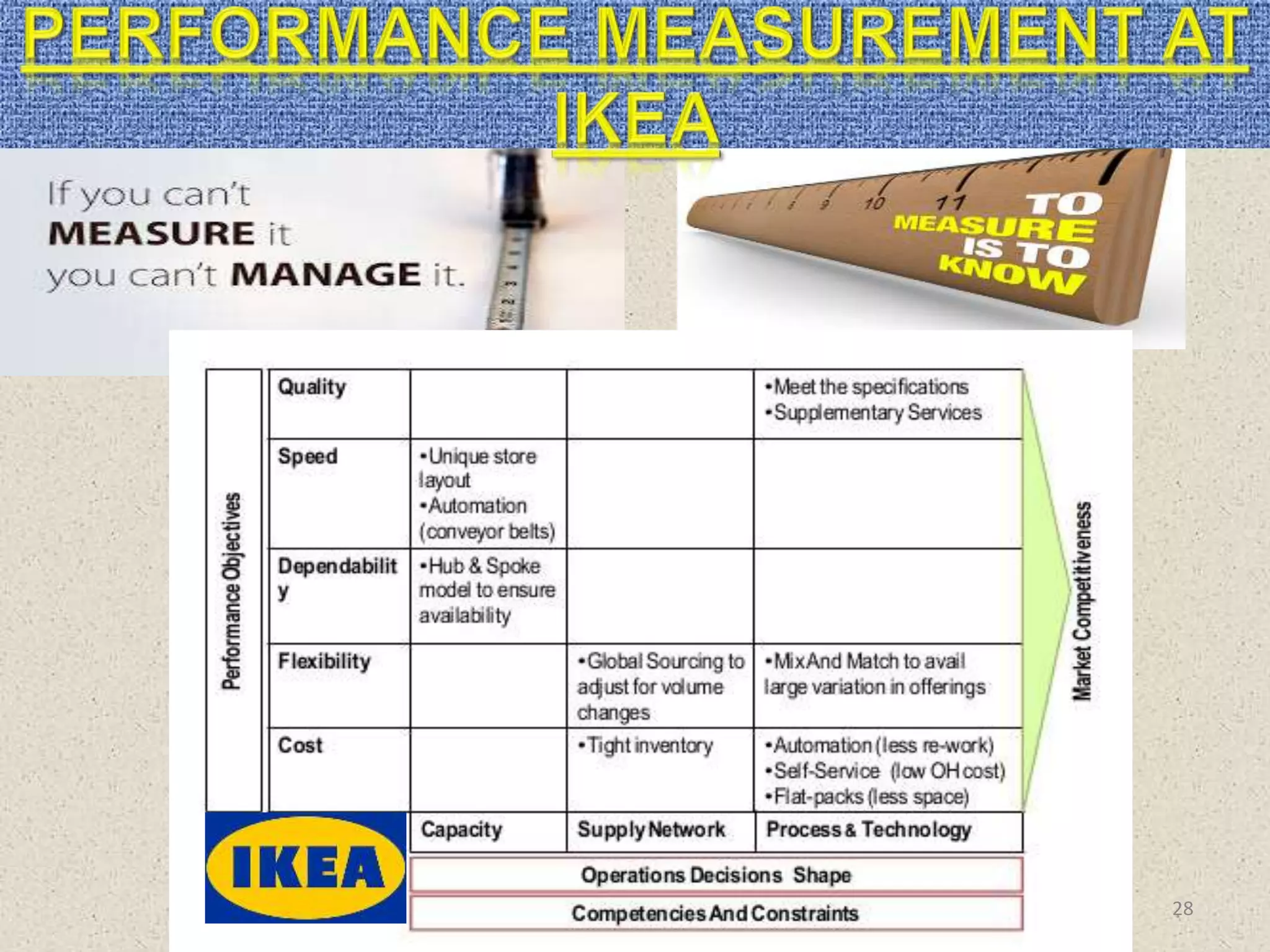
Designing Performance Measurement
A framework for guidance & control
More holistic view for co-workers –
I-people need to become T-people
Designed by practitioners
Neutral
No need to invent the wheel
26
Supplier Raw Material Warehouse Factory Finished Goods Warehouse
IKEA Distribution
Center
The Customer
IKEA Store
27
28
29
30
31
32
33
34
35
IKEA INVENTORY PLANNING & FORECASTING
Cost-Per-TouchInventoryTactic
In-Store Logistics
Maximum/Minimum Settings
As Proprietary System
Usage Of High-Flow& Low-Flow
Warehouse Facilities
Do-It-Yourself Assembly
Lowers Packaging Costs
36
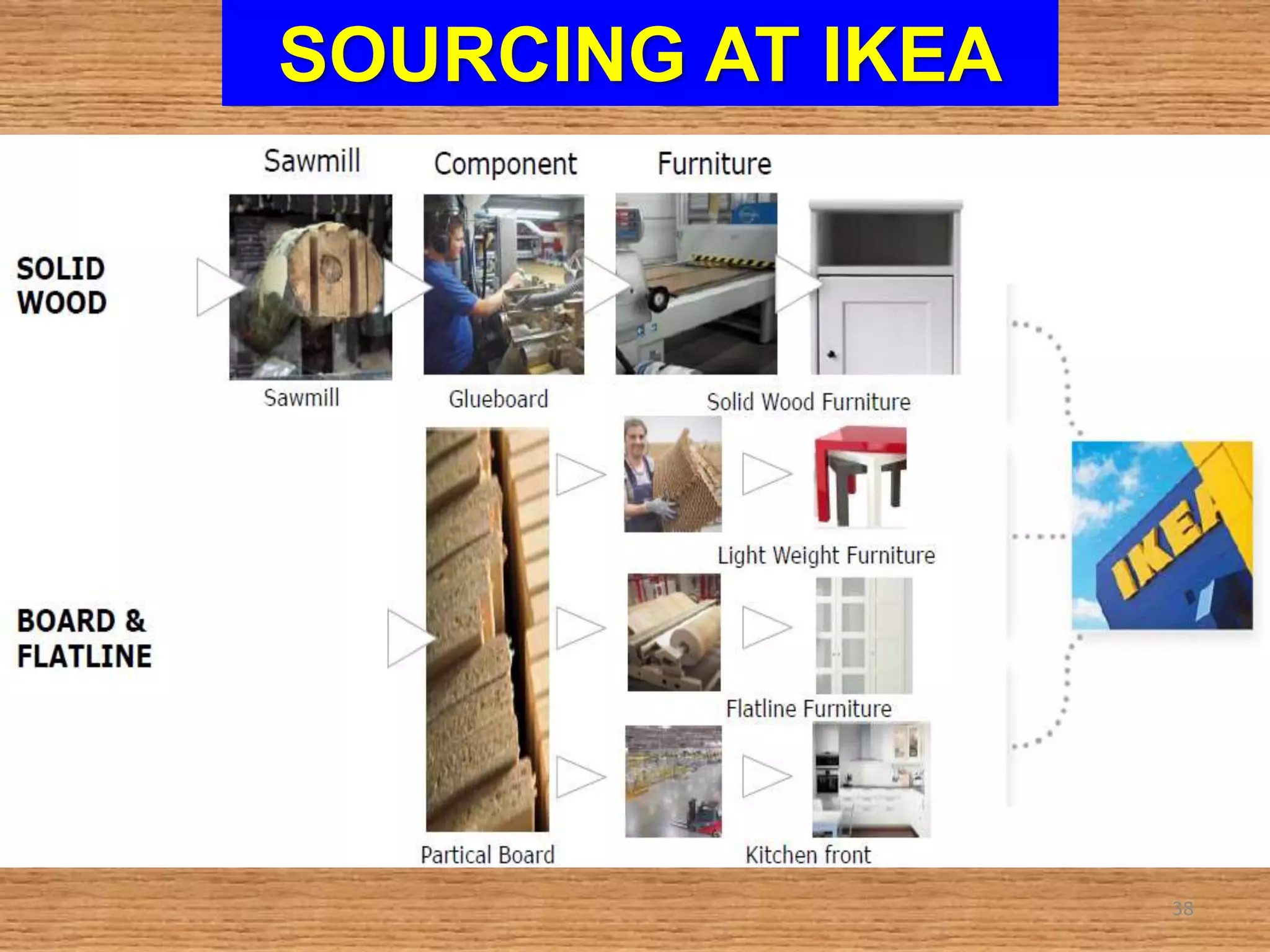
SOURCING AT IKEA
37
SOURCING AT IKEA
38
IKEA MANUFACTURING &
DISTRIBUTION NETWORK
39
Designs for furniture, lamps, kitchen
equipment and beds are logistically formed
The packaging also is designed to squeeze
as many units as possible into trucks
delivering inventory to the stores. “Air out,
product-in” – Loading Ledge technology
Once a product is designed and
manufactured, it can be checked for quality
by an independent firm whose location is as
proximate to the manufacturer as possible.
Example, Intertek in China
MANUFACTURING AT IKEA
40
IKEA LOGISTICS - WAREHOUSING
I K E A h a s a b o u t 4 0 d i s t r i b u t i o n c e n t e r s w o r l d w i d e i n 1 6
d i f f e r e n t c o u n t r i e s
C r o s s - D o c k i n g m e t h o d u s e d
A s t r o W M S a d o p t e d b y I K E A i n 2 0 1 0 i n c r e a s e s a n d
i m p r o v e s e f f i c i e n c y i n t h e i r d i s t r i b u t i o n c e n t r e .
A s t r o i s a n a u t o ma t e d w a r e h o u s e m a n a g e m e n t s y s t e m
t h a t a l l o w s f o r o r d e r i n g f u l f i l l m e n t a u t o m a t i c a l l y s o
r e d u c i n g m a n u a l c o s t w i t h a u t o m a t e d r e - o r d e r i n g p u r c h a s e
o r d e r s b e i n g s e n t t o s u p p l i e r s w h e n s t o c k l e v e l s a r e l o w .
41
IKEAproductsaretransportedby road,railandsea betweensuppliers,distributioncentersandIKEA
stores,andfromthestoresto customers.
IKEAtransportserviceprovidersmustcomplywiththerequirementsinthesuppliercodeof conduct
IWAY,includingindustry-specificrequirements.
IKEA LOGISTICS - DELIVERY
42
IKEA –RETURNPOLICY
IKEA takes returned products seriously.
Customers have atleast 30daysto bring backpurchased
productsfor a full refund regardless of the reason for the
return
Recovery team present ateach store
Afternecessary repairs, they offer them to customers in
store space tagged “As Is,”
More damaged products are broken down to their
components and recycled.
Every return and complaint is systematically
documented so that IKEA can analyze reasons for returns
and take action throughout the value chain when needed.
43
It launched a code of conduct called ‘IWAY’ as corporate sustainability standards
through the practice of following environmental responsibility in relation to customers,
co-workers and suppliers
Offer solutions and know-how that help customers live a more sustainable life
Use natural resources in a sustainable manner within the entire supply chain ;
careful waste management
Minimize the carbon footprint from all IKEA related operations
Be transparent to all stakeholders and communicate more to customers and co-
workers
IKEA’s sustainability effort, successfully spans across all major supply chain
processes from Source to Make, Deliver and Return, which demonstrates long-term
management commitment.
IKEA BEST PRACTICES
44
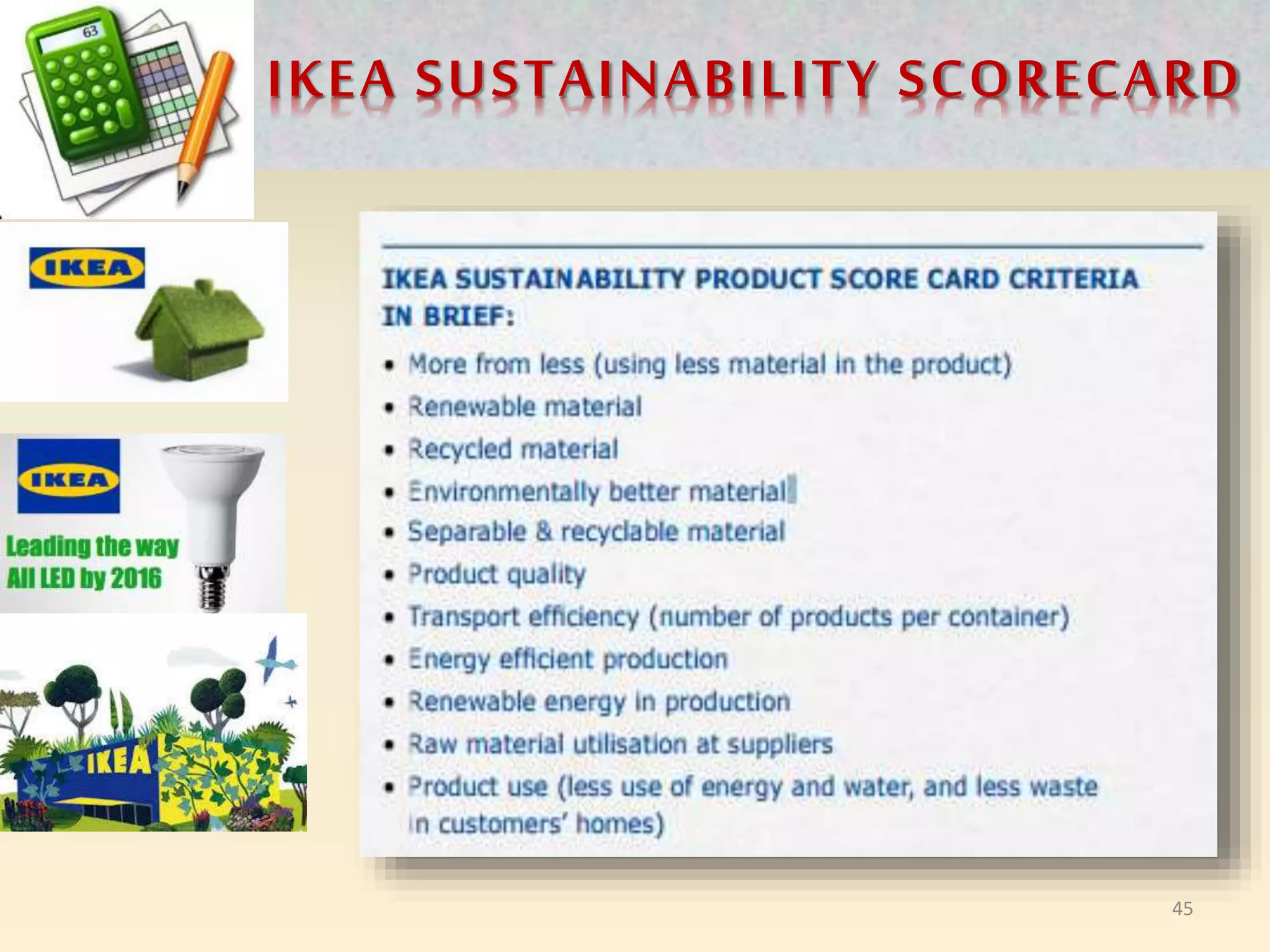
IKEA SUSTAINABILITY SCORECARD
45
 Rigorous safety alarm procedures
 Every IKEA store and national
Service Office has dedicated
resources working with safety alarm
procedures, and they receive regular
training.
 Proactive risk assessment and
extensive testing
 Special focus on children’s safety
 Using the safest possible
chemicals 46
“Our co-workers are our most valuable resource – when they grow, IKEA grows.”
V a l u e s - I K E A e m b r a c e s h u m a n r i g h t s a n d r e s p e c t f o r t h e i n d i v i d u a l ,
a n d t h e w a y w e w o r k i s b a s e d o n a s t r o n g a n d l i v i n g c o m p a n y c u l t u r e .
L i s t e n i n g t o o u r c o - w o r k e r s I K E A u s e s “ V O I C E ” – a c o m p a n y - wi d e
s u r v e y – t o m o n i t o r h o w c o w o r k e r s v i e w v a r i o u s a s p e c t s o f t h e i r
e m p l o y m e n t a t I K E A .
S a f e a n d h e a l t h y w o r k i n g c o n d i t i o n s
K e e p i n g c o - w o r k e r s i n v o l v e d
D i a l o g u e w i t h u n i o n s
S u p p o r t i n g w o r k - l i f e b a l a n c e
IKEA MANAGING
PEOPLE
47
IKEA MANAGING
PEOPLE
48
IKEA MANAGING
PEOPLE
49
IKEA MANAGING
PEOPLE
50
IKEA MANAGING
PEOPLE
51
52
SCOR could be extended into a complete business process architecture, or even into
a complete process-centric enterprise architecture (HOLISTIC/ SYSTEM VIEW)
53
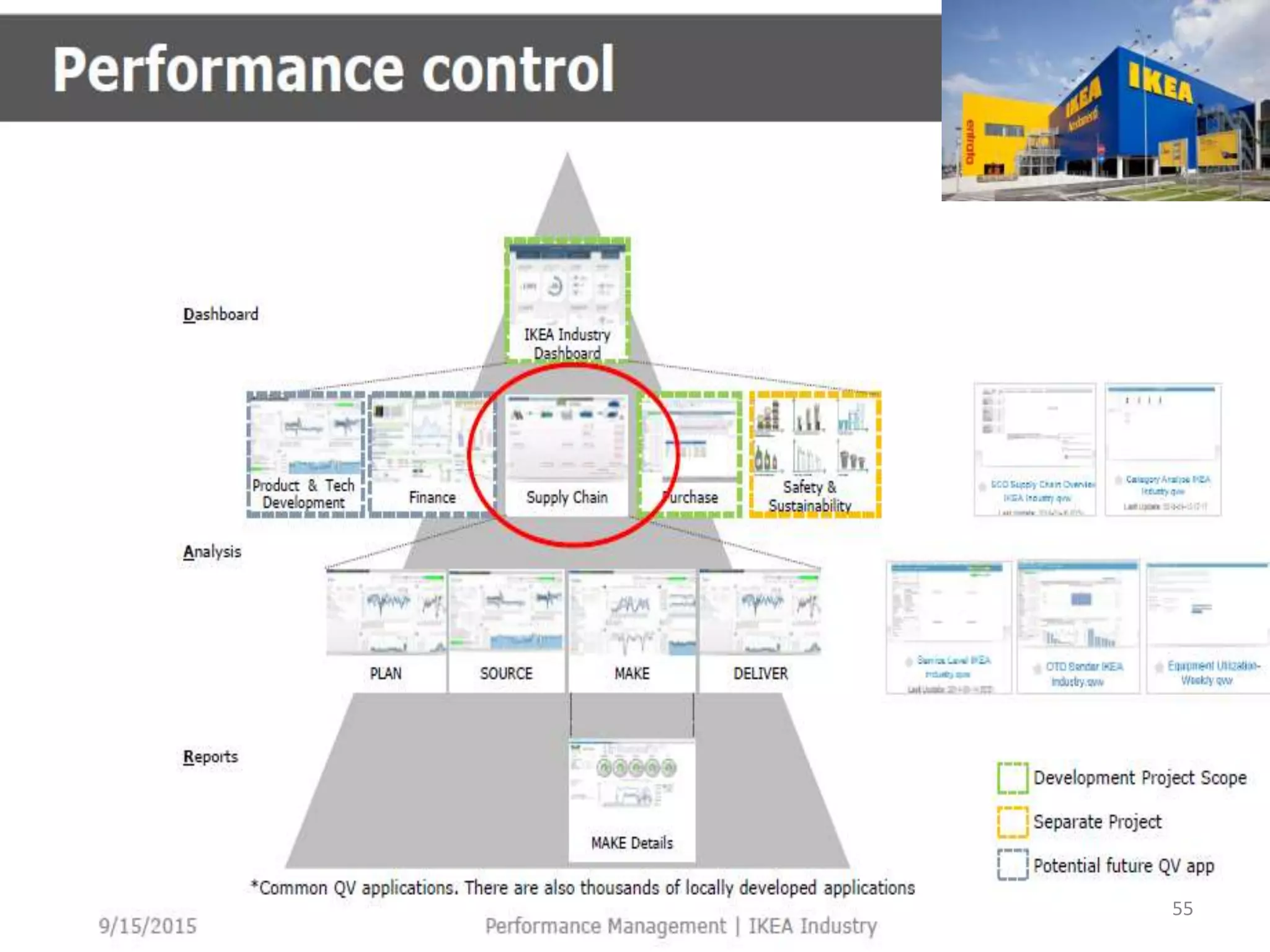
HOW DOES IT ALL COME TOGETHER AT
IKEA?
54
55
56

Scor model

  • 1.
  • 2.
  • 3.
  • 4.
    Objective Of SCCthrough SCOR To develop a standard supply-chain process reference model that enables effective communication and integration among the supply chain partners, by - Using standard terminology to better communicate and learn the supply chain issues -Using standard metrics to compare , benchmark and measure their performances that is applicable in every type of industry 2 Boston-based consulting firms: Pit t iglio R abin Todd & McGrat h & A MR R esearch d e c i d e d t o d e v e l o p a s t a n d a r d a p p r o a c h t o a n a l y z i n g a n d d e s c r i b i n g a l l t h e a s p e c t s o f s u p p l y c h a i n p r o c e s s e s . SC C f ormed – Independent Global N on - Pr ofit Or ganiz ation founded in 1 9 9 6 by a c ons or tium of 69 member volunteer or ganiz ations ; now c los e to 1000 SCOR Framework developed by the Supply Chain Council (SCC) 4
  • 5.
    5 SCOR-A Process ReferenceModel Level 1- Process Type Level 2- Configuration Level Level 3- Process Element Level Level 4- Implement Level
  • 6.
    R a pi d A s s e s s m e n t o f S u p p l y C h a i n P e r f o r m a n c e C l e a r i d e n t i f i c a t i o n o f p e r f o r m a n c e g a p s E f f i c i e n t s u p p l y c h a i n n e t w o r k r e d e s i g n a n d o p t i m i z a t i o n E n h a n c e d o p e r a t i o n a l c o n t r o l S t r e a m l i n e d m a n a g e m e n t r e p o r t i n g & o r g a n i z a t i o n a l s t r u c t u r e A l i g n e d s u p p l y c h a i n t e a m s k i l l s w i t h s t r a t e g i c o b j e c t i v e s D e t a i l e d g a m e p l a n f o r l a u n c h i n g n e w b u s i n e s s e s & p r o d u c t s S y s t e m a t i c s u p p l y c h a i n m e r g e r s c a p t u r i n g p r o j e c t e d s a v i n g s 6
  • 7.
    Superior Customer Service Cost Control Planning& Risk ManagementSupplier/ Partner Relationship Management Talent SCOR DELIVERS VALUE ! 7
  • 8.
    Characterize the management practices and software solutionsthat result in “best-in- class” performance Quantify the operational performance of similar companies and establish internal targets based on “best-in-class” results Capture the “as- is” state of a process and derive the desired “to-be” future state How SCOR Works? It’sall aboutintegration& buildingrelationships  Integrates Business Process Reengineering, Benchmarking, and Process Measurement into a cross-functional framework.  SCOR is one of the best known guidelines used by companies to examine the configuration of their supply chains, identify and measure metrics in the chain, determine weak links and achieve best practices Benchmarking Best Practices Analysis Process Reference Model Business Process Reengineering Capture the “as-is” state of a process and derive the desired “to-be” future state Quantify the operational performance of similar companies and establish internal targets based on “best- in-class” results Characterize the management practices and software solutions that result in “best- in-class” performance 8
  • 9.
    SCOR MODEL –SCOPE/ BOUNDARIESSCORcovers: • All customer interactions, from order entrythroughpaid invoice. • All product (physical material and service) transactions, from supplier’s supplier to customer’s customer, including equipment, supplies, spare parts, bulk product, software, etc. • All marketinteractions, from the understanding of aggregate demand to the fulfillment of each order SCORdoes not attempt to describe every businessprocessoractivity, including: • Sales and marketing(demand generation) • Research and technology development • Product development • Some elements of post-delivery customer support 9
  • 10.
    SCORcontains 4P’s: Performance Measurement:Standardattributes & metrics tomeasure process performance Processes: Standarddescriptions ofmanagement processes anda framework ofprocess relationships Practices: Management practices that produce best-in-class performance People:Training and skills requirements aligned with processes, best practices, andmetrics E n a b l e s c o m p a n i e s t o :  E v a l u a t e a n d c o m p a r e t h e i r p e r f o r m a n c e s w i t h o t h e r c o m p a n i e s e f f e c t i v e l y ( b e n c h m a r k & a d o p t b e s t i n - c l a s s p r a c t i c e s )  I d e n t i f y a n d p u r s u e s p e c i f i c c o m p e t i t i v e a d v a n t a g e s  I d e n t i f y s o f t w a r e t o o l s b e s t s u i t e d t o t h e i r s p e c i f i c p r o c e s s r e q u i r e m e n t s PROCESSESPERFORMANCE MEASUREMENT PRACTICES PEOPLE 10
  • 11.
    A metric isa standard for measurement of the performance of a process. SCOR metrics are diagnostic metrics. SCOR recognizes three levels of predefined metrics: • LEVEL 1 metrics are diagnostics for the overall health of the supply chain. These metrics are also known as strategic metrics and key performance indicators (KPIs). Benchmarking level 1 metrics helps establish realistic targets that support strategic objectives. • LEVEL 2 metrics serve as diagnostics for the level 1 metrics. The diagnostic relationship helps to identify the root cause or causes of a performance gap for a level 1 metric. • LEVEL 3 metrics serve as diagnostics for level 2 metrics. The analysis of performance of metrics from level 1 through 3 is referred to as decomposition. Many metrics in the SCOR model are hierarchical, just as the process elements are hierarchical. Decomposition helps identify the processes that need to be studied further. (Processes are linked to level 1 and level 2 metrics.) Supply Chain Council recommends that supply chain scorecards contain at least one metric for each performance attribute to ensure balanced decision making and governance. Performance Metrics 11
  • 12.
  • 13.
  • 14.
    Return Level Description Schematic Comments TopLevel (Process Types) Level 1 defines the scope and content for the Supply chain Operations Reference-model. Here basis of competition performance targets are set.Source Make Deliver Plan 1 # Configuration Level (Process Categories) A company’s supply chain can be “configured- to-order” at Level 2 from the core “process categories.” Companies implement their operations strategy through the configuration they choose for their supply chain. 2 Process Element Level (Decompose Processes) Level 3 defines a company’s ability to compete successfully in its chosen markets, and consists of: Process element definitions Process element information inputs, and outputs Process performance metrics Best practices, where applicable System capabilities required to support best practices Systems/tools 3 P1.1 Identify, Prioritize, and Aggregate Supply-Chain Requirements P1.2 Identify, Assess, and Aggregate Supply-Chain Requirements P1.3 Balance Production Resources with Supply-Chain Requirements P1.4 Establish and Communicate Supply-Chain Plans Implementation Level (Decompose Process Elements) 4 Not in Scope Return Three Levels of Process Detail Companies implement specific supply-chain management practices at this level. Level 4 defines practices to achieve competitive advantage and to adapt to changing business conditions. SupplyChainOperationsReferenceModel SCOR: PROCESSES 5 26 185 14
  • 15.
  • 16.
    PLAN(P) (Processesthat balance aggregate demand andsupply) • Forecasting • SensitivityAnalysis • Balanceresourceswith requirements • Establish/communicate plansforthewhole supply chain SOURCE(S) (Processesthat procure goods and services to meet planned or actual demand) • Scheduledeliveries(receive, verify,transfer) MAKE(M) (Processesthat transform product toa finished state tomeetplanned or actual demand) • Scheduleproduction DELIVER(D) (Processesthatprovide finished goodsand servicesto meet plannedor actualdemand, typically includingorder management,transportation management,anddistribution management) Warehousemanagementfrom receivingandpickingproducttoload andshipproduct. LEVEL 1 -KEY PROCESSES EXPLAINED….. RETURN (R) (Processes associated with returning or receiving returned products)– ReverseLogistics ManageReturnbusiness rules 16
  • 17.
    LEVEL 2 -PROCESS TYPES AND DEFINITIONS PLANNING A process that aligns expected resourcesto meet expected demand requirements. Balance aggregated demand and supply Consider consistent planning horizon (Generally) occurat regular,periodic intervals EXECUTION A process triggered by planned or actual demand that changesthe state of material goods. Scheduling/sequencing Transformingproduct Moving product to the next process ENABLE A process that prepares, maintains, or manages information orrelationships on which planningand execution processes rely 17
  • 18.
    Level 2 ProcessCategories  P 1 : P l a n S u p p l y C h a i n  P 2 - P 5 : P l a n S C O R P r o c e s s  S 1 : S o u r c e S t o c k e d P r o d u c t  S 3 : S o u r c e E n g i n e e r - t o - O r d e r P r o d u c t  S 2 : S o u r c e M a k e - t o - O r d e r P r o d u c t  M 1 : M a k e - t o - S t o c k  M 2 : M a k e - t o - O r d e r  M 3 : E n g i n e e r - t o - O r d e r  D 1 : D e l i v e r S t o c k e d P r o d u c t  D 2 : D e l i v e r M a k e - t o - O r d e r P r o d u c t  D 3 : D e l i v e r E n g i n e e r - t o - O r d e r P r o d u c t  D 4 : D e l i v e r R e t a i l P r o d u c t  S R 1 / D R 1 : R e t u r n D e f e c t i v e P r o d u c t ( S o u r c e R e t u r n / D e l i v e r R e t u r n )  S R 2 : S o u r c e R e t u r n M R O P r o d u c t ( M a i n t e n a n c e , R e p a i r a n d O v e r h a u l )  D R 2 : D e l i v e r R e t u r n M R O P r o d u c t  S R 3 / D R 3 : R e t u r n E x c e s s P r o d u c t ( S o u r c e R e t u r n / D e l i v e r R e t u r n )  E P , E S , E M , E D , E R : E n a b l e c o r r e s p o n d i n g S C O R P r o c e s s e s 18
  • 19.
  • 20.
  • 21.
  • 22.
    1. SCOR SupplyChain Risk Management The systematic identification, assessment, and mitigation of potential disruptions (both within and outside the supply chain) in logistics networks with the objective toreduce their negative impact on the logistics network’s performance. T h e R e l a t e d S C O R P r o c e s s e s E P. 9 , E S . 9 , E M . 9 , E D . 9 & E R . 9 PROCESS SCOR:BestPractices 22
  • 23.
  • 24.
  • 25.
  • 26.
    WHY DOES IKEAUSE SCORMODEL? Legitimacy & Common Terminology (Integration) in supply chain for better communication Sustainable Supplier Relationship Management Designing Performance Measurement A framework for guidance & control More holistic view for co-workers – I-people need to become T-people Designed by practitioners Neutral No need to invent the wheel 26
  • 27.
    Supplier Raw MaterialWarehouse Factory Finished Goods Warehouse IKEA Distribution Center The Customer IKEA Store 27
  • 28.
  • 29.
  • 30.
  • 31.
  • 32.
  • 33.
  • 34.
  • 35.
  • 36.
    IKEA INVENTORY PLANNING& FORECASTING Cost-Per-TouchInventoryTactic In-Store Logistics Maximum/Minimum Settings As Proprietary System Usage Of High-Flow& Low-Flow Warehouse Facilities Do-It-Yourself Assembly Lowers Packaging Costs 36
  • 37.
  • 38.
  • 39.
  • 40.
    Designs for furniture,lamps, kitchen equipment and beds are logistically formed The packaging also is designed to squeeze as many units as possible into trucks delivering inventory to the stores. “Air out, product-in” – Loading Ledge technology Once a product is designed and manufactured, it can be checked for quality by an independent firm whose location is as proximate to the manufacturer as possible. Example, Intertek in China MANUFACTURING AT IKEA 40
  • 41.
    IKEA LOGISTICS -WAREHOUSING I K E A h a s a b o u t 4 0 d i s t r i b u t i o n c e n t e r s w o r l d w i d e i n 1 6 d i f f e r e n t c o u n t r i e s C r o s s - D o c k i n g m e t h o d u s e d A s t r o W M S a d o p t e d b y I K E A i n 2 0 1 0 i n c r e a s e s a n d i m p r o v e s e f f i c i e n c y i n t h e i r d i s t r i b u t i o n c e n t r e . A s t r o i s a n a u t o ma t e d w a r e h o u s e m a n a g e m e n t s y s t e m t h a t a l l o w s f o r o r d e r i n g f u l f i l l m e n t a u t o m a t i c a l l y s o r e d u c i n g m a n u a l c o s t w i t h a u t o m a t e d r e - o r d e r i n g p u r c h a s e o r d e r s b e i n g s e n t t o s u p p l i e r s w h e n s t o c k l e v e l s a r e l o w . 41
  • 42.
    IKEAproductsaretransportedby road,railandsea betweensuppliers,distributioncentersandIKEA stores,andfromthestorestocustomers. IKEAtransportserviceprovidersmustcomplywiththerequirementsinthesuppliercodeof conduct IWAY,includingindustry-specificrequirements. IKEA LOGISTICS - DELIVERY 42
  • 43.
    IKEA –RETURNPOLICY IKEA takesreturned products seriously. Customers have atleast 30daysto bring backpurchased productsfor a full refund regardless of the reason for the return Recovery team present ateach store Afternecessary repairs, they offer them to customers in store space tagged “As Is,” More damaged products are broken down to their components and recycled. Every return and complaint is systematically documented so that IKEA can analyze reasons for returns and take action throughout the value chain when needed. 43
  • 44.
    It launched acode of conduct called ‘IWAY’ as corporate sustainability standards through the practice of following environmental responsibility in relation to customers, co-workers and suppliers Offer solutions and know-how that help customers live a more sustainable life Use natural resources in a sustainable manner within the entire supply chain ; careful waste management Minimize the carbon footprint from all IKEA related operations Be transparent to all stakeholders and communicate more to customers and co- workers IKEA’s sustainability effort, successfully spans across all major supply chain processes from Source to Make, Deliver and Return, which demonstrates long-term management commitment. IKEA BEST PRACTICES 44
  • 45.
  • 46.
     Rigorous safetyalarm procedures  Every IKEA store and national Service Office has dedicated resources working with safety alarm procedures, and they receive regular training.  Proactive risk assessment and extensive testing  Special focus on children’s safety  Using the safest possible chemicals 46
  • 47.
    “Our co-workers areour most valuable resource – when they grow, IKEA grows.” V a l u e s - I K E A e m b r a c e s h u m a n r i g h t s a n d r e s p e c t f o r t h e i n d i v i d u a l , a n d t h e w a y w e w o r k i s b a s e d o n a s t r o n g a n d l i v i n g c o m p a n y c u l t u r e . L i s t e n i n g t o o u r c o - w o r k e r s I K E A u s e s “ V O I C E ” – a c o m p a n y - wi d e s u r v e y – t o m o n i t o r h o w c o w o r k e r s v i e w v a r i o u s a s p e c t s o f t h e i r e m p l o y m e n t a t I K E A . S a f e a n d h e a l t h y w o r k i n g c o n d i t i o n s K e e p i n g c o - w o r k e r s i n v o l v e d D i a l o g u e w i t h u n i o n s S u p p o r t i n g w o r k - l i f e b a l a n c e IKEA MANAGING PEOPLE 47
  • 48.
  • 49.
  • 50.
  • 51.
  • 52.
  • 53.
    SCOR could beextended into a complete business process architecture, or even into a complete process-centric enterprise architecture (HOLISTIC/ SYSTEM VIEW) 53
  • 54.
    HOW DOES ITALL COME TOGETHER AT IKEA? 54
  • 55.
  • 56.