Supply Chain Performance
Measurement:
Trends and Transformations
Steven A. Melnyk
• Professor of Operations & Supply Chain
Management
Department of Supply Chain Management
Eli Broad Graduate School of Business
Michigan State University
East Lansing, MI 48824-1122
USA
• +15174326410
• melnyk@msu.edu
Introduction
Understanding performance
measurement
Introduction – understanding
performance measurement
Performance Measurement
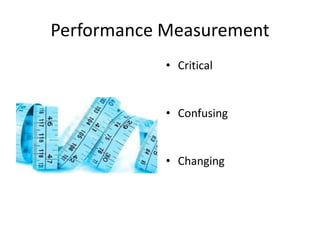
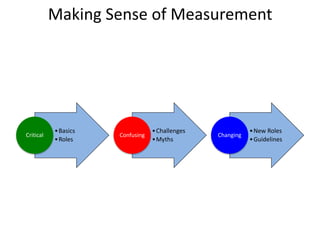
• Critical
• Confusing
• Changing
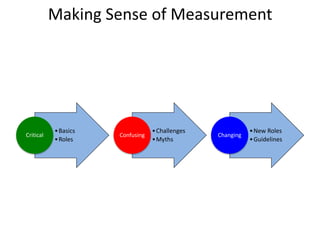
Making Sense of Measurement
•Basics
•Roles
Critical
•Challenges
•Myths
Confusing
•New Roles
•Guidelines
Changing
How well do you know performance
measurement?
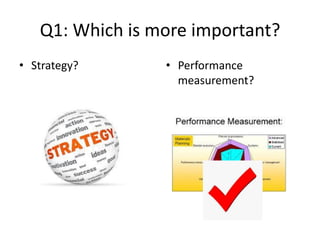
Q1: Which is more important?
• Strategy? • Performance
measurement?
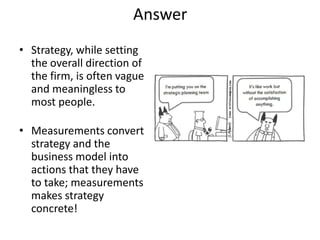
Answer
• Strategy, while setting
the overall direction of
the firm, is often vague
and meaningless to
most people.
• Measurements convert
strategy and the
business model into
actions that they have
to take; measurements
makes strategy
concrete!
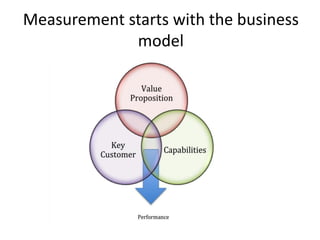
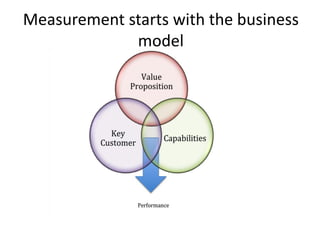
Measurement starts with the business
model
Value
The Flow
• Who is our key customer(s)?
• What is our value proposition?
• What does the customer value?
– Order qualifiers
– Order winners
– Order losers
• What is the Desired Outcome?
• These determine how frequency of measurement!
The Importance of Measurement
• One of the most powerful management disciplines, the
one that more than any other keeps people focused and
pulling in the same direction, is to make an
organization’s purposes tangible. Managers do this by
translating the organization’s mission – what it,
particularly, exists to do – into a set of goals and
performance measures that make success concrete for
everyone. This is the real bottom line for every
organization – whether it’s a business or a school or a
hospital. Its executives must answer the question,
“Given our mission, how is our performance going to be
defined?”
– Magretta & Stone, Management. 2002, p. 129
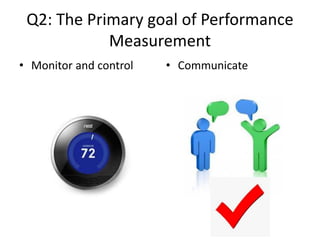
Q2: The Primary goal of Performance
Measurement
• Monitor and control • Communicate
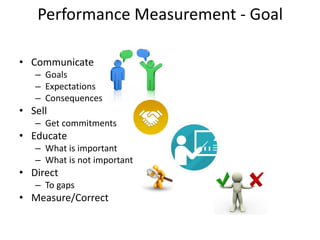
Performance Measurement - Goal
• Communicate
– Goals
– Expectations
– Consequences
• Sell
– Get commitments
• Educate
– What is important
– What is not important
• Direct
– To gaps
• Measure/Correct
Q3: We should use the same measures
throughout the firm?
• True? • False?
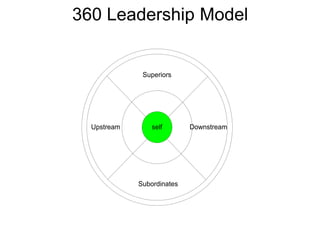
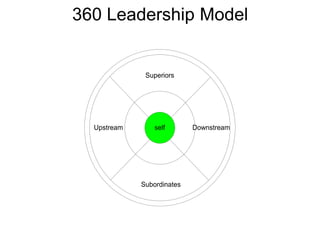
360 Leadership Model
self
Superiors
Subordinates
Upstream Downstream
How do we communicate?
• Top management
– Output measures (after the fact)
• Sales
• Market share
• Quality problems reported
– Why?
• Get their support
• Resources
• Time
How do we communicate?
• To our subordinates/suppliers
• Output measures are useless except as score
keeping.
• Need predictive or process measures
– Measures associated with the process
– Identifies process attributes that we should
manage to achieve the desired outcome(s)!
Process Measures Example
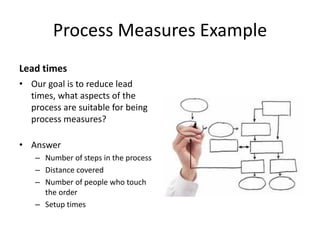
Lead times
• Our goal is to reduce lead
times, what aspects of the
process are suitable for being
process measures?
• Answer
– Number of steps in the process
– Distance covered
– Number of people who touch
the order
– Setup times
360 Leadership Model
self
Superiors
Subordinates
Upstream Downstream
Q4: Measures and metrics mean the
same thing?
• True? • False?
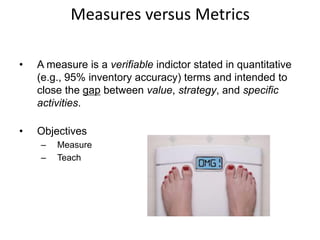
Measures versus Metrics
• A measure is a verifiable indictor stated in quantitative
(e.g., 95% inventory accuracy) terms and intended to
close the gap between value, strategy, and specific
activities.
• Objectives
– Measure
– Teach
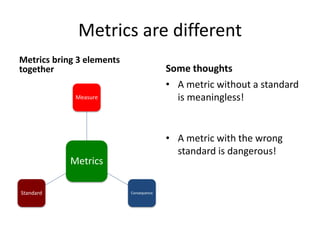
Metrics are different
Metrics bring 3 elements
together
Metrics
Measure
ConsequenceStandard
Some thoughts
• A metric without a standard
is meaningless!
• A metric with the wrong
standard is dangerous!
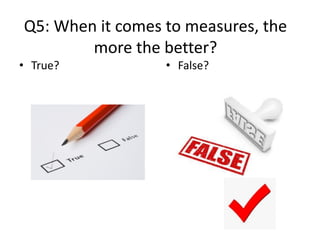
Q5: When it comes to measures, the
more the better?
• True? • False?
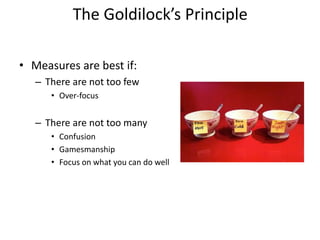
The Goldilock’s Principle
• Measures are best if:
– There are not too few
• Over-focus
– There are not too many
• Confusion
• Gamesmanship
• Focus on what you can do well
Then what is just right?
• For decision-makers:
– 5 +/- 2 has been found to be about right!
Implications
• If you want to introduce a new measure or metric
and you are at 7 something has to go!
• Measure what you need, not what you can.
• Avoid conflicts in measurement systems.
– The lesson of a cereal company
• Measures have life cycles.
• Beware bad data!
Q6: Measures are accurate indicators of
performance?
• True? • False?
Truth of Measures
• Measures are often imperfect proxies for
performance and desired outcomes.
• Just because the numbers look right, don’t
assume that the desired changes are taking place.
– A pharma story
– A company tries to change its strategy from lean to
innovation.
• Measures are subject to the telephone game
effect.
Q7: Measurement problems indicate
problems in performance?
• True? • False?
It depends!
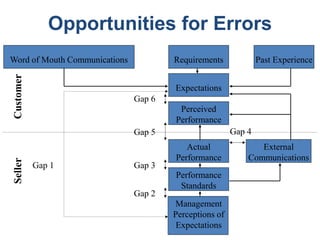
Word of Mouth Communications Requirements Past Experience
Expectations
Perceived
Performance
Actual
Performance
Performance
Standards
Management
Perceptions of
Expectations
External
Communications
Gap 2
Gap 3
Gap 5 Gap 4
Gap 6
CustomerSeller
Gap 1
Opportunities for Errors
The Advent of Forwardcasting!
• If you focus on the past, then the measures
ultimately become punitive!
– The past is done, move on!
• New approach
– Measures describe future goals
– Periodically, we compare actual progress with desired
progress
• If on track, keep going
• If off track, why? What can be done to reorient activities to
achieve future goals.
Q9: Within the supply chain, measures
should be aligned?
• True? • False?
Through Whose Eyes Do We See
the World
Through our own! Through our customers’
Measurement starts with the business
model
Value
Making Sense of Measurement
•Basics
•Roles
Critical
•Challenges
•Myths
Confusing
•New Roles
•Guidelines
Changing
Final Comments
Concluding Comments
Final Comments
Comments
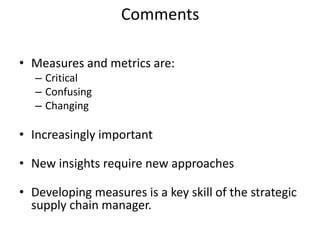
• Measures and metrics are:
– Critical
– Confusing
– Changing
• Increasingly important
• New insights require new approaches
• Developing measures is a key skill of the strategic
supply chain manager.
The Three Laws of Metrics
• Management has a desired to
measure quantitatively everything.
• Every metric will generate under
desired or unexpected
behavior/results.
• There should be balance
– Long term vs. short term
– Making money now vs. investing in the
future
– Outcomes vs. processes.
Questions

Supply chain performance measurement trends

  • 1.
  • 2.
    Steven A. Melnyk •Professor of Operations & Supply Chain Management Department of Supply Chain Management Eli Broad Graduate School of Business Michigan State University East Lansing, MI 48824-1122 USA • +15174326410 • melnyk@msu.edu
  • 3.
  • 4.
  • 5.
    Making Sense ofMeasurement •Basics •Roles Critical •Challenges •Myths Confusing •New Roles •Guidelines Changing
  • 6.
    How well doyou know performance measurement?
  • 7.
    Q1: Which ismore important? • Strategy? • Performance measurement?
  • 8.
    Answer • Strategy, whilesetting the overall direction of the firm, is often vague and meaningless to most people. • Measurements convert strategy and the business model into actions that they have to take; measurements makes strategy concrete!
  • 9.
    Measurement starts withthe business model Value
  • 10.
    The Flow • Whois our key customer(s)? • What is our value proposition? • What does the customer value? – Order qualifiers – Order winners – Order losers • What is the Desired Outcome? • These determine how frequency of measurement!
  • 11.
    The Importance ofMeasurement • One of the most powerful management disciplines, the one that more than any other keeps people focused and pulling in the same direction, is to make an organization’s purposes tangible. Managers do this by translating the organization’s mission – what it, particularly, exists to do – into a set of goals and performance measures that make success concrete for everyone. This is the real bottom line for every organization – whether it’s a business or a school or a hospital. Its executives must answer the question, “Given our mission, how is our performance going to be defined?” – Magretta & Stone, Management. 2002, p. 129
  • 12.
    Q2: The Primarygoal of Performance Measurement • Monitor and control • Communicate
  • 13.
    Performance Measurement -Goal • Communicate – Goals – Expectations – Consequences • Sell – Get commitments • Educate – What is important – What is not important • Direct – To gaps • Measure/Correct
  • 14.
    Q3: We shoulduse the same measures throughout the firm? • True? • False?
  • 15.
  • 16.
    How do wecommunicate? • Top management – Output measures (after the fact) • Sales • Market share • Quality problems reported – Why? • Get their support • Resources • Time
  • 17.
    How do wecommunicate? • To our subordinates/suppliers • Output measures are useless except as score keeping. • Need predictive or process measures – Measures associated with the process – Identifies process attributes that we should manage to achieve the desired outcome(s)!
  • 18.
    Process Measures Example Leadtimes • Our goal is to reduce lead times, what aspects of the process are suitable for being process measures? • Answer – Number of steps in the process – Distance covered – Number of people who touch the order – Setup times
  • 19.
  • 20.
    Q4: Measures andmetrics mean the same thing? • True? • False?
  • 21.
    Measures versus Metrics •A measure is a verifiable indictor stated in quantitative (e.g., 95% inventory accuracy) terms and intended to close the gap between value, strategy, and specific activities. • Objectives – Measure – Teach
  • 22.
    Metrics are different Metricsbring 3 elements together Metrics Measure ConsequenceStandard Some thoughts • A metric without a standard is meaningless! • A metric with the wrong standard is dangerous!
  • 23.
    Q5: When itcomes to measures, the more the better? • True? • False?
  • 24.
    The Goldilock’s Principle •Measures are best if: – There are not too few • Over-focus – There are not too many • Confusion • Gamesmanship • Focus on what you can do well
  • 25.
    Then what isjust right? • For decision-makers: – 5 +/- 2 has been found to be about right!
  • 26.
    Implications • If youwant to introduce a new measure or metric and you are at 7 something has to go! • Measure what you need, not what you can. • Avoid conflicts in measurement systems. – The lesson of a cereal company • Measures have life cycles. • Beware bad data!
  • 27.
    Q6: Measures areaccurate indicators of performance? • True? • False?
  • 28.
    Truth of Measures •Measures are often imperfect proxies for performance and desired outcomes. • Just because the numbers look right, don’t assume that the desired changes are taking place. – A pharma story – A company tries to change its strategy from lean to innovation. • Measures are subject to the telephone game effect.
  • 30.
    Q7: Measurement problemsindicate problems in performance? • True? • False? It depends!
  • 31.
    Word of MouthCommunications Requirements Past Experience Expectations Perceived Performance Actual Performance Performance Standards Management Perceptions of Expectations External Communications Gap 2 Gap 3 Gap 5 Gap 4 Gap 6 CustomerSeller Gap 1 Opportunities for Errors
  • 32.
    The Advent ofForwardcasting! • If you focus on the past, then the measures ultimately become punitive! – The past is done, move on! • New approach – Measures describe future goals – Periodically, we compare actual progress with desired progress • If on track, keep going • If off track, why? What can be done to reorient activities to achieve future goals.
  • 33.
    Q9: Within thesupply chain, measures should be aligned? • True? • False?
  • 34.
    Through Whose EyesDo We See the World Through our own! Through our customers’
  • 35.
    Measurement starts withthe business model Value
  • 36.
    Making Sense ofMeasurement •Basics •Roles Critical •Challenges •Myths Confusing •New Roles •Guidelines Changing
  • 37.
  • 38.
  • 39.
    Comments • Measures andmetrics are: – Critical – Confusing – Changing • Increasingly important • New insights require new approaches • Developing measures is a key skill of the strategic supply chain manager.
  • 40.
    The Three Lawsof Metrics • Management has a desired to measure quantitatively everything. • Every metric will generate under desired or unexpected behavior/results. • There should be balance – Long term vs. short term – Making money now vs. investing in the future – Outcomes vs. processes.
  • 41.