Third Party
Logistics
Presented by
Vikram Kumar
September 19, 2013
Definition
• “Third-party Logistics is simply the use of an
outside company to perform all or part of the
firm’s materials management and product
distribution function.”
-- Simchi-Levi (2000)
THIRD PARTY LOGISTICS is an industry to which a shipper
(owner of transported goods) outsources various elements of
the supply chain to perform some / all logistics management
functions including inbound freight, customs, warehousing,
order fulfillment, distribution and outbound freight.
•Initiated in 1980s when companies began looking for opportunities to
improver logistics performance.
•FedEx drew attention to 3PL service by offering JIT delivery
•FedEx success in 3PL marketplace opened it up to competition
•Initially primarily domestic coverage, 3PL industry is now global in
character with a revenues approaching $150 billion in NA
Third Party Logistics DefinedThird Party Logistics Defined
Cont..
• 3PLs are external suppliers that perform all or part
of a company’s logistics functions, including:
– Transportation
– Warehousing
– Distribution
– Financial services
• Terms contract logistics and outsourcing are
sometimes used in place of 3PL.
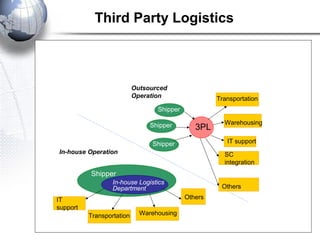
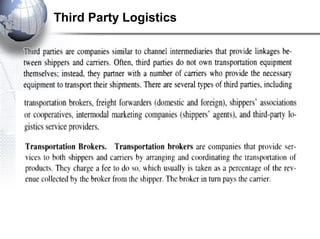
Third Party Logistics
In-house Logistics
Department
Shipper
Transportation
IT
support
Warehousing
Others
In-house Operation
Outsourced
Operation
3PL
Shipper
Shipper
Shipper
Transportation
Warehousing
IT support
SC
integration
Others
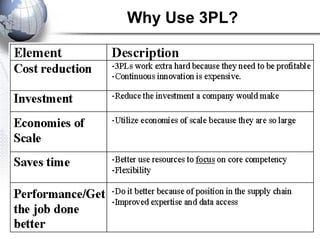
Why Use 3PL?
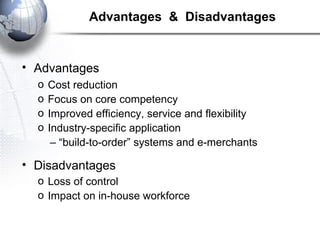
Advantages & Disadvantages
• Advantages
o Cost reduction
o Focus on core competency
o Improved efficiency, service and flexibility
o Industry-specific application
– “build-to-order” systems and e-merchants
• Disadvantages
o Loss of control
o Impact on in-house workforce
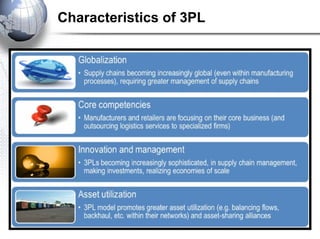
Characteristics of 3PL
Types of 3PL
• There are three types of third party logistics providers:
1. Asset Based – 3PL companies that use their own trucks,
warehouses and personnel to operate the client’s business
2. Management Based – 3PL companies that provide the technological
and managerial functions to operate the logistics functions of their
clients, but do so using the assets of other companies and do not
necessarily own any assets
3. Integrated Providers – 3PL companies that can either be asset
based or management based that supplement their services with
whatever services are needed by their clients
Third Party Logistics Provider
A firm which provides multiple logistics services for use
by customers.
These services are integrated or “bundled” together by
the provider.
These firms facilitate the movement of parts and
materials from suppliers to manufacturers and finished
products from manufacturers to distributors and retailers.
Among the services which they provide are
transportation, warehousing, cross-docking, inventory
management, packaging and freight forwarding.
Types of 3PL Provider
• Transportation-Based
• Warehouse/Distribution-Based
• Forwarder-Based
• Financial-Based
• Information-Based
Third Party Logistics
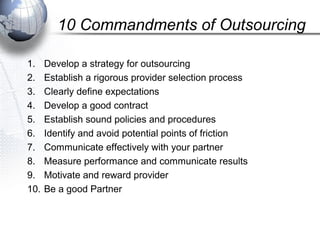
10 Commandments of Outsourcing
1. Develop a strategy for outsourcing
2. Establish a rigorous provider selection process
3. Clearly define expectations
4. Develop a good contract
5. Establish sound policies and procedures
6. Identify and avoid potential points of friction
7. Communicate effectively with your partner
8. Measure performance and communicate results
9. Motivate and reward provider
10. Be a good Partner
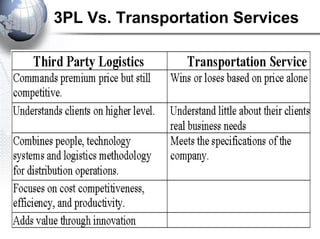
3PL Vs. Transportation Services
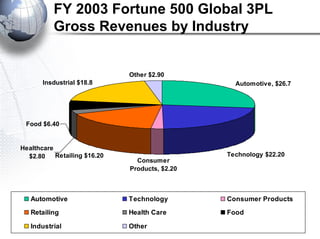
FY 2003 Fortune 500 Global 3PL
Gross Revenues by Industry
Consumer
Products, $2.20
Healthcare
$2.80
Food $6.40
Insdustrial $18.8
Other $2.90
Automotive, $26.7
Technology $22.20Retailing $16.20
Automotive Technology Consumer Products
Retailing Health Care Food
Industrial Other
Costs stated in Billion's of Dollars
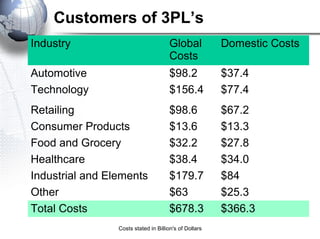
Customers of 3PL’s
Industry Global
Costs
Domestic Costs
Automotive $98.2 $37.4
Technology $156.4 $77.4
Retailing $98.6 $67.2
Consumer Products $13.6 $13.3
Food and Grocery $32.2 $27.8
Healthcare $38.4 $34.0
Industrial and Elements $179.7 $84
Other $63 $25.3
Total Costs $678.3 $366.3
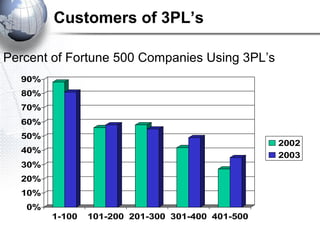
Customers of 3PL’s
Percent of Fortune 500 Companies Using 3PL’s
0%
10%
20%
30%
40%
50%
60%
70%
80%
90%
1-100 101-200 201-300 301-400 401-500
2002
2003
Need for Collaborative
Relationships
• Supply chain relationships are most
effective when collaboration occurs.
• Collaboration is facilitated by the ability of
the supply chain partners to readily access
and exchange information over the Internet.
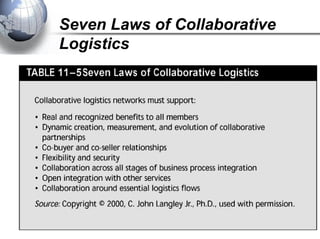
Seven Laws of Collaborative
Logistics
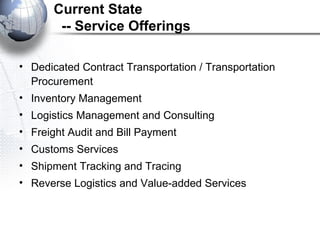
Current State
-- Service Offerings
• Dedicated Contract Transportation / Transportation
Procurement
• Inventory Management
• Logistics Management and Consulting
• Freight Audit and Bill Payment
• Customs Services
• Shipment Tracking and Tracing
• Reverse Logistics and Value-added Services
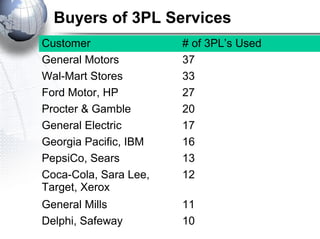
Buyers of 3PL Services
Customer # of 3PL’s Used
General Motors 37
Wal-Mart Stores 33
Ford Motor, HP 27
Procter & Gamble 20
General Electric 17
Georgia Pacific, IBM 16
PepsiCo, Sears 13
Coca-Cola, Sara Lee,
Target, Xerox
12
General Mills 11
Delphi, Safeway 10
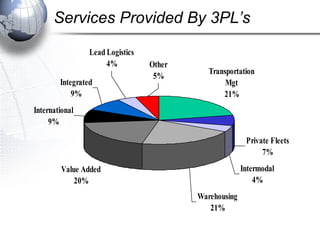
Services Provided By 3PL’s
Transportation
Mgt
21%
Private Fleets
7%
Intermodal
4%
Warehousing
21%
Value Added
20%
International
9%
Integrated
9%
Other
5%
Lead Logistics
4%
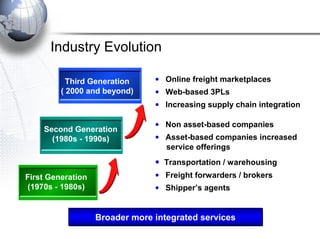
Industry Evolution
Third Generation
( 2000 and beyond)
First Generation
(1970s - 1980s)
Second Generation
(1980s - 1990s)
Broader more integrated services
• Transportation / warehousing
• Freight forwarders / brokers
• Shipper’s agents
• Non asset-based companies
• Asset-based companies increased
service offerings
• Online freight marketplaces
• Web-based 3PLs
• Increasing supply chain integration
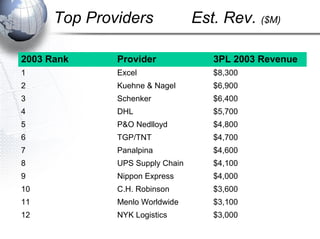
Top Providers Est. Rev. ($M)
2003 Rank Provider 3PL 2003 Revenue
1 Excel $8,300
2 Kuehne & Nagel $6,900
3 Schenker $6,400
4 DHL $5,700
5 P&O Nedlloyd $4,800
6 TGP/TNT $4,700
7 Panalpina $4,600
8 UPS Supply Chain $4,100
9 Nippon Express $4,000
10 C.H. Robinson $3,600
11 Menlo Worldwide $3,100
12 NYK Logistics $3,000
3rd party logistic

3rd party logistic

  • 1.
  • 2.
    Definition • “Third-party Logisticsis simply the use of an outside company to perform all or part of the firm’s materials management and product distribution function.” -- Simchi-Levi (2000)
  • 3.
    THIRD PARTY LOGISTICSis an industry to which a shipper (owner of transported goods) outsources various elements of the supply chain to perform some / all logistics management functions including inbound freight, customs, warehousing, order fulfillment, distribution and outbound freight. •Initiated in 1980s when companies began looking for opportunities to improver logistics performance. •FedEx drew attention to 3PL service by offering JIT delivery •FedEx success in 3PL marketplace opened it up to competition •Initially primarily domestic coverage, 3PL industry is now global in character with a revenues approaching $150 billion in NA Third Party Logistics DefinedThird Party Logistics Defined

  • 4.
    Cont.. • 3PLs areexternal suppliers that perform all or part of a company’s logistics functions, including: – Transportation – Warehousing – Distribution – Financial services • Terms contract logistics and outsourcing are sometimes used in place of 3PL.
  • 5.
    Third Party Logistics In-houseLogistics Department Shipper Transportation IT support Warehousing Others In-house Operation Outsourced Operation 3PL Shipper Shipper Shipper Transportation Warehousing IT support SC integration Others
  • 6.
  • 7.
    Advantages & Disadvantages •Advantages o Cost reduction o Focus on core competency o Improved efficiency, service and flexibility o Industry-specific application – “build-to-order” systems and e-merchants • Disadvantages o Loss of control o Impact on in-house workforce
  • 8.
  • 9.
    Types of 3PL •There are three types of third party logistics providers: 1. Asset Based – 3PL companies that use their own trucks, warehouses and personnel to operate the client’s business 2. Management Based – 3PL companies that provide the technological and managerial functions to operate the logistics functions of their clients, but do so using the assets of other companies and do not necessarily own any assets 3. Integrated Providers – 3PL companies that can either be asset based or management based that supplement their services with whatever services are needed by their clients
  • 10.
    Third Party LogisticsProvider A firm which provides multiple logistics services for use by customers. These services are integrated or “bundled” together by the provider. These firms facilitate the movement of parts and materials from suppliers to manufacturers and finished products from manufacturers to distributors and retailers. Among the services which they provide are transportation, warehousing, cross-docking, inventory management, packaging and freight forwarding.
  • 11.
    Types of 3PLProvider • Transportation-Based • Warehouse/Distribution-Based • Forwarder-Based • Financial-Based • Information-Based
  • 12.
  • 15.
    10 Commandments ofOutsourcing 1. Develop a strategy for outsourcing 2. Establish a rigorous provider selection process 3. Clearly define expectations 4. Develop a good contract 5. Establish sound policies and procedures 6. Identify and avoid potential points of friction 7. Communicate effectively with your partner 8. Measure performance and communicate results 9. Motivate and reward provider 10. Be a good Partner
  • 16.
  • 17.
    FY 2003 Fortune500 Global 3PL Gross Revenues by Industry Consumer Products, $2.20 Healthcare $2.80 Food $6.40 Insdustrial $18.8 Other $2.90 Automotive, $26.7 Technology $22.20Retailing $16.20 Automotive Technology Consumer Products Retailing Health Care Food Industrial Other
  • 18.
    Costs stated inBillion's of Dollars Customers of 3PL’s Industry Global Costs Domestic Costs Automotive $98.2 $37.4 Technology $156.4 $77.4 Retailing $98.6 $67.2 Consumer Products $13.6 $13.3 Food and Grocery $32.2 $27.8 Healthcare $38.4 $34.0 Industrial and Elements $179.7 $84 Other $63 $25.3 Total Costs $678.3 $366.3
  • 19.
    Customers of 3PL’s Percentof Fortune 500 Companies Using 3PL’s 0% 10% 20% 30% 40% 50% 60% 70% 80% 90% 1-100 101-200 201-300 301-400 401-500 2002 2003
  • 20.
    Need for Collaborative Relationships •Supply chain relationships are most effective when collaboration occurs. • Collaboration is facilitated by the ability of the supply chain partners to readily access and exchange information over the Internet.
  • 21.
    Seven Laws ofCollaborative Logistics
  • 22.
    Current State -- ServiceOfferings • Dedicated Contract Transportation / Transportation Procurement • Inventory Management • Logistics Management and Consulting • Freight Audit and Bill Payment • Customs Services • Shipment Tracking and Tracing • Reverse Logistics and Value-added Services
  • 23.
    Buyers of 3PLServices Customer # of 3PL’s Used General Motors 37 Wal-Mart Stores 33 Ford Motor, HP 27 Procter & Gamble 20 General Electric 17 Georgia Pacific, IBM 16 PepsiCo, Sears 13 Coca-Cola, Sara Lee, Target, Xerox 12 General Mills 11 Delphi, Safeway 10
  • 24.
    Services Provided By3PL’s Transportation Mgt 21% Private Fleets 7% Intermodal 4% Warehousing 21% Value Added 20% International 9% Integrated 9% Other 5% Lead Logistics 4%
  • 25.
    Industry Evolution Third Generation (2000 and beyond) First Generation (1970s - 1980s) Second Generation (1980s - 1990s) Broader more integrated services • Transportation / warehousing • Freight forwarders / brokers • Shipper’s agents • Non asset-based companies • Asset-based companies increased service offerings • Online freight marketplaces • Web-based 3PLs • Increasing supply chain integration
  • 26.
    Top Providers Est.Rev. ($M) 2003 Rank Provider 3PL 2003 Revenue 1 Excel $8,300 2 Kuehne & Nagel $6,900 3 Schenker $6,400 4 DHL $5,700 5 P&O Nedlloyd $4,800 6 TGP/TNT $4,700 7 Panalpina $4,600 8 UPS Supply Chain $4,100 9 Nippon Express $4,000 10 C.H. Robinson $3,600 11 Menlo Worldwide $3,100 12 NYK Logistics $3,000

Editor's Notes

  • #25 Many 3PL’s grow from a single discipline, but the buyers want turn key, multi functional capabilities. It is no longer valuable to simply manage the truck linehaul. 3PL’s are supply chain managers who move and monitor goods from Asia to Alpheretta, GA, managing cost, service and information, every step of the way.
  • #27 Source Armstrong and Associates This list of 10 ten providers is interesting in that Ryder may be the largest but their revenues are not from trucking alone. Excel is dominent in the warehouse and value added area, but they must also package the movement of goods from start to finish. While UPS may be the largest carrier in the shipping business, they are not the largest 3PL