
Dr S G Deshmukh
ABV-Indian Institute of Information Technology & Management
www.iiitm.ac.in
Trends of Research in Operations
Management :
A case of SCM
Presentation @FDP @iiitm Gwl
On 27 July 2012
The business function responsible for planning,
coordinating, and controlling the resources
needed to produce products and services for a
company
Source: Operations Management. Dan Reid & Nada R. Sanders, Wiley,
2010, 4th Edition
2
Operations Management
• A management function
• An organization’s core function
• In every organization whether Service or
Manufacturing, profit or Not for profit
SUPPLY CHAIN MANAGEMENT – an important
domain within OM !
3
Operations Management
• Opening remarks
• Track 1: Performance Measurement System
• Track 2: Revenue Sharing
• Track 3: Information security issues
• Track 4 :Service Oriented Architecture
• Closing remarks
Speaking points..
• Manufacturing as Services
Opening Remarks..
• Source:
• Cuthbertson R and Piotrowicz, 2011,
Performance measurement systems in Supply
chains: A framework fro contextual analysis,
Int J of Productivity & Performance
Measurement , 60(6),583-602
Research Track 1: Performance
Measurement System
• As early as 1985 A T Kearney Consultants have
identified a high correlation between superior
performance & development /use of
sophisticated assessment/measurement
capabilities
– Firms engaging such systems reported realized
improvements in productivity of 14 to 22 %
Performance Measurement
System
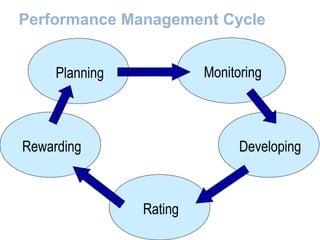
What Is Performance Management?
 It is a systematic process of
 Planning work and setting expectations
 Continually monitoring performance
 Developing the capacity to perform
 Periodically rating performance in a summary
fashion
 Rewarding good performance
Performance Management Cycle
Planning
Rewarding
Rating
Developing
Monitoring
• How well the organization is doing?
• Is the organization meeting its goals?
• Are the customers happy?
• Are the processes in control?
• If and where improvements are
necessary?
Issues in performance
measurement system
• Measuring the activity (volume) and the SC
performance
• Setting goals and comparing the actual situation
• Following a plan
• Determining the levers that will help achieve
goals and single out the priority action programs
• Revealing the degree of flexibility
Objectives of Metrics
Speed, reliability , and simplicity are the main
criteria for efficient metrics
• Arranging indicators by priority
• Segmenting the metrics
• Visualizing the function content
• Classifying objectives of the function or team
• Selecting indicators that deal with quality
• Formatting the metrics effectively
Principles of metrics design
• Independence
• Appropriateness
• Objectivity
• Regularity
• Linkage with other
indicators
• Coherence
• Simplicity
• Cumulative
• Realistic
Characteristics of Effective Metrics
• Transparent
• Simple
• self-regulating
• Objective
• Motivating and stimulating to all
stakeholders
Performance measurement system (PMS):
Desirable Features
• PMS should have multiple criteria
• Primary purpose should not be to reward or to punish
• Performance-to-schedule measures must use group, not
individual results
• Specific goals must be established and reviewed
• PM must be understood by those whose performance is
being measured.
• PM data must be available for constant review
Performance measurement system (PMS):
Desirable Features (contd.)
• Measurements of multiple performance factors
occur frequently at each stage in the supply chain
• Time and cost are key measures, but others are used
as appropriate to the specific supply chain.
• All measures must relate to the ultimate supply
chain goals.
Quantitatively based performance
management
• Cost { total cost, cost/unit, cost/sales, inbound freight,
outbound freight, warehouse cost, admn, processing, direct
labor etc.}
• Customer service {fill rate, stock-outs, shipping errors, on-
time delivery, back-orders, cycle time, customer feedback}
• Productivity {units shipped/employee, units/labour Rs.,
orders per sales person, etc.}
• Asset Measurement {Inventory turns, Inv. Carry costs,
obsolete Inv., ROI etc.}
• Quality {frequency of damage, Rs of damage, Customer
returns, Cost of returned goods etc.}
Internal Performance Measurement
• Customer Perception Measurement
• Best Practices benchmarking
– World Class Logistic- CLM
– Logistics Excellence - Michigan State University
External Performance Measurement
• Framework 1: Function based measurement system
• Framework 2: Dimensions based measurement
system
• Framework 3: Hierarchical measurement system
• Framework 4: Balanced scorecard system
• Framework 5:SCOR model
Various frameworks for measurement
• Covers detailed performance measures
applicable at different linkages of SC
– Marketing, Operations, Finance etc.
Framework 1: Function based measurement system
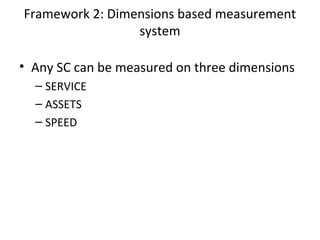
• Any SC can be measured on three dimensions
– SERVICE
– ASSETS
– SPEED
Framework 2: Dimensions based measurement
system
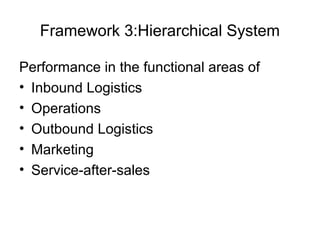
Performance in the functional areas of
• Inbound Logistics
• Operations
• Outbound Logistics
• Marketing
• Service-after-sales
Framework 3:Hierarchical System
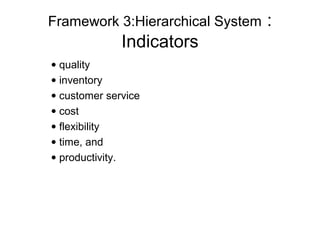
• quality
• inventory
• customer service
• cost
• flexibility
• time, and
• productivity.
Framework 3:Hierarchical System :
Indicators
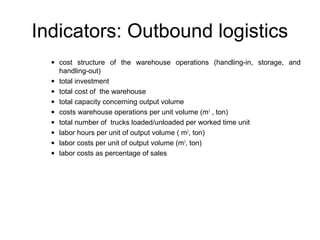
• cost structure of the warehouse operations (handling-in, storage, and
handling-out)
• total investment
• total cost of the warehouse
• total capacity concerning output volume
• costs warehouse operations per unit volume (m3
, ton)
• total number of trucks loaded/unloaded per worked time unit
• labor hours per unit of output volume ( m3
, ton)
• labor costs per unit of output volume (m3
, ton)
• labor costs as percentage of sales
Indicators: Outbound logistics
• Compare each of the metrics and compute the relative weightage
for each
• Compare each of the links (inbound logistics, manufacturing etc.)
on each of the metrics above and compare relative weightages .
• Compute the aggregate weight for the links.
• Rank the links on the basis of weights arrived
• Devise an action plan to improve the performance of
weakest/weaker links in the supply chain.
• Monitor the performance and repeat steps above on a continual
basis.
Hierarchical System :Procedure
• Various perspectives such as the following
should be Balanced!
– Financial
– Innovation & learning
– Customer service
– Internal business
Balance scorecard balances and links financial and non-
financial indicators, tangible and intangible measures,
internal and external aspects, performance drivers and
outcomes.
Framework 4: Balanced scorecard
The Supply-Chain Council (SCC) has developed and
endorsed the Supply Chain Operations Reference-
model (SCOR) as the cross-industry standard for
supply chain management
The SCC was organized in 1996 by 69 voluntary
member companies and the European Chapter was
started in 1998.
www.supply-chain.orgwww.supply-chain.org
Framework 5:SCOR model
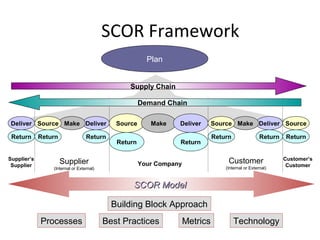
Plan
DeliverMakeSource DeliverMakeSourceDeliver Source
Supplier
(Internal or External)
Your Company Customer
(Internal or External)
ReturnReturnReturn
Customer’s
Customer
Supplier’s
Supplier
Source Make Deliver
Return
Return Return
Return
Return
SCOR ModelSCOR Model
Processes Best Practices Metrics Technology
Building Block Approach
SCOR Framework
Demand Chain
Supply Chain
• Performance measurement system and its linkages
with strategy ?
• Behavioral issues related to performance
measurement system?
• Development of Multi-criteria decision making
framework ?
• Role of information system in measurement?
• Benchmarking and performance measurement
system?
Performance Measurement:
Research Issues ..1..
• What to benchmark and how?
• Industry/sector specific measures?
• Revenue /Profit/Cost sharing ?
Performance Measurement:
Research Issues ..2..
• Source:
Arshinder, Kanda Arun and Deshmukh, S G,2008,
Supply Chain Coordination: Perspectives,
Empirical Studies and Research Directions,
International J of Production Economics,
115(2), 316-335
Track 2: Revenue Sharing Contracts
• It increases the total supply chain profits
• It involves in risk sharing among supply chain
partners
• It may be possible with supply chain contracts
that a member achieves more profits than he
would do without contracts
• Hence, result in win-win situation for both
supplier and his buyer
Objective of Supply Chain Contracts
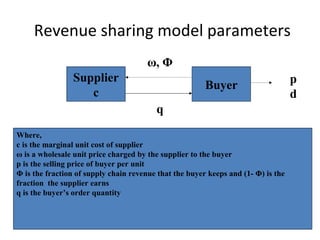
Revenue sharing model parameters
Supplier
c
Buyer
q
ω, Φ
p
d
Where,
c is the marginal unit cost of supplier
ω is a wholesale unit price charged by the supplier to the buyer
p is the selling price of buyer per unit
Φ is the fraction of supply chain revenue that the buyer keeps and (1- Φ) is the
fraction the supplier earns
q is the buyer’s order quantity
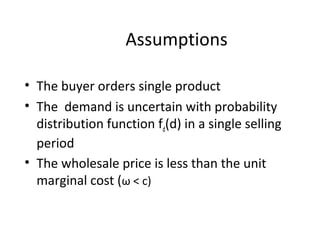
• The buyer orders single product
• The demand is uncertain with probability
distribution function fd(d) in a single selling
period
• The wholesale price is less than the unit
marginal cost (ω < c)
Assumptions
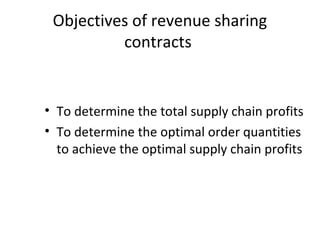
• To determine the total supply chain profits
• To determine the optimal order quantities
to achieve the optimal supply chain profits
Objectives of revenue sharing
contracts
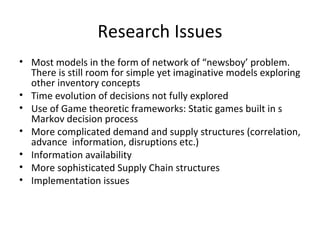
• Most models in the form of network of “newsboy’ problem.
There is still room for simple yet imaginative models exploring
other inventory concepts
• Time evolution of decisions not fully explored
• Use of Game theoretic frameworks: Static games built in s
Markov decision process
• More complicated demand and supply structures (correlation,
advance information, disruptions etc.)
• Information availability
• More sophisticated Supply Chain structures
• Implementation issues
Research Issues
• Source:
• Arup Roy, 2012, Management of Information
Security in Supply Chains- A Process
Framework, Presented at 42nd
Intentional Con.
On Computers in Industrial Engg, Cape town, S
Africa, July 16-18
Track 3: Management of Information
Security in Supply Chains
What is Information Security?
Information
“Information is an asset that, like other
important business assets, is essential to
an organization's business and
consequently needs to be suitably
protected”
Information Security
“Preservation of confidentiality, integrity and
availability of information”
(Reference: ISO 27000)
Security in Supply Chains
“The application of policies, procedures, and technology to protect supply chain
assets (product, facilities, equipment, information, and personnel) from theft,
damage, or terrorism and to prevent the introduction of unauthorized contraband,
people or weapons of mass destruction into the supply chain”.
– Closs & McGarrell (2004)
There are 2 aspects:
• Soft aspect – Intangible vulnerabilities such as information theft
• Hard aspect – Tangible vulnerabilities such as physical theft /
physical damages / terrorism
Information Security – one of the soft aspects
Hard aspects influence the soft aspects
Why do we need Information
Security?
• Measure and mitigate risk related to information assets.
Key motivator –
• Management of business and financial risk
• Reduction of threat to both reputation and customers
.
• Ensure compliance to regulatory/ legislative/ contractual
requirements.
Summary of concerns
• Information leakage & misappropriation in supply chain networks, which can
lead to:
• Demand imperative overriding information imperative
• Product & service deliveries may not be optimal
• Firms may lose their competitive edge
• Vulnerabilities in IT infrastructure may not be adequately controlled
• Information reliability and consequently knowledge generation may be
compromised
• Human security requirements may be overlooked
What is a Process Framework?
• Formal description of processes in a company
• Formally existing / ad-hoc / need to be developed
• KPIs defined to “measure” the process, with industry benchmarks
• Improvements based on the KPI s achieved
• Methodologies – used to actually improve the process
Why do we need a Process
Framework?
To enable organizations develop and maintain
consistent business practices
• Helps in managing a company's key
processes and roles & responsibilities
• Aligns processes and performance
improvement with corporate strategy
• Can be implemented at any level of an
organization
Research Propositions
• Identify weaknesses related to information
security in supply chain processes
• Analyze information security related risks
• Study relationship between supply chain
performance metrics and information security
• Source:
Giannakis M, 2011, Management of service
supply chains with service-oriented reference :
A case of management consulting, Supply
Chain Management: An international Journal,
16(5), 346-361
Track 4: Service Oriented Architecture
 Integration
◦ Providing the linkage between people, processes, and data
 Open
◦ Supporting a strong commitment to standards for OS, Language and Web
Services/SOA
 Virtualized
◦ Providing a flexible Build-time and Runtime environment for developing and
running applications across a highly distributed IT architecture
 Autonomic
◦ Self regulating … self healing … self maintaining
46
Four Characteristics of On Demand
47
SOA: Service Oriented Architecture
• An approach for building distributed systems that allows tight
correlation between the business model and the IT implementation.
• Characteristics:
◦ Represents business function as a service
◦ Shifts focus to application assembly rather than implementation
details
◦ Allows individual software assets to become building blocks that
can be reused in developing composite applications representing
business processes
◦ Leverages open standards to represent software assets
What is a service?
 A coarse grained, self-contained entity that performs a distinct business
function
What is a service description?
 A standards based interface definition that is independent of the
underlying implementation
How do services interact?
 Through loosely-coupled, intermediated connections
How are SOA solutions created and enhanced?
Using tools and middleware according to SOA principles
48
SOA Concepts
 Build –Model Driven Architecture
◦ A style of enterprise application development and integration based on
using automated tools to build system independent models and
transform them into efficient implementations1
 Run –Service Oriented Architecture
◦ An approach for designing and implementing distributed systems that
allows a tight correlation between the business model and the IT
implementation
 Manage –Business Performance Management
◦ An approach to systems management that tightly links IT concerns with
business process concerns
49
Three Key Concepts for the
Foundation for On Demand
• How to define service standards?
• What is the role of technology in SOA?
• How to align business strategy with SOA?
• Issues related to flexibility ?
Research Issues
• Supply chain management: an opportunity for
seamless integration
• Research issues involving a variety of
domains : performance measurement,
modeling, security, on-demand business
• Borrowing terminology & frameworks from
IT !
• Research : interdisciplinary !
Concluding remarks..
• www.researchgate.net
• http://www.emeraldinsight.com/research/index.h
• http://www.emeraldinsight.com/research/connec
Useful web linkages
Thank you
deshmukh.sg@gmail.com
53

Trends in-om-scm-27-july-2012-2

  • 1.
    Dr S GDeshmukh ABV-Indian Institute of Information Technology & Management www.iiitm.ac.in Trends of Research in Operations Management : A case of SCM Presentation @FDP @iiitm Gwl On 27 July 2012
  • 2.
    The business functionresponsible for planning, coordinating, and controlling the resources needed to produce products and services for a company Source: Operations Management. Dan Reid & Nada R. Sanders, Wiley, 2010, 4th Edition 2 Operations Management
  • 3.
    • A managementfunction • An organization’s core function • In every organization whether Service or Manufacturing, profit or Not for profit SUPPLY CHAIN MANAGEMENT – an important domain within OM ! 3 Operations Management
  • 4.
    • Opening remarks •Track 1: Performance Measurement System • Track 2: Revenue Sharing • Track 3: Information security issues • Track 4 :Service Oriented Architecture • Closing remarks Speaking points..
  • 5.
    • Manufacturing asServices Opening Remarks..
  • 6.
    • Source: • CuthbertsonR and Piotrowicz, 2011, Performance measurement systems in Supply chains: A framework fro contextual analysis, Int J of Productivity & Performance Measurement , 60(6),583-602 Research Track 1: Performance Measurement System
  • 7.
    • As earlyas 1985 A T Kearney Consultants have identified a high correlation between superior performance & development /use of sophisticated assessment/measurement capabilities – Firms engaging such systems reported realized improvements in productivity of 14 to 22 % Performance Measurement System
  • 8.
    What Is PerformanceManagement?  It is a systematic process of  Planning work and setting expectations  Continually monitoring performance  Developing the capacity to perform  Periodically rating performance in a summary fashion  Rewarding good performance
  • 9.
  • 10.
    • How wellthe organization is doing? • Is the organization meeting its goals? • Are the customers happy? • Are the processes in control? • If and where improvements are necessary? Issues in performance measurement system
  • 11.
    • Measuring theactivity (volume) and the SC performance • Setting goals and comparing the actual situation • Following a plan • Determining the levers that will help achieve goals and single out the priority action programs • Revealing the degree of flexibility Objectives of Metrics
  • 12.
    Speed, reliability ,and simplicity are the main criteria for efficient metrics • Arranging indicators by priority • Segmenting the metrics • Visualizing the function content • Classifying objectives of the function or team • Selecting indicators that deal with quality • Formatting the metrics effectively Principles of metrics design
  • 13.
    • Independence • Appropriateness •Objectivity • Regularity • Linkage with other indicators • Coherence • Simplicity • Cumulative • Realistic Characteristics of Effective Metrics
  • 14.
    • Transparent • Simple •self-regulating • Objective • Motivating and stimulating to all stakeholders Performance measurement system (PMS): Desirable Features
  • 15.
    • PMS shouldhave multiple criteria • Primary purpose should not be to reward or to punish • Performance-to-schedule measures must use group, not individual results • Specific goals must be established and reviewed • PM must be understood by those whose performance is being measured. • PM data must be available for constant review Performance measurement system (PMS): Desirable Features (contd.)
  • 16.
    • Measurements ofmultiple performance factors occur frequently at each stage in the supply chain • Time and cost are key measures, but others are used as appropriate to the specific supply chain. • All measures must relate to the ultimate supply chain goals. Quantitatively based performance management
  • 17.
    • Cost {total cost, cost/unit, cost/sales, inbound freight, outbound freight, warehouse cost, admn, processing, direct labor etc.} • Customer service {fill rate, stock-outs, shipping errors, on- time delivery, back-orders, cycle time, customer feedback} • Productivity {units shipped/employee, units/labour Rs., orders per sales person, etc.} • Asset Measurement {Inventory turns, Inv. Carry costs, obsolete Inv., ROI etc.} • Quality {frequency of damage, Rs of damage, Customer returns, Cost of returned goods etc.} Internal Performance Measurement
  • 18.
    • Customer PerceptionMeasurement • Best Practices benchmarking – World Class Logistic- CLM – Logistics Excellence - Michigan State University External Performance Measurement
  • 19.
    • Framework 1:Function based measurement system • Framework 2: Dimensions based measurement system • Framework 3: Hierarchical measurement system • Framework 4: Balanced scorecard system • Framework 5:SCOR model Various frameworks for measurement
  • 20.
    • Covers detailedperformance measures applicable at different linkages of SC – Marketing, Operations, Finance etc. Framework 1: Function based measurement system
  • 21.
    • Any SCcan be measured on three dimensions – SERVICE – ASSETS – SPEED Framework 2: Dimensions based measurement system
  • 22.
    Performance in thefunctional areas of • Inbound Logistics • Operations • Outbound Logistics • Marketing • Service-after-sales Framework 3:Hierarchical System
  • 23.
    • quality • inventory •customer service • cost • flexibility • time, and • productivity. Framework 3:Hierarchical System : Indicators
  • 24.
    • cost structureof the warehouse operations (handling-in, storage, and handling-out) • total investment • total cost of the warehouse • total capacity concerning output volume • costs warehouse operations per unit volume (m3 , ton) • total number of trucks loaded/unloaded per worked time unit • labor hours per unit of output volume ( m3 , ton) • labor costs per unit of output volume (m3 , ton) • labor costs as percentage of sales Indicators: Outbound logistics
  • 25.
    • Compare eachof the metrics and compute the relative weightage for each • Compare each of the links (inbound logistics, manufacturing etc.) on each of the metrics above and compare relative weightages . • Compute the aggregate weight for the links. • Rank the links on the basis of weights arrived • Devise an action plan to improve the performance of weakest/weaker links in the supply chain. • Monitor the performance and repeat steps above on a continual basis. Hierarchical System :Procedure
  • 26.
    • Various perspectivessuch as the following should be Balanced! – Financial – Innovation & learning – Customer service – Internal business Balance scorecard balances and links financial and non- financial indicators, tangible and intangible measures, internal and external aspects, performance drivers and outcomes. Framework 4: Balanced scorecard
  • 27.
    The Supply-Chain Council(SCC) has developed and endorsed the Supply Chain Operations Reference- model (SCOR) as the cross-industry standard for supply chain management The SCC was organized in 1996 by 69 voluntary member companies and the European Chapter was started in 1998. www.supply-chain.orgwww.supply-chain.org Framework 5:SCOR model
  • 28.
    Plan DeliverMakeSource DeliverMakeSourceDeliver Source Supplier (Internalor External) Your Company Customer (Internal or External) ReturnReturnReturn Customer’s Customer Supplier’s Supplier Source Make Deliver Return Return Return Return Return SCOR ModelSCOR Model Processes Best Practices Metrics Technology Building Block Approach SCOR Framework Demand Chain Supply Chain
  • 29.
    • Performance measurementsystem and its linkages with strategy ? • Behavioral issues related to performance measurement system? • Development of Multi-criteria decision making framework ? • Role of information system in measurement? • Benchmarking and performance measurement system? Performance Measurement: Research Issues ..1..
  • 30.
    • What tobenchmark and how? • Industry/sector specific measures? • Revenue /Profit/Cost sharing ? Performance Measurement: Research Issues ..2..
  • 31.
    • Source: Arshinder, KandaArun and Deshmukh, S G,2008, Supply Chain Coordination: Perspectives, Empirical Studies and Research Directions, International J of Production Economics, 115(2), 316-335 Track 2: Revenue Sharing Contracts
  • 32.
    • It increasesthe total supply chain profits • It involves in risk sharing among supply chain partners • It may be possible with supply chain contracts that a member achieves more profits than he would do without contracts • Hence, result in win-win situation for both supplier and his buyer Objective of Supply Chain Contracts
  • 33.
    Revenue sharing modelparameters Supplier c Buyer q ω, Φ p d Where, c is the marginal unit cost of supplier ω is a wholesale unit price charged by the supplier to the buyer p is the selling price of buyer per unit Φ is the fraction of supply chain revenue that the buyer keeps and (1- Φ) is the fraction the supplier earns q is the buyer’s order quantity
  • 34.
    • The buyerorders single product • The demand is uncertain with probability distribution function fd(d) in a single selling period • The wholesale price is less than the unit marginal cost (ω < c) Assumptions
  • 35.
    • To determinethe total supply chain profits • To determine the optimal order quantities to achieve the optimal supply chain profits Objectives of revenue sharing contracts
  • 36.
    • Most modelsin the form of network of “newsboy’ problem. There is still room for simple yet imaginative models exploring other inventory concepts • Time evolution of decisions not fully explored • Use of Game theoretic frameworks: Static games built in s Markov decision process • More complicated demand and supply structures (correlation, advance information, disruptions etc.) • Information availability • More sophisticated Supply Chain structures • Implementation issues Research Issues
  • 37.
    • Source: • ArupRoy, 2012, Management of Information Security in Supply Chains- A Process Framework, Presented at 42nd Intentional Con. On Computers in Industrial Engg, Cape town, S Africa, July 16-18 Track 3: Management of Information Security in Supply Chains
  • 38.
    What is InformationSecurity? Information “Information is an asset that, like other important business assets, is essential to an organization's business and consequently needs to be suitably protected” Information Security “Preservation of confidentiality, integrity and availability of information” (Reference: ISO 27000)
  • 39.
    Security in SupplyChains “The application of policies, procedures, and technology to protect supply chain assets (product, facilities, equipment, information, and personnel) from theft, damage, or terrorism and to prevent the introduction of unauthorized contraband, people or weapons of mass destruction into the supply chain”. – Closs & McGarrell (2004) There are 2 aspects: • Soft aspect – Intangible vulnerabilities such as information theft • Hard aspect – Tangible vulnerabilities such as physical theft / physical damages / terrorism Information Security – one of the soft aspects Hard aspects influence the soft aspects
  • 40.
    Why do weneed Information Security? • Measure and mitigate risk related to information assets. Key motivator – • Management of business and financial risk • Reduction of threat to both reputation and customers . • Ensure compliance to regulatory/ legislative/ contractual requirements.
  • 41.
    Summary of concerns •Information leakage & misappropriation in supply chain networks, which can lead to: • Demand imperative overriding information imperative • Product & service deliveries may not be optimal • Firms may lose their competitive edge • Vulnerabilities in IT infrastructure may not be adequately controlled • Information reliability and consequently knowledge generation may be compromised • Human security requirements may be overlooked
  • 42.
    What is aProcess Framework? • Formal description of processes in a company • Formally existing / ad-hoc / need to be developed • KPIs defined to “measure” the process, with industry benchmarks • Improvements based on the KPI s achieved • Methodologies – used to actually improve the process
  • 43.
    Why do weneed a Process Framework? To enable organizations develop and maintain consistent business practices • Helps in managing a company's key processes and roles & responsibilities • Aligns processes and performance improvement with corporate strategy • Can be implemented at any level of an organization
  • 44.
    Research Propositions • Identifyweaknesses related to information security in supply chain processes • Analyze information security related risks • Study relationship between supply chain performance metrics and information security
  • 45.
    • Source: Giannakis M,2011, Management of service supply chains with service-oriented reference : A case of management consulting, Supply Chain Management: An international Journal, 16(5), 346-361 Track 4: Service Oriented Architecture
  • 46.
     Integration ◦ Providingthe linkage between people, processes, and data  Open ◦ Supporting a strong commitment to standards for OS, Language and Web Services/SOA  Virtualized ◦ Providing a flexible Build-time and Runtime environment for developing and running applications across a highly distributed IT architecture  Autonomic ◦ Self regulating … self healing … self maintaining 46 Four Characteristics of On Demand
  • 47.
    47 SOA: Service OrientedArchitecture • An approach for building distributed systems that allows tight correlation between the business model and the IT implementation. • Characteristics: ◦ Represents business function as a service ◦ Shifts focus to application assembly rather than implementation details ◦ Allows individual software assets to become building blocks that can be reused in developing composite applications representing business processes ◦ Leverages open standards to represent software assets
  • 48.
    What is aservice?  A coarse grained, self-contained entity that performs a distinct business function What is a service description?  A standards based interface definition that is independent of the underlying implementation How do services interact?  Through loosely-coupled, intermediated connections How are SOA solutions created and enhanced? Using tools and middleware according to SOA principles 48 SOA Concepts
  • 49.
     Build –ModelDriven Architecture ◦ A style of enterprise application development and integration based on using automated tools to build system independent models and transform them into efficient implementations1  Run –Service Oriented Architecture ◦ An approach for designing and implementing distributed systems that allows a tight correlation between the business model and the IT implementation  Manage –Business Performance Management ◦ An approach to systems management that tightly links IT concerns with business process concerns 49 Three Key Concepts for the Foundation for On Demand
  • 50.
    • How todefine service standards? • What is the role of technology in SOA? • How to align business strategy with SOA? • Issues related to flexibility ? Research Issues
  • 51.
    • Supply chainmanagement: an opportunity for seamless integration • Research issues involving a variety of domains : performance measurement, modeling, security, on-demand business • Borrowing terminology & frameworks from IT ! • Research : interdisciplinary ! Concluding remarks..
  • 52.
    • www.researchgate.net • http://www.emeraldinsight.com/research/index.h •http://www.emeraldinsight.com/research/connec Useful web linkages
  • 53.

Editor's Notes

  • #47 There are four key focuses to On-Demand: Integration – Providing the linkage between people, processes, and data Open – Supporting a strong commitment to standards for OS, Language and Web Services/SOA Virtualized – Providing a flexible Build time and Runtime environment for developing and running applications across a highly distributed IT architecture Autonomic – Self regulating … self healing … self maintaining
  • #48 SOA represents a focused approach towards implementing/developing component oriented solutions – it comes directly from the mandate of MDA/MDD – by representing discrete functions as services and promoting application assembly (versus “development from scratch”), it enables a “building block” approach which encourages the reuse of assets to solve problems as well as enabling the ability to choreograph services to create higher level coarse services. Most importantly, it is founded on open standards to promote interoperable solution design and delivery.
  • #49 These concepts really form the underlying context for SOA – of all of them, service discovery is still in an evolutionary phase although many initiatives around UDDI and other service repository initiatives will provide more context in this area in the near term. Today – service description is largely WSDL-based – service interaction is over an ESB/”smart” messaging framework to enable delivery as well as routing/transform/mediation – service choreography via BPEL – and service creation via MDA/MDD and tools approaches akin to the WebSphere Studio family for application assembly, process choreography, software development management and component definition/discovery.
  • #50 From an IT perspective – moving to the world on On-Demand from an integration perspective comes down to three key focus areas – MDA – To provide a solution framework that maps directly to the business processes and provide abstraction services to build platform independent implementations that can be used to implement integration solutions SOA – To provide a runtime environment that encourages component/service design and construction across distributed environments BPMS – To monitor both IT as well as Business metrics as part of the operational management of the distributed SOA solution foundation